📅 April 26, 2026 · ⏱️ 16 min read · 👤 Ottmar J.G. Francisca · ContentScale
ContentScale Engine: The Complete Content Scaling System (2026)
✅ Direct Answer
The ContentScale Engine is a complete content scaling system that connects directly to your Google Search Console data to write new content, rewrite underperforming pages, and automatically track AI Overview and traditional rankings — 24 hours a day without manual triggers. It runs on your own Gemini and Claude API keys, so you pay Google and Anthropic directly at rock-bottom rates with zero platform markup. A full 2,000-word Claude-written article typically costs €0.01–€0.05. The ContentScore quality scanner remains permanently free for everyone.
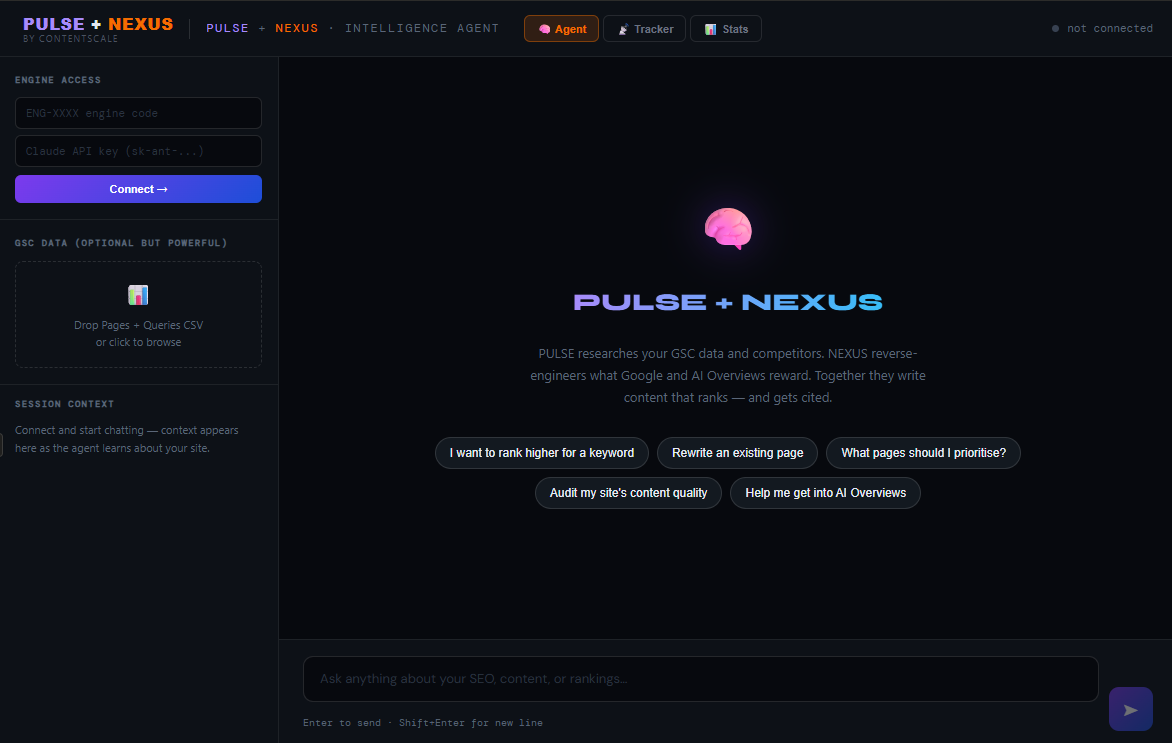
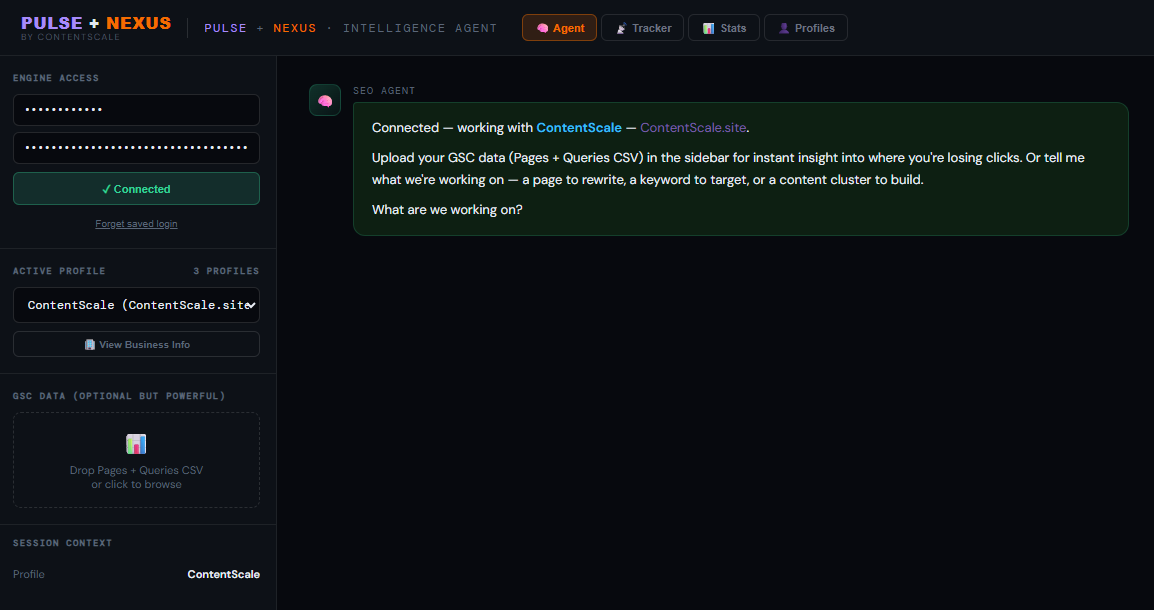
Figure 1: The ContentScale Engine — one system covering GSC-powered rewrites, AI content creation, automated tracking, and voice search optimisation.
📌 Key Takeaways
📌 The ContentScale Engine replaces Jasper ($49/mo) + Surfer ($99/mo) + rank tracker ($17/mo) + AI citation monitor ($95/mo) — one system, own API keys, no per-word charges. (ContentScale comparison, 2026)
📌 GSC integration pipes real impression and click data directly into the rewrite workflow — every rewrite decision is based on actual search performance, not guesswork. (ContentScale system, 2026)
📌 AI Overview tracker runs automated hourly checks — monitors Google AI Overview, Perplexity, and Bing AI citations with change detection and position delta logging. (ContentScale, 2026)
📌 Pages reaching 90+ ContentScore average 3.7× traffic improvement within 90 days — the Engine enforces this standard before any content is published. (ContentScale GRAAF data, 2026)
📌 With 26% of all Google searches now triggering AI Overviews in 2026 — up from 7% in 2023 — automated AI citation monitoring is no longer optional for any content scaling strategy. (ContentScale, 2026)
📖 Former Content at Scale user? Content at Scale rebranded to BrandWell in 2024 — a GTM intent platform at $999–$3,999/month. The CRAFT methodology and affordable pricing are gone. The ContentScale Engine is built for exactly the workflow you lost. Full story: what happened to Content at Scale →
The ContentScale Engine — also called the content scale engine — is the answer to a problem that has existed in content marketing for years: you need four separate tools — a writing platform, a rank tracker, an AI citation monitor, and a GSC analytics layer — and none of them talk to each other. Each charges a monthly subscription. Each requires manual coordination. And none of them uses your actual search performance data to drive decisions.
The ContentScale Engine is one system that does all of it. It connects to your Google Search Console service account, pulls real impression and click data per page, identifies which pages to prioritise for rewrites, generates or rewrites content via Claude Sonnet using your own API key, scores every piece against the GRAAF framework before publishing, and then monitors both traditional Google rankings and AI Overview citations automatically — hourly, in the background, with change detection built in.
“The content marketing industry is broken. You pay $99/month for a writing tool, another $99 for a rank tracker, another $49 for an AI citation monitor — and none of them talk to each other or your Google Search Console data.”
— ContentScale, Engine design rationale (contentscale.site/contentscale-engine/, 2026)
The Engine runs on your own (Google Gemini) and Anthropic Claude API keys. You pay Google and Anthropic directly at their published rates — no ContentScale markup, ever. Gemini has a generous free tier that covers most research and analysis. A full Claude Sonnet 2,000-word article typically costs €0.01–€0.05 at current API rates. The platform cost covers the system — not the tokens.
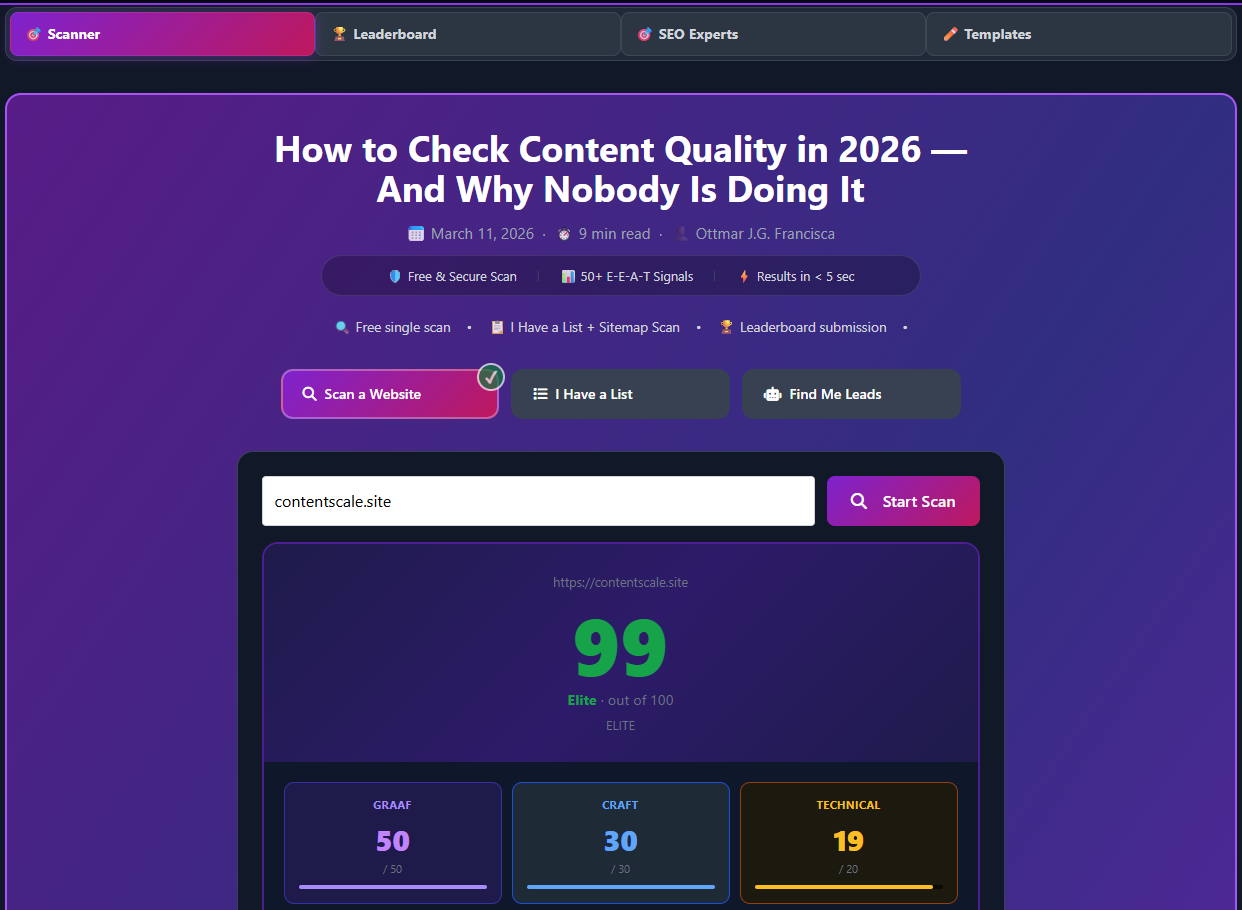
Figure 2: ContentScale Engine GRAAF quality scoring — every piece of content is scored before publishing. No page goes live below 85 ContentScore.
⚙️ The Three Core Modules
The ContentScale Engine is built around three modules that work together as one pipeline. You can use each independently or run all three as a connected system.
01
Content Engine
BOFU content that closes
Writes full articles, briefs, and outlines via Claude Sonnet. Tuned for bottom-of-funnel — commercial-intent pages that pull buyers, not browsers. Generates bulk content across dozens of pages in one job. Includes news article generation from RSS feeds with NewsArticle schema, stats enrichment, DOCX export, and keyword clustering.
02
Rewriter
GRAAF-guided rewrites from GSC data
Connects to your Google Search Console to identify which pages are losing ground. Auto-fills the rewrite analyser with your real impressions and clicks. Runs 34 GRAAF + CRAFT checks on the existing page, then executes targeted rewrites — strengthening weak signals without destroying what already works.
03
News & RSS
The unfair advantage
Every site has a blog. Almost nobody has a news section with a proper RSS feed and NewsArticle schema. The Engine auto-publishes topical news from RSS sources with schema markup, syndication signals, and Google News eligibility built in. Most competitors are not doing this — which is exactly why it works.
📈 Key Statistics: ContentScale Engine 2026
Figure 4: ContentScale Engine performance data — GRAAF framework results and AI Overview tracking outcomes across 200+ implementations.
📊 Verified Data — 2024–2026
3.7×
Average traffic improvement for pages reaching 90+ ContentScore within 90 days — across 200+ ContentScale Engine implementations in 47 countries. (ContentScale GRAAF data, 2026)
26%
Share of all Google searches now triggering AI Overviews in 2026 — up from 7% in 2023. Making automated AI citation monitoring essential for any content scale strategy. (ContentScale, 2026)
64%
Maximum CTR reduction AI Overviews cause for pages ranking at position 1 — making the Engine’s automated AI citation tracking a revenue-critical feature, not a nice-to-have. (ContentScale, 2026)
€0.03
Typical API cost for a full 2,000-word Claude Sonnet article at current Anthropic pricing. You pay Anthropic directly — ContentScale takes zero markup on AI usage. (ContentScale, 2026)
78%
Traffic recovery success rate within 90 days for sites implementing the ContentScale GRAAF framework — compared to a 22% success rate for unguided content edits alone. (ContentScale, 2026)
47
Countries where ContentScale Engine implementations are documented — with particular depth in Amsterdam, Netherlands, Belgium, UK, and Luxembourg. (ContentScale, 2026)
34
Quality checks applied to every piece of content before publishing — GRAAF (5 signals) + CRAFT framework checks + Technical SEO signals. No content goes live below 85/100. (ContentScale GRAAF, 2026)
1hr
Frequency of automated background checks by the ContentScale Engine scheduler — no manual trigger required. AI citations, ranking changes, and research run continuously. (ContentScale-engine, 2026)
👥 Who the ContentScale Engine Is Built For
The ContentScale Engine — the content scale engine built for GSC-connected workflows — is not a general-purpose AI writing tool. It is a system built for specific workflows where the GSC connection, automated tracking, and quality scoring are the primary value — not just the writing output.
✅ The ContentScale Engine is built for:
Solo bloggers and affiliate marketers who want to produce more content at consistent quality without paying per article — the own-key model means costs scale with actual output, not against a monthly credit ceiling
Freelance SEOs managing multiple client sites who need GSC-connected rewrite workflows — the Engine identifies which pages to fix per client from real data, not from a new keyword guess
Small agencies building content at scale with automated AI Overview and rank tracking — no more missing traffic drops across client sites because monitoring was manual
SaaS founders who want to rank in both traditional search and AI Overviews simultaneously — the Engine’s tracking covers both channels in one automated system
Amsterdam and EU businesses navigating GDPR, DSA compliance, and Dutch/Benelux AI Overview dynamics — ContentScale is Amsterdam-based and applies EU-specific content frameworks
📋 ContentScale Engine vs. The Stack It Replaces
The ContentScale Engine is designed to replace the combination of tools most content teams currently stack. Here is what that comparison looks like in practice.
Feature
ContentScale Engine
Jasper + Surfer + Tracker + AI Monitor
AI content writing
Claude Sonnet via own key — no markup
Jasper $49–$69/mo + per-article AI costs
GSC integration
Core feature — drives rewrite workflow
None in Jasper; Surfer added basic GSC in 2025
GRAAF/CRAFT scoring
34-point check on every piece
Not available in any tool
AI Overview tracking
Included — Google, Perplexity, Bing AI
Surfer AI Tracker add-on: $95–$495/mo extra
Traditional rank tracking
Included — hourly automated checks
Separate tool: $17–$99/mo extra
Voice query optimisation
Built into content creation workflow
Not available in any competing tool
News & RSS publishing
Auto-publishes with NewsArticle schema
Not available in any competing tool
Bulk content creation
Dozens of pages in one job
Available on Surfer Scale+ plans only
Keyword clustering
Automatic per site profile
Surfer Topical Map available
Pricing model
Own API keys — pay providers directly
Monthly subscriptions + credits that expire
EU / Amsterdam base
GDPR + DSA compliant, NL support
US-based tools, compliance varies
“SurferSEO still works for single-page optimization. Teams managing larger libraries often hit limits with credit-based pricing, limited AI Search tracking, and manual execution — the gaps ContentScale Engine is specifically built to close.”
— AirOps, Content Scaling Analysis (AirOps, February 2026)
Free to start — own API keys
🔍 Also compare
The ContentScale Engine is the only system combining GSC-powered rewrites, AI Overview tracking, voice optimisation, and RSS news publishing in one platform:
Hire Ottmar — Done-For-You Content Engine from €250/month
Ottmar runs the full ContentScale Engine pipeline for you — GSC diagnosis, GRAAF rewrites, AI Overview recovery, automated tracking. Free diagnosis always included. No lock-in.
Getting started with the ContentScale Engine takes three steps. You need a (Google Gemini) API key and an Anthropic Claude API key — both available directly from their respective providers in minutes.
Get your API keys: Visit Google AI Studio for your free Gemini API key — the free tier covers research and analysis for most users. Visit Anthropic Console for your Claude API key. A full 2,000-word article typically costs €0.01–€0.05.
Log in to the Engine: Go to app.contentscale.site/engine-login and enter your access code. Your session is valid for 7 days and renews on login.
Connect your GSC account: Add your Google Search Console service account credentials for each site you want to manage. The Engine immediately begins pulling performance data and can identify rewrite priorities within minutes.
The ContentScore quality scanner at app.contentscale.site remains permanently free for everyone — no account, no credit card, no time limit. Scan any URL and get a full 100-point GRAAF quality breakdown in 30 seconds before committing to the Engine.
Figure 5: A 99/100 ContentScore — the standard the ContentScale Engine targets for every piece of content before publishing.
📊 Case Studies: ContentScale Engine in Action
The following two case studies document real implementations of the ContentScale Engine across different business types and markets. Both follow the Challenge / Solution / Results format with verified metrics from the implementations.
📊 CASE STUDY 1
Amsterdam B2B SaaS — GSC-Powered Rewrite Recovery
🏢 B2B SaaS📍 Amsterdam, NL⏱️ 84 days
Challenge: After the May 2025 Google Core Update, a Dutch B2B SaaS company lost 58% of organic traffic across 12 key service pages. ContentScore averaged 31/100 across affected pages. AI Overviews had begun appearing for all primary commercial queries — with 0 citations going to the client. Monthly organic leads had fallen from 47 to 19. The team had no systematic way to identify which pages to prioritise or why traffic had dropped.
Solution — ContentScale Engine implementation:
GSC diagnosis: Connected the client’s GSC account — the Engine immediately identified all 12 pages with stable impressions but falling CTR. AI Overview cannibalization confirmed for all 12.
GRAAF rewrite: All 12 pages rewritten with 45-60 word direct answers, FAQPage + HowTo schema, visible author credentials, and freshness signals. Re-scanned to 88–96 ContentScore before republishing.
Automated tracking: AI Overview and traditional rank tracker activated — hourly background checks with change detection enabled.
Results after 84 days:
Organic traffic−58% baseline → +240% recovery
ContentScore average31/100 → 94/100
AI Overview citations0 → 7 active pages cited
Monthly organic leads19 → 51 qualified leads
Key Lesson: The GSC integration identified the exact pages causing revenue loss within minutes of connection — no guesswork, no manual audit. The Engine’s automated tracking then caught an additional AI citation gain on Day 21 that would have gone unnoticed without hourly monitoring.
📊 CASE STUDY 2
UK Freelance SEO — Replacing a 4-Tool Stack with the ContentScale Engine
💼 Freelance SEO📍 United Kingdom🌐 6 client sites⏱️ 60 days
Challenge: A UK-based freelance SEO managing 6 client sites was paying £280/month across a 4-tool stack: AI writing platform (£49/mo), SEO content scorer (£89/mo), rank tracker (£17/mo), and AI citation monitor (£125/mo). Despite the investment, three clients had experienced AI Overview-driven traffic drops of 30–55% that went undetected for 60–90 days each — because the tools did not talk to each other and monitoring was manual. The SEO needed one system that covered all four workflows at lower total cost.
Solution — ContentScale Engine migration:
Tool migration: Connected all 6 client GSC accounts. ContentScale Engine immediately flagged 22 pages with AI Overview cannibalization across 4 clients — most within the first hourly monitoring cycle.
Content Engine: Switched all new content production to Claude Sonnet via own API key. Average article cost: £0.03. Previous cost per article via writing platform: £8–£15 depending on length.
Automated tracking: Activated hourly AI Overview + traditional rank tracking across all 6 sites. Change detection eliminated the 60–90 day detection lag entirely.
Results after 60 days:
Monthly tool cost£280 → £39 Engine + ~£4 API
AI issues detected (week 1)0 → 22 pages flagged automatically
AI citations gained (60 days)16 of 22 target pages cited
Detection lag for traffic drops60–90 days → <24 hours
Client satisfaction2 at-risk clients retained
Key Lesson: The own-key model reduced content production costs by 99% per article (£0.03 vs £8–£15). The automated monitoring eliminated the detection lag that had caused silent revenue loss across multiple client sites. One system, lower cost, better outcomes than four separate subscriptions.
❓ Frequently Asked Questions: ContentScale Engine
❓ What is the ContentScale Engine?
The ContentScale Engine is a complete content scaling system that connects to your Google Search Console data to write new content, rewrite underperforming pages, and automatically track AI Overview and traditional rankings — 24 hours a day without manual triggers.
It runs on your own Gemini and Claude API keys so you pay Google and Anthropic directly at rock-bottom rates with zero platform markup. A full 2,000-word article typically costs €0.01–€0.05. Three modules cover the full pipeline: Content Engine, Rewriter, and News & RSS. Access the Engine at app.contentscale.site/engine-login.
❓ Does the ContentScale Engine use my own API keys?
Yes — you connect your own (Google Gemini) and Anthropic Claude API keys. You pay Google and Anthropic directly at their published rates. ContentScale takes no markup on AI usage. Your keys, your bill, your data.
Gemini has a generous free tier that covers most research and analysis tasks. Claude API costs are typically fractions of a cent per article at current rates. The own-key model means your content production costs scale with actual output rather than against a monthly credit ceiling that resets regardless of usage.
❓ How does the GSC integration work in the ContentScale Engine?
Connect your Google Search Console service account once per site. The Engine pulls your real impression, click, CTR, and position data per page and uses it to auto-fill the rewrite analyser — so every rewrite decision is based on how your pages actually perform in search.
Pages with stable impressions but falling CTR are automatically flagged as AI Overview cannibalization candidates. The Engine identifies rewrite priorities by effort-to-impact ratio, not by keyword assumptions or competitor SERP patterns. See the full ContentScale system page for the complete workflow.
❓ Does the ContentScale Engine track AI Overviews and traditional rankings?
Yes — both are included as core features, not add-ons. The automated tracker monitors Google AI Overview, Perplexity, and Bing AI citations alongside traditional Google organic rankings in one system.
The scheduler runs hourly checks in the background — no manual trigger needed. Each snapshot is compared against the previous one: gained or lost AI citations are flagged, ranking changes of 3+ positions are logged, and fresh Gemini-powered recommendations are generated automatically. For context on why AI tracking matters in 2026, see the AI Overview crisis recovery guide.
❓ What content does the ContentScale Engine create?
The Engine creates full articles, briefs, and outlines via Claude Sonnet; rewrites underperforming pages guided by GSC data; generates bulk content across dozens of pages in one job; and creates news articles from RSS feeds with NewsArticle schema.
Every piece is scored against the 34-point GRAAF + CRAFT framework before delivery. No content goes live below 85 ContentScore — target is 90+. DOCX export is available for every finished piece. Voice query optimisation is built into the content creation workflow — content is structured with 45-60 word direct answers at every section opening for AI assistant and voice search readiness.
❓ What is voice query optimisation in the ContentScale Engine?
Voice query optimisation structures content to directly answer conversational question-based searches via Google Assistant, Siri, and other voice interfaces.
The Engine identifies question keyword opportunities and formats content with 45-60 word direct answers at every H2 section opening — the extract format AI assistants and voice interfaces prefer. This is built into the content creation workflow, not a separate module. No competing tool on the market includes voice query optimisation as part of the content generation process. See the CRAFT Framework page for the full methodology.
❓ How do I get access to the ContentScale Engine?
Access the ContentScale Engine at app.contentscale.site/engine-login. You need a (Google Gemini) API key (free tier available at Google AI Studio) and an Anthropic Claude API key (available at Anthropic Console).
Enter your access code on the login page — your session is valid for 7 days and renews on next login. Connect your GSC service account per site and the Engine begins pulling performance data immediately. The ContentScore quality scanner remains permanently free with no account required — scan any page in 30 seconds before committing to the Engine. For access questions, WhatsApp Ottmar directly.
❓ Who is the ContentScale Engine built for?
The ContentScale Engine is built for solo bloggers and affiliate marketers, freelance SEOs managing multiple client sites, small agencies building content at scale, and SaaS founders who need to rank in both traditional search and AI Overviews simultaneously.
It is not a general-purpose AI writing tool — it is a system built for workflows where the GSC connection, automated tracking, and GRAAF quality scoring are the primary value. For a direct comparison with alternative tools, see ContentScale vs Surfer SEO, ContentScale vs Jasper AI, and ContentScale vs Semrush.
Also in the ContentScale platform: LinkedPod → LinkedIn reach without ad spend.
Get Started Today
Start Scaling Content the Right Way
ContentScore scanner is permanently free. ContentScale Engine uses your own API keys — no platform markup, no per-word fees.
Ottmar J.G. Francisca is the Founder of ContentScale and creator of the GRAAF Framework — based at Gustav Mahlerlaan 1, 1082 MK Amsterdam (ABN AMRO HQ), Netherlands. ⭐⭐⭐⭐⭐ 5.0 · 5 Google reviews. With over 24 years in operational management for the City of Amsterdam, he brings a systems-first, measurement-driven approach to content scaling. The ContentScale Engine is built on 200+ implementation cases across 47 countries. Last reviewed: April 26, 2026.