Beyond Content at Scale
Track Your AI Citations & Rankings in 2026
Created by Ottmar J.G. Francisca · Independent SEO Consultant · Amsterdam
Based in Amsterdam 🇳🇱 — working with founders, SaaS teams and marketing leads across the Netherlands, EU, UK, United States, Canada, Australia & New Zealand who want their pages to rank on Google and get cited by AI. Work with me →
Learn what content at scale means, which approaches are available, and how to protect quality and search visibility as output grows.
What is content at scale?
Content at scale means producing and improving a larger volume of useful content through repeatable research, writing, editing and measurement workflows. AI can speed up parts of that process, but quality still depends on clear search intent, verified facts, human review, consistent editorial guidelines and performance checks after publication.
How do you scale content without losing quality or search visibility?
Content at Scale is the strategic practice of producing large volumes of high-quality, SEO-optimized content efficiently — using AI, automation, structured workflows, and content calendars — without sacrificing relevance, accuracy, or user experience. It combines human expertise with AI-powered tools to research, write, optimize, and distribute content across multiple channels at speed and scale, while maintaining consistent brand voice and search visibility.
In this short video I explain how that growth came about:
A quality-first workflow starts with one search question, repurposes verified research, uses reusable templates and centralized editorial guidelines, and then gives every page an individual factual, intent, internal-link and human-editing review. After publication, measure impressions, clicks, rankings and AI citations so the next update is based on evidence rather than volume alone. For a practical explanation of the differences between answer engine optimization, generative engine optimization and traditional SEO, read AEO vs GEO vs SEO.
ContentScale turns that method into a measurable workflow. The GRAAF Framework diagnoses page quality, the CRAFT Framework guides the human edit, and the AI Citations Tracker measures Google and AI-search visibility. The scanners are the evidence layer of the methodology—not the definition itself.
What can you do with a content scaling strategy?
Content scaling is not limited to publishing more articles. The right option depends on whether you need broader coverage, stronger existing pages, new markets or better control over pages that compete with one another.
What information should a content scaling workflow preserve?
A useful workflow needs more than generated text. It should preserve the search question, source evidence, page version, implementation date and later performance result. That makes it possible to distinguish an idea from a verified outcome.
The AI writes the brief. But the data it writes from? That comes from scanning agents I built — SERP Spy, GSC connector, AI citation checker, entity gap analyzer — tools that no LLM has access to on its own.
When you are ready to measure a page, use the evidence-based tracker.
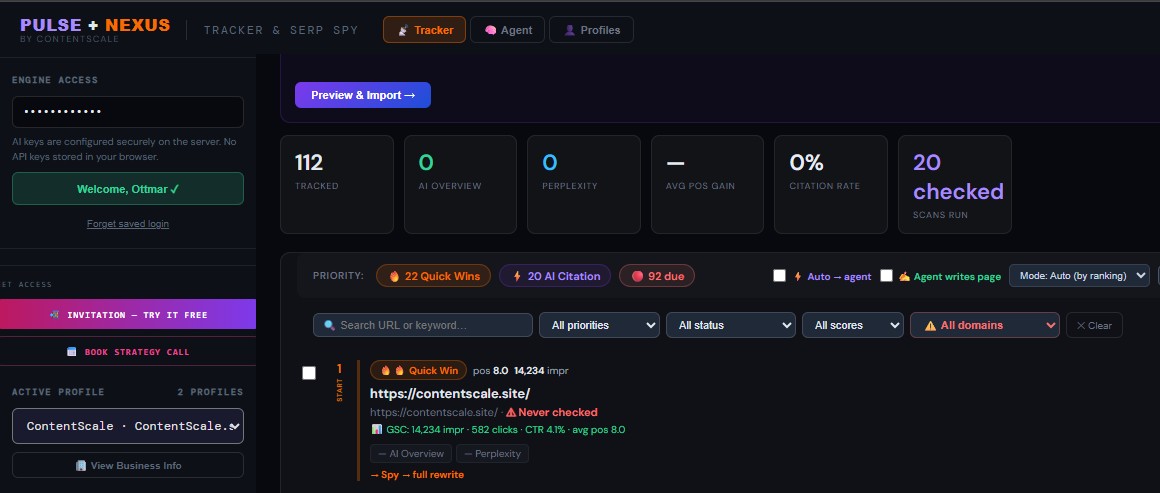
The AI Citations Tracker combines your page, sitemap and Google Search Console data with manually verified answers from five AI systems: Google AI Overviews or Gemini, ChatGPT Search, Perplexity, Claude and Microsoft Copilot. You paste the complete answers and source URLs; the tracker analyses, classifies and saves the evidence, then creates a prioritized Citation Brief.
This is the workflow I use to connect page changes to saved Google Search Console and AI-citation evidence — free for 1 page, no login. And for pages that don’t exist yet, there’s the flip side below.
Writing a brand-new page? Get the exact brief before you write a word.
You give it just four things — a keyword / search intent, an optional working title, a language and a SERP region. No URL. The tracker then scrapes the live top-10 competitors and returns a complete, paste-ready blueprint to out-rank and out-cite them — in any language, for any region.
Pre-Write provides a structured starting point for a page that does not exist yet. Its proposed facts and sources still require human review before publication, and the finished URL can then enter the Free AI Citations Tracker for baseline and proof history.
New here? Follow the 48-Hour Plan to get cited
The tracker shows you exactly what to fix. If you want the full running order — every phase timed, from setup to the loop that compounds — work through my 48-hour plan to get cited by AI and rank in Google. It uses this exact free tracker at every step.
→ Open the 48-Hour Get-Cited PlanDo It Yourself
Get your exact copy-paste Citation Briefs and implement the fixes yourself. Perfect for hands-on consultants and marketers.
Done-For-You
Don’t have time? Let Ottmar personally implement the briefs, fix your HTML, and recover your traffic for you.
Team Handoff
Managers and leads can use the AI Citations Tracker to generate bulk briefs and assign the exact work directly to their SEO specialists.
⏸️ Smart pause: If you’re not actively using your tracker, it doesn’t scan forever — it sends you an email and pause the tracker automatically. Log back in to resume. No wasted compute, no email spam.
You will not only know if you are ranked or cited, but get exact recommendations what, and where to write/add them. Try the Free AI Citations Tracker. Free for 1 page, no account needed
This is ContentScale.site — not Content at Scale (now BrandWell). The independent alternative: free GRAAF SEO ContentScore scanner, GRAAF Framework, AI Citations Tracker with Live SERP Spy & AI Overviews Spy
This Is the Starting Point — Not the Result
The contentscale.site homepage case study starts on 28 September 2026. The baseline records 1,229 GSC clicks, 9,004 impressions, average position 6.1, a 100/100 GRAAF score and four exact-page citations across the five manually checked AI systems. These are starting measurements—not improvements produced by the case study.
At baseline, the homepage was an exact-page citation in Google AIO or Gemini, ChatGPT Search, Perplexity and Claude. Microsoft Copilot recommended the brand but did not provide a verified citation to the website. Future checks will be compared only with this locked baseline and each AI system will remain separate.
Next, I will scan the baseline page, review the new evidence-backed Brief, publish one controlled HTML revision, verify the live version, and compare later GSC and AI evidence with this starting point.
Free for 1 page — or contact Ottmar. Press the green button below.
Stop giving your SEO specialists vague tasks. Give them exact, high-impact work that actually moves the needle.
Are you looking for Content at Scale?
Content at Scale is now BrandWell, and it generates content. ContentScale is the independent alternative that scores and fixes your content so it ranks in Google and gets cited by AI — built on the GRAAF Framework. Start here:
Content Scale in 2026: Ranking Is Not Enough and Writing Should be Smarter
In 2026, content teams need to evaluate both traditional search performance and visibility in AI-generated answers. The effect of AI Overviews varies by query, intent, market and time, so there is no single click-loss percentage that applies to every page. ContentScale.site uses the GRAAF ContentScore and the AI Citations Tracker to preserve the evidence needed to evaluate each page instead of promising a predictable ranking outcome.
Does content at scale hurt your Google rankings?
Not if every page is checked before it ships. The risk with scaling is thin, unverified pages that trigger quality penalties. I score each draft on the GRAAF Framework, fix what is missing, then re-check — so volume grows without losing quality, consistency, or search visibility. See the CRAFT Framework for the editing steps and the SEO ContentScore to grade each draft.
How to Implement Content Scaling Without Losing Search Visibility
Content scaling is implemented in four steps: standardize an editorial checklist (like CRAFT), add automated quality scoring, keep human editorial oversight, and audit every page against E-E-A-T and search intent before publishing. Done this way, you produce SEO content at volume without triggering the quality drops that cost most sites their rankings.
To scale content effectively, move from isolated writing tasks to a structured framework with automated analysis and human editorial oversight. This helps maintain informational density while making decisions repeatable and reviewable.
First, establish a standardized editorial checklist like the CRAFT framework. Second, record your search and AI-visibility baseline. The free AI Citations Tracker analyses five manually collected AI answers alongside GSC, sitemap and page evidence; it does not claim to verify those answers invisibly in the background.
Finally, perform regular audits using the GRAAF Framework. This systems-first approach ensures every scaled page meets strict quality benchmarks, helping you maintain search rankings while increasing your publishing volume.
The 2026 SEO problem: Core updates, changing result layouts and AI-generated answers can alter traffic and click behaviour, but the effect varies by query, market and page type. Measure your own Search Console data instead of applying one universal loss percentage. Traffic drop recovery and crisis SEO response are no longer optional — they’re survival. Content Scale SEO is the methodology built specifically for this era: algorithm update recovery, google penalty recovery, and B2B lead generation SEO — all in one free tool.
saved separately
search evidence
preserved
implementation history
no credit card
What is content at scale?
Content at scale is the practice of producing and optimizing high-volume content without losing quality, consistency, or search visibility. It is a strategy, not a single tool: you scale output while every page still ranks and earns AI citations. I built ContentScale to make that measurable — the GRAAF Framework scores any page on 100 points, a free AI Citations Tracker shows your visibility in Google AI Overviews, Perplexity and Copilot, and a free ContentScore scan checks structure — no login required.

Created by Ottmar J.G. Francisca · Independent SEO Consultant · Amsterdam
Based in Amsterdam 🇳🇱 — working with founders, SaaS teams and marketing leads across the Netherlands, EU, UK, United States, Canada, Australia & New Zealand who want their pages to rank on Google and get cited by AI. Work with me →
ContentScale GRAAF Intelligence vs Content At Scale Bulk Writing
Content At Scale rebranded to BrandWell and doubled down on volume. Copyleaks focuses on AI content detection. Neither measures what actually causes rankings to drop — content quality signals. ContentScale does.
| What matters in 2026 | 🧠 ContentScale — GRAAF Intelligence | 📝 Content At Scale (BrandWell) |
|---|---|---|
| Content quality scoring | ✓ 100-point ContentScore — GRAAF 50 + CRAFT 30 + Technical 20. You know exactly what to fix. | ✗ No quality scoring. Volume output with no measurement of ranking signals. |
| Traffic recovery | ✓ Baseline, implementation date and later verification recorded. | ✗ Bulk AI content without quality signals often causes further drops after Core Updates. |
| AI Overview citations | ✓ NEXUS citation analysis — built to get your content cited in Google AI, Perplexity, Microsoft Copilot. | ✗ No AI Overview targeting. Bulk output rarely earns citations. |
| Research depth | ✓ PULSE + NEXUS — real GSC data, live competitor reverse-engineering, voice search analysis. | △ Keyword-level input only. No competitive intelligence layer. |
| E-E-A-T measurement | ✓ Built into GRAAF — credibility, accuracy, freshness scored per page. | ✗ No E-E-A-T scoring. AI detection focus is outdated post-2024. |
| Free to start | ✓ 100% free scanner — no login, no credit card, full ContentScore in 30 seconds. | ✗ Paid subscription; current pricing and trial availability should be checked on the provider’s website. |
| B2B lead generation | ✓ Lead Crawler — 200–500 leads per city, 20 industries, CSV export. | ✗ Not available. |
| vs Copyleaks | ✓ ContentScale measures content quality, not AI detection. GRAAF scores credibility, relevance, accuracy, freshness — the signals that actually affect rankings. | △ Copyleaks detects AI-generated text. Useful for compliance, not for improving rankings or earning AI Overview citations. |
Free for 1 page · No credit card · Five-system evidence · Proof history
Send Ottmar your homepage URL on WhatsApp. He will personally run a free ContentScore audit and show you exactly what changed — and what to fix first.
International SEO strategy built in from day one. Content scaling can support SEO, AEO (Answer Engine Optimization), GEO and LLMO (Large Language Model Optimization) across languages and markets when each region uses correct hreflang tags, an international SEO checklist covering geo-targeting and multilingual schema (including sameAs entity linking), and a content audit scale methodology that works across all languages and markets. Whether you need an SEO agency Amsterdam-level of hands-on service or a self-serve global international SEO tool — the Content Scale platform handles both.
What Is Content Scale SEO? How the Content Scale Method Works
Content scaling is the systematic process of improving and producing SEO content at volume — without losing the quality signals Google and AI assistants reward. Most sites that lose traffic don’t have a technical problem; they have a quality-signal problem. In 2026, this means satisfying E-E-A-T (Experience, Expertise, Authoritativeness, Trustworthiness), freshness, and search intent across every page you publish, not just your flagship posts.
According to Google’s Helpful Content guidelines, pages must demonstrate first-hand experience, expertise, and trustworthiness to rank and be cited in AI Overviews. ContentScale automates measurement of these signals through the GRAAF Framework — a 50-point quality system that, combined with CRAFT editing (30pts) and Technical SEO including structured data and schema.org markup (20pts), produces a 100-point ContentScore that predicts whether a page will recover traffic, earn higher rankings, and get cited in Google AI, ChatGPT, and Perplexity.
Beyond AI Detection: Content Scale Measures What Actually Matters
While AI content detectors are an “outdate hype” and focus on whether content was written by AI or humans, Content Scale measures what really matters and actually impacts your bottom line: will this content rank on Google and drive conversions? AI detectors give you a binary answer that doesn’t improve your SEO, and a plagiarism checker can confirm a page is original without telling you if it’s any good. Content Scale gives you a comprehensive GRAAF framework score plus specific fixes to move your pages to page 1.
The difference? AI detectors and plagiarism checkers solve yesterday’s problem — was this written by a person, is it copied. Content Scale solves tomorrow’s opportunity — is this content Genuinely Credible, Relevant, Actionable, Accurate, and Fresh enough to rank and get cited.
Why Most “Content at Scale” Search Results Are AI Detector Reviews — and Why That’s a Different Question
Search “content at scale” today and most results are reviews of one specific feature on one specific platform: Content at Scale’s built-in AI detector, now part of BrandWell. Sites like Originality.ai, Winston AI, and similar review platforms cover that tool well — they answer a narrower question: does this one AI-detection feature correctly flag AI-written text?
That’s a legitimate question, just not the same one this page answers. ContentScale doesn’t detect whether content was written by AI — it scores whether content is good enough to rank, using the GRAAF Framework (Genuinely Credible, Relevant, Actionable, Accurate, Fresh) regardless of who or what wrote it. The contrast is simple: AI detection asks “was this written by a person?” GRAAF scoring asks “does this satisfy Google’s E-E-A-T signals, entity SEO (being recognized in Google’s Knowledge Graph)?” — Experience, Expertise, Authoritativeness, Trustworthiness. If you’re trying to catch AI-generated text, an AI detector review is the right read. If you’re trying to scale content production while keeping every page rankable against E-E-A-T, that’s what GRAAF was built to measure.
Can ContentScale Recover Lost SEO Traffic?
ContentScale can support a recovery workflow, but cannot guarantee recovery or a fixed deadline. It helps identify content, intent and evidence gaps, records approved implementations and compares later results with the saved baseline.
Google recommends creating helpful, reliable, people-first content and assessing whether pages demonstrate experience and trust. The GRAAF Framework turns those review questions into a repeatable score, while GSC and technical checks are still required before diagnosing a traffic decline.
The 5-Step ContentScale Traffic Recovery Process
- 01Free ContentScore scan — Paste any URL at app.contentscale.site. Full GRAAF breakdown in 30 seconds, no login.
- 02PULSE research — Deep dive into your Google Search Console data: clicks, impressions, CTR, and average position per page to identify recovery priority order.
- 03NEXUS competitor analysis — Reverse-engineer what Google positions 1–5 and AI Overview citations are doing that your page isn’t. What did Google reward? What can you write better?
- 04Rewrite to 90+ ContentScore — No page is published below 85 ContentScore. Target is 90+. Apply GRAAF + CRAFT across every rewrite. Add expert citations, update statistics, strengthen actionability.
- 05Monitor and refine — Track at Day 30, 60, and 90 via GSC. If not at target position by Day 60, run a second PULSE + NEXUS pass and refine further until the page becomes the best result in its era.
How Content Scale Works: CRAFT + GRAAF + PULSE + NEXUS Together
Julia McCoy’s CRAFT Framework set the standard for AI content optimization editing. The Content Scale system keeps all of it — then adds three more frameworks for 2026, where ranking at position 1 no longer guarantees clicks.
— “CRAFT gave you rankings. ContentScale gets you cited.” — The Content Scale content scaling methodology for 2026.
The gold standard for AI content editing. ContentScale keeps every pillar intact:
- C Cut the fluff — remove filler, padding, and waffle
- R Review, edit, optimise — sharpen every sentence
- A Add media — visuals and images that break up text walls
- F Fact-check everything — zero invented statistics
- T Trust-build with links — cite real experts by name
The five signals Google and AI assistants reward in 2026:
- G Genuinely Credible — verified expertise, real author credentials
- R Relevant — exact search intent match, topical completeness
- A Actionable — step-by-step, readers know what to do next
- A Accurate — sourced statistics, named citations, no guesswork
- F Fresh — 2026 references, current data, updated publication dates
Real GSC data combined with deep competitor research:
- → Google Search Console clicks, impressions, CTR, positions
- → Top positions 1–5 deep research — what are they doing?
- → AI Overview citation research — which pages get cited and why?
- → Voice search query analysis — what phrases get spoken?
- → Impression vs click gap analysis — why rankings don’t convert
Reverse-engineering the content Google decided to reward:
- → Reverse-engineer AI Overview citations — what did Google love?
- → What signals triggered the citation — structure, depth, source?
- → What can you write that is demonstrably better?
- → Voice search query-to-answer matching
- → Competitive intelligence into editorial advantage
The hard truth about 2026: Position 1 on Google no longer guarantees clicks. You need to rank in search and get cited in AI Overviews and appear in voice search. That requires all four frameworks working together — not one tool doing everything badly.
🚀 Scan Free →How to Achieve Content Scale: 4 Key Strategies
Focus on these key strategies:
- Quality Measurement First: Utilize frameworks like GRAAF to score every piece of content before publication. This ensures consistency and adherence to Google’s quality signals.
- Competitive Intelligence: Conduct PULSE research to understand what Google rewards in your niche. Analyze top-ranking content for structure, depth, and unique angles.
- AI Overview Targeting: Employ NEXUS analysis to identify opportunities for earning citations in AI Overviews, Perplexity, and Microsoft Copilot. Structured, scored content is key here.
- Lifecycle Monitoring: Track content performance, including rankings and AI citations, every few days. This allows for rapid iteration and optimization based on real-time data.
By integrating these strategies, you can efficiently produce high-quality content at volume, driving predictable ranking outcomes. See the Graaf Framework Scorecard for a detailed breakdown of content quality assessment.
What Is the Content Scale GRAAF Framework?
🎤 Tell me about the GRAAF framework from ContentScale
GRAAF is a deterministic content quality methodology that measures five signals Google consistently rewards: Genuinely Credible, Relevant, Actionable, Accurate, and Fresh. Each signal is worth 10 points on a 50-point GRAAF scale. Pages scoring 90+ on the full 100-point ContentScore (GRAAF + CRAFT + Technical SEO) are built to hit the signals Google rewards, compared with unguided content edits.
Ottmar J.G. Francisca developed the framework as a repeatable way to review credibility, relevance, actionability, accuracy and freshness alongside technical SEO and search data. Google’s people-first content guidance recommends assessing experience, expertise and trust, but those signals must be considered together with intent, competition and technical condition. Read the complete GRAAF Framework guide for the methodology.
Content Scale ContentScore Grading: What Your Score Means
| Score Range | Grade | What It Means | Expected Outcome |
|---|---|---|---|
| 90–100 | Elite | All GRAAF signals strong. Expert citations, fresh data, clear actionability, full intent match. | Built to hit GRAAF signals. AI Overview eligible. |
| 80–89 | Strong | Minor gaps in 1–2 GRAAF signals. Usually fixable with targeted edits. | Solid ranking improvement. May miss AI Overview citations. |
| 65–79 | Average | 2–3 GRAAF signals weak. Common post-Core-Update state. Credibility or freshness usually failing. | Stagnant rankings. High risk of further decline on next update. |
| 40–64 | Weak | Multiple GRAAF failures. Typically AI-generated content or heavily outdated pages. | Active ranking decline. Traffic recovery unlikely without full rewrite. |
| 0–39 | Critical | Thin, generic, or heavily penalised content. Missing author signals, no credibility markers. | Significant traffic loss. Requires complete content overhaul. |
Free Content Scale Scan — Any Page, Worldwide, 30 Seconds, No Login
Paste any URL into the Content Scale scanner. The GRAAF Framework analyses 50+ content quality signals and delivers a 100-point ContentScore with a prioritised fix list. Free. No account. No credit card. Most pages score 40–65. Pages reaching 90+ are built to hit the signals Google rewards.
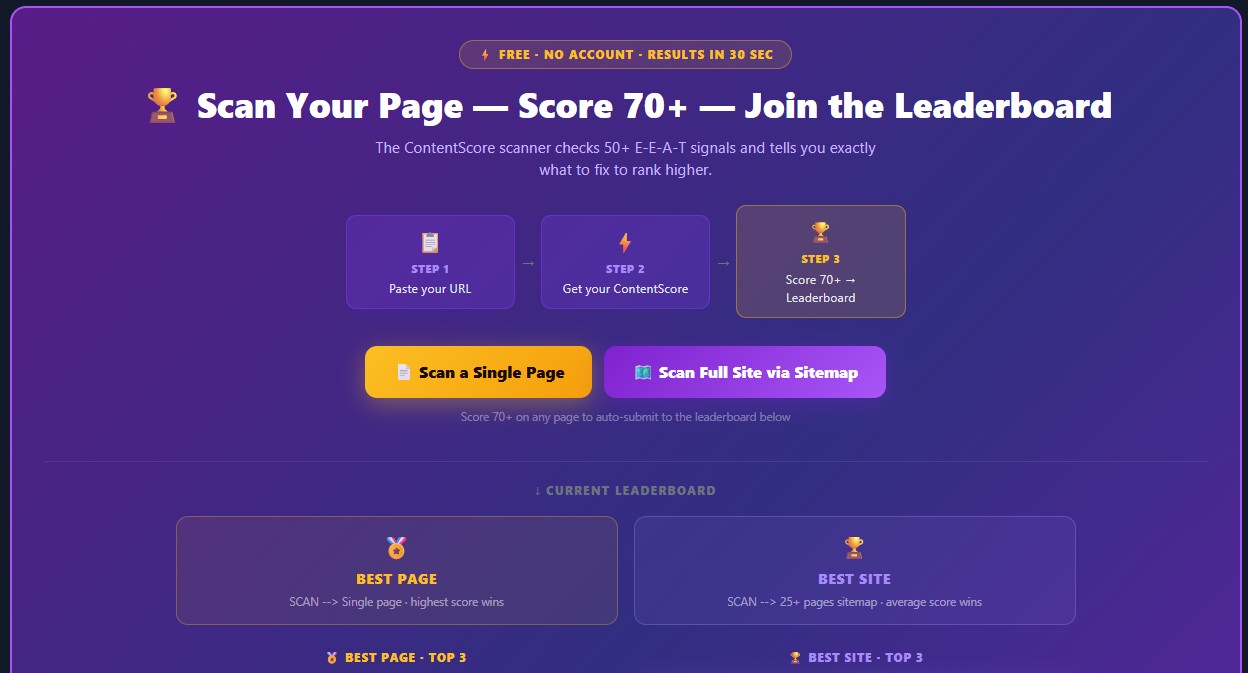
Score 70+ to qualify for the public leaderboard
The Content Scale Score That Predicts Your Rankings
The ContentScore is a 100-point diagnostic built on GRAAF (50pts), CRAFT methodology (30pts) and Technical SEO (20pts). A higher score shows that more checklist criteria are present; it does not predict a guaranteed ranking or traffic result.
How Does ContentScale Find B2B Leads?
The ContentScale AI Lead Crawler searches 20 industries simultaneously in any city worldwide and returns 200–500 real businesses with thin or outdated websites. Each lead is automatically scored, sorted into 6 urgency buckets — from Ghost Sites (0–5 pages) to Established (150+ pages) — and delivered with a ready-to-use pitch angle. All results export to CSV.
Content Scale Lead Finder: 200–500 Qualified B2B Leads in Any City
B2B lead generation SEO is the fastest ROI path for content agencies and freelancers: find businesses that visibly need help, then pitch with a ContentScore scan as proof. Enter any city and country. The crawler runs 20 industry searches in parallel — restaurants, law firms, gyms, dentists, HVAC companies, accountants, and more. Results stream in live. No manual searching. No scraping grey areas. Real businesses with a real content problem you can solve.
Also searched: content scale ai · contentscale.ai · content@scale · ai content optimization
Tell Me About ContentScale’s AI-Era Content Strategy
ContentScale’s AI-era strategy is built on one insight: in 2026, ranking at position 1 in Google no longer guarantees clicks. AI Overviews answer questions directly in the search results, removing the need to click through. Voice assistants answer questions without showing any links at all. To win traffic, content must do two things simultaneously — rank in traditional search and get cited in AI responses. The GRAAF + CRAFT + PULSE + NEXUS system is designed specifically to achieve both.
Content Scale Strategy: Getting Cited in AI Overviews Through Topical Authority
Google’s AI Overviews prioritise pages that are Genuinely Credible (named expert sources), Accurate (verified statistics with named citations), and Actionable (structured steps and numbered lists). According to Moz’s research on content freshness, structured and actionable content with real data consistently earns more AI Overview citations than long-form opinion content.
- → Use H2 headings that directly answer PAA (People Also Ask) questions
- → Include a 40–60 word direct answer at the top of every page
- → Cite specific statistics with named sources and years
- → Use numbered or bulleted lists for steps and recommendations
- → Implement Speakable schema markup for voice search eligibility
Voice Search Optimisation
Voice searches are conversational — people ask full questions, not keyword strings. ContentScale’s NEXUS framework analyses the exact voice query patterns used for your topic and rewrites answers to match them. The Speakable schema implemented on this page targets these specific voice queries:
- 🎤 “What is ContentScale and how can it help my website?”
- 🎤 “Can ContentScale recover lost SEO traffic?”
- 🎤 “How does ContentScale find B2B leads?”
- 🎤 “What is the GRAAF framework for content?”
- 🎤 “Tell me about ContentScale’s AI-era content strategy.”
What the Data Shows About AI Search (2025-2026)
Every figure below is from a named, independent study – the standard the GRAAF “Accurate” signal requires.
AI Overview prevalence changes over time and differs by query category, location and measurement method. Check current data and inspect the actual queries that matter to your audience.
An AI Overview can change how people interact with the organic results, but the click impact is not uniform. Compare impressions, clicks, CTR and the visible search layout for each affected query group.
Independent research indicates that users may click traditional results less often when an AI summary appears. Treat that as context, then verify the pattern against your own pages and queries.
Being cited is a separate visibility outcome from ranking. Save the exact AI answer and cited URL, then compare it with the page’s Google performance without assuming that one caused the other.
The Contentscale.site Case Study Starts Here
The baseline was locked on 28 September 2026 before the first measured implementation in this case-study cycle. Earlier scans and changes remain in Proof & History, but they are not counted as case-study results.
This is a prospective case study. The live HTML, GSC measurements, target query and five-engine AI evidence were saved before the first controlled revision. No improvement is claimed yet.
Search results can vary by location and time. The protected Tracker baseline—not a live Google link—is the comparison source for this case study.
🎤 Does Content Scale traffic recovery?
ContentScale records a baseline before implementation and compares later evidence with that saved state. Recovery time and results vary by site, query, market and implementation. A ContentScore is a diagnostic checklist, not a traffic forecast. This case study will report changes only after new evidence has been collected against the 28 September 2026 baseline.
In 2026, publishing content at scale without checking each page first is a measurable risk. Google’s back-to-back March and April 2026 core updates hit AI-generated content produced at volume the hardest \u2014 the exact pattern that scoring each page against a rubric before it ships is designed to catch.
This is not my opinion \u2014 it is what the update data shows. Independent audits of the March\u2013April 2026 core updates found programmatic sites with thin AI content losing roughly 60\u201380% of their organic traffic, and affiliate sites with rewritten comparisons losing 40\u201360%. The common thread was volume without editorial judgement: no first-hand experience, no original data, no named author.
Author credibility is now a structural ranking factor: industry tracking reported that roughly 73% of top-ranking YMYL pages now show detailed author credentials, up from 58% before this update cycle (source).
Even when a page ranks, the click is no longer guaranteed. When an AI Overview appears, roughly 83% of those searches end without a click, versus about 60% without one (SparkToro / Similarweb via Search Engine Land). For informational queries the zero-click rate is around 74% (Semrush intent study).
The tools I use to do this — free to try
The same tools I run on my own pages and my clients’. Point them at any URL and see what an AI engine sees:
- → Free ContentScore Scanner — score any page on the 100-point GRAAF Framework in 30 seconds, no login.
- → Free AI Citations Tracker — check whether Google AI Overviews, Perplexity and Copilot actually cite your page, and get a copy-paste fix when they don’t.
- → The GRAAF Framework — the 100-point method behind the score.
Want a second pair of eyes on a page that lost traffic or isn’t getting cited? I work one-on-one with people recovering rankings and adapting content for AI search. Message me on WhatsApp or see how I can help.
Sources: Lucid Media \u00b7 March 2026 core update analysis \u00b7 Search Engine Land / SparkToro \u00b7 Omnibound (Semrush, Ahrefs, SparkToro).
What Google actually says about content at scale
These aren’t my claims — they’re on the record from Google’s own Search Liaison. They’re also why I score every page on quality before it ships, instead of chasing volume or AI tricks.
“Are you producing a lot of content at scale to rank well in search? That is your issue if you’re doing it primarily for ranking purposes.”
— Danny Sullivan, Google Search Liaison, on scaled-content policy (Search Engine Roundtable, 2024)
“We don’t want you to turn your content into bite-sized chunks because LLMs like things that are really bite size.”
— Danny Sullivan, Google Search Liaison, on LLM-optimization tactics (Search Off the Record, January 2026)
“The more that you dramatically shift things around and start doing something completely different, the more you may be making things far more complicated, not necessarily successful.”
— Danny Sullivan, Google Search Liaison, on chasing separate AI-SEO strategies (Search Engine Land, February 2026)
ContentScale vs Traditional SEO Tools: What’s Actually Different?
Most SEO tools measure technical signals and keyword density. The Content Scale platform measures the five quality signals that actually cause traffic drops and recoveries — and is the only free tool built specifically for AI-era content.
| Feature | Content Scale | Traditional SEO Tools | Generic AI Writers |
|---|---|---|---|
| Free to use | ✓ 100% free scanner | Freemium / trial only | Limited free tier |
| GRAAF quality scoring | ✓ Full 50-point GRAAF | ✗ Not available | ✗ Not available |
| AI Overview optimisation | ✓ NEXUS citation analysis | Basic — no citation tracking | ✗ Not available |
| Voice search analysis | ✓ PULSE + NEXUS | ✗ Not available | ✗ Not available |
| B2B lead generation | ✓ 200–500 leads per city | ✗ Not available | ✗ Not available |
| Traffic recovery rate | Baseline, implementation and later verification | No documented rate | Often causes further drops |
| Speakable schema guidance | ✓ Built into scoring | ✗ Not available | ✗ Not available |
| Login / account required | ✗ No login ever | ✓ Always required | ✓ Always required |
Content At Scale was sold to Brandwell — what changed and where to go. The CRAFT Framework by Julia McCoy remains excellent — ContentScale keeps all of it and adds GRAAF + PULSE + NEXUS for 2026. Read the full ContentScale system →
A Before-and-After Record You Can Inspect
Every result should be tied to a dated baseline, a recorded implementation and a later verification. The cards below describe that proof structure rather than promising an average result.
📌 Want the proof on your own page? Run a free ContentScore scan, apply the fixes, and rescan – the before/after is yours to verify, no testimonial required. Scan free →
“Goede service, klantvriendelijk en makkelijk in contact. Zeker een aanrader!!”
32 weeks ago · 1 review
“ContentScale heeft me geholpen met mijn website verkeer. Dankjewel.”
32 weeks ago · 2 reviews
“ContentScale heeft goed geholpen. Er waren problemen met mijn websiteverkeer, en ze hebben een oplossing geboden. Binnen 90 dagen waren mijn gemiste kliks weer terug. Het GRAAF Framework lijkt goed te werken.”
35 weeks ago · 1 review
“Ik ben ontzettend blij met de hulp van ContentScale. Mijn website had te maken met een aanzienlijke daling in verkeer, en ik was ten einde raad. Dankzij hun deskundigheid en het GRAAF Framework heb ik binnen 90 dagen weer een significante stijging in kliks gezien.”
35 weeks ago · 1 review
“Wat een ontdekking! Als ondernemer in België had ik te maken met een daling in websiteverkeer. Gelukkig vond ik ContentScale. Hun GRAAF Framework heeft me geholpen om snel weer kliks te genereren.”
36 weeks ago · 2 reviews
Reviews shown as posted, in Dutch, on ContentScale’s Google Business Profile.
Choose the Tool That Matches Your Next Step
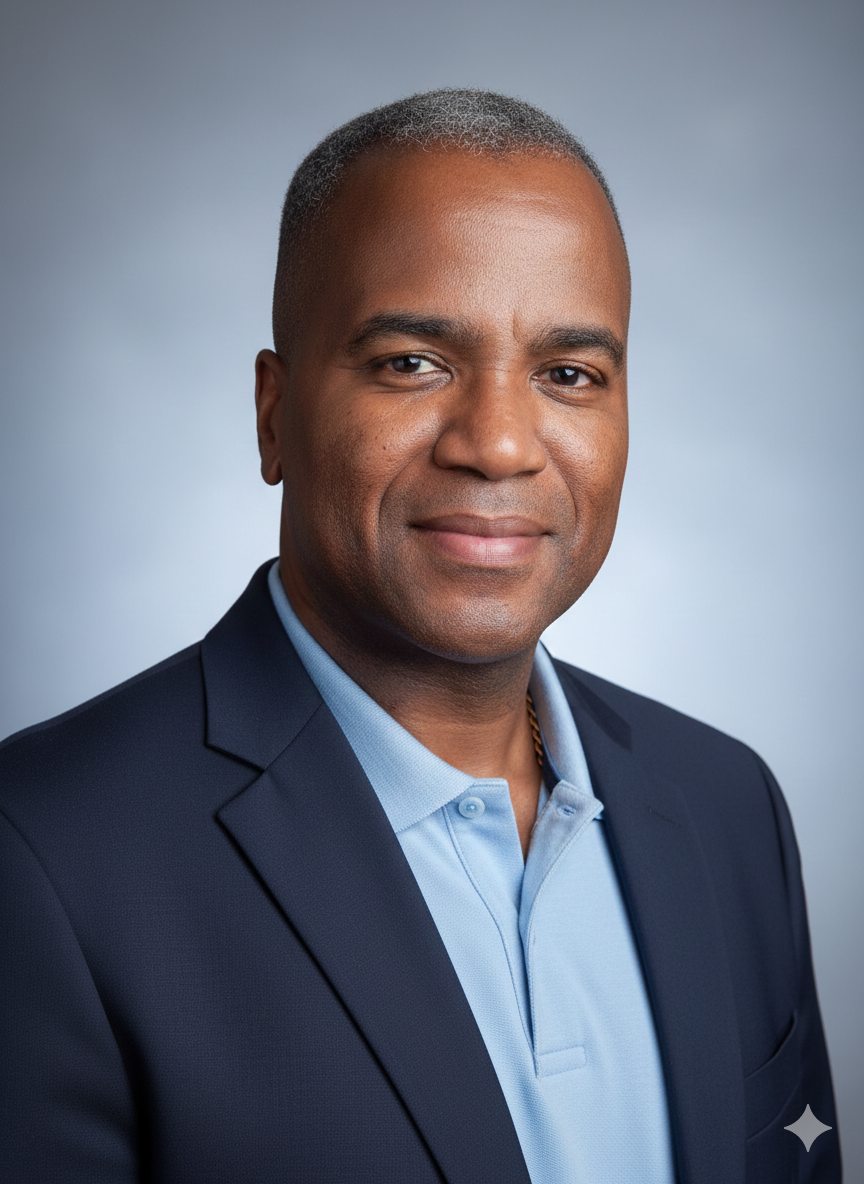
Ottmar J.G. Francisca built the ContentScale AI Citations Tracker and created the GRAAF Framework, the 100-point content-quality system used in each Citation Brief. Operating solo from Amsterdam with 24+ years in systems and operations management for the City of Amsterdam, he combines GRAAF with Julia McCoy’s CRAFT Framework and the PULSE + NEXUS research system.
His current work centers on the AI Citations Tracker: preserving five-system answers, GSC baselines, page versions, implementation dates and later verification so results are measured rather than promised. See the case study for dated examples.
- ✓ Five-system AI evidence recorded separately
- ✓ Baseline, implementation and verification history
- ✓ Creator of the GRAAF Framework — ContentScore 99/100 on this page
- ✓ 24+ years systems & operations experience (formerly City of Amsterdam), now working remotely from Amsterdam
FAQ: ContentScale, GRAAF Framework & SEO in 2026
See also: Full GRAAF Framework Guide · ContentScale System Walkthrough · ContentScore Documentation · AI Content Quality Checker · Latest SEO insights
Common questions about content scaling in SEO, how ContentScale works, what the GRAAF Framework measures, how CRAFT and GRAAF work together, and what happened to Content At Scale.
❓ What are the key components of a content scale strategy?
❓ How does content scale differ from content marketing?
❓ What are the benefits of achieving content scale?
❓ What is ContentScale and how can it help my website?
❓ Can ContentScale recover lost SEO traffic?
❓ How does ContentScale find B2B leads?
❓ What is the GRAAF framework for content?
❓ How does CRAFT and GRAAF work together?
❓ What is content scaling in SEO?
❓ What happened to Content At Scale and the CRAFT Framework?
❓ What is the difference between ContentScale and BrandWell?
❓ Is ContentScale an SEO agency in Amsterdam?
❓ Does the AI Citations Tracker work outside WordPress?
❓ Is ContentScale really free?
❓ What is the primary benefit of content scale?
❓ How does ContentScale automate content scale?
❓ Is content scale important for AI Overviews in 2026?
Differentiating Content Scaling Strategies
To successfully scale your digital footprint, you must align your content with specific searcher intents. For optimizing your existing assets to match natural search queries, explore my guide on conversational content optimization.
If you need to measure the exact quality and search readiness of your drafts, check out my SEO ContentScore tool to grade your pages against 100 critical search factors.
For those implementing a structured, human-in-the-loop writing workflow, learn how to apply the CRAFT framework to elevate AI drafts into high-performing editorial assets.