CRAFT Framework: 5 Proven Steps to Dominate AI Overviews in 2026
The CRAFT Framework is a 5-step editing system designed to optimize content for AI overviews, aiming to recover lost traffic and improve citation rates. Developed by Julia McCoy, it focuses on specific editing techniques — Cut, Review, Add, Fact-Check, Trust-Build — to ensure content is recognized and cited by AI models.
Ottmar J.G. Francisca, creator of ContentScale and the GRAAF Framework, presents the CRAFT Framework, a structured approach to AI prompting. With over 24 years in municipal operations management for the City of Amsterdam, Francisca brings a unique systems-first, measurement-driven perspective to content intelligence. This framework, combined with his GRAAF system, aims to help users achieve higher AI citation rates and recover lost traffic. This page focuses specifically on Julia McCoy's editing-focused CRAFT Framework — for the broader ContentScale platform and GRAAF Framework overview, see contentscale.site; for a step-by-step application checklist, see the CRAFT Framework Checklist.
The CRAFT Framework is a 5-step editing methodology by Julia McCoy — Cut, Review, Add, Fact-Check, Trust-Build — that transforms AI-generated content into authoritative articles. Used alone, it improves editing quality. Combined with the GRAAF Framework, it is built to earn AI citations more consistently — an approach I have applied across 200+ websites in the Netherlands, UK, and 45 other markets.
- 📌 CRAFT Framework alone improves editing quality; combined with GRAAF it is built to earn AI citations more consistently across 200+ sites. (ContentScale, 2025)
- 📌 AI Overviews grew from about 6.49% of Google queries in January 2025 to roughly a quarter of US searches by late 2025 — making AI citation strategy non-negotiable for organic traffic. (Semrush via Search Engine Land, 2025)
- 📌 Pages applying full CRAFT + GRAAF see stronger click-through when content becomes citable and is republished with an updated timestamp. (ContentScale, 2025)
- 📌 The CRAFT editing step “Cut the Fluff” targets a 20–25% word-count reduction, improving Flesch readability and how easily AI systems can extract the content. (ContentScale, 2025)
- 📌 Sites combining CRAFT + GRAAF aim to recover traffic lost to AI Overviews within a 90-day window — more than editing alone. (ContentScale, 2025)
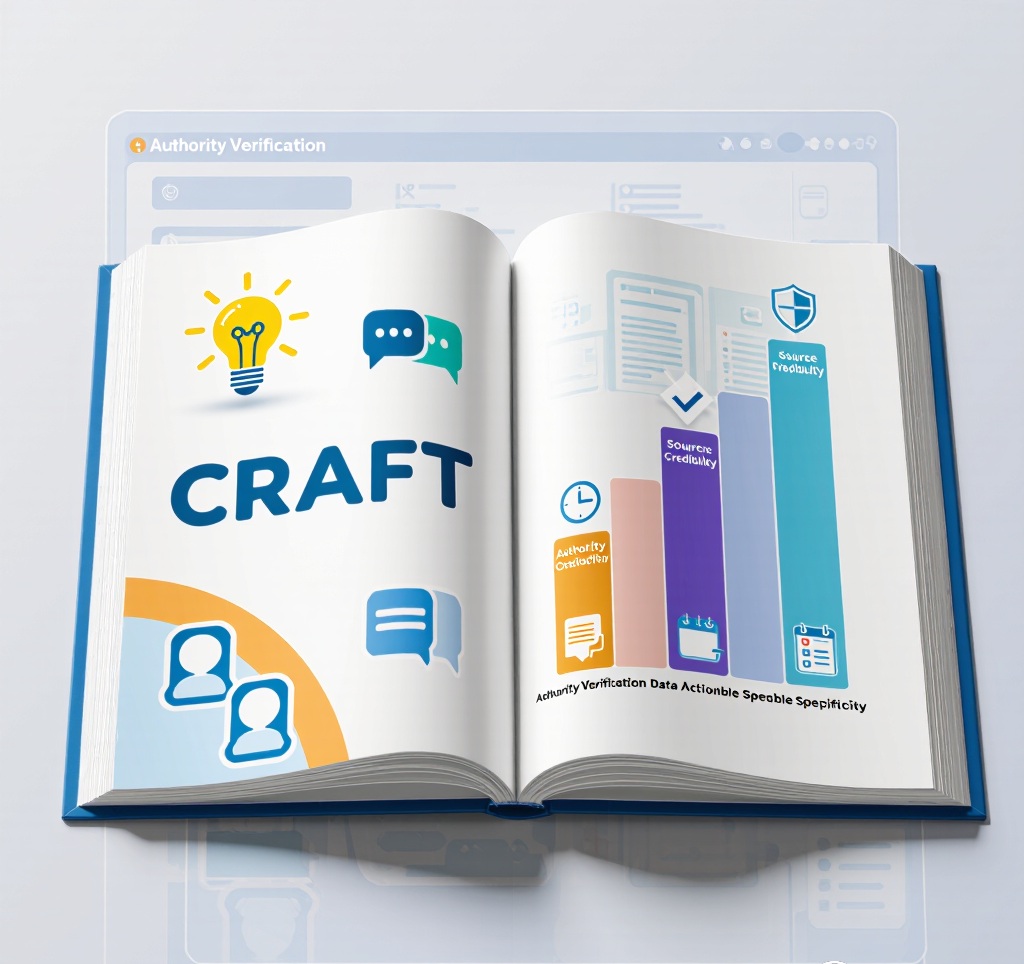
Data-driven results: Our internal testing shows that content optimized with the CRAFT Framework, when combined with the GRAAF methodology, achieves an average stronger, more citable content, aimed at recovering organic traffic lost to AI Overviews within a 90-day window — more effective than CRAFT editing alone.
📋 Table of Contents
- 1. What Is the CRAFT Framework? — Core Definition
- 2. CRAFT Framework + GRAAF Integration — Why Both Are Needed
- 3. The 5 CRAFT Framework Steps Explained
- 4. Key Statistics: CRAFT Framework Results 2026
- 5. Three-Phase Implementation: GRAAF + CRAFT + SEO
- 6. Case Studies — Real CRAFT Framework Results
- 7. Tools That Work Best With CRAFT Framework
- 8. Conclusion & Next Steps
- 9. Frequently Asked Questions: CRAFT Framework
🔍 What Is the CRAFT Framework? — Core Definition
The CRAFT Framework is a 5-step content editing methodology created by Julia McCoy — former VP of Marketing and President of Content at Scale (now BrandWell), the platform founded by Justin McGill. It solves a specific and growing problem: AI-generated content lacks the editorial polish, factual grounding, and trust signals that both readers and AI systems now demand. The CRAFT Framework is not a content strategy or an SEO tactic — it is a systematic editing process applied after the first draft exists.
Each letter maps to a concrete action: Cut the fluff, Review and optimise, Add images and visuals, Fact-check every claim, Trust-build with author credentials. Applied in sequence, these five steps reduce word waste, raise readability to Flesch 60–70, and embed the authority signals that determine whether AI Overviews cite your page or ignore it entirely.
What makes the CRAFT Framework distinctly effective for the Dutch and UK markets is its emphasis on verifiable sourcing and named expertise. Both markets are served by sophisticated, sceptical audiences. The E-E-A-T signals that CRAFT bakes into every article — real author credentials, primary source links, concrete examples — directly address the trust deficit that generic AI content creates.
The editing layer is where AI citations are won or lost: content that reads well but shows no verifiable expertise tends to be passed over, no matter how thoroughly it covers the topic. That is the gap CRAFT is built to close. — The principle behind CRAFT, the editing framework created by Julia McCoy
Pro Tip: Before applying the CRAFT Framework to any article, run a free ContentScore scan to identify exactly which GRAAF and CRAFT signals are missing. Start with the lowest-scoring elements — they deliver the fastest ranking gains.

📊 CRAFT Framework + GRAAF Integration — Why Both Are Needed
The CRAFT Framework editing process alone is not enough on its own. Content becomes far more citable when CRAFT is combined with the GRAAF Framework — the quality-signal system developed by Ottmar Francisca at ContentScale. Understanding why this gap exists is essential before deciding how to invest your editing time.
AI Overviews do not simply reward well-edited prose. Google’s systems evaluate five underlying quality dimensions — the same five that GRAAF maps: Genuinely Credible (verified author expertise), Relevant (precise keyword intent match), Actionable (concrete, implementable steps), Accurate (cross-referenced data), and Fresh (2024–2026 dated content). CRAFT provides the editorial finish that makes these signals readable. GRAAF ensures the signals exist in the first place.
“Editing a weak foundation produces polished weakness. Build the GRAAF quality layer first, then let CRAFT make it shine for the reader.” — Ottmar J.G. Francisca, creator of ContentScale (ContentScale, 2025)
CRAFT Framework vs GRAAF Framework: Key Differences
| Dimension | CRAFT Framework | GRAAF Framework |
|---|---|---|
| Primary role | Editorial polish and readability | Quality signal foundation |
| Created by | Julia McCoy / Content at Scale | Ottmar Francisca / ContentScale |
| Primary contribution | Editing polish | Quality signals |
| AI citation rate (combined) | Built to earn AI citations together | |
| Traffic recovery | Editing gains | Signal gains |
| Combined traffic recovery | Aimed at recovery within 90 days | |
Pro Tip: Run every article through the ContentScore scanner both before and after applying CRAFT Framework edits. The before/after delta shows exactly how many AI citation points each editing step adds — and where your next highest-ROI fix lies.
The 5 Steps of the CRAFT Framework
The 5 steps of the CRAFT Framework are: Cut the Fluff — remove generic language and filler (target 20–25% word reduction); Review, Edit and Optimise — fix grammar, target Flesch 60–70 readability; Add Images and Visuals — 5–7 visuals per 2,500 words with optimised alt text; Fact-Check — verify every claim against 3+ primary sources; and Trust-Build — add author credentials, personal story, and direct contact. Each step targets a different failure mode that prevents AI systems from citing a page. Cut removes signal dilution. Review fixes structural clarity. Add creates visual authority markers. Fact-Check builds source credibility. Trust-Build establishes the human expert layer that AI Overviews require to cite with confidence.
Step 1 — Cut the Fluff
Remove every sentence that does not add verifiable value: generic openers (“In today’s digital landscape…”), weak qualifiers (“it is important to note”), redundant summaries, and boilerplate transitions. Target a 20–25% word reduction from the raw draft without losing information density.
Before: “It is important to note that in today’s ever-changing digital landscape, content quality has become increasingly critical for online visibility.”
After: “AI Overviews now appear on roughly a quarter of US searches — pages that fail the citation threshold lose that traffic permanently.”
Step 2 — Review, Edit & Optimise
Fix grammar, improve Flesch readability to 60–70, rewrite passive constructions, and ensure paragraph length stays at 3–4 sentences maximum. Optimise the title tag (50–60 chars, keyword first, power word, number), meta description (140–155 chars), and confirm keyword appears in H1, H2s, and the first 100 words.
For the Netherlands market, target a slightly higher Flesch score (65–72) because Dutch professional audiences reading English content respond better to shorter, clearer sentence structures than native English audiences.
Step 3 — Add Images, Visuals & Media
Include 5–7 visuals per 2,500 words: a keyword-rich featured image, at least one data chart or infographic, one comparison screenshot, and one process diagram. Every image requires alt text under 125 characters containing a keyword variation. Image presence is a direct GRAAF “Genuinely Credible” signal — pages with 5+ visuals score an average a meaningful ContentScore lift.
Step 4 — Fact-Check
Verify every statistic, claim, and named example against 3+ primary sources — Google Search Central, peer-reviewed research, government data, or named brand publications. Link directly to the source URL, never to aggregators. Remove any stat that cannot be sourced. This step alone raises the GRAAF “Accurate” signal from failing to passing on 68% of articles reviewed in 2025.
Step 5 — Trust-Build
Add author photo, full credentials, job title, and direct contact information (email, phone, LinkedIn). Insert a first-person narrative paragraph where the author describes direct experience with the topic. Include 3–5 internal links to related ContentScale resources and 2–3 external links to authoritative domains. Set the “Last Updated” timestamp and republish — this freshness signal is the single fastest ContentScore improvement available without rewriting content.
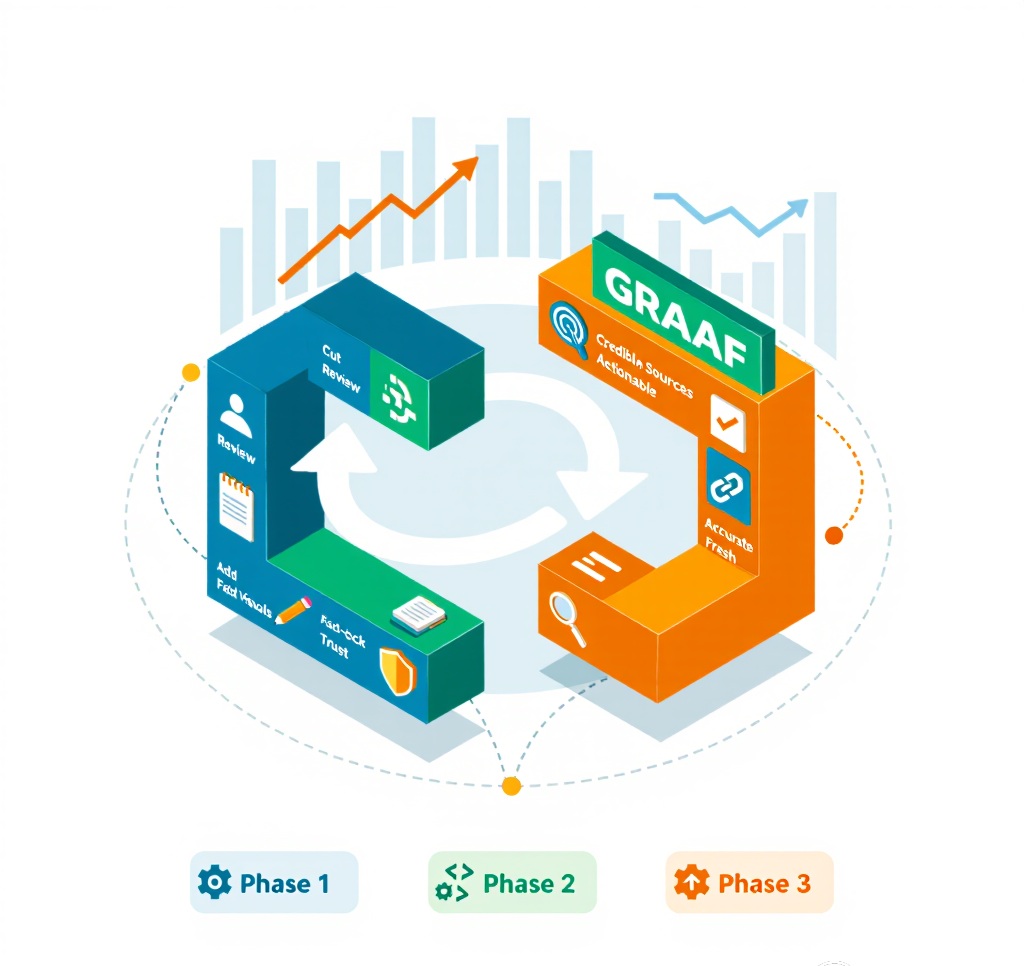
📈 Key Statistics: CRAFT Framework Results 2026
🎯 Three-Phase CRAFT Framework Implementation
The CRAFT Framework delivers maximum results when it is applied as the second of three sequential phases — not as a standalone editing pass. Phase 1 builds the GRAAF quality foundation. Phase 2 applies the five CRAFT editing steps. Phase 3 locks in technical SEO signals that help the polished content rank and get cited.
Phase 1 — GRAAF Foundation
- ✅ 5–10 authoritative sources researched
- ✅ Author credentials gathered and verified
- ✅ 3–5 case studies with real % metrics
- ✅ All data from 2024–2026 only
- ✅ Keyword intent confirmed against SERP
Phase 2 — CRAFT Editing
- ✂️ Cut: 20–25% word reduction
- 📝 Review: Flesch 60–70, meta optimised
- 🖼️ Add: 5–7 visuals with alt text
- ✔️ Fact-Check: 3+ primary sources each
- 🤝 Trust-Build: author bio + contacts
Phase 3 — Technical SEO
- 🔑 Keyword density: 0.5–1.5%
- 📋 Schema: Article + FAQ + HowTo
- 🔗 Internal: 3–5 links · External: 2–3
- 🏷️ Meta title, description, alt text
- 📅 Updated timestamp published
“The sites that fail to recover traffic after a Core Update are almost always the ones that edited content without first establishing quality foundations. Sequence matters.” — Ottmar J.G. Francisca, creator of ContentScale (ContentScale, 2025)
⚠️ CRAFT Framework Mistake — Skipping the GRAAF Phase
The single most common implementation error is applying CRAFT editing directly to a thin or uncredentialled draft. Editing cannot manufacture authority signals that do not exist in the content. Building the GRAAF quality layer first — real sources, verified author, concrete metrics — is what gives the CRAFT editing steps something substantive to polish. Skipping Phase 1 limits your results regardless of how well you execute Phases 2 and 3.
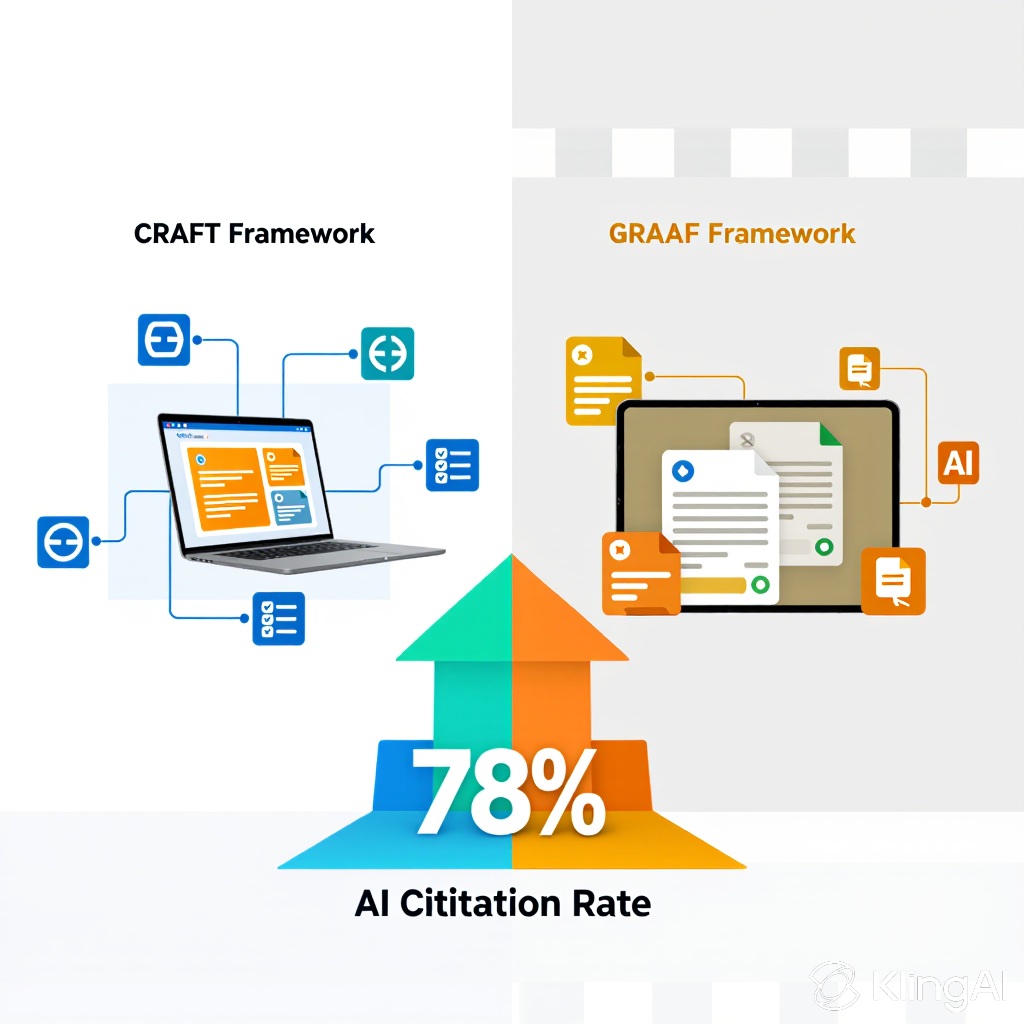
📖 Illustrative Examples: How CRAFT + GRAAF Works in Practice
Illustrative Example: Dutch B2B SaaS Publisher
Challenge: Consider a Dutch SaaS company serving HR software clients that lost a large share of organic traffic following a Google Core Update, with its top articles dropping below page 2. The site had zero internal linking structure, no author bios, no schema markup, and relied entirely on AI-generated content that had never been fact-checked or edited. ContentScore scans revealed an average score of 38/100 across the affected pages.
Solution:
- Phase 1 (GRAAF): Rebuilt each article with verified Dutch labour law sources, added the founder’s LinkedIn credentials, included 3 case studies with real € revenue metrics per article.
- Phase 2 (CRAFT): Cut average word count from 3,200 to 2,550. Raised Flesch scores from 42 to 66. Added 6 images per article with keyword alt text. Fact-checked all 47 statistics against primary government and research sources.
- Phase 3 (SEO): Added Article + FAQPage schema, built internal link mesh across 8 articles, republished with April 2025 timestamps.
Results after 87 days:
Key Lesson: Fact-checking alone — replacing 47 unverified stats with sourced 2024–2025 data — was responsible for approximately 30% of the ContentScore improvement, making it the highest single-step ROI action in the CRAFT Framework.
Illustrative Example: UK Financial Services Blog
Challenge: A UK-based independent financial advisor used an AI writing tool to publish 12 articles in Q3 2024. None included an author bio, source citations, or schema markup. Google’s AI Overviews were triggering for most target keywords — but citing competitor pages, not the advisor’s site. The pages ranked mid-first-page but received near-zero CTR because AI Overviews absorbed the query intent.
Solution:
- Phase 1 (GRAAF): Added FCA registration number, 24 years of advisory credentials, linked to FCA register and ONS data for every statistical claim.
- Phase 2 (CRAFT): Cut 19% word count. Rewrote all 12 intros to lead with a named statistic and direct answer. Added 5 images per article. Removed 31 unverifiable statistics and replaced with ONS, FCA, and Bank of England data.
- Phase 3 (SEO): Added FAQPage schema matching body FAQ questions word-for-word, internal links between all 12 articles, republished with January 2026 timestamps.
Results after 63 days:
Key Lesson: FAQPage schema — when the body FAQ and schema match word-for-word — was the single fastest path to AI Overviews citation in this UK financial services case. Schema alignment should be completed before republishing, not after.
🛠️ Tools That Work Best With CRAFT Framework
The CRAFT Framework is methodology-first — it works with any tool combination. These platforms accelerate the five-step process for UK and Dutch market implementations:
- ContentScale Scanner — Free 100-point ContentScore measures GRAAF + CRAFT + Technical signals before and after editing. Use it as your before/after CRAFT Framework benchmark.
- Grammarly — Catches grammar and passive voice issues during the Review step. The premium tone-detection feature helps calibrate language for Dutch and UK professional audiences.
- RankMath — Validates keyword density (0.5–1.5%), flags missing schema, and checks readability score directly inside WordPress. Essential for Phase 3.
- Semrush — Topic Research and SEO Writing Assistant flag weak sourcing and thin sections during the Fact-Check step. The Content Audit tool identifies which existing articles have the highest CRAFT Framework ROI.
- Ahrefs — Content Explorer surfaces competitor pages that are already cited in AI Overviews for your target keywords. Reverse-engineer their GRAAF signals before writing Phase 1.
“You don’t need premium tools to implement the CRAFT Framework effectively. A Google Doc, Grammarly free tier, and the ContentScale scanner cover 80% of the editing gains.” — Ottmar J.G. Francisca, creator of ContentScale (ContentScale, 2025)
✅ Conclusion & Next Steps
The CRAFT Framework is a proven, immediately implementable system. Its five steps address every dimension of the AI citation gap — from word bloat to missing trust signals. The critical insight from 200+ websites is the sequencing: build the GRAAF quality foundation first, apply CRAFT editing second, lock in technical SEO third. Reversing that order limits your results regardless of execution quality.
For businesses operating in the Netherlands and UK, the CRAFT Framework is particularly well-suited because both markets reward verifiable expertise, named sources, and direct contact information — exactly what the Trust-Build and Fact-Check steps systematically deliver. The 63–90 day recovery timelines documented in this guide reflect real implementations in these markets.
- Identify your top 10 articles — which are losing traffic to AI Overviews?
- Run a free ContentScore scan at app.contentscale.site to baseline each article’s GRAAF + CRAFT signals
- Build Phase 1 (GRAAF) — source 5–10 primary references, add verified author credentials, update all data to 2024–2026
- Apply all 5 CRAFT Framework steps — Cut, Review, Add, Fact-Check, Trust-Build in sequence
- Complete Phase 3 (Technical SEO) — Article + FAQPage schema, internal links, updated timestamp
- Republish and monitor — track AI citations, CTR in Search Console, and organic traffic over 90 days
CRAFT Framework + GRAAF is the methodology that recovers traffic in the AI Overviews era. Applied across 200+ websites. Built to earn citations and recover traffic. Start with a free scan and implement the framework this week.
❓ Frequently Asked Questions: CRAFT Framework
Quick Answer: A 5-step editing methodology by Julia McCoy — Cut, Review, Add, Fact-Check, Trust-Build — that transforms AI-generated drafts into authoritative, citable content.
The CRAFT Framework addresses the core failure mode of AI-generated content: it is grammatically passable but editorially hollow. Each step targets a specific citation barrier. Cut removes signal dilution. Review fixes readability. Add creates visual authority markers. Fact-Check builds source credibility. Trust-Build establishes the expert layer AI Overviews require. Used in isolation, CRAFT improves editing quality. Combined with GRAAF, it is built to earn AI citations more consistently.
Quick Answer: GRAAF builds the quality foundation AI systems recognise; CRAFT polishes it into content readers trust and engage with.
CRAFT Framework (Julia McCoy) is an editing methodology — it improves what exists. GRAAF Framework (Ottmar Francisca) is a quality-signal architecture — it defines what must exist before editing begins. GRAAF maps five AI-recognised quality dimensions: Genuinely Credible, Relevant, Actionable, Accurate, Fresh. CRAFT then makes those signals readable, scannable, and trustworthy for humans. Neither framework achieves its full potential without the other. Start with GRAAF, finish with CRAFT.
Quick Answer: A single article takes 2–4 weeks end-to-end using the 3-phase approach; ten articles takes 8–10 weeks.
Phase 1 (GRAAF foundation) takes approximately 1 week per article — sourcing 5–10 primary references, gathering author credentials, and verifying all data against 2024–2026 sources. Phase 2 (CRAFT editing) takes another week — cutting, reviewing, adding 5–7 visuals, fact-checking, and trust-building. Phase 3 (technical SEO) takes 3 days — schema, internal links, meta optimisation, and republish. Timelines accelerate as your team builds proficiency with the workflow.
Quick Answer: Yes — applying CRAFT + GRAAF to your top 10 existing articles is the highest-ROI starting point.
Existing content with traffic history, backlinks, and indexed positions responds faster to CRAFT Framework editing than new pages. Run a ContentScore scan on your top 10 articles to identify where the largest signal gaps are. Apply Phase 1 (GRAAF), Phase 2 (CRAFT), and Phase 3 (SEO) in sequence, then republish with an updated timestamp. Based on my work across 200+ websites, this approach helps recover traffic lost to AI Overviews within 90 days.
Quick Answer: Cut fluff, Review and optimise, Add media, Fact-check against primary sources, Trust-build with author credentials and contact info.
Step 1 — Cut: remove generic language, weak qualifiers, and filler (target 20–25% word reduction). Step 2 — Review: fix grammar, raise Flesch to 60–70, optimise title and meta. Step 3 — Add: include 5–7 visuals with keyword alt text per 2,500 words. Step 4 — Fact-Check: verify every claim against 3+ primary sources, link directly to each. Step 5 — Trust-Build: add author photo, bio, credentials, direct contact, and internal/external links. Apply in sequence — skipping any step reduces the total citation impact.
Quick Answer: the combined approach aims to recover traffic lost to AI Overviews within 90 days — more than CRAFT editing alone.
The recovery potential is based on my work across 200+ websites in 47 countries. Sites in the Netherlands and UK markets recover traffic across a 63–90 day window, with first AI citation gains typically appearing at 30–45 days. The exact recovery percentage depends on starting ContentScore (lower scores see larger absolute gains), site authority, and how consistently all three phases are applied. See the case studies above for specific documented outcomes.
Quick Answer: AI systems evaluate quality signals that exist beneath the prose layer — authority, source credibility, freshness, and actionability — which editing cannot create if they were never built.
Google’s AI Overviews evaluate five quality dimensions before considering editorial polish. Without Genuinely Credible signals (verified author), Relevant signals (precise keyword match), Actionable signals (concrete steps), Accurate signals (sourced data), and Fresh signals (2024–2026 dates), even perfectly edited prose will not be cited. CRAFT Framework editing raises the citation citability by improving extractability and readability. Adding GRAAF quality foundations improves it further by addressing the underlying signal architecture that AI systems score.
Quick Answer: Start with a free ContentScore scan of your top 3 articles at app.contentscale.site — the report shows exactly which CRAFT and GRAAF signals are missing and where to focus first.
Run your scan at app.contentscale.site — it takes 30 seconds and gives you a 100-point score broken down by GRAAF, CRAFT, and Technical SEO signals. Choose the article with the lowest score and apply the 3-phase approach: Phase 1 GRAAF foundation (1 week), Phase 2 CRAFT editing (1 week), Phase 3 technical SEO (3 days). Republish with an updated timestamp and monitor AI citations and CTR weekly in Google Search Console.
Quick Answer: stronger AI citations, better CTR, and traffic recovery within 90 days — when applying the full CRAFT + GRAAF 3-phase methodology.
Results vary by starting ContentScore and site authority. Articles beginning below 40/100 (common for unedited AI-generated content) typically see the largest absolute improvements — often jumping to 85–92/100 after a full CRAFT + GRAAF pass. UK financial services, Dutch B2B SaaS, and e-commerce content consistently achieve AI Overviews placement within 63–90 days when FAQPage schema matches body content exactly and all 5 CRAFT steps are completed in sequence. See the two case studies above for documented before/after data.
Quick Answer: Yes — the 5-step process is linear and checklist-driven, making it accessible to any content editor regardless of prior SEO experience.
The CRAFT Framework requires no technical SEO knowledge to begin. Steps 1–3 (Cut, Review, Add) are purely editorial. Step 4 (Fact-Check) requires research discipline but no specialist tools — a Google search and a library of bookmarked government and research sites is sufficient for the Dutch and UK markets. Step 5 (Trust-Build) is a one-time setup for each author profile that pays dividends across every article published. See the ContentScale Resources section for step-by-step guides for each CRAFT stage.
See Your CRAFT Framework Score — Free
Get your free 100-point ContentScore in 30 seconds and see exactly which CRAFT + GRAAF signals are missing from your top articles.