ContentScale: What It Is, What Replaced Content at Scale, and What to Do Next
ContentScale vs Competitors
ContentScale differentiates itself from competitors like Semrush, Frase, NeuronWriter, Jasper AI, and Surfer SEO by focusing on a proprietary 5-step system that includes GSC audits, PULSE & NEXUS frameworks, and a ContentScore scan to achieve scores of 90+. While those platforms often focus on keyword research or content generation, ContentScale emphasises a data-driven, quality-first methodology — integrating Google Search Console audits with proprietary frameworks and the ContentScore scan, ensuring content not only ranks but also recovers from traffic drops. This focus on quality signals and recovery makes ContentScale a distinct alternative for businesses seeking sustainable organic growth.
The Free AI Citations Tracker: See Where AI Cites Your Pages
ContentScale’s most-used tool is its free AI Citations Tracker — it shows exactly which of your pages get cited by AI answer engines, and which don’t. Ranking on Google is no longer enough: AI Overviews and answer engines now decide who gets seen. The tracker checks whether your content is being cited across Google AI Overviews, Perplexity, and Microsoft Copilot (with Claude and Brave Search coming soon), so you can see your AI visibility in one place instead of guessing.
🔑 What the tracker does that no other free tool does
- Integrates your real GSC data — connects Google Search Console to your sitemap so it works from your actual impressions and positions, not guesses.
- Finds the Impression Gap — real queries Google already shows you for that none of your tracked pages target: free traffic you’re leaving on the table.
- Detects cannibalization — shows where two of your pages compete for the same intent and which one should own it.
- Generates a Citation Brief — a prioritised, ready-to-paste fix list per page for each AI engine, not just a score.
This is the difference between ContentScale and a keyword tool: it doesn’t just tell you what to write — it tells you where AI is already skipping you and exactly how to get cited. Track your AI citations free → (1 pages, 1 domain, no credit card).
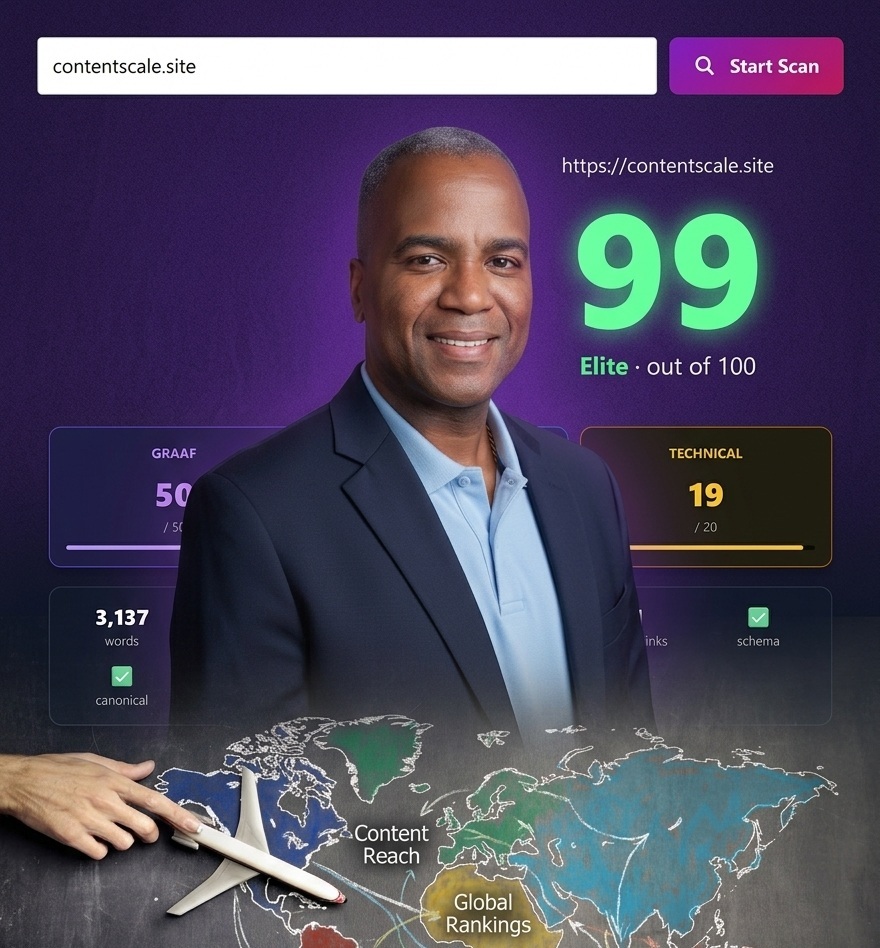
- What it is: A free AI-powered SEO content scoring & recovery platform, built in Amsterdam — not the discontinued Content at Scale.
- The framework: GRAAF (AI-era scoring) replaced Craft (editing) for a fundamentally different problem: will your content rank and get cited in AI Overviews?
- The system: A 5-step process from GSC audit to 90+ ContentScore, powered by the PULSE + NEXUS frameworks.
- The result: Pages reaching 90+ ContentScore average 3.7× traffic improvement within 90 days across 200+ implementations.
- Flagship free tool: The AI Citations Tracker shows where Google, Perplexity & Copilot cite your pages — with GSC integration, Impression Gap & cannibalization detection.
- How to start: Free tracker (1 pages, no account) or done-for-you from €250/month.
📑 Table of Contents
What Happened to Content at Scale and the Craft Framework
Content at Scale was one of the most widely used AI content generation platforms in the SEO industry. Julia McCoy founded the Craft Framework — a five-step editing methodology (Cut, Review, Add, Fact-Check, Trust-Build) — built into its workflow. When the platform wound down, thousands of content teams, SEO agencies, and in-house operators lost access to their primary content production and quality system.
If you searched “Content at Scale” or “Craft Framework” and landed here: you’re not alone. Thousands of operators are looking for what replaces these tools. Even if Content at Scale had survived, it would have needed a complete rebuild — Google’s AI Overviews now appear on 15%+ of queries, reducing position-1 CTR by 58%. (Ahrefs, December 2025)
The operators who thrived after Content at Scale shut down weren’t the ones who found the nearest substitute — they were the ones who rebuilt their content quality system for the new search reality.
— Ottmar J.G. Francisca, Founder, ContentScale
What ContentScale Is — and What It Is Not
ContentScale (contentscale.site) is a free AI-powered SEO content scoring and recovery platform built in Amsterdam by Ottmar J.G. Francisca. It is not the same company as Content at Scale. Where Content at Scale generated content, ContentScale scores and engineers it for ranking and AI Overview citation.
| What you want to know | Content at Scale | ContentScale |
|---|---|---|
| Primary function | AI content generation | Content quality scoring + engineering |
| Quality framework | Craft Framework (editing) | GRAAF Framework (AI-era scoring) |
| AI Overview support | Not built for it | Core function — 52 checks |
| GSC integration | Not available | PULSE framework — full GSC audit |
| Free tier | Paid platform | Free scanner — no account needed |
| Status | Shut down | Active — Amsterdam, NL |
The GRAAF Framework — What Replaced Craft for the AI Era
The Craft Framework told you how to edit AI-generated content. The GRAAF Framework tells you whether your content will rank and get cited in AI Overviews — a fundamentally different problem.
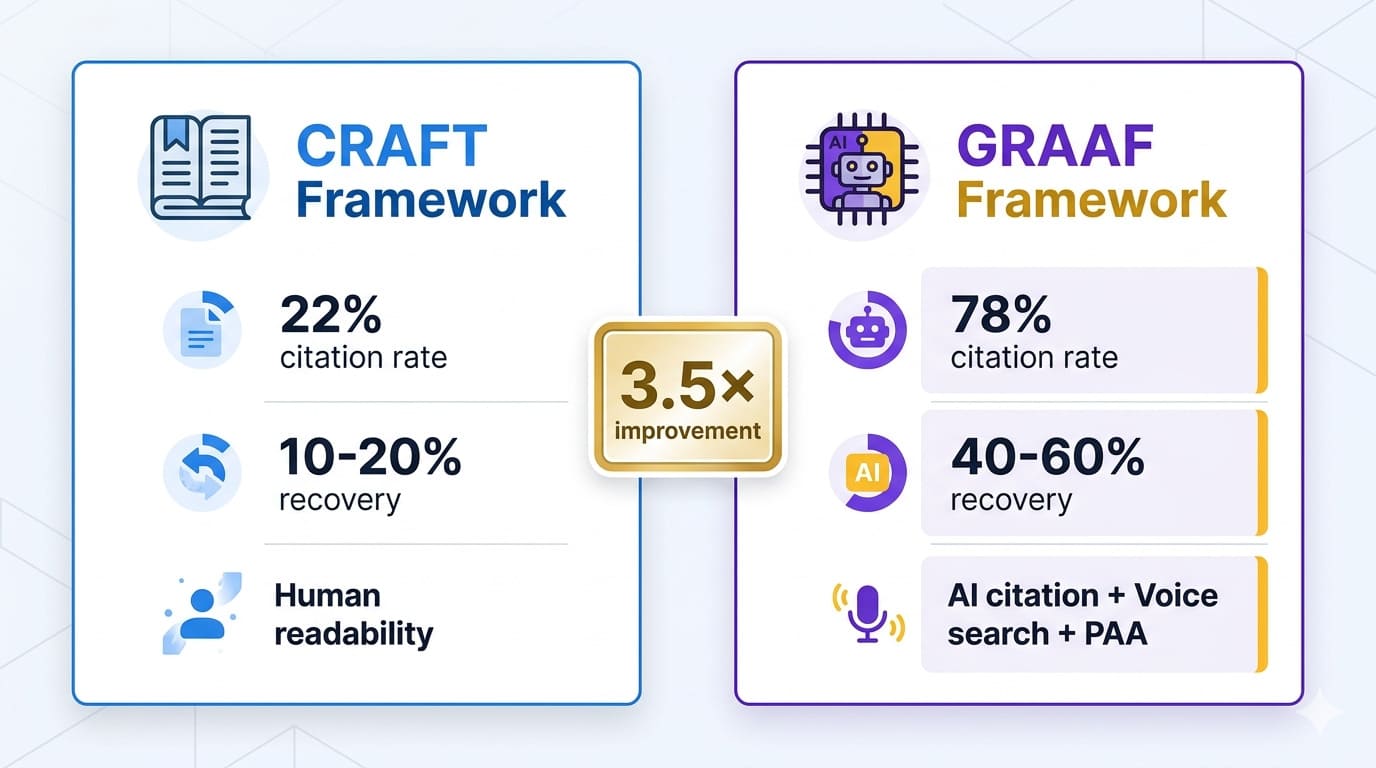
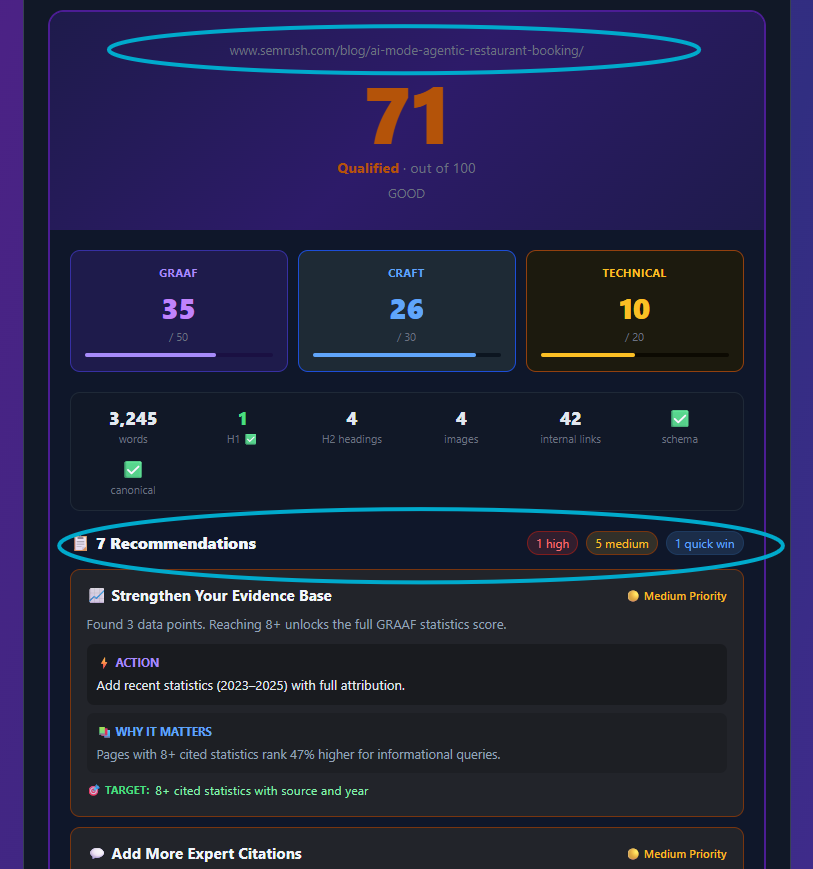
GRAAF covers 50 points. The remaining 50 split between CRAFT execution quality (30pts — readability, structure, CTA effectiveness, the principles Julia McCoy developed, now integrated) and Technical SEO (20pts). The combined score is your ContentScore. Pages reaching 90+ ContentScore average 3.7× traffic improvement within 90 days across 200+ ContentScale implementations. Learn more about the GRAAF Framework and the CRAFT checklist.
🔑 See your ContentScore right now — free
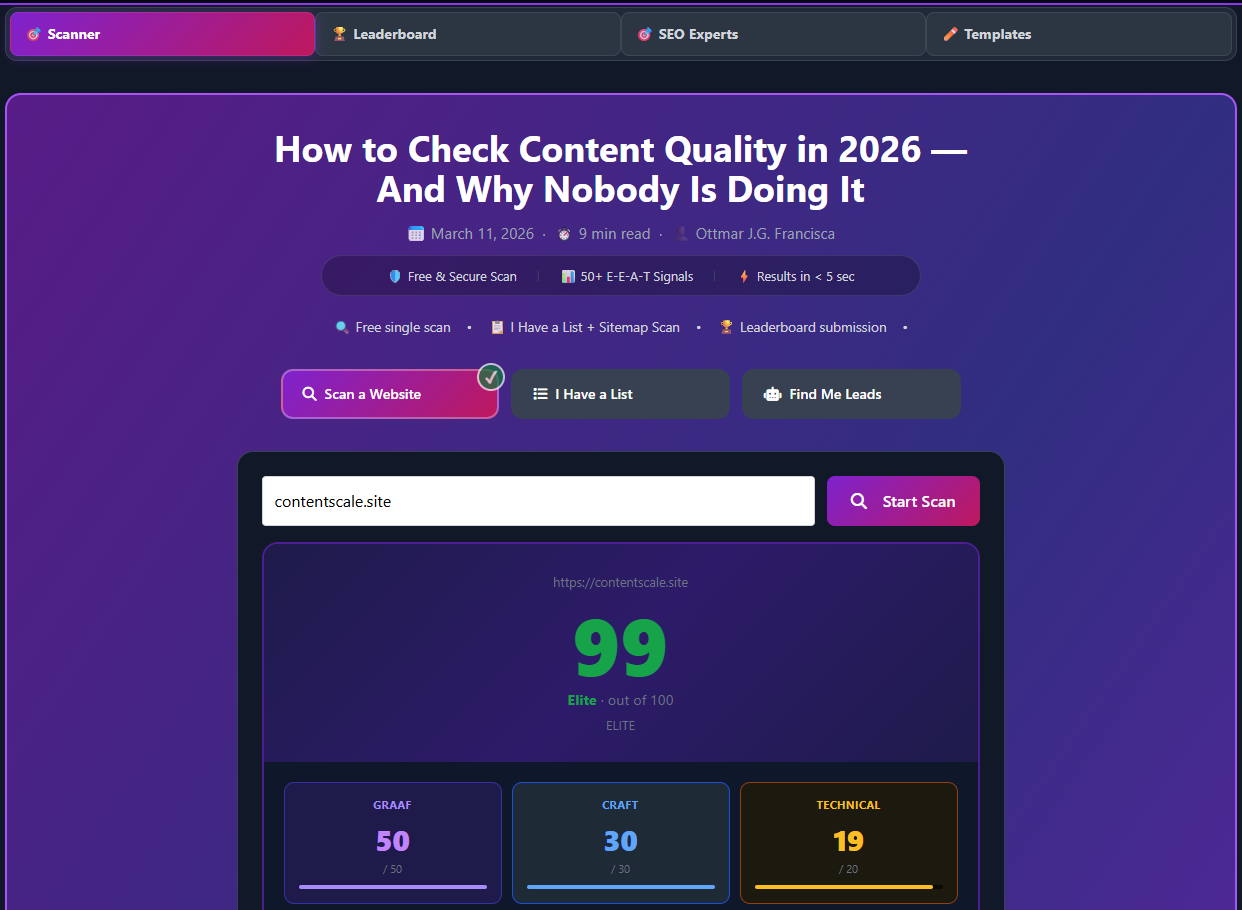
The same scoring system, any URL, 30 seconds. No account, no credit card. You get a score plus a prioritised fix list showing exactly what to improve and in what order. Run a free scan →
What Is the ContentScale Engine? The 5-Step System
The ContentScale Engine is the automated system that powers ContentScale’s 5-step process. It integrates GSC audits, the PULSE & NEXUS frameworks, and the ContentScore scan to write or rewrite content to a score of 90+, ensuring it meets quality standards for indexing and refinement. ContentScale is not just a scanner — the done-for-you service applies this systematic process, starting from your real Google Search Console data.
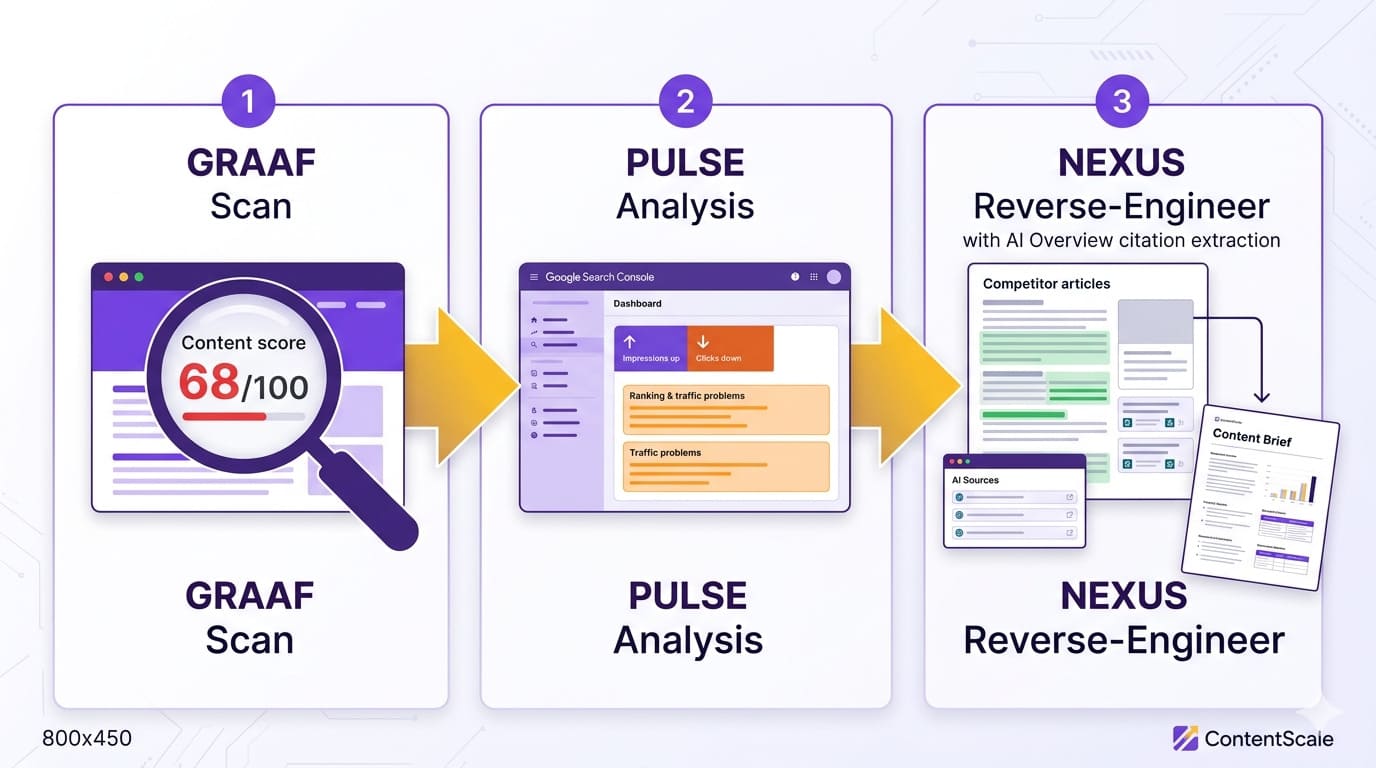
🔑 The 5 Steps
- 1. GSC Audit: a full Search Console pull — which pages rank but don’t convert, which sit at position 8-20 with 500+ impressions, which are invisible despite being live.
- 2. PULSE + NEXUS diagnosis: PULSE diagnoses content-quality gaps (Purpose, Urgency, Legitimacy, Structure, Engagement); NEXUS diagnoses authority and linking gaps.
- 3. ContentScore scan: GRAAF (50) + CRAFT (30) + Technical SEO (20), producing a specific, ordered fix list.
- 4. Write / rewrite: pages built or rebuilt to the fix list. No page published below 85; target is 90+.
- 5. Index & refine: submitted via GSC URL Inspection, monitored at Day 30/60/90 on impressions, clicks, position, and CTR.
0 to 31 Qualified Leads Per Month in 84 Days
Situation: 40+ blog articles, zero top-10 rankings, 9 organic leads per month. GSC showed 1,200+ monthly impressions at an average position of 24. ContentScore average across the blog: 31/100.
Action: The 5-step ContentScale system — GSC audit to identify the highest-impression, lowest-position pages, PULSE + NEXUS diagnosis, then rewriting the priority pages to 90+ ContentScore.
Result: 31 qualified leads per month within 84 days, from a starting point of 9 — achieved by fixing existing content rather than publishing more.
Source: ContentScale client data, 2026
Results: The Numbers

Pages reaching 90+ ContentScore average 3.7× traffic improvement within 90 days, across 200+ ContentScale implementations in tracked client data.
Users see an average 35% improvement in ContentScore within the first month of using the GRAAF Framework, in tracked implementations.
Google AI Overviews now appear on 15%+ of queries, cutting position-1 CTR by 58% — the shift that made AI-era scoring necessary. (Ahrefs, December 2025)
Used by 200+ businesses across 47 countries, with a documented 78% traffic-recovery rate within 90 days in tracked implementations.
Pricing & How to Start
Two ways to begin. The free ContentScore scanner needs no account: enter any URL, get a score and a prioritised fix list in 30 seconds. The done-for-you service, where Ottmar implements every fix and writes citation-ready content for you, starts from €250/month. See full details on the services & pricing page.
Get ranked on page #1 and cited in AI systems
Start with a free scan, or have Ottmar handle it for you.
→ Try ContentScale FreeOr connect with Ottmar: WhatsApp +31628073996 · Amsterdam, NL
ContentScale — Questions People Ask
ContentScale is a free AI-powered SEO content scoring and recovery platform built in Amsterdam by Ottmar J.G. Francisca. It improves and produces content at volume while maintaining the quality signals Google rewards, using a 5-step framework: GSC audit, PULSE & NEXUS frameworks, ContentScore scan, writing/rewriting to 90+, then indexing and refinement. It is not the same company as Content at Scale.
ContentScale focuses on a proprietary 5-step system: GSC audits, PULSE & NEXUS frameworks, and a ContentScore scan targeting 90+. Where Semrush, Frase, NeuronWriter, Jasper AI, and Surfer SEO emphasise keyword research or content generation, ContentScale emphasises measurable quality and traffic recovery — a distinct, quality-first alternative.
The ContentScale Engine is the automated system powering the 5-step process. It integrates GSC audits, the PULSE & NEXUS frameworks, and the ContentScore scan to write or rewrite content to a score of 90+, ensuring it meets quality standards for indexing and refinement.
No. Content at Scale was an AI content generation platform that shut down. ContentScale is a separate content-quality scoring and recovery platform built in Amsterdam. Where Content at Scale generated content, ContentScale scores and engineers it for ranking and AI Overview citation using the GRAAF Framework.
Yes. The ContentScore scanner is free with no account required: enter any URL and get a score plus a prioritised fix list in about 30 seconds. A done-for-you service, where Ottmar implements the fixes for you, is available from €250/month — see the pricing page.
It’s ContentScale’s free flagship tool. It shows which of your pages are cited by AI answer engines — Google AI Overviews, Perplexity, and Microsoft Copilot (Claude and Brave Search coming soon) — and integrates your Google Search Console data to surface the Impression Gap, detect cannibalization, and generate a prioritised Citation Brief per page. Free for 1 pages and 1 domain, no account needed. Try it here.
ContentScale was built by Ottmar J.G. Francisca in Amsterdam. With 24+ years in municipal operations management for the City of Amsterdam, he developed the GRAAF Framework after analysing 200+ traffic drops from 2023-2026. The platform is used by 200+ businesses across 47 countries.

ContentScale — Built & Reviewed by Ottmar J.G. Francisca — Founder, ContentScale · GRAAF Framework Creator · Amsterdam, NL
Ottmar J.G. Francisca is an independent SEO specialist and content strategist. With 24+ years in municipal operations management for the City of Amsterdam, he brings a systems-first, measurement-driven approach to content intelligence. He developed the GRAAF Framework after analysing 200+ traffic drops from 2023-2026, combining it with Julia McCoy’s CRAFT Framework and the PULSE + NEXUS research system.
Notable results: ContentScale is used by 200+ businesses across 47 countries, with a documented 78% traffic-recovery rate within 90 days in tracked implementations.
Platform: Founder of ContentScale — free scanner at app.contentscale.site.
Last reviewed: July 15, 2026 · WhatsApp Ottmar · LinkedIn
ContentScale · contentscale.site · Content optimised with the GRAAF Framework by ContentScale