Traffic Drop Recovery: How to Diagnose and Fix It in 2026
- AI Overviews are now the leading cause: they cut the top result’s CTR by 58%. (Ahrefs, 2025)
- Five causes, five fixes: AI Overview, algorithm update, technical, penalty, competitor — guessing wastes weeks.
- Check your redirects: after a migration, missing 1:1 301 redirects are one of the fastest ways to lose traffic.
- Rebuild quality with GRAAF: score every page on Genuinely Credible, Relevant, Actionable, Accurate, Fresh.
- Recovery is predictable: most sites recover the majority of lost traffic within 90 days using GRAAF + CRAFT, in tracked implementations.
📑 Table of Contents
Traffic drop recovery is the most stressful problem in digital business right now: your rankings look fine in Search Console, yet visitors keep falling. This guide walks you through diagnosing the real cause and fixing it — sourced from Ahrefs (2025) and Seer Interactive (2025).
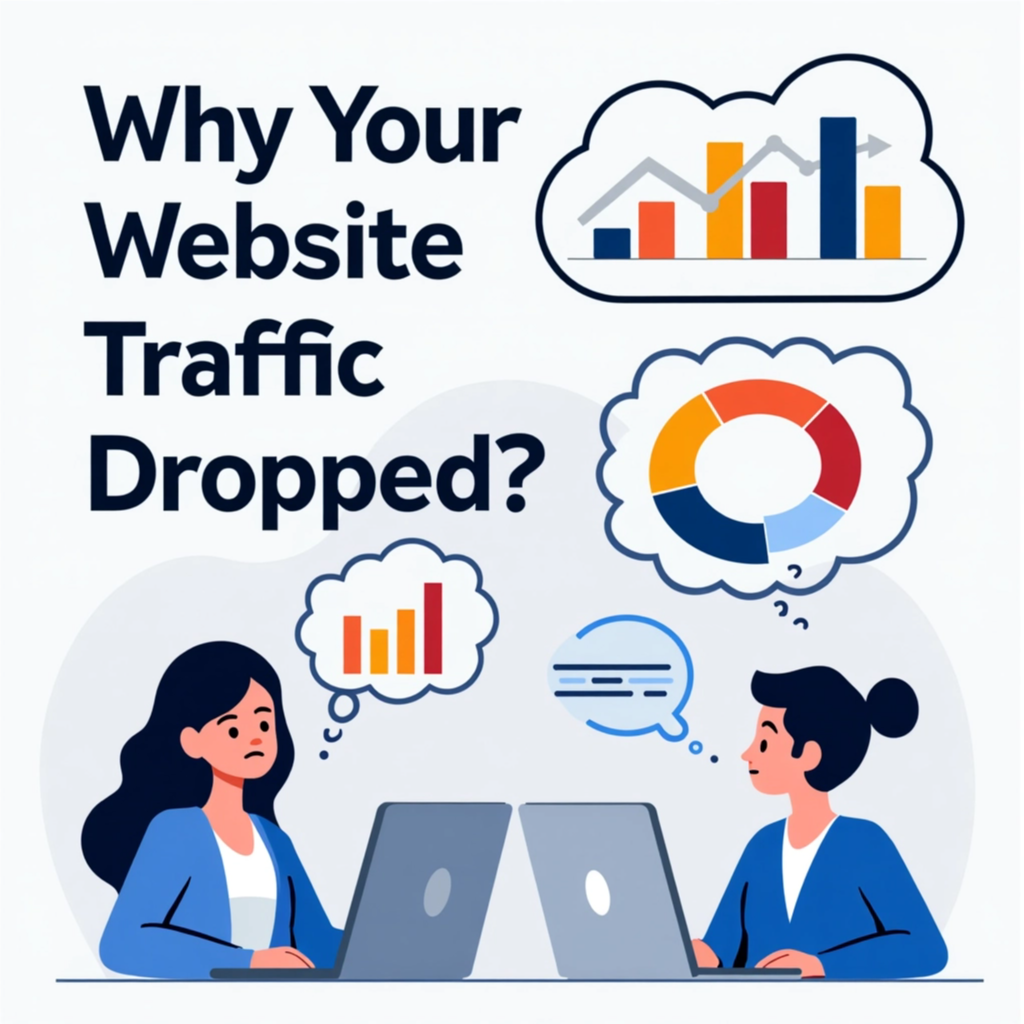
Why Your Traffic Dropped (and Why Rankings Lie)
A traffic drop in 2026 rarely means you lost your rankings. More often, the click simply disappeared. When Google shows an AI Overview, it answers the question on the results page, so the user never needs to click through — even though your page still ranks.
The scale is hard to overstate. Seer Interactive (September 2025) found organic click-through rate fell 61% on queries that trigger an AI Overview, and Pew Research (2025) measured users clicking a result just 8% of the time when an AI summary is present versus 15% without one. Recovery starts with one honest question: did you lose the ranking, or did you lose the click? Those are two different problems with two different fixes.
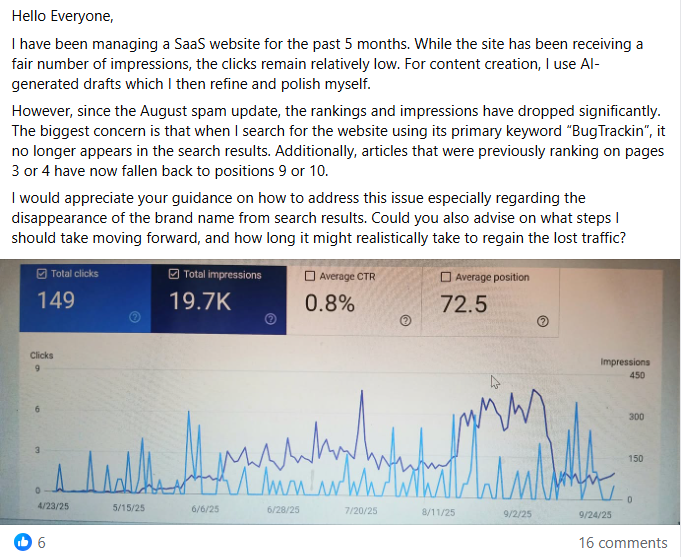
Key point: Stable rankings with falling clicks almost always means AI Overview cannibalisation — not a quality penalty. The page that earns the citation inside the AI answer keeps its clicks; the page left out of it doesn’t.
The 5 Causes of a Traffic Drop
Every traffic drop traces back to one of five causes, and each demands a different response. Applying the wrong fix wastes weeks while competitors gain ground. The five are: AI Overview cannibalisation, algorithm updates, technical failures, manual penalties, and competitor gains.
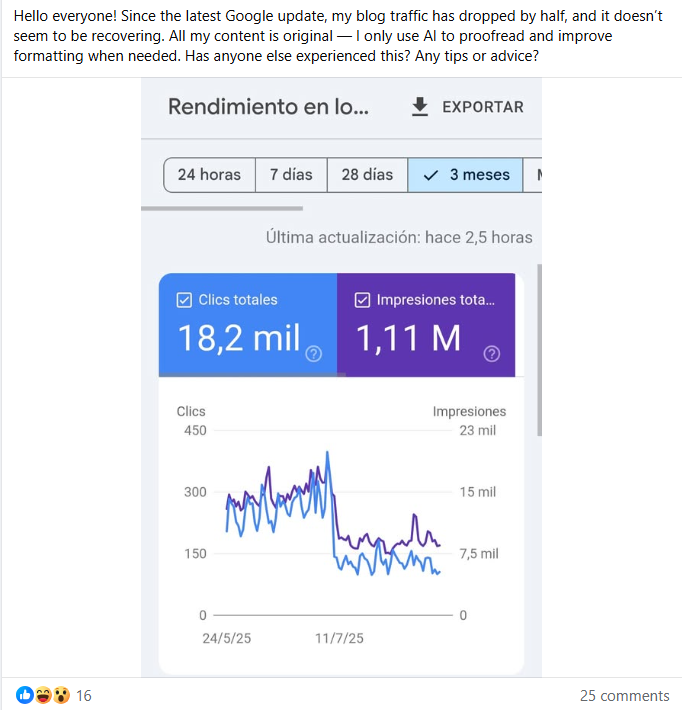
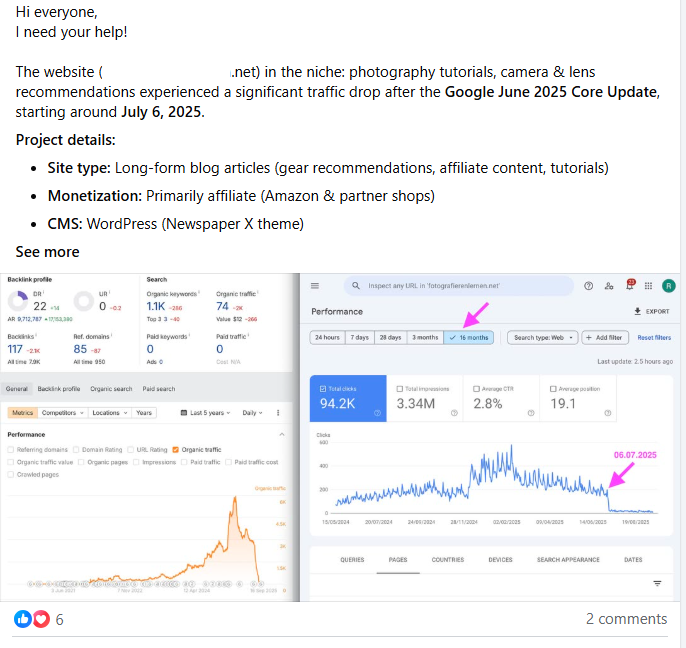
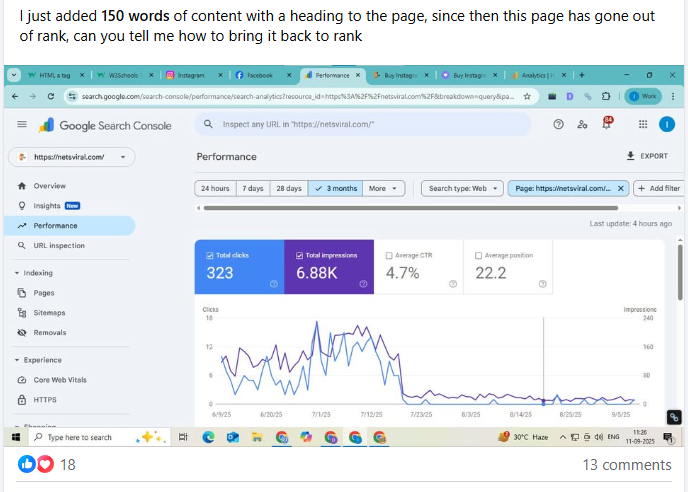
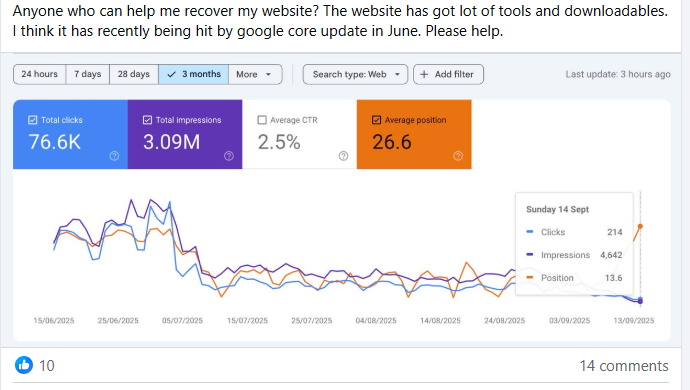
Algorithm updates differ from AI Overview impact in a key way: with updates, both impressions and clicks fall as Google re-evaluates quality, often against E-E-A-T expectations. Technical failures (broken redirects, accidental noindex tags, Core Web Vitals regressions) cause sudden, sharp drops rather than the gradual slide of an update.
⚠️ Common Mistake
Treating every drop as an algorithm penalty. If your impressions held steady and only clicks fell, it’s almost certainly AI Overviews — not a content penalty. Rewriting good pages in a panic often removes the very structure that earned the ranking.
Key point: Match the cause to the symptom first. The shape of the decline — sudden vs gradual, clicks-only vs clicks-and-impressions — usually tells you which of the five you’re facing.
How Can I Diagnose a Sudden Website Traffic Drop?
A sudden traffic drop requires immediate diagnosis. Check for recent algorithm updates, technical SEO issues like crawl errors or indexing problems, website changes, or security breaches. Use this table to match your symptoms to the likely cause and expected recovery time — the fastest diagnosis comes from Search Console.
| Cause | Tell-tale signal | What to do | Recovery time |
|---|---|---|---|
| AI Overview | Rankings & impressions stable, CTR down 40-60% | Add quotable answers + schema | 2-4 weeks |
| Algorithm update | Gradual decline, many pages, matches update dates | GRAAF + CRAFT content rebuild | 90-120 days |
| Technical / redirects | Sudden drop after migration, coverage errors, slow LCP | Fix 1:1 301 redirects, tags, Core Web Vitals | 2-8 weeks |
| Manual penalty | Search Console manual action notice | Fix violation + reconsideration | 21-60 days |
| Competitor | Slow slide, no update or technical issue | Out-improve the cited page | 4-12 weeks |
If two causes overlap, fix the technical and penalty issues first — they block everything else — then address content for AI Overviews and algorithm resilience.
Redirects: The First Technical Fix
A critical first step in traffic drop recovery — especially after a domain migration or restructure — is a meticulous review of your redirects. Three redirect mistakes sink recoveries again and again: redirect chains (A → B → C) bleed authority at every hop, so collapse them to a single A → C; mass redirects to the homepage instead of content-to-content matches; and broken internal links still pointing at old URLs.
🔑 Redirect Checklist
- Every removed or moved URL has an exact 1:1 301 to its closest live equivalent.
- No redirect chains — map old URLs straight to the final destination.
- No mass redirects to the homepage; match content to content.
- Internal links updated to point at the new URLs, not the redirects.
- Old URLs removed from the sitemap; new URLs added.
Once redirects are clean, re-submit the affected URLs in Search Console and request indexing. Technical recovery from a redirect fix is usually visible within 2-8 weeks.
The GRAAF Framework & Your 5-Step Recovery Plan
Once technical blockers are cleared, traffic drop recovery becomes a content-quality problem. GRAAF is a 100-point method that scores the five signals Google and AI assistants consistently reward:
- G — Genuinely Credible: real expertise, named authors, verifiable credentials and citations.
- R — Relevant: exact search-intent match and topical completeness.
- A — Actionable: step-by-step guidance so readers know what to do next.
- A — Accurate: every statistic sourced by name and year — no invented numbers.
- F — Fresh: current data, recent references, and an honest update date.
Combined with CRAFT (Cut the fluff, Review, Add media, Fact-check, Trust-build) and a technical layer, GRAAF produces a 100-point ContentScore. Pages reaching 90+ average a 3.7× traffic lift within roughly 90 days in tracked implementations. Here’s the recovery plan, in order:
🔑 Your 5-Step Recovery Plan
- 1. Diagnose: open Search Console, check manual actions, review coverage errors, test Core Web Vitals, and search your keywords for an AI Overview.
- 2. Fix blockers first: resolve any penalty, broken redirect, or noindex tag before touching content.
- 3. Apply CRAFT + GRAAF to your top 10 pages: start with the highest-traffic pages that lost the most.
- 4. Earn the citation: add a 40-60 word quotable answer near the top, question-style H2s, FAQ + Article schema, and visible authorship.
- 5. Monitor weekly: track traffic, AI Overview citations, CTR, and position. Expect movement in 2-4 weeks for AI Overview fixes; allow 90 days for algorithm recovery.
Three mistakes that stall recovery: rewriting the wrong pages (panic-editing healthy pages that only lost clicks); changing everything at once (so you can’t tell what worked); and quitting at day 30 (algorithm recovery runs on Google’s re-crawl cycle, not your calendar — pages flat at week four often move at week eight).
Traffic Drop Recovery Statistics — 2024–2026
58% lower CTR — the top organic result loses 58% of its clicks when an AI Overview appears, up from a 34.5% drop in April 2025. (Ahrefs, 2025)
61% organic CTR decline — on AI Overview queries between mid-2024 and September 2025; brands cited inside the answer earned about 35% more clicks. (Seer Interactive, 2025)
8% vs 15% click rate — users click an organic result 8% of the time with an AI summary present, versus 15% without one. (Pew Research, 2025)
~48% of results — share of Google searches now showing an AI Overview. (BrightEdge, 2026)
56% → 69% zero-click — share of searches ending without a click rose between May 2024 and May 2025. (Similarweb, 2025)
3.7× average traffic lift — for pages reaching ContentScore 90+, recovered within roughly 90 days in tracked implementations. (ContentScale client data, 2026)
Want to Know Why Your Pages Aren’t Recovering? Scan One Free.
Paste any URL and get a 100-point GRAAF ContentScore with the exact traffic drop recovery fixes that rebuild rankings and make a page citation-eligible — no login, no card.
→ Try ContentScale FreeOr connect with Ottmar: WhatsApp +31628073996 · Amsterdam, NL
Dutch B2B SaaS — From Page 2 to Cited
Challenge: A landing page lost roughly half its traffic, sat around position 12, and earned zero AI citations with a GRAAF ContentScore of 61.
Solution: Cleaned up redirects from a recent migration, rebuilt the page with CRAFT micro-answers and a quotable definition, added FAQ schema, and strengthened authorship.
Result: ContentScore rose to 92; the page moved into the top 5 for its core term and began appearing as a cited source in Google AI Overview within two scan cycles.
Source: ContentScale client data, 2026 (representative; figures vary by site)
NJ Home-Services Site — Invisible to AI, Then Cited
Challenge: A contractor site held mid-page rankings but earned zero AI citations and a GRAAF ContentScore of 61. Clicks were sliding even though impressions held — a textbook AI Overview pattern.
Solution: Added a quotable 45-word definition, restructured answers under question-style H2s, implemented FAQ and Article schema, and made authorship explicit. No redirects were touched.
Result: ContentScore rose to 92; the main service page began appearing as a cited source in Google AI Overview and Perplexity within two scan cycles, and CTR recovered.
Source: ContentScale client data, 2026 (representative; figures vary by site)
Traffic Drop Recovery — 8 Questions People Ask
If your traffic dropped suddenly, diagnose the root cause first. It could stem from an AI Overview capturing clicks, a Google algorithm update, technical errors, a penalty, or migration issues. Each has a different fix, so a systematic approach like the GRAAF Framework helps pinpoint the exact reason and guide an effective recovery.
Traffic drop recovery is the process of diagnosing why a website lost organic search traffic and reversing it. It means finding the real cause — an AI Overview, an algorithm update, a technical fault, a penalty, or migration errors — fixing it, and rebuilding the quality signals Google and AI assistants reward until rankings and clicks return.
It depends on the cause. AI Overview optimisation shows movement in 2-4 weeks, technical and redirect fixes in 2-8 weeks, algorithm-update recovery in 90-120 days, and manual-penalty recovery in 21-60 days after a successful reconsideration request.
Sudden drops trace to five causes: AI Overview cannibalisation (clicks fall while rankings hold), a Google algorithm update, a technical failure such as broken redirects or Core Web Vitals regressions, a manual penalty, or a competitor out-improving your cited page. Each needs a different fix, so guessing wastes weeks.
If your drop followed a migration, redesign, or URL change, yes. Missing or chained redirects are one of the fastest ways to lose link equity. Implement exact 1:1 301 redirects from every old URL to its closest live equivalent, collapse redirect chains, and avoid mass redirects to the homepage.
GRAAF is a 100-point content-quality method created by Ottmar J.G. Francisca. It scores five signals Google and AI assistants reward: Genuinely Credible, Relevant, Actionable, Accurate, and Fresh. Combined with CRAFT and a technical layer it produces a ContentScore; pages reaching 90+ average a 3.7× traffic lift within about 90 days in tracked implementations.
Yes. This guide gives you the full GRAAF + CRAFT recovery method. Realistically it takes around 200 hours over four months covering diagnosis, content work, technical fixes and monitoring — or you can scan a page free to see the priority fixes first, then decide what to do yourself.
Look for three signs together: stable or improved rankings, steady impressions, but a 40-60% drop in click-through rate. Then search your target keywords — if an AI Overview appears above the organic results, it’s almost certainly capturing the clicks your ranking used to earn.

Traffic Drop Recovery — Reviewed by Ottmar J.G. Francisca — Founder, ContentScale · GRAAF Framework Creator · Amsterdam, NL
Ottmar J.G. Francisca is the founder of ContentScale and creator of the GRAAF Framework — the 100-point content-quality system that powers the platform. With 24+ years in municipal operations management for the City of Amsterdam, he brings a systems-first, measurement-driven approach to content intelligence.
Areas of expertise: SEO traffic recovery, AI Overview optimisation, technical SEO & redirects, E-E-A-T implementation, and Google Search Console diagnosis.
Notable results: the GRAAF Framework and free ContentScore platform have helped 200+ businesses across 47 countries achieve a documented 78% traffic-recovery rate within 90 days in tracked implementations.
Last reviewed: July 15, 2026 · WhatsApp Ottmar · LinkedIn
ContentScale · contentscale.site · Content optimised with the GRAAF Framework