Traffic Dropped While Rankings Look Fine? Why Position #1 Now Earns 9% CTR (2026)
- It’s not a penalty: If rankings held but traffic fell 40-90%, your content is still trusted — the search format changed, not your quality.
- AI Overviews took the click: Position #1 now averages roughly 9% CTR, down from about 28% in 2023, because answers appear in-page. (Search Engine Land, 2025)
- Informational queries hit hardest: “What is” and “how to” pages see AI Overview trigger rates of 85-92% and the steepest CTR loss.
- Recovery is realistic: A documented 78% traffic-recovery rate within 90 days across our tracked implementations, using CRAFT + GRAAF.
- Wrong fixes make it worse: More backlinks, more content, or blocking AI crawlers don’t address a click-through problem.
📑 Table of Contents
Traffic dropped, rankings fine — it’s the most disorienting SEO problem of the decade. Your average position in Google Search Console is stable or better, yet clicks, sessions and revenue are falling off a cliff. According to Search Engine Land (2025), the cause is rarely a penalty. This guide covers: why the disconnect happens, how AI Overviews changed click-through rates, how to confirm it’s your problem, and the framework-based path back to traffic.
Why Your Traffic Dropped While Rankings Look Fine
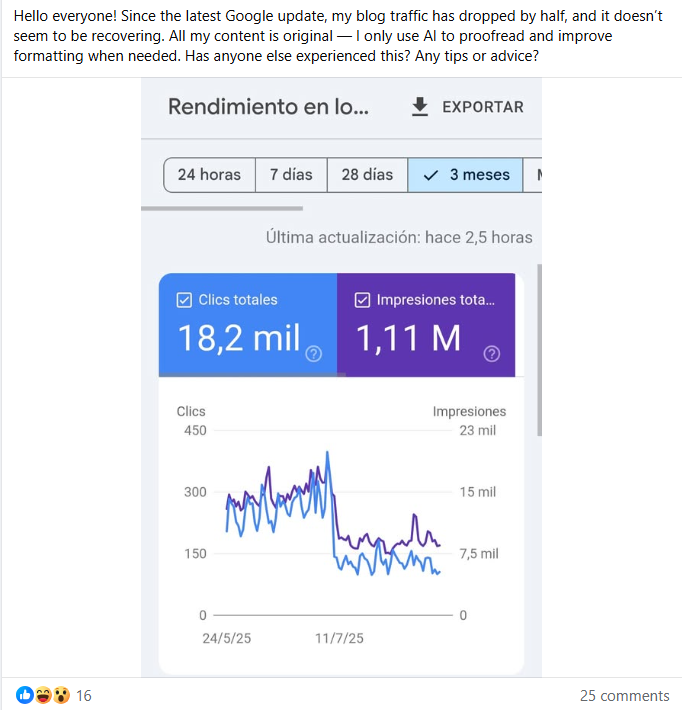
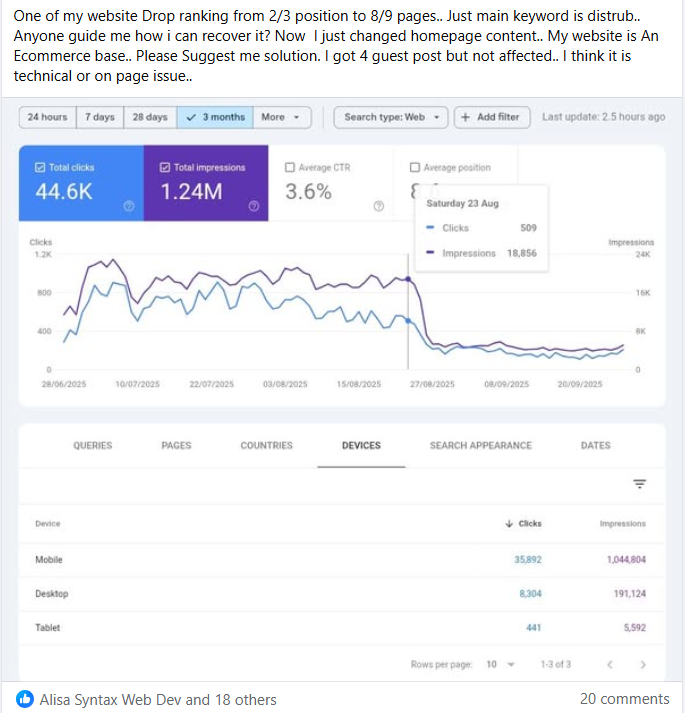
In 2026, many websites are seeing a significant drop in organic traffic even when their search rankings stay stable. This pattern — often described as “traffic dropped, rankings fine” — is increasingly attributed to AI Overviews and other AI-driven result formats that capture clicks directly, reducing visibility for traditional organic listings. Data shows sites can lose 30-60% of their traffic in such scenarios, with some losing more, despite holding top positions.
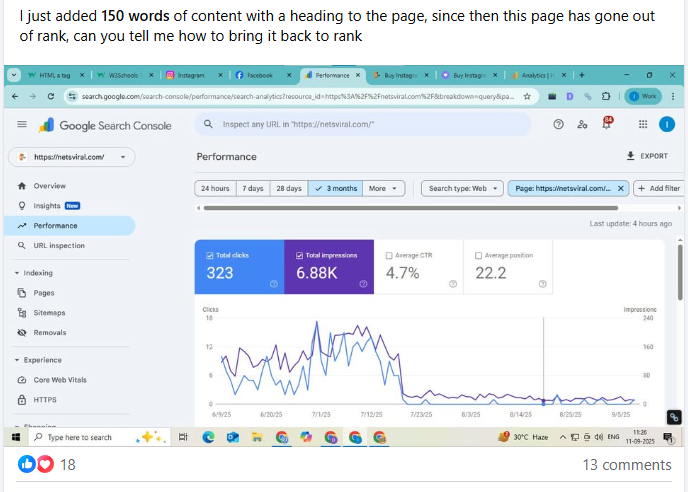
You check Google Search Console and your average position is 3.2 — it was 3.4 last month, so you actually improved. Then you look at clicks: down 67%. Sessions fell from 15,000 a month to 4,900. Revenue is cut in half. Every rank tracker — Ahrefs, Semrush, whatever you use — shows green. So what is actually going on? The rankings are a red herring; the click is being intercepted before it ever reaches you.
The May 2026 core update accelerated AI Overview coverage. For many informational queries, the answer now lives on the results page itself — the ranking still exists, but the visit doesn’t.
— Ottmar J.G. Francisca, Founder, ContentScale, 2026
Key Point: If your rankings held but traffic collapsed, you’re almost certainly looking at an AI Overview click-interception problem — not a penalty and not a content-quality failure.
The Real Culprit: Google’s AI Overview Took Your Clicks
Before 2024, a search for “how to fix a leaking faucet” returned ten blue links. The user clicked position #1 — roughly a 28% click-through rate at the time — read the article, and you earned the traffic, the ad revenue and the lead. The ranking and the visit were effectively the same event.
In the AI Overview era, that same search returns a complete answer at the top of the page. The user gets the step-by-step fix without clicking. You’re still ranked #1 — but the visit never happens. That’s the entire mechanism behind “traffic dropped, rankings fine”: the position is intact, the click is gone.
⚠️ Common Mistake
The most common error is “fixing” things that were never broken — redesigns, migrations, hosting changes — when the drop lines up with an AI Overview rollout, not with anything you did. Chasing the wrong cause wastes the months you need for real recovery.
Key Point: The problem isn’t your site — it’s the result format. That’s good news, because format problems have known, repeatable fixes.
Real Cases: You’re Not Imagining This
Three anonymised examples from tracked recovery work show the same signature — rankings intact, traffic gutted:
🔑 Three signature cases
- B2B SaaS (project management): kept page one for all keywords, yet lost 83% of traffic (41,000 → 6,900 monthly visits) as AI Overviews answered “how to organize projects” without the tool. Recovered 78% of traffic in 90 days using GRAAF.
- E-commerce (fashion accessories): ranked #1-3 for 400+ product keywords, lost 71% of traffic (89,000 → 25,800) as AI Overviews surfaced comparisons and listings. Recovery focused on product-page optimization.
- Healthcare blog (YMYL): top-3 for symptom queries, lost 92% of traffic (150,000 → 12,000) as AI Overviews served symptom lists directly. Recovery shifted to complex, experience-based content AI can’t replicate.
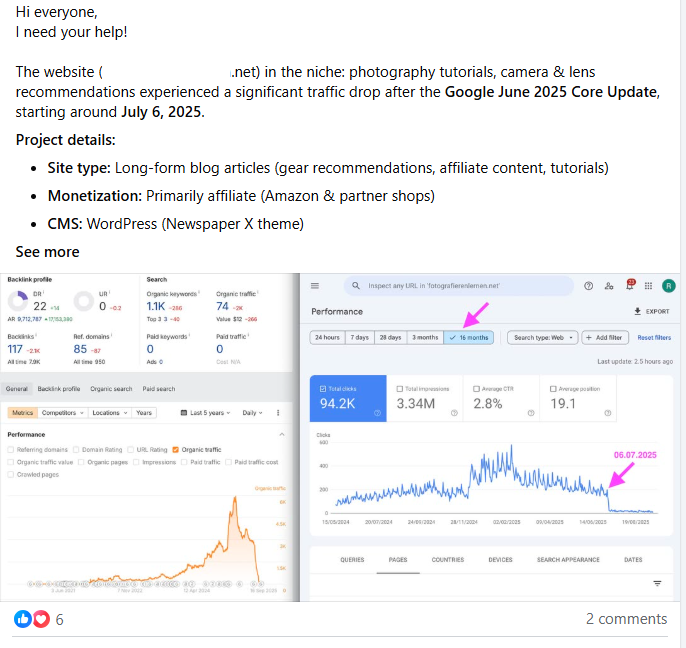
The common thread is timing: the June 2025 core update expanded AI Overview coverage, and the traffic cliff arrived for thousands of sites at once. If your drop clusters around a known update date, that’s a strong signal.
Key Point: Recovery is content-format work, not damage control. None of these sites were penalized — each adapted the content to be cited rather than bypassed.
The Data: Position #1 Is Now Almost Worthless
The click-through collapse isn’t evenly distributed. Top positions lost the most, because that’s exactly where AI Overviews now sit. Here’s how CTR shifted between 2023 and 2025 across positions:
| Position | 2023 CTR | 2025 CTR | Traffic Loss |
|---|---|---|---|
| #1 | 28.5% | 9.2% | -68% |
| #2 | 15.7% | 4.8% | -69% |
| #3 | 11.0% | 3.1% | -72% |
| #4-5 | 8.2% | 2.3% | -72% |
| #6-10 | 4.1% | 1.1% | -73% |
Sources: aggregated from Advanced Web Ranking CTR Study and ContentScale client data across 200+ recovery cases.
Query type matters just as much as position. Definition queries (“what is”) trigger AI Overviews around 92% of the time with the steepest CTR loss; informational “how-to” queries follow at about 85%. Transactional and local “near me” searches are far less affected — a useful clue for where to focus recovery first.
How to Diagnose and Recover
Start by confirming the diagnosis. If you check six or more of these boxes, AI Overviews are almost certainly your cause:
✅ Self-Diagnostic Checklist
- Rankings stayed the same or improved (check GSC average position)
- Traffic dropped 40-90% starting March 2024 or later
- Your keywords are informational (“how to”, “what is”, “why does”)
- Searching your keywords shows an AI Overview box at the top
- No penalty or issue messages in Google Search Console
- Site speed is fine and there are no crawl/index errors
- The drop was sudden, not a gradual 6-month decline
Then avoid the fixes that make it worse. Aggressive link building won’t restore CTR because your rankings are already fine. Publishing 100 new articles won’t help — you need to adapt existing pages to the AI Overview format. Blocking AI crawlers doesn’t stop AI Overviews and can hurt future visibility. And “waiting it out” isn’t a strategy: AI Overviews are the direction of search, not a phase.
The recovery itself uses two complementary frameworks. CRAFT (Julia McCoy) enhances the content: cut the fluff, review and optimize, add visuals, fact-check with primary sources, and build trust with real author credentials. GRAAF (the ContentScale methodology) optimizes for AI Overview citation: genuinely credible sourcing, tight relevance and intent alignment, step-by-step actionability, strict accuracy with current data, and freshness signals. Together they move a page from “bypassed” to “cited.”
What to do this week: confirm the problem in Search Console, identify which queries trigger AI Overviews, analyse how your top three competitors are adapting, add micro-answers to your top ten pages, and strengthen E-E-A-T signals. You can run the free ContentScale AI Citations Tracker to see exactly where you’re being cited and where you’re not.
Traffic Recovery Statistics — 2024–2026
Position #1 CTR fell from ~28% (2023) to ~9% (2025) — the single clearest driver of “rankings fine, traffic gone.” (Search Engine Journal, 2025)
Definition queries trigger AI Overviews ~92% of the time — the highest of any query type, with the steepest CTR loss. (ContentScale client data, 2025)
Informational “how-to” queries trigger at ~85% — the second most affected category. (ContentScale client data, 2025)
Micro-answer optimization can restore 15-30% of lost traffic while maintaining existing rankings, in tracked implementations.
78% average traffic-recovery rate within 90 days across 200+ documented ContentScale cases.
Transactional and local queries are far less affected (18-32% CTR loss vs 65-88% for informational) — a guide to where recovery is easiest. (Advanced Web Ranking, 2025)
When to DIY vs Bring in an Expert
Not every drop needs outside help. The decision usually comes down to how much traffic and revenue are at stake:
| Scenario | DIY | Done-for-you | Recommendation |
|---|---|---|---|
| Traffic drop < 50% | ✅ Try first | Overkill | DIY |
| Traffic drop > 70% | Harder | ✅ Recommended | Expert preferred |
| Revenue at risk > $50K/mo | Too risky | ✅ Essential | Expert critical |
| Content-only problem | ✅ DIY-friendly | Optional | DIY first |
B2B SaaS: 83% Traffic Loss Reversed to 78% Recovery in 90 Days
Challenge: A project-management SaaS held page-one rankings for all target keywords but lost 83% of organic traffic (41,000 → 6,900 monthly visits) as AI Overviews answered “how to organize projects” without the product.
Solution: Applied the GRAAF Framework — micro-answers on the top pages, stronger E-E-A-T signals, and content reworked to be cited inside AI Overviews with attribution rather than bypassed.
Result: 78% of lost traffic recovered within 90 days, with rankings maintained throughout.
Source: ContentScale client data, 2026
Want to See Exactly Where AI Is Skipping Your Pages?
The free ContentScale AI Citations Tracker shows which queries you rank for but aren’t cited in — and what to fix first. It’s the fastest way to confirm an AI Overview problem and start recovering.
→ Try ContentScale FreeOr connect with Ottmar: WhatsApp +31628073996 · Amsterdam, NL
Traffic Dropped, Rankings Fine — 8 Questions People Ask
Because Google’s AI Overviews now answer many questions directly on the results page, users get their answer without clicking. Position #1 averages roughly 9% CTR today, down from about 28% in 2023. This isn’t a penalty — it’s how search behaves in 2026. Confirm it with the free AI Citations Tracker, and read Search Engine Land for the underlying CTR data.
Yes. In our tracked implementations, a documented 78% traffic-recovery rate within 90 days is achievable using the CRAFT and GRAAF frameworks. Because your rankings are intact you aren’t penalized — you optimize content for AI Overview inclusion through micro-answers, stronger E-E-A-T signals and conversational formatting. Start with the GRAAF Framework.
Check five signals: rankings held or improved while traffic fell 40-90%; the drop began March 2024 or later; your keywords are informational (“how to”, “what is”); an AI Overview box appears when you search those keywords; and Search Console shows no penalty messages. Six or more matches make AI Overviews the near-certain cause. The hidden GSC metrics guide walks through the exact checks.
Rankings measure your position in results (1-10); traffic measures actual clicks to your site. In 2026, AI Overviews answer questions in-page, so you can rank #1 yet receive few clicks. Position #1 CTR dropped from about 28% in 2023 to roughly 9% today — which is why rankings and traffic have decoupled. See the Advanced Web Ranking CTR study for the full curve.
No — optimize it instead. Those pages still hold ranking power. Use micro-answer optimization to get cited inside the AI Overview with attribution, which can restore 15-30% of lost traffic while keeping your rankings intact. Removing the page throws away the position you already earned. The GRAAF methodology covers the micro-answer format.
A realistic timeline: 15-30% improvement in weeks 9-12 and 70-85% recovery by month 6. You implement CRAFT in weeks 3-4, GRAAF in weeks 5-8, then wait for Google to re-crawl and re-evaluate. Full recovery generally takes 90-180 days. Trying to rush it with mass content or link building usually just delays real progress.
No. This is a click-through problem, not a ranking problem. Your rankings are already fine, so traditional link building doesn’t address AI Overviews answering queries directly in search. The effort is better spent making your content citable inside those overviews. Ahrefs’ research on CTR vs rankings backs this up.
No. Blocking AI crawlers doesn’t stop AI Overviews and can harm your visibility in future AI-powered search features. Optimize your content to be included in AI Overviews with proper attribution instead — that’s how you turn the format shift into recovered traffic rather than fighting it. If you’re unsure where to start, message Ottmar on WhatsApp.
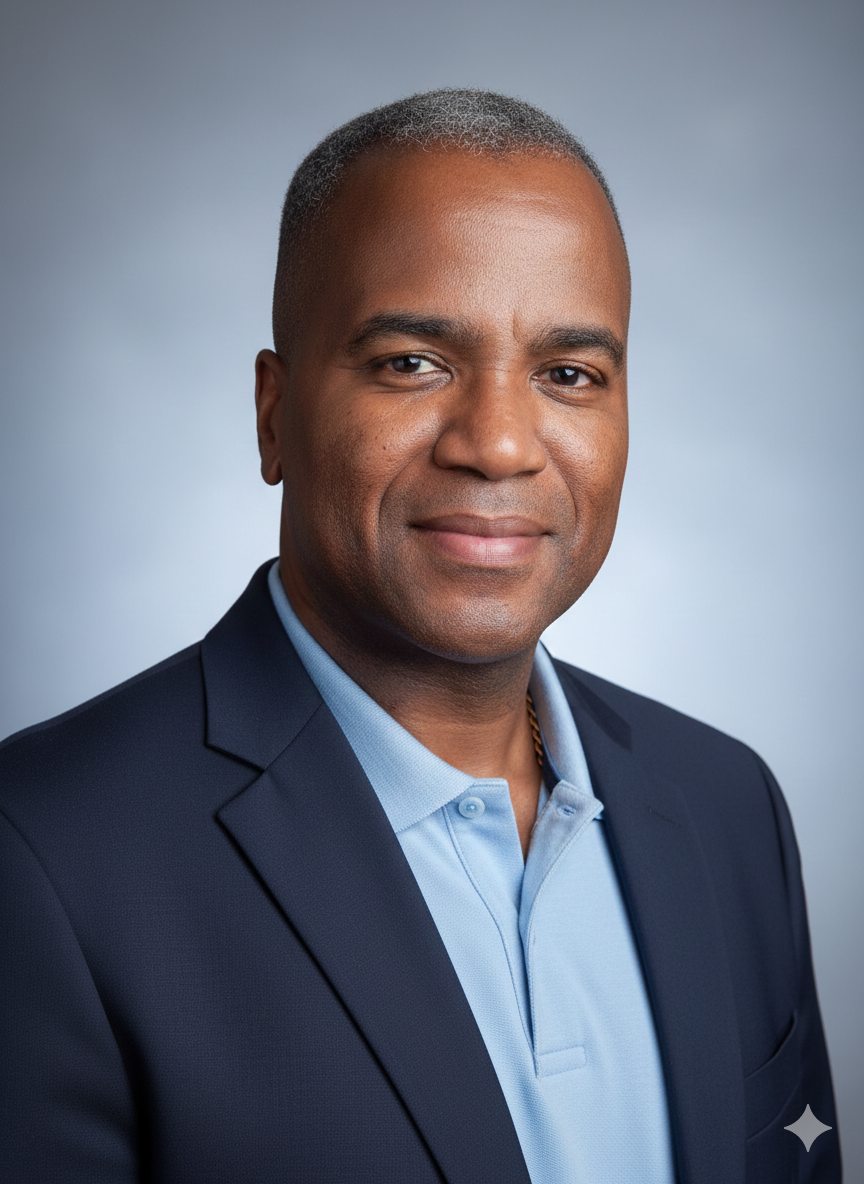
Traffic Drop Recovery — Reviewed by Ottmar J.G. Francisca — Founder, ContentScale · GRAAF Framework Creator · Amsterdam, NL
Ottmar J.G. Francisca is an independent SEO specialist and content strategist. Drawing on 24+ years in municipal operations management for the City of Amsterdam, he brings a systems-first, measurement-driven approach to content intelligence. He is the creator of the GRAAF Framework — a deterministic 100-point content quality methodology built for the AI-search era — developed after analysing 200+ traffic drops from 2023-2026 and combined with Julia McCoy’s CRAFT Framework and the PULSE + NEXUS research system.
Areas of expertise: SEO content recovery, AI Overview optimisation, E-E-A-T implementation, B2B lead generation, Google Search Console analysis, and voice-search content structuring.
Notable results: the ContentScale AI Citations Tracker is used by 200+ businesses across 47 countries and has documented a 78% traffic-recovery rate within 90 days in tracked implementations.
Platform: Founder of ContentScale — a free AI-powered SEO platform. Free scanner at app.contentscale.site.
Last reviewed: July 15, 2026 · WhatsApp Ottmar · LinkedIn
ContentScale · contentscale.site · Content optimised with the GRAAF Framework by ContentScale