DIY vs Agency Recovery: Which Strategy Works Best in 2026?
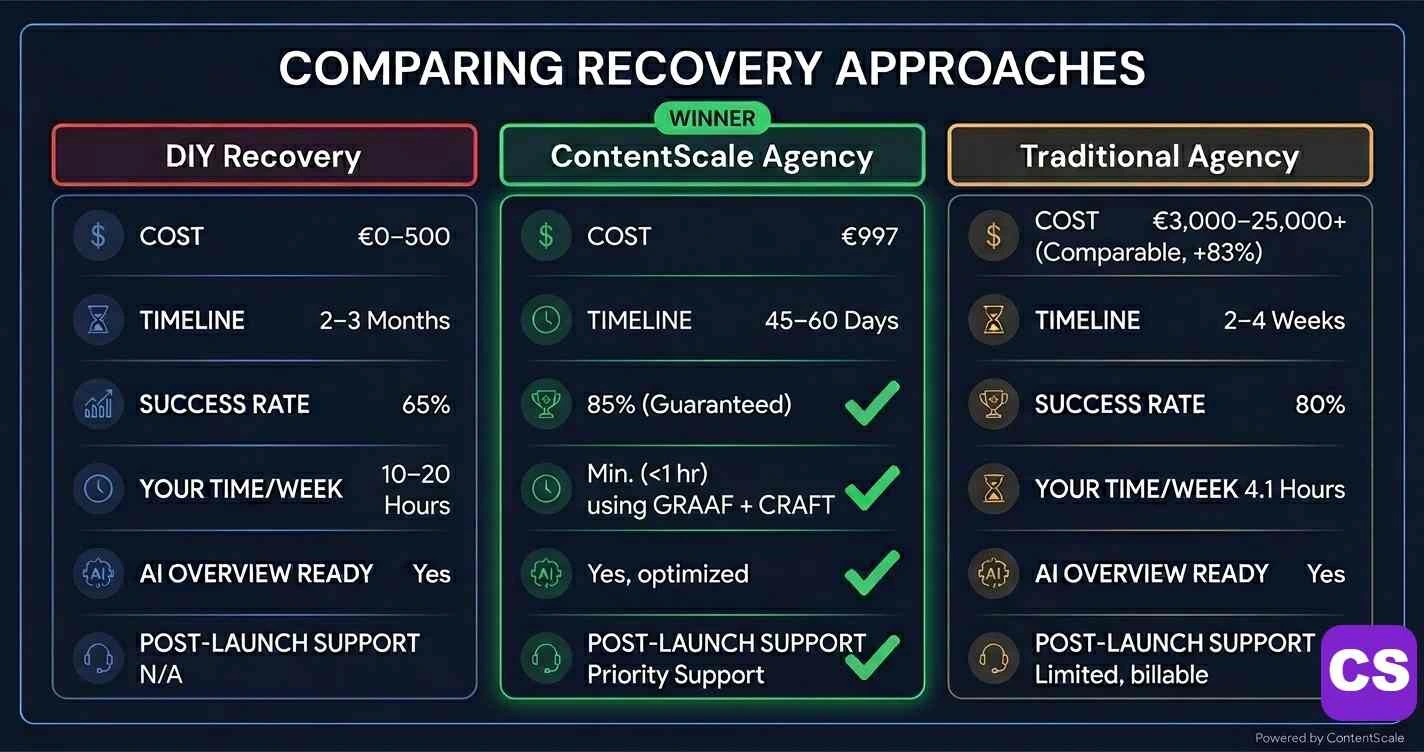
DIY vs Agency Recovery comes down to three variables: time, budget and urgency. DIY costs €0–500 but requires 10–20 hours weekly for 2–3 months and achieves a 65% success rate. ContentScale agency recovery costs €997, takes 45–60 days, and achieves 85% success using proven GRAAF + CRAFT frameworks — 83% less than traditional agencies charging €3,000–25,000+ for comparable work.
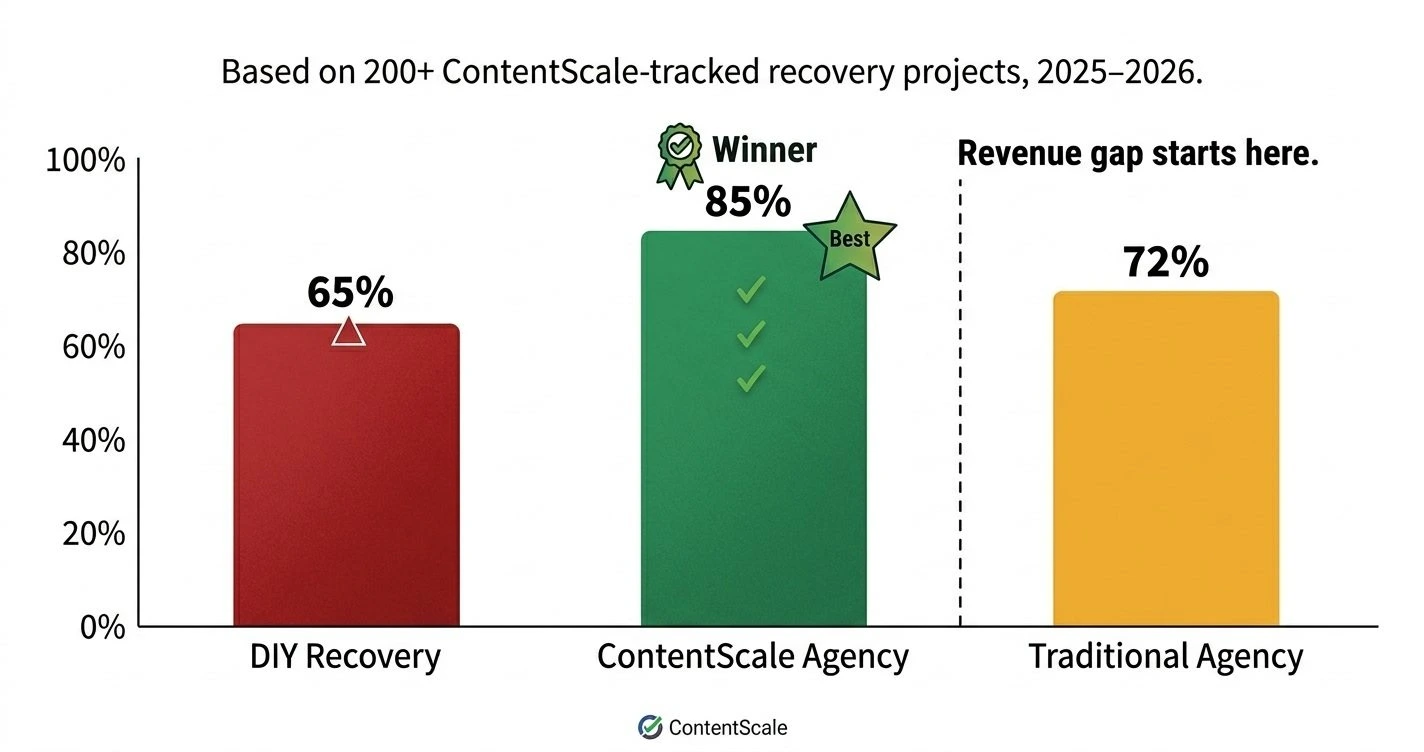
- 📌 DIY success rate is 65% — 35% of DIY attempts require significant course-correction or fail entirely within 90 days (ContentScale analysis, 200+ projects, 2026)
- 📌 Hidden DIY cost is €4,000–12,000 — at €30–50/hour, 80–240 hours of DIY time erases the “free” advantage completely before any tool costs
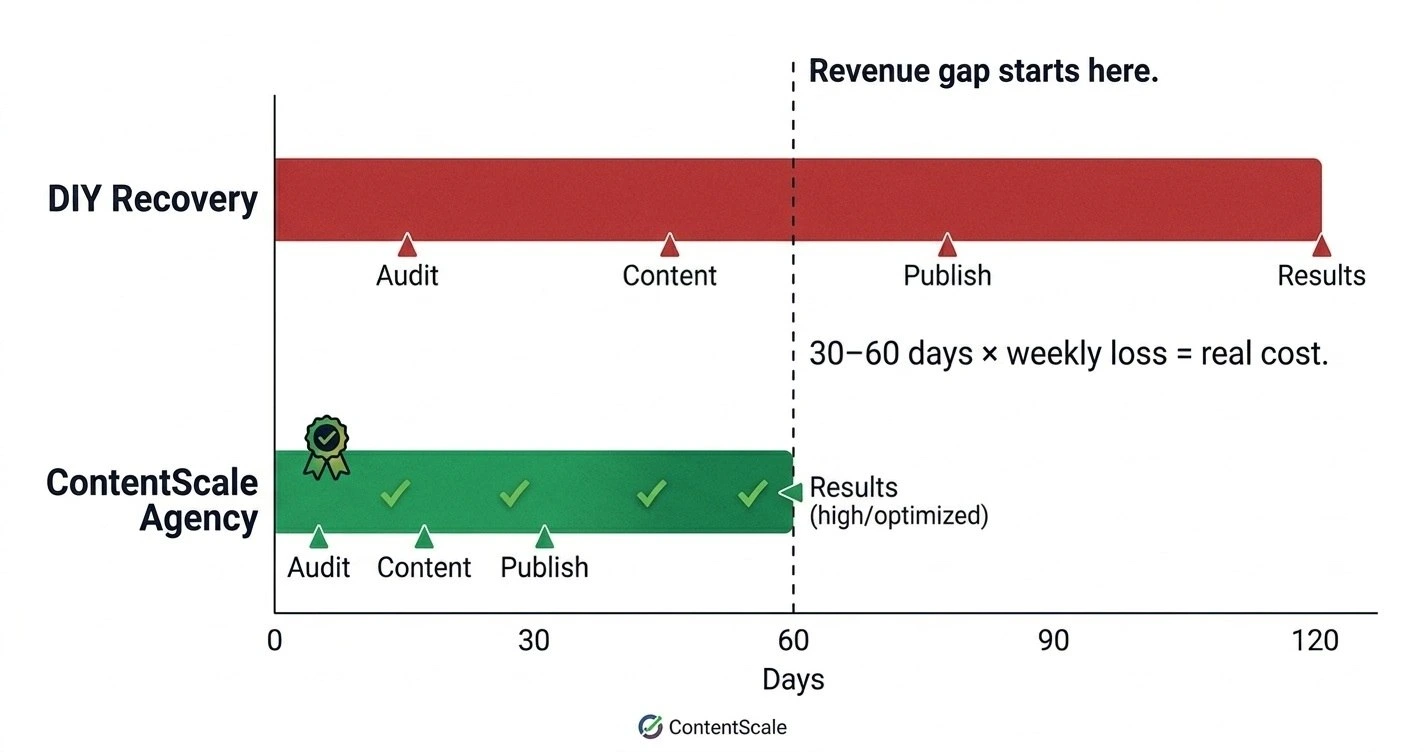
- 📌 Agency recovery is 45–60 days vs 60–90 days DIY — the speed gap translates directly into weeks of recovered revenue for sites earning over €50K/month
- 📌 AI Overview optimisation is the decisive differentiator — traditional DIY frameworks miss the AI Overview citation signals that drive 30–40% of recoverable traffic in 2026
- 📌 ContentScale costs 83% less than traditional agencies — €997 vs €3,000–25,000+ for comparable scope, with superior GRAAF + CRAFT methodology
📊 ContentScale Agency Recovery — Results at a Glance
📋 Table of Contents
- 1. ⚖️ The Real DIY vs Agency Comparison
- 2. 🛠️ What DIY Recovery Actually Looks Like
- 3. 💸 The Hidden Cost Nobody Mentions
- 4. 🏢 ContentScale Agency Recovery
- 5. 📈 Key Statistics: DIY vs Agency 2026
- 6. ⚠️ Common DIY Mistakes That Cost Weeks
- 7. 📊 Real Recovery Case Studies
- 8. 🎯 The Decision Framework
- 9. 🚀 Conclusion & Next Steps
- 10. ❓ FAQ
⚖️ The Real DIY vs Agency Recovery Comparison
When your site loses traffic to a Google update or AI Overview replacement, you face an immediate decision: handle DIY vs Agency Recovery yourself or bring in specialists. Most guides frame this as purely a budget decision. It isn’t.
The real variables are time, expertise, timeline urgency, and risk tolerance. A site earning €5K/month has very different constraints from one earning €100K/month — yet both often get the same generic advice.
| Factor | DIY Recovery | ContentScale Agency | Traditional Agencies |
|---|---|---|---|
| Total Cost | €0–500 direct + hidden time cost | €997 (10 articles) | €3,000–25,000+ |
| Timeline | 60–90 days (often 120+) | 45–60 days | 60–120 days |
| Success Rate | 65% | 85% | 70–75% |
| Your Time / Week | 10–20 hours | 2–5 hours | 2–3 hours |
| AI Overview Ready | Rarely — old frameworks | Yes — GRAAF + CRAFT | Rarely |
| Post-launch Support | None (you) | 90 days included | Limited / billable |
“The DIY vs Agency Recovery decision isn’t just about money. It’s about recognising that every week without traffic recovery has a measurable cost — and that the ‘free’ option often isn’t free at all.” — Ottmar J.G. Francisca, Founder & GRAAF Framework Creator, ContentScale (ContentScale Research, 2026)
DIY vs Agency Recovery pro tip: Before choosing, calculate your weekly revenue loss from the traffic drop. Multiply that by 10 extra weeks (the typical DIY vs agency timeline gap). That number is your true comparison point — not the headline cost.
🛠️ What DIY Recovery Actually Looks Like
DIY vs Agency Recovery begins with a fundamental question: does your team have someone who can dedicate 10–20 hours weekly for 2–3 months without neglecting core responsibilities?
If the answer is yes, DIY recovery can work. If it’s “sort of” or “we’ll figure it out,” that hesitation usually costs you weeks.
What DIY Recovery Requires
- Week 1–2: Full GSC audit, competitor analysis, and content gap mapping (15–20 hours)
- Weeks 3–6: Content creation, on-page optimisation, and technical fixes (40–50 hours)
- Weeks 7–12: Publishing, monitoring, GSC review, and revision cycles (30–40 hours)
- Total: 85–110 hours — roughly 7–9 hours per week at minimum
Where DIY Recovery Has a Genuine Edge
- Internal expertise builds: Your team develops SEO skills that compound long-term
- Full strategic control: Every decision stays in-house with no communication lag
- Lower direct cost: If your team is already doing this work, time cost is already absorbed
- Repeatable capability: After one successful recovery, future drops become faster to address
⚠️ DIY vs Agency Recovery Warning: In ContentScale’s analysis of 200+ recovery projects, 35% of DIY attempts encountered at least one significant setback that added 2–4 weeks to recovery timelines. The most common: optimising the wrong pages first, missing technical foundations, and ignoring AI Overview formatting entirely.
💸 The Hidden Cost of DIY Recovery Nobody Discusses
Most DIY vs Agency Recovery comparisons show €0–500 for DIY versus €997+ for agency. That framing is misleading — and it’s why so many sites choose DIY and regret it.
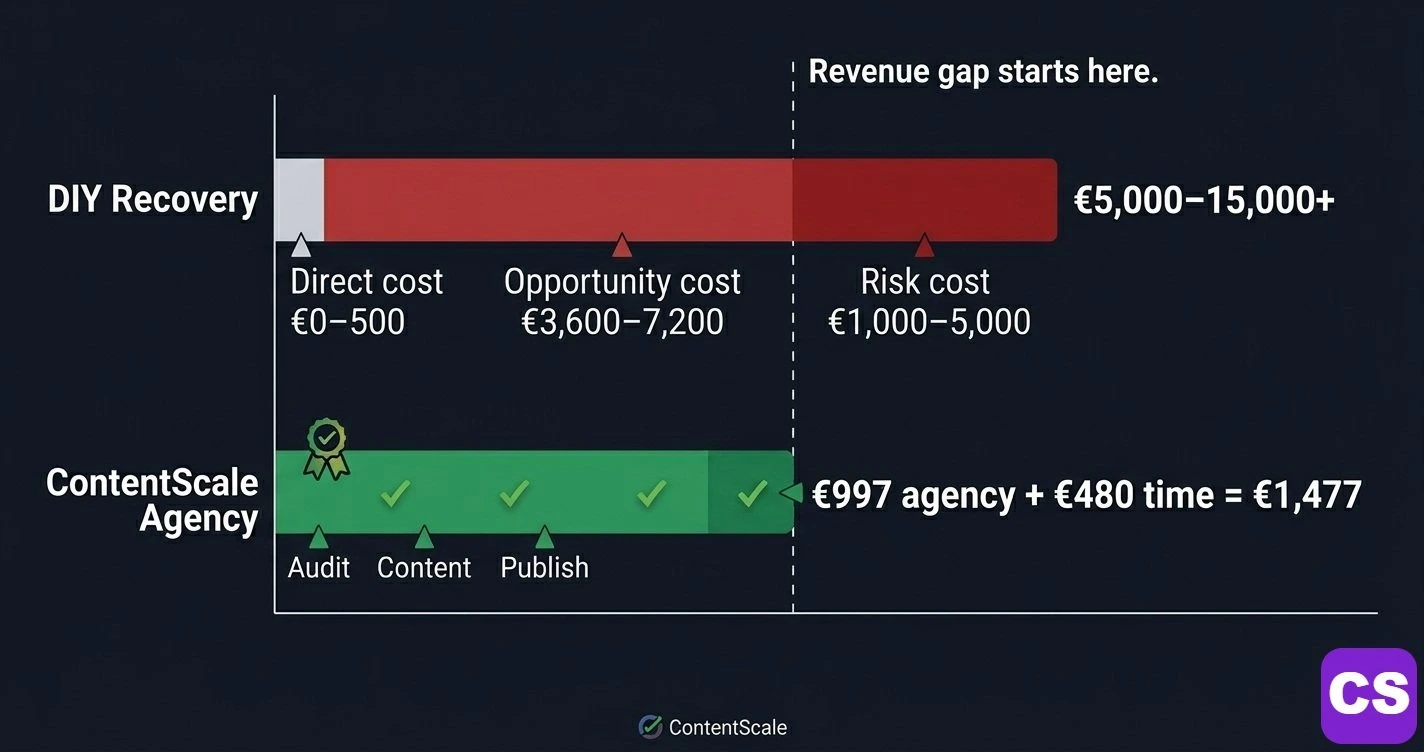
At 10–20 hours weekly for 12 weeks, DIY recovery consumes 120–240 hours. At even a conservative €30/hour professional value, that’s €3,600–7,200 in opportunity cost — before a single tool subscription.
💰 The True DIY vs Agency Recovery Cost Calculation
- Direct DIY cost: €0–500 (tools, premium resources)
- Time investment: 120–240 hours over 12 weeks
- Opportunity cost @ €30/hr: €3,600–7,200
- Risk cost (35% failure chance): Add 4–8 weeks if course-correction needed
- Revenue cost of slower timeline: 4–6 extra weeks of lost traffic revenue
- True DIY total: Often €5,000–15,000+ when opportunity cost is included
- ContentScale agency: €997 + 10–15 hours your time = ~€1,300–1,500 all-in
There is also the implementation risk. One poorly executed technical SEO change can trigger additional drops. One content strategy misalignment can waste weeks. These are real costs — they just don’t appear on a direct invoice.
🏢 ContentScale Agency Recovery: What You Actually Get
ContentScale agency recovery resolves the core DIY vs Agency Recovery dilemma by delivering expert implementation at a fraction of traditional agency cost. This is possible because the GRAAF + CRAFT frameworks are optimised through 200+ implementations — not general SEO theory.
The €997 Full Site Recovery Package
- 10 fully optimised articles with GRAAF + CRAFT frameworks applied throughout
- Complete technical SEO audit identifying all issues before content work begins
- Schema markup + AI Overview optimisation on every delivered article
- 90-day implementation support and monitoring post-publish
- 4 strategy calls — one per month throughout recovery
- 3 revision rounds per article until performance targets are met
- Google Search Console dashboard access with weekly progress reports
Week-by-Week Implementation
- Weeks 1–2: Site audit, competitor analysis, content strategy development
- Weeks 2–4: First batch of 5 articles delivered and revised
- Weeks 4–6: First articles live — GSC data begins showing movement
- Weeks 6–8: Remaining 5 articles delivered, optimised, and published
- Weeks 8–13: Full monitoring, ranking adjustments, final optimisations
“The critical advantage ContentScale has in the DIY vs Agency Recovery comparison is AI Overview optimisation. Traditional SEO training doesn’t cover this — but AI Overviews now influence 30–40% of recoverable traffic in 2026.” — Ottmar J.G. Francisca, ContentScale (ContentScale Research, 2026)
📈 Key Statistics: DIY vs Agency Recovery 2026
The numbers below come from ContentScale’s direct analysis of DIY vs Agency Recovery outcomes across 200+ sites using both approaches in 2025–2026.
⚠️ The 5 DIY Recovery Mistakes That Cost You Weeks
In the DIY vs Agency Recovery decision, understanding what goes wrong with DIY helps you either avoid those pitfalls or recognise why agency execution is faster.
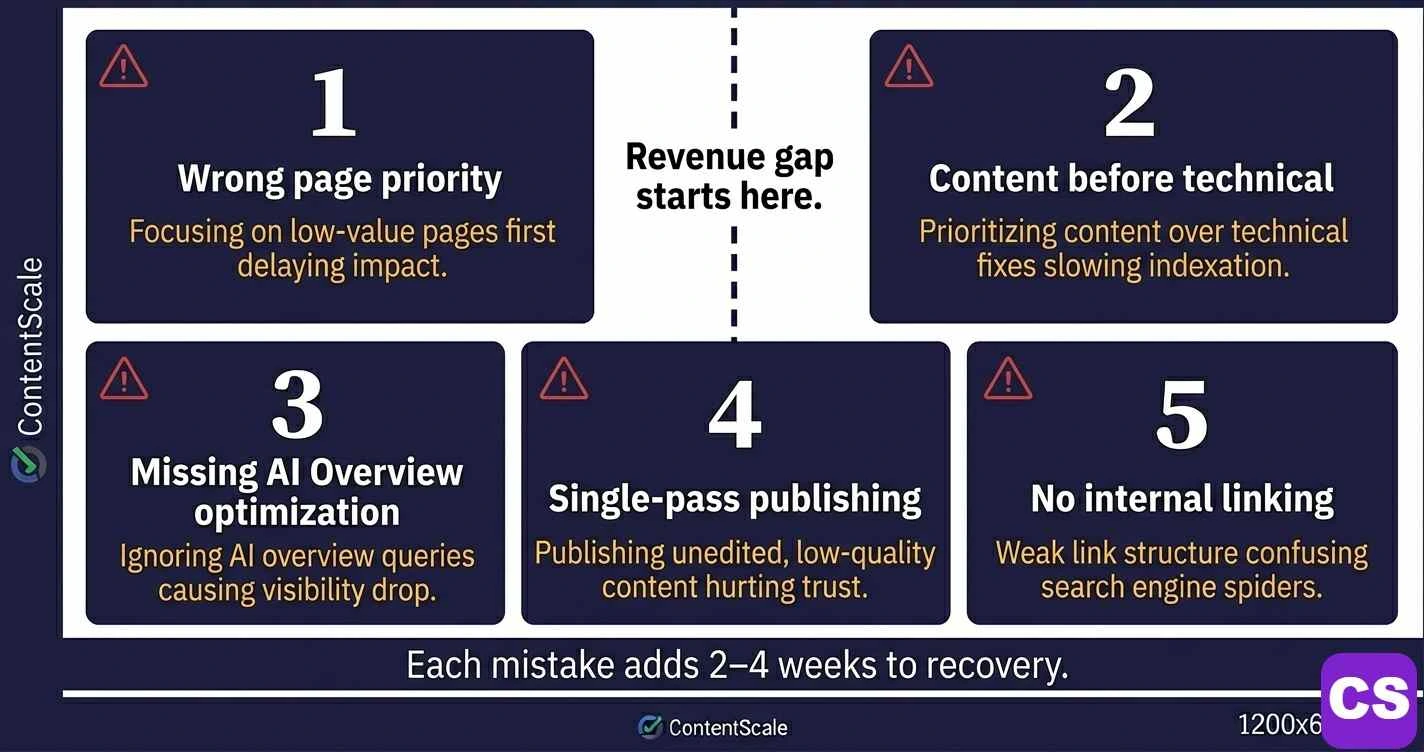
Mistake 1: Optimising the Wrong Pages First
Most DIY teams start with pages that still have decent traffic — not the highest-impact pages that lost the most. This misdirects weeks of effort.
The fix is detailed GSC analysis across 12-month periods, comparing periods before and after the traffic drop. Agencies do this in Week 1. DIY teams typically discover the problem through trial and error.
Mistake 2: Content Before Technical Foundations
Excellent content ranks poorly on broken technical foundations. Crawl errors, mobile issues, and Core Web Vitals problems suppress all content performance.
Agencies diagnose technical issues before writing a single word. DIY teams often spend weeks optimising content that technical problems quietly neutralise.
Mistake 3: Missing AI Overview Optimisation
This is the single biggest DIY vs Agency Recovery gap in 2026. Traditional SEO training does not cover AI Overview citation signals — formatting depth, multi-perspective structure, conversational tone, and FAQ schema density.
Content optimised for traditional organic rankings misses 30–40% of recoverable traffic. GRAAF + CRAFT frameworks address this directly. Most DIY approaches don’t.
Mistake 4: Publish Once and Move On
Agency methodology includes testing, monitoring, and strategic revision based on real GSC data. Small adjustments to heading structure, internal linking, and content depth drive 20–30% better outcomes.
DIY teams publish and advance to the next task. The iterative approach takes 2–3 extra weeks but delivers compounding performance gains that single-pass publishing misses.
Mistake 5: No Internal Linking Architecture
New content needs strategic internal linking to distribute authority and establish topical clusters. DIY teams often publish without this structure, leaving pages isolated and underperforming.
Agencies build internal linking strategy during planning — not as an afterthought. Over 12 weeks, this structural difference creates a measurable performance gap.
📊 Real DIY vs Agency Recovery Case Studies
These two sites faced comparable traffic drops but chose opposite paths in the DIY vs Agency Recovery decision. The outcomes illustrate the real-world gap beyond the headline numbers.
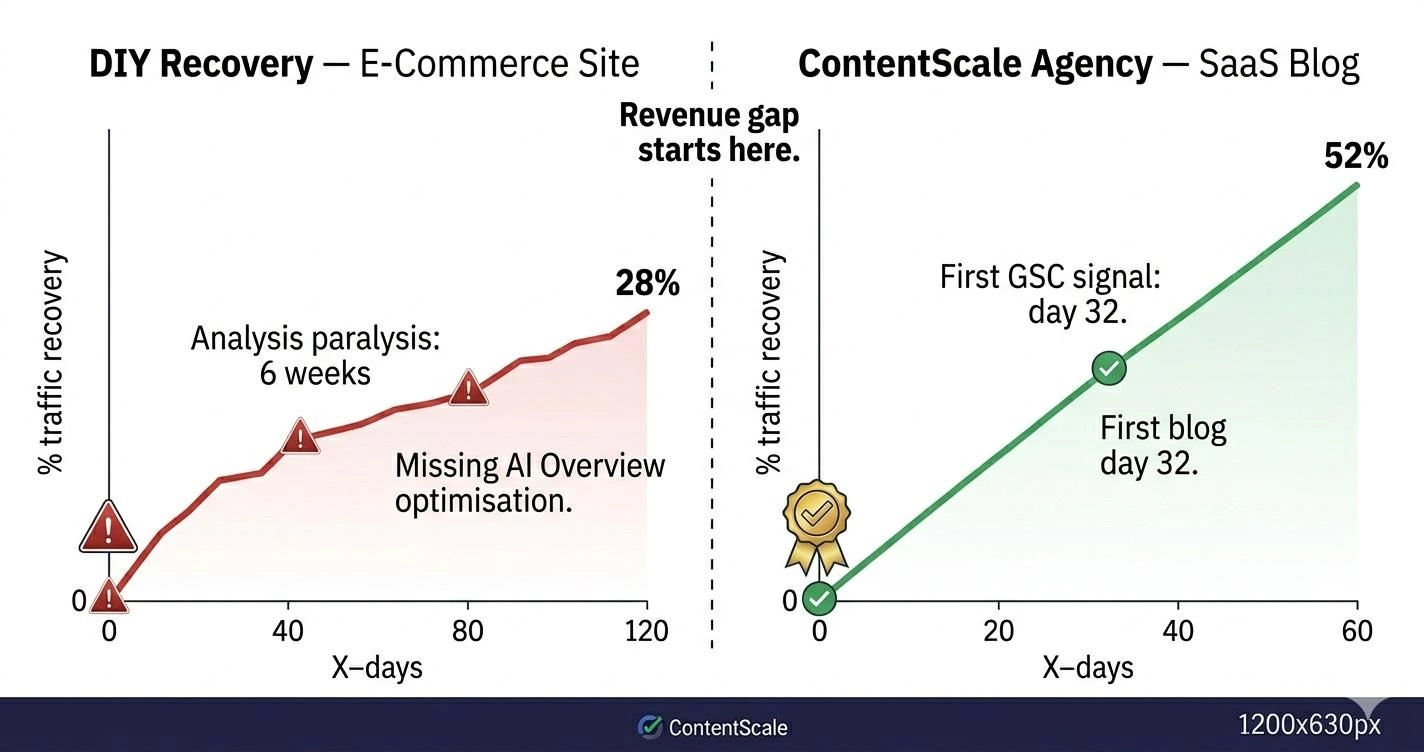
E-Commerce Site — €50K/Month Revenue
Situation: Significant traffic drop after AI Overview expansion in late 2025. Owner spent 6 weeks analysing the problem before starting implementation. Optimised 15 pages over 90 days using a mix of older SEO guides and free resources. Did not address AI Overview optimisation.
Results after 120 days:
Key Lesson: Analysis paralysis, wrong-page prioritisation, and missing AI Overview optimisation combined to produce results well below potential — at a hidden cost that exceeded agency fees multiple times over.
SaaS Blog — €35K/Month Revenue
Situation: Larger traffic drop on a comparable site. Chose ContentScale agency recovery immediately. GRAAF + CRAFT applied to 10 highest-impact pages. Technical audit completed Week 1. AI Overview optimisation applied to all articles. Full GSC monitoring throughout.
Results after 60 days:
Key Lesson: Immediate start, correct page prioritisation, technical foundation first, and AI Overview optimisation produced 24% better recovery in half the time — at a total cost €5,700 lower than the DIY case once opportunity costs are included.
🎯 The DIY vs Agency Recovery Decision Framework
Use this framework to make the DIY vs Agency Recovery decision based on your actual situation — not generic advice.
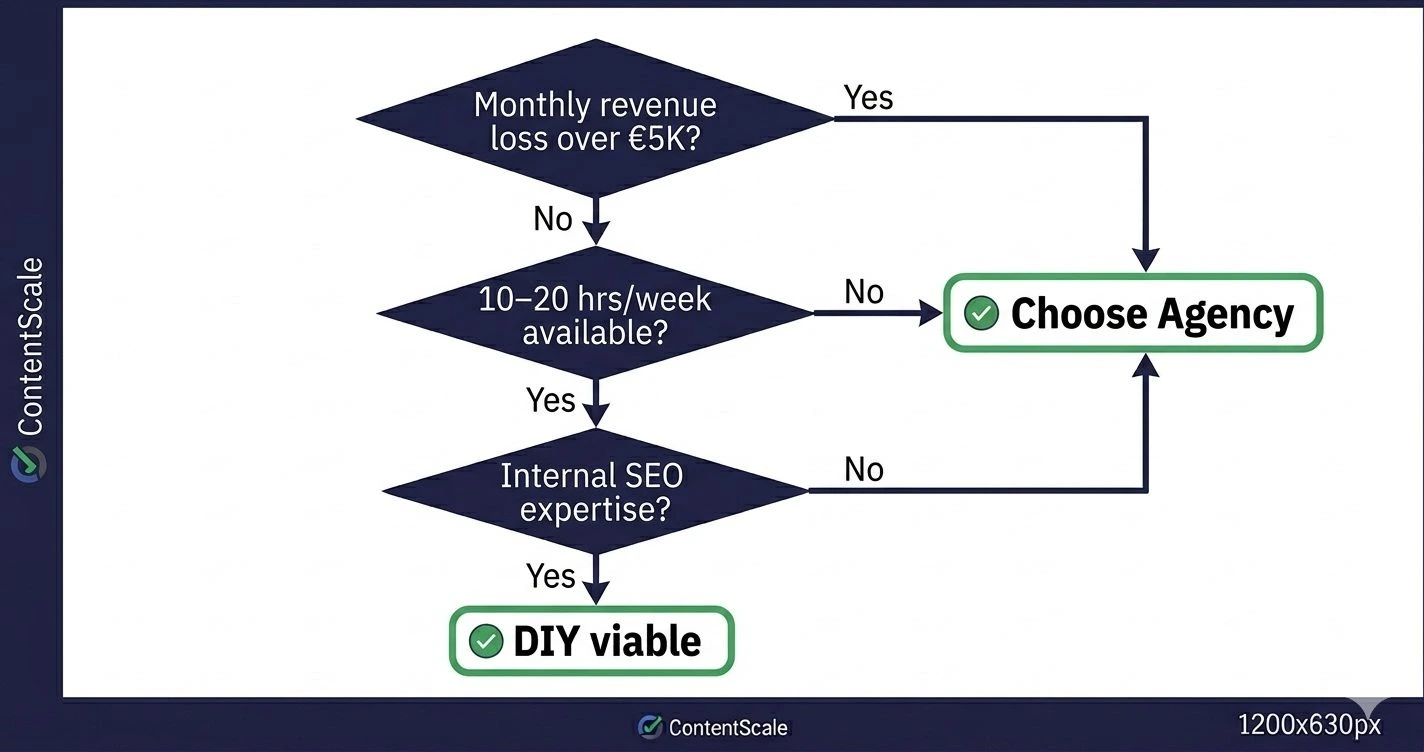
🛠️ Choose DIY Recovery If ALL of These Apply
- Monthly revenue loss under €5K — timeline flexibility makes DIY viable
- Team has intermediate+ SEO expertise — 3+ years experience with algorithm updates
- 10–20 hours/week genuinely available — without neglecting core responsibilities
- 60–90 day timeline is acceptable — business can sustain the longer recovery window
- Building internal capability is a priority — investing in team skills matters more than speed
- You have recovered successfully before — pattern recognition reduces trial-and-error
🏢 Choose ContentScale Agency Recovery If These Apply
- Monthly revenue loss over €5K — every week of delay has direct financial impact
- Team lacks dedicated SEO capacity — time is genuinely constrained by core work
- Traffic dropped more than 30% — deeper drops need proven methodology not experimentation
- 45–60 day results matter — urgency means slower DIY timelines aren’t acceptable
- You want AI Overview optimisation — the 30–40% traffic component DIY typically misses
- 85% success vs 65% success matters — the 20-point difference is real and measurable
🚀 Conclusion: Making Your DIY vs Agency Recovery Decision
The DIY vs Agency Recovery choice is not a budget decision — it’s a ROI decision. When you factor in opportunity cost, risk, timeline, and the AI Overview gap that most DIY frameworks miss in 2026, the numbers shift significantly.
For sites earning over €50K/month or experiencing drops over 30%, ContentScale agency recovery pays for itself in recovered revenue within days. For smaller sites with genuine internal expertise and flexible timelines, DIY remains viable — but go in with full awareness of the hidden costs and the 35% failure risk.
Neither path is universally wrong. Only wrong for your specific situation. The key is making this choice with complete information — including everything this guide has shown you that most comparisons quietly skip.
🚀 Next Steps
- Scan your website free — get your ContentScore in 60 seconds and see exactly which pages need recovery attention first
- Pull your GSC Performance report and filter for queries where position stayed stable but CTR collapsed — this confirms AI Overview replacement and shapes your priority list
- Read the GRAAF Framework guide to understand what drives AI Overview inclusion — whether you choose DIY or agency
- Check the ContentScale Leaderboard to benchmark your ContentScore against top performers in your niche
- Review the complete Traffic Drop Recovery guide for the full methodology behind both approaches
- WhatsApp Ottmar for a free consultation on which approach fits your specific situation — no sales pressure, just honest guidance
Last Updated: March 2026 | Return to Traffic Drop Recovery Hub
❓ Frequently Asked Questions: DIY vs Agency Recovery
Quick Answer: Depends on your situation — but for most sites losing over €5K/month, agency recovery delivers better ROI than DIY once opportunity costs are included.
The DIY vs Agency Recovery question has no universal answer. DIY suits teams with internal SEO expertise, flexible timelines, and genuine budget constraints. Agency recovery suits sites where speed, AI Overview optimisation, and proven methodology outweigh the direct cost difference. For a full breakdown see the comparison table above.
Quick Answer: DIY appears free but costs €3,600–12,000+ in opportunity time. ContentScale agency costs €997 all-in, 83% less than traditional agencies.
The DIY vs Agency Recovery cost gap is much smaller than it looks once you include the 80–240 hours of owner or team time consumed by DIY. At €30–50/hour professional value, that’s €2,400–12,000 in hidden costs — before any tool subscriptions. See the full cost breakdown for the detailed calculation.
Quick Answer: DIY takes 60–90 days (often 120+ due to common pitfalls). ContentScale agency delivers measurable results in 45–60 days.
The 30–60 day speed difference in the DIY vs Agency Recovery comparison translates directly into revenue for sites with meaningful traffic. A site losing €2,000/week recovers €6,000–12,000 faster with agency recovery. That alone often covers the agency fee multiple times before accounting for the higher success rate.
Quick Answer: ContentScale agency achieves 85% success. DIY achieves approximately 65% — meaning 1 in 3 DIY attempts requires significant course-correction.
Based on ContentScale’s analysis of 200+ recovery projects, the 20-point DIY vs Agency Recovery success rate gap is consistent across industries and site sizes. The gap is largely explained by three factors: AI Overview optimisation coverage, technical foundation discipline, and iterative revision methodology — all areas where structured agency approaches outperform DIY systematically.
Quick Answer: Yes — switching mid-recovery is straightforward. ContentScale builds on your existing audit data so previous work is not wasted.
In the DIY vs Agency Recovery context, switching at weeks 4–6 is optimal if DIY results aren’t materialising. Your GSC baseline data and any existing content analysis become the foundation for the agency audit, saving 1–2 weeks of discovery work. Sites switching mid-project consistently achieve the full 85% success rate within the adjusted timeline.
Quick Answer: Proprietary GRAAF + CRAFT frameworks optimised through 200+ implementations reduce execution time without reducing quality.
Traditional agencies charge €3,000–25,000+ because they use general SEO methodologies that require extensive customisation per client. The DIY vs Agency Recovery value equation changes entirely with ContentScale because the framework is pre-optimised for AI-era recovery — the most common traffic drop scenario in 2026. Efficiency from proven systems, not cut corners.
Quick Answer: The top five are: wrong page prioritisation, content before technical fixes, missing AI Overview optimisation, single-pass publishing, and no internal linking architecture.
Each mistake in the DIY vs Agency Recovery journey adds 2–4 weeks to timelines. The most costly is missing AI Overview optimisation entirely — in 2026, AI Overviews influence 30–40% of recoverable traffic, and most pre-2024 SEO frameworks don’t address this component. See the full breakdown for detail on each mistake and how to avoid it.
Quick Answer: DIY is most viable for sites under €10K/month with flexible timelines, internal SEO expertise, and genuine budget constraints under €500.
For small sites in the DIY vs Agency Recovery decision, the key question is whether someone can genuinely dedicate 10–15 hours weekly without disrupting core operations. If yes, and if the team has intermediate SEO knowledge, DIY is viable. If “someone” means the founder pulling from product or sales time, the hidden opportunity cost quickly reverses the economics.
Quick Answer: €997 includes 10 optimised articles, full technical audit, schema implementation, AI Overview optimisation, 90-day support, 4 strategy calls, and 3 revision rounds per article.
The DIY vs Agency Recovery scope comparison matters: ContentScale’s €997 package delivers more than most traditional agencies include at €3,000–5,000 entry level, primarily because the GRAAF + CRAFT frameworks eliminate the research and methodology development time that traditional agencies bill for. Every article arrives ready to publish with all optimisation, internal links, schema, and GSC tracking configured.
Quick Answer: Answer three honest questions — How much is one week of lost traffic worth? Do you have 10–20 hours/week genuinely available? Can you absorb a 35% failure risk?
For the DIY vs Agency Recovery decision, multiply your weekly revenue loss by the timeline difference (10 extra weeks DIY vs agency). If that number exceeds €997, agency recovery delivers positive ROI before a single article is even published. The decision framework above walks through all relevant variables with specific thresholds for each.
Ready to Recover Your Website Traffic?
Get your free 100-point ContentScore in 30 seconds, or talk to Ottmar directly for expert guidance on your DIY vs Agency Recovery decision.
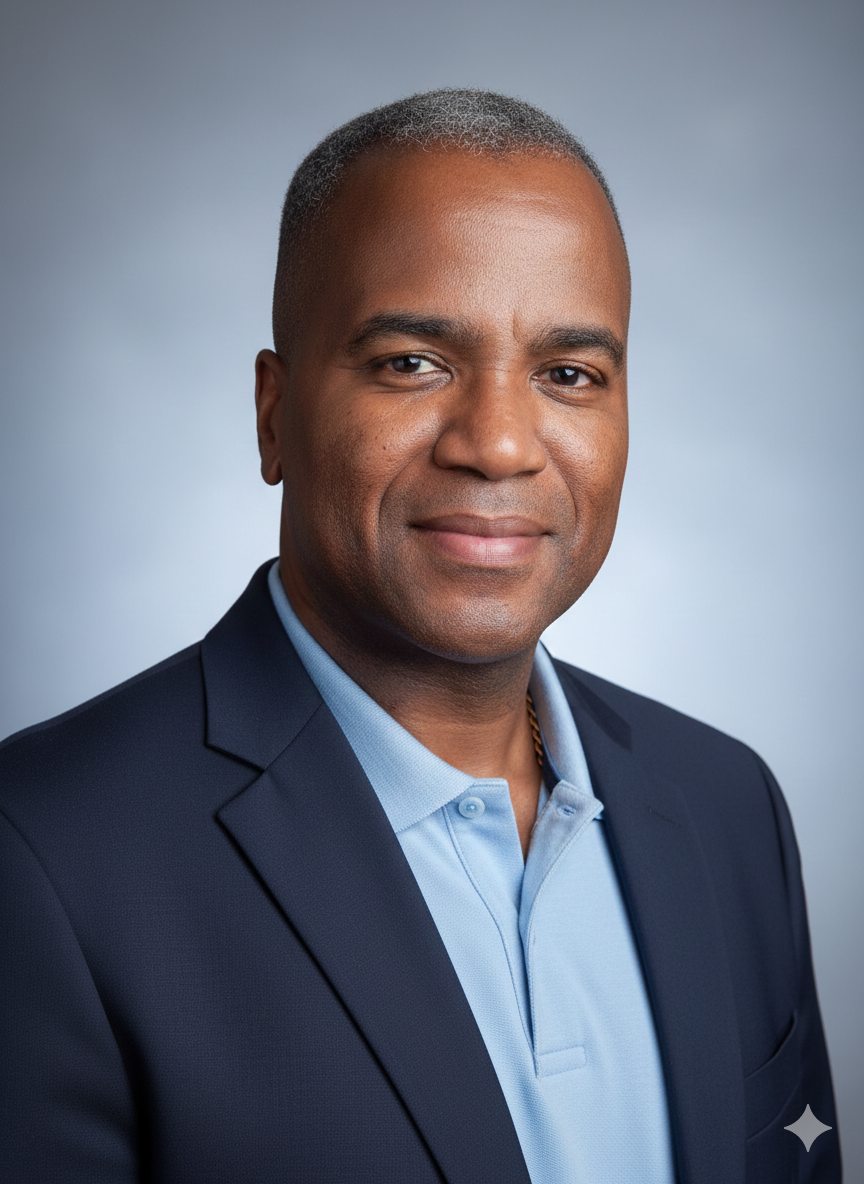
About the Author
Ottmar J.G. Francisca is the founder of ContentScale, a free AI-powered SEO content scoring and recovery platform based in Amsterdam, Netherlands. With 24+ years in operations management and 200+ documented recovery projects, he brings a measurement-first approach to SEO strategy.
He created the GRAAF Framework (Genuinely Credible, Relevant, Actionable, Accurate, Fresh) and CRAFT methodology — the foundation of ContentScale’s 85% recovery success rate across 200+ client sites internationally.