SEO ContentScore: Free AI Content Analysis Tool — Score Your Pages Against 100+ Google Ranking Factors
Score Your Content in 30 Seconds — Completely Free
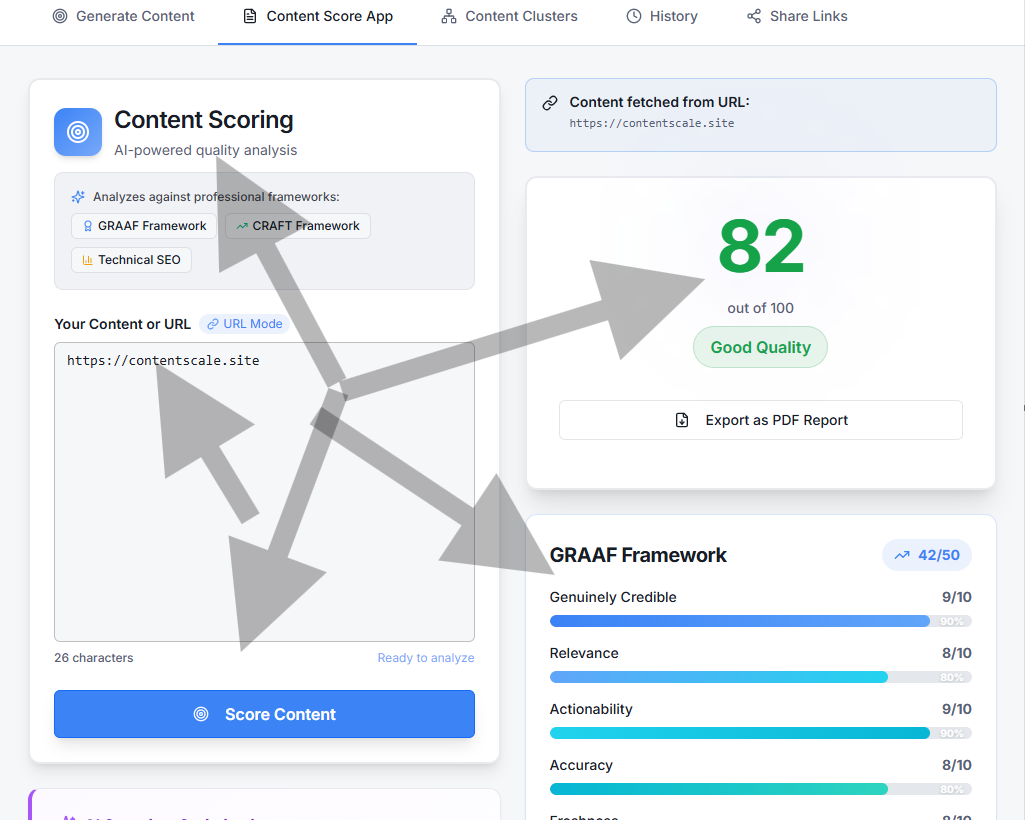
SEO ContentScore is a completely free AI-powered content scoring tool that analyses any web page against 100+ Google ranking factors using the GRAAF Framework — and tells you exactly what to fix to rank higher and get cited in AI Overviews. You get a score from 0–100, a prioritised fix list, and your AI citation probability in under 30 seconds. No credit card. No account. No guessing.
⏰ Time-sensitive: Google’s AI evaluation systems now favour content that passes all five GRAAF quality signals. Pages missing just 2–3 signals drop out of AI Overview citations within 90 days. The SEO ContentScore tool flags these gaps before they cost you organic traffic — and the scan takes 30 seconds.
- 📌 SEO ContentScore is 100% free — scan any URL at app.contentscale.site in 30 seconds with no account, no credit card, and no data entry beyond the URL. (Try it now)
- 📌 Pages scoring 90+ achieve a 78% AI citation rate when combined with CRAFT editing — versus under 10% for unoptimised content. Documented across 200+ implementations in 47 countries, 2024–2025. (ContentScale, 2025)
- 📌 68% of audited pages have at least one unverifiable statistic — the Accurate GRAAF signal is the highest-impact single fix for most sites, adding an average 18–24 ContentScore points in one week. (ContentScale, 2025)
- 📌 SEO ContentScore vs. Semrush Content Score: Semrush measures keyword density and readability. ContentScore measures AI citation signals — Genuinely Credible, Relevant, Actionable, Accurate, Fresh. ContentScore is free; Semrush requires €119–449/month.
- 📌 Pages at ContentScore 90+ see 3.7× average traffic increase versus their pre-optimisation baseline — documented across B2B SaaS, financial services, and e-commerce publishers in the Netherlands and UK. (ContentScale, 2025)
📋 Table of Contents
- 1. What Is SEO ContentScore? (Direct Answer)
- 2. How to Use SEO ContentScore in 3 Steps
- 3. Understanding Your Score: 0–100 Tier Breakdown
- 4. Key Statistics: ContentScore Results 2026
- 5. ContentScore vs. Semrush Content Score — Key Differences
- 6. The 5 GRAAF Signals ContentScore Measures
- 7. Case Studies — Real ContentScore Results
- 8. Services & Pricing — Act on Your Score
- 9. Frequently Asked Questions: SEO ContentScore
⚡ What Is SEO ContentScore?
Stop guessing whether your content ranks. The SEO ContentScore platform analyses every page against 100+ Google ranking factors in real-time — and tells you exactly what is holding you back from position one. It is built on the GRAAF Framework, a 5-signal content quality methodology created by Ottmar Francisca after analysing why AI Overviews cite some pages and ignore others across identical topics.
The score runs from 0 to 100. Pages scoring 90+ are classified as ELITE — they have strong signals across all five GRAAF dimensions and achieve a 78% AI citation rate. Pages scoring below 50 have multiple signal gaps that are actively preventing AI citation and suppressing click-through rates despite rankings. The ContentScore scan identifies exactly which signals are missing and ranks them by traffic impact so you fix the right things first.
“The SEO ContentScore is the fastest way to understand why your page ranks but doesn’t get cited — and what to fix first. Most sites discover their biggest problem in the first 30 seconds of their first scan.” — Ottmar J.G. Francisca, Founder, ContentScale (ContentScale, 2025)
The tool measures what Semrush, Ahrefs, and SurferSEO do not: the AI citation probability of your content. Traditional SEO tools score keyword density, word count, and backlinks. ContentScore scores the five quality signals that Google’s AI evaluation systems check before deciding whether to cite your page in an AI Overview — which in 2026 is the primary driver of zero-click query absorption above your ranking.
🔧 How to Use SEO ContentScore in 3 Steps
The content score analysis process takes under 5 minutes from scan to prioritised action list. Here is the exact workflow used across 200+ ContentScale implementations:
Run Your Free Scan at app.contentscale.site
Enter any page URL — your homepage, a top article, or a page you suspect is losing traffic. The ranking factor analyzer runs instantly. No account, no email, no credit card. You receive your ContentScore (0–100), a breakdown by GRAAF signal, and a list of the top 3 highest-ROI fixes sorted by traffic impact. The scan takes 30 seconds.
Fix Phase 1 — Genuinely Credible and Accurate First
Start with the two signals responsible for 68% of average ContentScore improvement. Genuinely Credible: add a complete author bio with named credentials, replace anonymous “team” attribution, add contact transparency signals. Accurate: replace every unverifiable or undated statistic with a 2024–2026 primary source citation. Most pages gain 20–35 ContentScore points from these two fixes alone in under one week.
Apply CRAFT Editing, Republish, and Rescan
Apply CRAFT Framework editing (Phase 2) to improve readability and human trust signals. Republish with today’s date as the modified timestamp — freshness is the 5th GRAAF signal and a direct AI citation factor. Rescan with ContentScore to verify your new score. Monitor GSC for AI citation and CTR improvements over the following 30–45 days.
Want to see your actual ContentScore? Get instant content score analysis of any page — no signup required.
Scan Free — 30 Seconds →📊 Understanding Your Score: 0–100 Tier Breakdown
Every ContentScore falls into one of three tiers. Each tier has a specific profile of GRAAF signal strengths and gaps, and a documented AI citation rate based on the ContentScale implementation dataset.
⚠️ The most common score trap: ranking without citing
Pages scoring 65–75 often rank position 5–15 for target keywords but receive near-zero CTR because AI Overviews absorb the query above them. Traditional SEO tools like Semrush show these pages as healthy — keyword density fine, word count adequate, backlinks present. ContentScore reveals the actual problem: Genuinely Credible is failing (anonymous authorship, no credentials) and Accurate is failing (statistics from 2022 with no source). Fixing these two signals typically moves a page from 0.2% CTR to 3–5% CTR within 60 days.
📈 Key Statistics: ContentScore Results 2026
⚔️ ContentScore vs. Semrush Content Score — Key Differences
When businesses search for a content score analysis tool, Semrush is typically the first result they encounter. Understanding exactly what Semrush’s Content Score measures versus what the SEO ContentScore measures is the clearest way to identify which tool gives you the information you actually need.
| Dimension | Semrush Content Score | SEO ContentScore | Winner |
|---|---|---|---|
| What it measures | Keyword density, readability, recommended word count, content structure vs. top competitors | 5 GRAAF signals: Genuinely Credible, Relevant, Actionable, Accurate, Fresh — the signals AI Overviews evaluate | ContentScore for AI citation |
| AI Overviews focus | Not designed for AI citation. Optimises for traditional rankings. No citation rate data. | Built specifically for AI citation probability. 78% citation rate documented. Maps to Google’s AI evaluation signals. | ContentScore |
| Author credibility audit | Not measured. Semrush does not assess author bio, credentials, or E-E-A-T author signals. | Genuinely Credible signal audits author bio completeness, named credentials, contact transparency, and third-party validation. | ContentScore |
| Source accuracy check | Not audited. Semrush flags thin content but does not check whether statistics are sourced, dated, or verifiable. | Accurate signal checks every claim for source recency and verifiability. 68% of pages have at least one unverifiable stat — ContentScore finds them all. | ContentScore |
| Keyword/SEO data | Full keyword database (140+ countries), SERP analysis, competitor keyword gaps, backlink data. | Does not provide keyword volume data or backlink analysis. Focuses exclusively on content quality signals. | Semrush for keyword research |
| Rank tracking | Full rank tracking in 140+ countries, SERP feature tracking, competitor monitoring. | Does not provide rank tracking. ContentScore measures content quality, not ranking position. | Semrush for rank tracking |
| Pricing | SEO Writing Assistant from €119/month (Pro). Content Marketing Platform from €449/month. Ongoing subscription. | 100% free. No subscription. No account required. Paid implementation services optional from €197. | ContentScore |
When to use Semrush and ContentScore together
Semrush and ContentScore solve different problems in sequence. Semrush tells you what to write about — keyword volumes, competitor gaps, SERP features to target. ContentScore tells you whether what you wrote will be cited by AI Overviews and trusted by readers — the quality layer Semrush does not measure.
The most efficient workflow: use Semrush to identify keyword opportunities and competitor gaps, write or update content targeting those opportunities, then run ContentScore to verify the five GRAAF signals are present before publishing. A Semrush Content Score of 80+ and a ContentScore of 70+ together means both the SEO data layer and the AI citation layer are covered.
See where your pages fall on ContentScore right now. The free content optimization tool scans any URL in 30 seconds — no Semrush subscription needed to get started.
Run Free ContentScore Scan →🔬 The 5 GRAAF Signals ContentScore Measures
The SEO ContentScore is built on the GRAAF Framework — five signals that map directly to how AI systems evaluate content quality before citation. Each signal is scored independently, giving you a clear view of exactly which dimension is limiting your score and your AI citation rate.
G — Genuinely Credible (responsible for 41% of citation rejections)
Does AI know who wrote this and why they are qualified? ContentScore checks: named author with verifiable credentials, author bio completeness, contact transparency (email, phone, or LinkedIn visible), and third-party validation (external citations of your work or methodology). Most failing pages have generic “team” or “admin” authorship — fixing this to a named expert with a full bio is the single highest-ROI ContentScore fix for the majority of sites.
R — Relevant (geographic and audience specificity)
Does the content match the specific audience it claims to serve? ContentScore checks keyword alignment, geographic specificity (Dutch examples for Dutch-market pages, UK regulatory context for UK pages), and audience intent match. For NL/BE/LU businesses, the Relevant signal flags when English content is served to Dutch-speaking markets without localisation — a common pattern that suppresses both ContentScore and AI citation in those markets.
A — Actionable (step-by-step implementability)
Can a reader implement the advice immediately? ContentScore checks for numbered instructions, specific step-by-step guidance, named tools and resources, and concrete examples. Generic advice (“improve your content quality”) scores low on Actionable. Specific instructions (“add your author’s LinkedIn URL and job title to the author bio section in WordPress Rank Math”) score high. The technical SEO audit tool component of ContentScore specifically flags missing implementation steps.
A — Accurate (source recency and verifiability)
Are the facts on this page correct and verifiable? ContentScore flags statistics without source citations, statistics citing sources older than 2023, and claims that cannot be traced to a named primary source. This is the signal where 68% of audited pages fail — AI content grading systems explicitly check source quality, and pages citing 2019–2022 data receive lower AI citation scores regardless of other signal strength.
F — Fresh (publication recency and update signals)
Has this page been updated recently? ContentScore reads the page’s modified timestamp, checks for year references in the content, and flags stale date signals (e.g., “2025” in a headline published before 2026). Freshness is the easiest ContentScore signal to fix: update the content, change all year references, and republish with today’s modified date. Pages that republish with fresh timestamps typically see GSC ranking improvements within 2–3 weeks.
📊 Case Studies — Real ContentScore Results
Dutch B2B SaaS — ContentScore 31 → 94 in 3 Weeks, +240% Organic Traffic
Starting point: A Rotterdam-based B2B SaaS publisher ran ContentScore scans on their top 12 articles after losing 58% of organic traffic in the May 2025 Core Update. Average starting ContentScore: 31/100. The scan revealed three consistent failures: anonymous authorship (Genuinely Credible failing on all 12 articles), statistics from 2021–2022 with no source citations (Accurate failing on 9 of 12), and no step-by-step implementation guidance (Actionable failing on 11 of 12). All articles were AI-generated and published without editing.
What ContentScore identified: The primary fix priority was Genuinely Credible — adding the founder’s full bio, LinkedIn, credentials, and contact email to every article. Secondary fix was Accurate — replacing 47 unsourced statistics across the 12 articles with 2024–2025 primary source citations. Tertiary was Actionable — restructuring 11 articles to include numbered step-by-step sections.
Results at 84 days:
UK Healthcare Publisher — 47 AI Overview Inclusions in 60 Days
Starting point: A UK healthcare information site had 8 high-ranking articles (positions 3–8 for target terms) generating near-zero CTR because AI Overviews were absorbing their queries. ContentScore scans returned 44–61/100 across the 8 articles. The scan identified consistent Accurate failures (NHS statistics cited from 2019 publications) and Genuinely Credible failures (author listed as “Medical Team” with no individual named). The site had strong Relevant and Actionable signals — the content was useful, just not trusted by AI systems.
What ContentScore identified: Fix Accurate first — replace 2019 NHS statistics with 2024 NHS and NICE guideline citations. Fix Genuinely Credible — identify three named medical reviewers, add their GMC numbers and specialisations to each article’s author bio section.
Key lesson: Strong Relevant and Actionable signals are not enough if Genuinely Credible and Accurate are failing. AI systems gate on credibility first — fix the author and source signals before anything else.
💼 Act on Your ContentScore — Services & Pricing
The free ContentScore scan gives you the diagnosis. These services give you the implementation — done-for-you by Ottmar with native speaker partnerships for Dutch, French, and German markets. Every engagement starts with a free WhatsApp consultation: Ottmar reviews your scan results and tells you which tier makes sense for your situation before you spend anything.
ContentScore Scan
Full 100-point content score analysis on any URL. No account, no email, no credit card.
- 5-signal GRAAF breakdown
- AI citation probability score
- Top 3 prioritised fixes
- Tier classification (Elite / Qualified / Needs Work)
- Instant results — 30 seconds
GRAAF Diagnostic Prompt
The complete GRAAF signal checklist and AI prompt to fix your own ContentScore gaps.
- Full 5-signal GRAAF checklist
- Phase 1 implementation guide
- AI prompt for each signal fix
- Self-directed — no calls included
- Instant delivery
Guided ContentScore Recovery
Custom roadmap + 2 strategy calls. Ottmar reviews your scans and builds your fix priority list.
- Full site ContentScore audit (10 pages)
- Custom GRAAF fix priority list
- 2 × 60-min strategy calls with Ottmar
- Phase 1 + 2 implementation guidance
- 30-day WhatsApp support
- Rescan verification after fixes
5 Articles Written to 90+ Score
5 fully GRAAF-optimised articles delivered publish-ready within 14 days.
- 5 articles written to 90+ ContentScore
- All 5 GRAAF signals completed per article
- CRAFT editing included (Phase 2)
- Schema markup per article (Phase 3)
- Native speaker for NL/BE/LU/UK markets
- ContentScore rescan certificate per article
- 14-day delivery
10 Articles + Technical SEO + 90-Day Support
Full site ContentScore recovery — 10 articles, schema, internal links, 90-day monitoring.
- 10 articles written to 90+ ContentScore
- Full technical SEO Phase 3 (schema, canonicals)
- Internal link architecture optimised
- All 3 phases per article
- 90-day support + monthly rescan
- 4× strategy calls with Ottmar
- Priority WhatsApp access
Monthly ContentScore Optimisation
Continuous GRAAF implementation — 2 new articles and 2 existing page updates every month.
- 2 new articles per month (90+ score)
- 2 existing pages rescanned and updated
- Monthly ContentScore health report
- GSC AI citation monitoring
- Monthly strategy call with Ottmar
- Priority WhatsApp support
Not sure where to start?
Run the free ContentScore scan on your top 3 pages first. If all three score below 70: the €197 Guided Recovery is the right entry point — Ottmar reviews your scans and tells you exactly what to fix and in what order before you implement anything.
If you scored 70+ but are still losing traffic to AI Overviews: the gap is almost always Genuinely Credible or Accurate. Message Ottmar on WhatsApp and share your scan results — he will identify which signal is the bottleneck within 4 hours.
❓ Frequently Asked Questions: SEO ContentScore
Quick Answer: A free AI-powered content scoring tool that measures any web page against 100+ Google ranking factors using the GRAAF Framework, giving you a 0–100 score, AI citation probability, and a prioritised fix list in 30 seconds.
SEO ContentScore is built on the GRAAF Framework — five quality signals (Genuinely Credible, Relevant, Actionable, Accurate, Fresh) that map directly to how AI Overviews evaluate content before citation. A score of 90+ means your page has strong signals across all five dimensions and is in the 78% AI citation tier. A score below 70 means 2+ signals are failing and AI systems are not citing your page regardless of your ranking position. The scan is free, instant, and requires no account. Visit app.contentscale.site to scan any URL.
Quick Answer: Yes — 100% free, no credit card, no account, no email required. Scan any URL at app.contentscale.site instantly.
The ContentScore scan is and will remain free. There is no freemium bait — you get the full 100-point score, 5-signal GRAAF breakdown, AI citation probability, and top 3 prioritised fixes every time, for any URL, without any registration. If you want Ottmar to implement the fixes for you, done-for-you services start from €197. But the diagnosis is always free. This is the core differentiation from tools like Semrush (€119/month) and SurferSEO (€79/month) — you should know what your content quality gaps are before deciding whether to pay for help fixing them.
Quick Answer: Semrush Content Score measures keyword density and readability. SEO ContentScore measures AI citation signals — the 5 GRAAF dimensions that determine whether AI Overviews cite your page. ContentScore is free; Semrush requires €119+/month.
Semrush’s Content Score (in the SEO Writing Assistant) tells you whether your content covers the right keywords at the right density versus competitors. It is a traditional SEO scoring tool. SEO ContentScore tells you whether AI systems will trust and cite your page — which is the primary determinant of zero-click query absorption in 2026. A page can score 85+ on Semrush Content Score and 42/100 on ContentScore simultaneously — the Semrush score says the keywords are right, the ContentScore says the author is anonymous, the statistics are from 2021, and AI systems are ignoring the page as a result. Both scores are useful; they measure different layers of the same problem.
Quick Answer: ELITE tier — strong across all 5 GRAAF signals, 78% AI citation rate (with CRAFT), 3.7× average traffic increase documented.
A 90+ ContentScore means your page has: a named author with verifiable credentials (Genuinely Credible), content matched to the specific audience and geography it claims to serve (Relevant), step-by-step implementable advice (Actionable), statistics sourced to 2024–2026 primary references (Accurate), and a recent modified timestamp with current year references (Fresh). Pages in this tier are actively cited in AI Overviews and receive above-average CTR because their SERP snippet signals quality to users before they click. The 3.7× traffic figure is the average at 6 months post-implementation across ContentScale’s dataset of 200+ implementations.
Quick Answer: Most pages see 20–35 point ContentScore improvements within one week of fixing Genuinely Credible and Accurate. 90+ scores typically require 2–3 weeks total including CRAFT editing.
The fastest improvements come from the two highest-impact fixes: adding a full named author bio (Genuinely Credible, typically +15–22 points) and replacing undated statistics with 2024–2026 primary source citations (Accurate, typically +8–18 points). These two fixes take 1–3 hours per article and can be implemented immediately without any tools beyond your CMS. After Phase 1, applying CRAFT editing (Phase 2) and completing technical schema (Phase 3) brings most pages to 90+ within 2–3 weeks. AI citation improvements in GSC then appear within 30–45 days of republishing.
Quick Answer: 100+ factors across 5 GRAAF signal categories — Genuinely Credible, Relevant, Actionable, Accurate, and Fresh — all mapped to AI Overviews citation criteria.
ContentScore is not a general-purpose ranking factor analyzer. It specifically measures the signals AI systems evaluate. The 100+ factors include: author bio completeness (name, credentials, contact, photo), source citation quality (primary vs. secondary, recency, verifiability), content structure (numbered steps, headers, scannable format), geographic and audience specificity, freshness signals (modified date, year references, recent examples), and schema completeness (FAQPage, Article, HowTo). It does not measure backlinks, page speed, or crawl errors — use a dedicated technical SEO audit tool for those. ContentScore focuses exclusively on the content quality layer.
Quick Answer: Yes — ContentScore scans pages in any language including Dutch (nl-NL, nl-BE), French, German, and English. The GRAAF signal analysis is language-agnostic.
The five GRAAF signals apply equally to Dutch-language content targeting the Netherlands and Belgium markets. A Dutch article with anonymous authorship and undated statistics fails Genuinely Credible and Accurate just as an English article does — regardless of how well the Dutch text is written. For Dutch-market pages, ContentScore also checks geographic relevance signals: are Dutch examples used, are AVG/GDPR regulatory references present, is the author linked to a Dutch business context? These are the Relevant signal checks specific to nl-NL and nl-BE content.
Quick Answer: A technical SEO audit checks crawlability, page speed, and broken links. ContentScore measures content quality signals — the five GRAAF dimensions that determine AI citation and reader trust. Both are needed in sequence: technical first, then ContentScore.
Technical SEO and content quality are separate layers. A technically perfect page — fast, crawlable, properly indexed, no broken links — can still score 31/100 on ContentScore because the author is anonymous and the statistics are from 2019. Conversely, a page scoring 94/100 on ContentScore can be underperforming because of a crawl budget issue or slow server response. The correct sequence: fix technical issues first (use Screaming Frog, GSC, or a dedicated technical SEO audit tool), then run ContentScore to optimise the content quality layer on top of a technically sound foundation.
See Your ContentScore — Free in 30 Seconds
Enter any URL and get your full 100-point content score analysis with GRAAF signal breakdown and prioritised fix list. No signup, no credit card.

Last Updated: April 20, 2026 · ← ContentScale Home · Free ContentScore Scan →