ContentScale vs Surfer SEO: Honest 9-Point Comparison (2026)
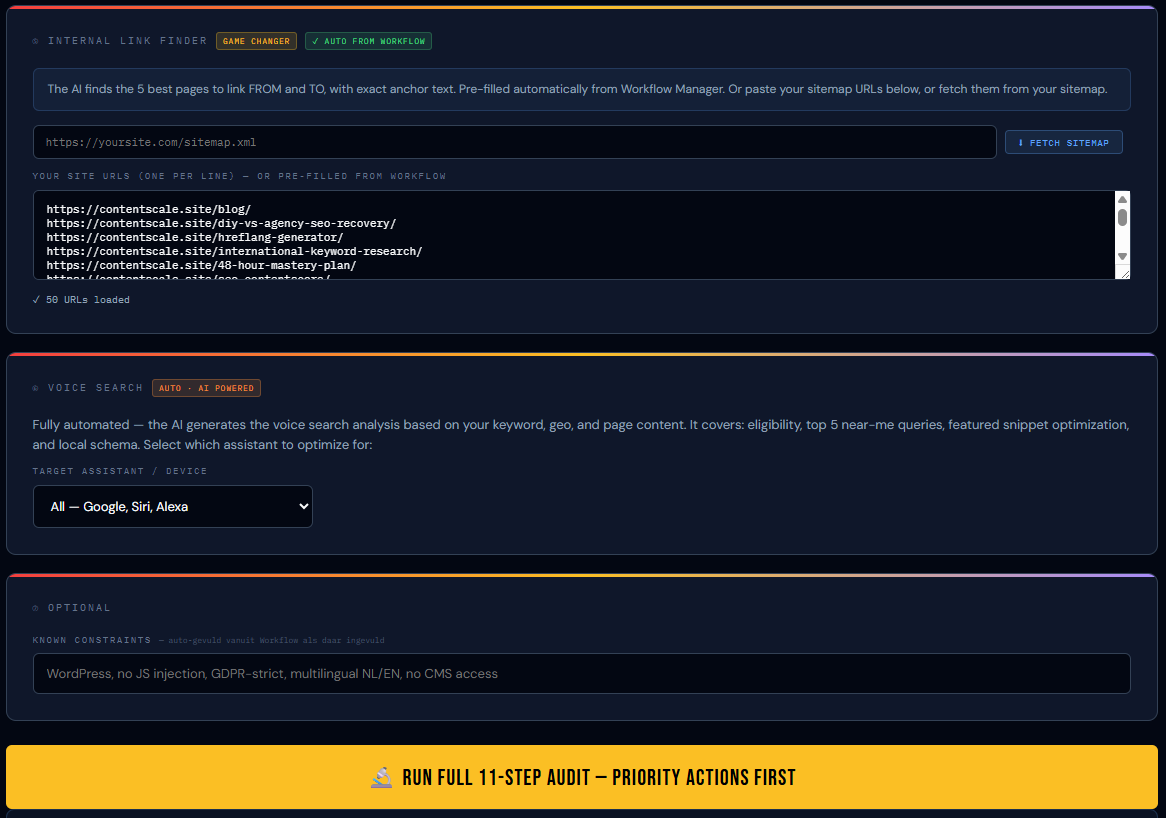
ContentScale vs Surfer SEO comes down to depth versus scope. Surfer SEO excels at real-time on-page scoring during content drafting, with 150,000+ users across 159 countries. ContentScale covers the full content scale pipeline: GSC-powered page prioritisation, AI content generation, GRAAF quality scoring, automated AI Overview and traditional rank tracking, and voice query optimisation — all using your own API keys with no per-word markup. The right choice depends on whether you need a writing assistant or an end-to-end content scaling system.
- 📌 Surfer SEO’s AI Tracker (covering AI Overviews, Perplexity, Gemini) costs $95–$495/month on top of the base plan — it is not included. (NestContent, 2026)
- 📌 Surfer SEO credits do not roll over on monthly plans — unused content editor credits expire at month end, meaning you pay for capacity you may not use. (Surfer SEO Docs, 2026)
- 📌 Surfer SEO was acquired by Group Positive in October 2025 — product direction and pace of development are worth monitoring in 2026. (Frase, 2026)
- 📌 Independent testing found Surfer AI-generated articles flagged as AI-written by Surfer’s own Humanizer detection tool — the output requires significant editing. (NestContent, 2026)
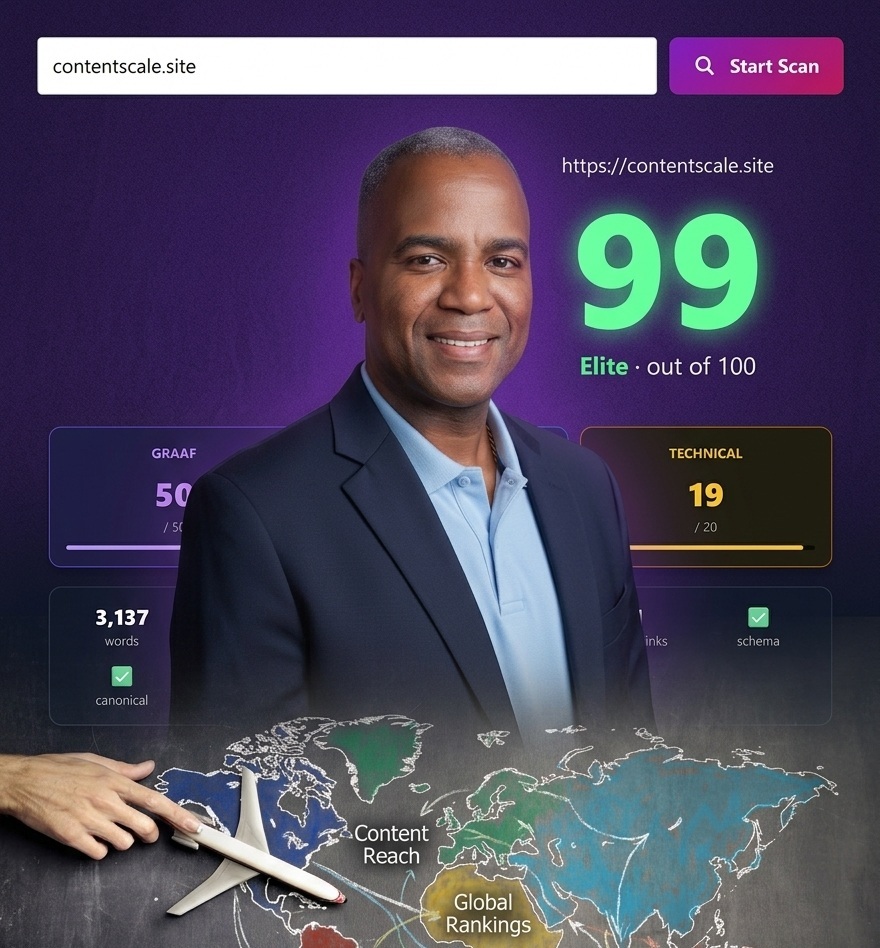
- 📌 ContentScale’s free ContentScore scanner requires no account, no credit card — scan any page and get a full 100-point GRAAF quality breakdown in 30 seconds. (ContentScale, 2026)
📋 Table of Contents
- 1. What ContentScale and Surfer SEO Actually Do
- 2. GSC Integration: Surface vs. Pipeline
- 3. Content Scoring: GRAAF vs. Content Score
- 4. Key Statistics: Content Scaling Tools 2026
- 5. AI Overview & Traditional Rank Tracking
- 6. Pricing Model: Subscription vs. Own API Keys
- 7. ContentScale vs Surfer SEO: Full Feature Table
- 8. Case Studies: Real Content Scaling Results
- 9. Who Should Use Which Tool?
- 10. Conclusion
- 11. Frequently Asked Questions
🔍 ContentScale vs Surfer SEO: What Each Tool Actually Does
The ContentScale vs Surfer SEO comparison starts with understanding what each tool actually solves. Both describe themselves as content optimisation tools, but they solve different problems at different stages of the content scaling workflow. Understanding the distinction saves you from paying for the wrong tool — or for two tools that overlap more than you realise.
Surfer SEO is primarily a content editor with real-time on-page scoring. You open a keyword, Surfer analyses the top-ranking pages for that term, and as you write, a sidebar updates your Content Score based on NLP term coverage, heading structure, word count, and 500+ on-page signals. It tells you what the currently-ranking pages have in common and suggests you match that pattern. It launched in 2017 and had grown to 150,000+ users across 159 countries by 2026. (Surfer SEO, 2026)
ContentScale is a full content scaling system built around the GRAAF Framework — Genuinely Credible, Relevant, Actionable, Accurate, Fresh. Rather than optimising one page at a time during drafting, ContentScale connects to your Google Search Console data to identify which pages already in your index are losing ground, generates content from scratch or rewrites existing pages guided by your real GSC impression and click data, and then monitors both traditional Google rankings and AI citation visibility automatically. The free ContentScore scanner gives any page a 100-point quality score in 30 seconds with no account required. The full Engine — covering research, writing, rewriting, and tracking — runs on your own Gemini and Claude API keys so there is no per-word or per-article platform markup.
“SurferSEO still works for single-page optimization. Teams managing larger libraries often hit limits with credit-based pricing, limited AI Search tracking, and manual execution.” — AirOps, Content Scaling Analysis (AirOps, February 2026)
The honest summary: Surfer is a precision instrument for individual page optimisation at drafting time. ContentScale is a system for managing content quality and visibility across an entire site — from identifying what to fix, to writing or rewriting it, to tracking what happens after it publishes.
📊 ContentScale vs Surfer SEO: GSC Integration Depth
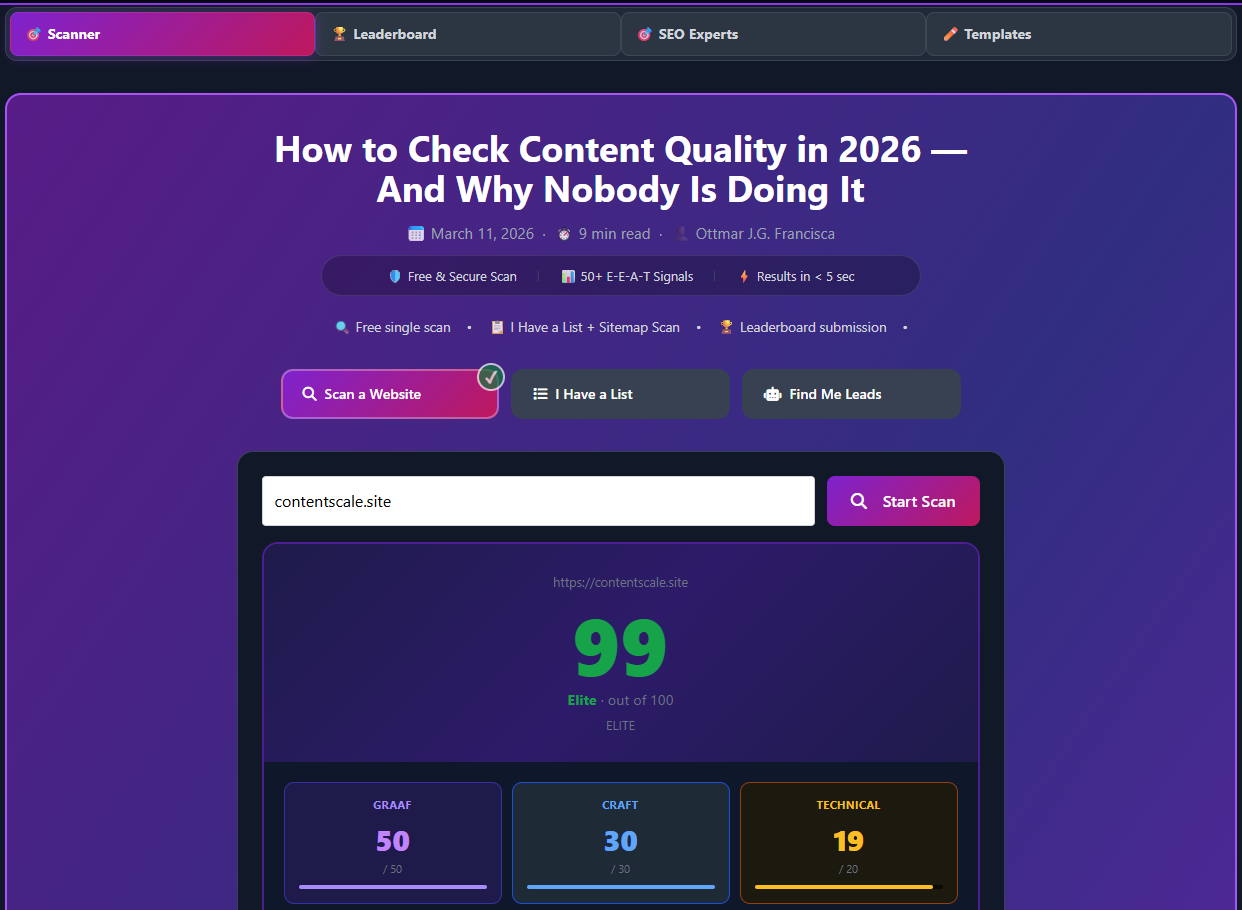
In the ContentScale vs Surfer SEO GSC comparison, both tools integrate with Google Search Console, but the integration depth differs significantly — and for content scaling workflows, depth matters more than presence.
Surfer SEO added a GSC integration in 2025 as part of its Sites hub, giving access to 48-hour performance data including traffic spikes, dips, and trends. It shows Content Score, position, traffic, impressions, and CTR per page, and flags pages that have dropped in rankings for the Content Audit feature. This is a genuinely useful addition. According to independent reviews, however, without the GSC connection the Topical Map accuracy drops and insights “feel generic.” The integration surfaces performance data but does not automatically drive the rewrite workflow — that still requires manual selection. (Search Atlas, 2026)
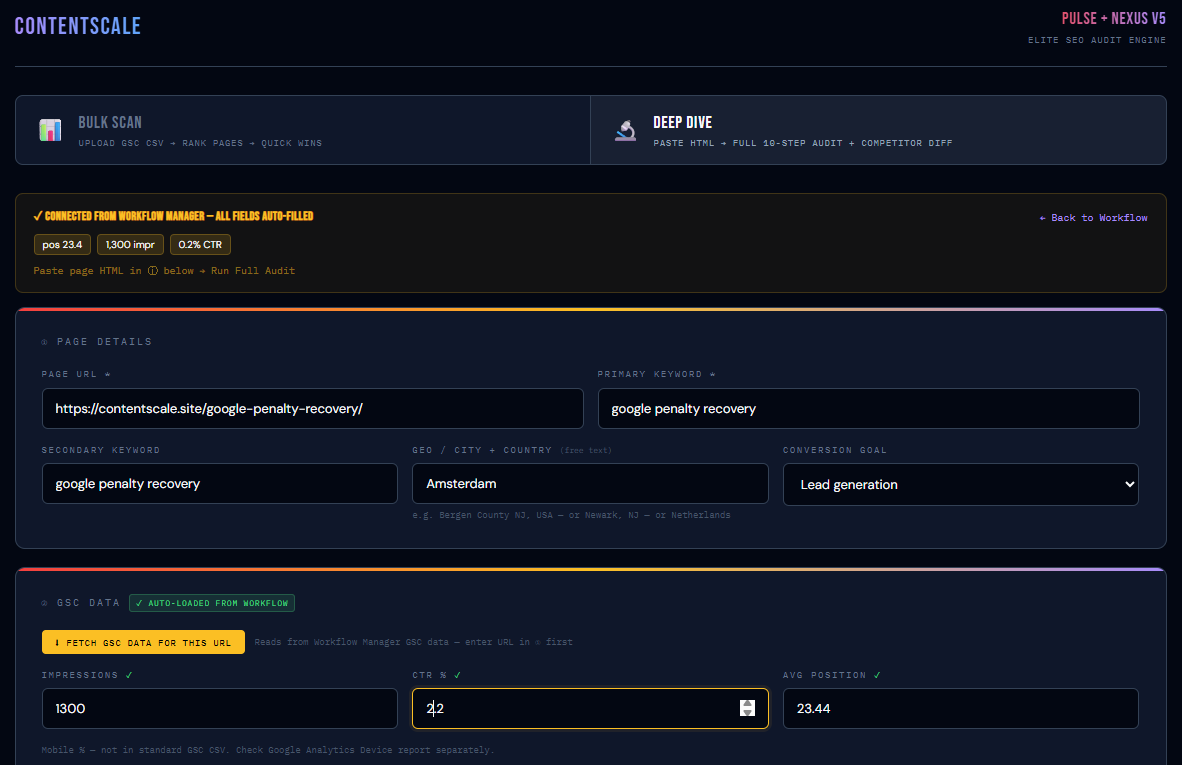
ContentScale’s GSC integration takes a different approach. Rather than displaying performance data as a dashboard layer, it pipes your real impression and click data directly into the rewrite analyser. Connect your GSC service account once per site, and ContentScale automatically identifies which pages to prioritise for rewrites based on actual search performance — not generic recommendations. Every rewrite decision is anchored to how your pages perform in search, not to how competitor pages are structured. For agencies managing multiple client sites, this means rewrite prioritisation is driven by data, not guesswork.
“Without GSC data, Surfer SEO Topical Map accuracy drops, and insights feel generic. Boosting topical authority is possible, but the tool relies on your ability to act on suggestions wisely.” — Search Atlas, Surfer SEO Review (Search Atlas, 2026)
Pro Tip: For a content scale strategy that is driven by your actual search performance rather than SERP patterns from competitors, a GSC integration that feeds directly into the rewrite workflow delivers materially better prioritisation than one that surfaces data for manual review. Run your most important pages through the ContentScore system to see the gap between SERP-pattern scoring and GRAAF quality scoring.
See Your ContentScore Before Choosing a Tool
Scan any page free. No credit card. Compare your GRAAF score to Surfer’s Content Score recommendations.
🚀 Scan Free Now 💬 Ask Ottmar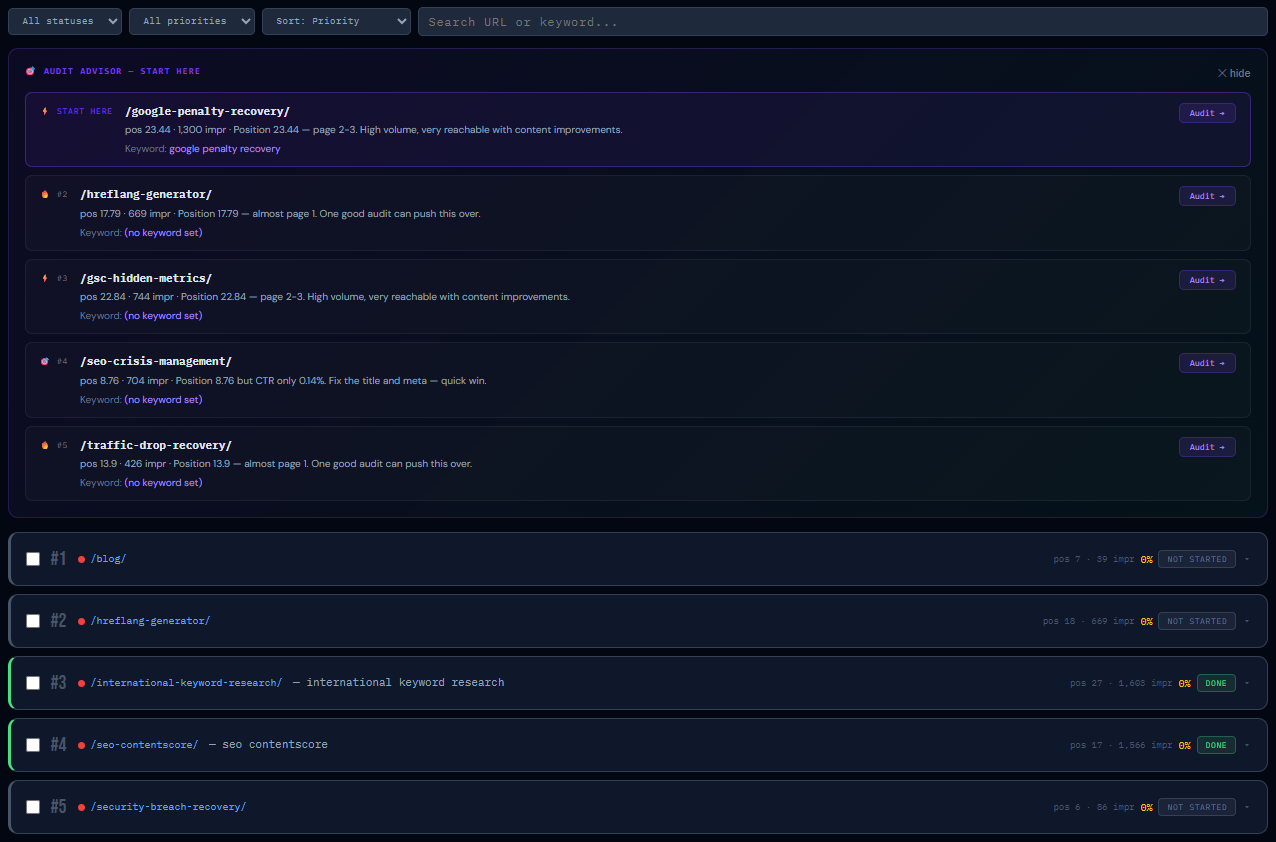
🎯 ContentScale vs Surfer SEO: GRAAF Framework vs Content Score
In the ContentScale vs Surfer SEO scoring debate, content scoring is where both tools spend most of their R&D, and the philosophical difference is worth understanding before choosing one for your content scaling workflow. Surfer’s Content Score and ContentScale’s GRAAF score measure different things — and optimising for one does not guarantee performance on the other.
Surfer’s Content Score is a competitive pattern-matching score. It analyses the pages currently ranking in the top 10 for your target keyword, identifies which NLP terms, heading structures, word counts, and on-page signals they share, and gives your content a score based on how closely it matches those patterns. The logic is that if the top-ranking pages share certain characteristics, matching those characteristics should help you rank. This approach works well when the SERP is stable and the top-ranking pages are genuinely high-quality signals. It is less reliable when the top-ranking pages are themselves low-quality, or when you are trying to rank in AI Overviews rather than traditional positions. Independent reviewers note that it is possible to “game” the score — hitting 80+ by inserting required terms without improving actual content quality. (RoboRhythms, 2026)
ContentScale’s GRAAF score is a deterministic quality measurement across five signals that predict both traditional ranking and AI citation readiness: Genuinely Credible (does the content cite verifiable sources and show real expertise?), Relevant (does it match exact user intent?), Actionable (does it give the reader something concrete to do?), Accurate (are all claims verifiable and current?), and Fresh (is the content updated and dated?). These signals map directly to what Google’s Quality Rater Guidelines assess for E-E-A-T, and to the structural characteristics AI systems prefer when selecting sources for citations. Pages scoring 90+ on the GRAAF ContentScore average 3.7× traffic improvement within 90 days across documented implementations. Explore the full methodology on the GRAAF Framework page.
“Score gaming is real. It is possible to hit 80+ by stuffing in required terms without improving readability or depth.” — RoboRhythms, Independent Surfer SEO Review (RoboRhythms, April 2026)
GRAAF vs. Surfer Content Score: Core Differences
| Criterion | GRAAF ContentScore | Surfer Content Score |
|---|---|---|
| Scoring basis | Deterministic quality signals (E-E-A-T aligned) | SERP pattern matching vs. top-10 competitors |
| AI citation readiness | Built into GRAAF — Fresh + Accurate + Credible signals | Not measured; AI Tracker is a separate paid add-on |
| Voice search optimisation | Direct answer structure built into scoring criteria | No dedicated voice query feature |
| Score gaming risk | Low — measures verifiable quality signals | High — term insertion can raise score without quality gain |
| Free access | Full score free at app.contentscale.site — no account | No free plan; 7-day money-back on paid plans from $99/mo |
| Real-time drafting feedback | Via CRAFT framework guidelines | Live sidebar score updates as you type |
📈 ContentScale vs Surfer SEO: Key Statistics 2026
⚡ ContentScale vs Surfer SEO: AI Overview Tracking Compared
This is the clearest structural difference between the two tools in 2026, and it matters for every content scale strategy that targets both traditional SERPs and AI-driven search.
Surfer SEO launched its AI Tracker in July 2025, adding monitoring for Google AI Overview, Google AI Mode, ChatGPT, Perplexity, and Gemini. Gemini tracking was added in December 2025. The feature tracks Visibility Score, Mention Rate, and Average Position across AI platforms. It is a well-built addition. The critical caveat: the AI Tracker is not included in any base plan. It costs $95–$495 per month as a separate add-on, depending on the volume of prompts tracked. On the Essential plan ($99/month), adding the AI Tracker means your effective monthly cost starts at $194 before any team seats. Traditional rank tracking is also a separate add-on — $17/month for 200 keywords. (NestContent, 2026)
ContentScale includes AI citation monitoring across Google AI Overview, Perplexity, and Bing AI, plus traditional Google organic rank monitoring, as part of the core system — not as add-ons. The automated scheduler checks due pages every hour in the background, compares each new snapshot against the previous one, flags when you gain or lose an AI citation, and logs position changes of 3+ positions for traditional rankings. Fresh Gemini-powered recommendations are generated automatically after each tracking cycle. For teams managing content scaling at volume, the difference between automated background monitoring and a manually-triggered add-on is significant. Learn more about the full tracking capability on the ContentScale system page.
“AI Search visibility depends on citations inside answers, not just keyword rankings on the SERP. Credit-based tools slow production when teams need to refresh or publish at scale.” — AirOps, Surfer SEO Alternatives Analysis (AirOps, February 2026)
⚠️ ContentScale vs Surfer SEO: AI Tracking Is Not Optional
With 26% of Google searches triggering AI Overviews in 2026 — and AI Overviews reducing CTR by up to 64% even for position-1 pages — monitoring AI citations is no longer optional for any serious content scaling strategy. A tool that charges $95+/month extra for this feature adds that cost to every client site you manage. At 5 client sites, that is $475–$2,475/month in add-on costs alone, before the base subscription.
💰 ContentScale vs Surfer SEO: Pricing Model Comparison
The ContentScale vs Surfer SEO pricing model difference is structural, not just numerical — and it compounds significantly at scale.
Surfer SEO operates on a credit-based subscription model. The Essential plan ($99/month, or $79/month annually) includes 30 content editor credits per month. The Scale plan ($219/month, or $175/month annually) gives 100 credits. Unused credits do not roll over on monthly plans — they expire at the end of the billing period. AI-generated articles cost extra on top: $10–19 per article depending on plan. The SERP Analyzer is a $29 add-on on Essential. Rank Tracker is $17/month extra. AI Tracker is $95–$495/month extra. A growing team can quickly reach an effective cost of $400–$700/month before hitting enterprise tier, where pricing becomes custom. (Surfer SEO Docs, 2026)
ContentScale’s Engine uses a bring-your-own-API-key model. You connect your Gemini API key (which has a generous free tier for research and analysis) and your Anthropic Claude API key. You pay Google and Anthropic directly at their published rates — typically $0.01–$0.05 for a full 2,000-word Claude-written article at current pricing. ContentScale takes no markup on AI usage. The platform cost covers the system — the GSC integration, the tracking infrastructure, the GRAAF scoring, the rewrite workflow — not the AI tokens. For high-volume content scaling, this model means your costs scale with actual output rather than against a credits ceiling that resets monthly regardless of usage.
✅ What the Pricing Difference Means in Practice
- For solo bloggers in the ContentScale vs Surfer SEO decision: ContentScale’s free scanner covers quality auditing at zero cost. Surfer Essential at $99/month is hard to justify below 6 articles/month. (RoboRhythms, 2026)
- For freelance SEOs: ContentScale’s own-key model means no capacity ceiling — article volume is limited by your API key limits, not by platform credits that expire.
- For agencies: AI tracking and rank tracking are included in ContentScale’s system. On Surfer, both are separate add-ons that multiply per client site managed.
- For high-volume content teams: ContentScale’s bulk content creation and automated background tracking eliminate the manual execution overhead that credit-based tools require at scale.
- For EU businesses: ContentScale is Amsterdam-based, GDPR and DSA compliant, with direct WhatsApp support — removing the compliance friction that comes with US-based subscription tools.
📋 ContentScale vs Surfer SEO: Full Feature Comparison Table
| Feature | ContentScale | Surfer SEO |
|---|---|---|
| Content quality scoring | GRAAF Framework — 100-point deterministic quality score | Content Score — SERP competitor pattern matching |
| Free access | Full ContentScore scanner free — no account needed | No free plan; 7-day money-back on paid plans |
| GSC integration depth | GSC data drives rewrite prioritisation automatically | GSC data displayed in dashboard; manual action required |
| AI Overview tracking | Included — Google AI Overview, Perplexity, Bing AI | Separate add-on: $95–$495/month |
| Traditional rank tracking | Included — position changes, 3+ delta alerts | Separate add-on: $17/month for 200 keywords |
| AI content writing | Claude Sonnet via own API key — no per-article markup | Surfer AI: $10–$19/article extra; output needs heavy editing |
| Automated background monitoring | Checks due pages every hour — no manual trigger | Manual checks; AI Tracker add-on required for automation |
| Voice query optimisation | Built into content creation workflow | No dedicated voice query feature |
| News article generation | AI-written news from RSS feeds with schema | No RSS/news content generation feature |
| Bulk content creation | Generate dozens of pages in one job | Batch content creation available on Scale+ plans |
| Keyword clustering | Automatic cluster generation per profile | Topical Map feature available |
| Real-time drafting score | CRAFT framework guidelines during writing | Live sidebar Content Score updates as you type |
| Pricing model | Own API keys — pay Google/Anthropic directly, no markup | Monthly credits; unused expire; multiple add-ons compound costs |
| EU/GDPR compliance | Amsterdam-based; GDPR and DSA compliant | UK/EU VAT registered; compliance varies |
| Company stability | Independent, founder-led from Amsterdam | Acquired by Group Positive, October 2025 — watch closely |
| Base entry price | Free scanner; Engine on own API keys | $99/month (Essential); no free tier |
ContentScale vs Surfer SEO — Run Your Own ContentScale Score Now
Compare your GRAAF quality score against any competitor. No Surfer subscription needed.
🚀 Free ContentScore Scan 📄 See Full System📊 ContentScale vs Surfer SEO: Real Content Scaling Results
Amsterdam Digital Marketing Agency — 340% Traffic Lift in 90 Days
Challenge: The agency had been using a content scoring tool (similar to Surfer’s approach) for 18 months, consistently hitting 80+ content scores on every article. Despite the green scores, organic traffic had plateaued for 12 consecutive months. 14 key service pages were losing ground to AI Overviews — impressions stayed stable but clicks dropped 38% over Q4 2024. The agency needed a content scaling approach that addressed AI citation readiness, not just SERP pattern matching. Monthly organic leads had fallen from 47 to 29.
Solution — ContentScale GRAAF implementation:
- GSC diagnosis: Connected GSC to identify the 14 pages with stable impressions but falling CTR — AI Overview cannibalization confirmed for all 14
- GRAAF scoring: All 14 pages scored below 62 on ContentScore — Genuinely Credible and Fresh signals were the primary gaps despite high Surfer-style scores
- CRAFT + GRAAF rewrite: Added 45-60 word direct answers, FAQPage schema, author credential visibility, and quarterly freshness signals to all 14 pages
Results after 90 days:
Key Lesson: A high Surfer-style Content Score and a high GRAAF ContentScore measure different things. Pages can hit 80+ on SERP pattern matching while failing the quality signals that determine AI citation readiness — and in 2026, AI citation readiness determines whether your traffic grows or stagnates.
Netherlands B2B SaaS — Switching from Credit-Based Tool to Own-Key Content Scaling
Challenge: A Netherlands-based SaaS company had been paying €280/month for a content optimisation subscription (base plan + rank tracking add-on), hitting credit limits mid-month and pausing content production as a result. 24 blog posts were being extracted by AI Overviews without citation — impressions at 45,000/month but clicks fallen from 1,890 to 907. The team needed to scale content output without hitting artificial capacity ceilings, and needed AI citation monitoring without adding another subscription.
Solution:
- Migration to own-key model: Set up Gemini API (free tier covered all research) and Claude API (approximately €0.03 per 2,000-word article at current rates)
- GSC-connected prioritisation: ContentScale identified the 24 blog posts with the highest impression-to-click ratio gap — these became the rewrite priority list
- GRAAF + CRAFT implementation: Rewrote all 24 posts with proprietary data points, micro-answer blocks, and complete schema — no credit ceiling mid-project
Results after 60 days:
Key Lesson: Credit-based content scaling tools create production pauses that compound over time. When your content strategy is interrupted mid-month because credits ran out, rankings suffer and AI citation momentum is lost. The own-key model eliminates that ceiling entirely.
🏆 ContentScale vs Surfer SEO: Who Should Use Which Tool?
In the ContentScale vs Surfer SEO decision, both are legitimate tools. The honest answer is that the right choice depends on where your content scaling bottleneck actually is.
✅ Choose ContentScale if:
- You need AI Overview and traditional rank tracking together — both are included, not priced as separate add-ons that multiply per client site
- You manage multiple client sites for an agency — GSC-connected prioritisation and own-key economics scale without compounding subscription costs
- You are publishing for both Google and AI search — the GRAAF framework measures AI citation readiness, not just SERP pattern matching
- You need content creation that goes beyond on-page scoring — research, writing, rewriting, tracking, and voice query optimisation in one workflow
- You want to start free with no commitment — the ContentScore scanner is permanently free with no account required
✅ Surfer SEO is the stronger choice if:
- You need live on-page scoring during drafting — Surfer’s real-time Content Score sidebar is its strongest differentiator and genuinely useful for writers
- You already have a separate rank tracker and AI monitoring tool — if those are covered, Surfer’s core editor is excellent at what it does
- Your team is large and workflow-oriented — Surfer’s collaboration features, shared links, and workspace management work well for bigger editorial teams
- You publish in a language where Surfer has strong NLP support — English, Danish, Dutch, and Polish receive the most complete NLP analysis
🚀 Conclusion: ContentScale vs Surfer SEO in 2026
The complete ContentScale vs Surfer SEO comparison in 2026 is not really about which tool writes better copy or produces a prettier score. It is about what your content scaling bottleneck actually is. If you need a real-time drafting companion that tells you whether your keyword coverage matches the current top-10 pages, Surfer SEO is genuinely good at that. If you need a system that identifies which pages to fix using your actual GSC data, generates or rewrites content, and then monitors both traditional rankings and AI citations automatically — without a growing stack of add-ons — ContentScale is the more complete answer.
One more ContentScale vs Surfer SEO factor worth noting: the acquisition of Surfer SEO by Group Positive in October 2025 is worth watching. Platform acquisitions in the SEO tool space have historically led to pricing changes and slower feature development. ContentScale remains independently operated from Amsterdam with direct founder access via WhatsApp. For EU businesses navigating GDPR and DSA compliance alongside content scaling, that proximity matters.
The free ContentScore scanner gives you immediate, actionable data with no commitment. Scan your most important pages at app.contentscale.site and compare the GRAAF breakdown to what your current tool tells you. The gaps between the two scores are exactly where traffic is being lost.
🚀 Your Next Steps
- Scan your highest-traffic page free — get your ContentScore in 30 seconds, no account
- Compare your GRAAF score to your current Surfer Content Score — this is the heart of the ContentScale vs Surfer SEO quality gap — they will diverge on Credibility and Freshness signals
- Read the GRAAF Framework guide to understand what drives a 90+ score
- Review the AI Overview crisis recovery guide if your traffic has already been affected
- Check the ContentScore methodology page for the full 100-point breakdown
- WhatsApp Ottmar for a direct implementation conversation

❓ ContentScale vs Surfer SEO: Frequently Asked Questions
Quick Answer: Surfer SEO optimises individual pages during drafting using SERP competitor pattern matching; ContentScale is an end-to-end content scaling system driven by your Google Search Console data.
Surfer’s Content Score measures how closely your draft matches the top-10 ranking pages for a keyword — a useful writing aid. ContentScale connects to your GSC data to identify which pages need treatment, rewrites them using the GRAAF quality framework, and automatically monitors both traditional Google rankings and AI Overview citations after publishing. The free ContentScore scanner requires no account and gives a full 100-point GRAAF breakdown in 30 seconds. For agencies and teams managing content at scale across multiple sites, the GSC-connected prioritisation and own-key pricing model are the primary reasons to choose ContentScale over Surfer.
Quick Answer: Yes — Surfer added a GSC integration in 2025, but it displays performance data for manual review rather than feeding it into the rewrite workflow automatically.
Surfer’s Sites hub now pulls 48-hour GSC data including positions, clicks, impressions, and CTR per page. The Content Audit feature uses this to flag pages for review. ContentScale’s GSC integration goes further — it pipes impression and click data directly into the rewrite analyser, automatically identifying which pages to prioritise and pre-filling the analysis with real search performance data. For a content scale strategy where rewrite prioritisation needs to be data-driven rather than manual, this depth of integration is the deciding factor. See the full workflow on the ContentScale system page.
Quick Answer: Surfer SEO’s AI Tracker covers Google AI Overview, Perplexity, ChatGPT, and Gemini — but it costs $95–$495/month extra on top of the base subscription, and is not included in any plan.
Surfer launched the AI Tracker add-on in July 2025, with Gemini added in December 2025. It tracks Visibility Score, Mention Rate, and Average Position across AI platforms. The significant caveat is that it is priced as a separate add-on: $95/month for 25 prompts per week at the entry level. On the Essential plan ($99/month), adding AI tracking brings the effective cost to $194+/month before team seats or other add-ons. ContentScale includes AI citation tracking for Google AI Overview, Perplexity, and Bing AI in the base system, with automated hourly checks and change detection built in. For the AI Overview recovery methodology, see the AI Overview crisis recovery guide.
Quick Answer: The ContentScore scanner is permanently free — no account, no credit card, no time limit. Scan any URL and get a full 100-point GRAAF quality breakdown in 30 seconds.
The free scanner at app.contentscale.site has been available with no account requirement since launch and will remain free. The ContentScale Engine — covering GSC-connected rewrites, AI content generation, automated tracking, and bulk creation — uses your own Gemini and Claude API keys. You pay Google and Anthropic directly at their published rates with no ContentScale markup. Gemini has a free tier that covers most research and analysis tasks. A full Claude-written 2,000-word article typically costs $0.01–$0.05 at current API rates. Surfer SEO has no free plan; access starts at $99/month with a 7-day money-back guarantee.
Quick Answer: Surfer’s Content Score measures SERP pattern matching against competitors; the GRAAF Framework measures five deterministic quality signals that predict both traditional ranking and AI citation readiness.
GRAAF stands for Genuinely Credible, Relevant, Actionable, Accurate, and Fresh. These five signals map directly to Google’s E-E-A-T quality criteria and to the structural characteristics AI systems prefer when selecting sources for AI Overviews. Pages scoring 90+ on the GRAAF ContentScore average 3.7× traffic improvement within 90 days. Surfer’s Content Score can be raised by inserting required keyword terms without improving actual content quality — independent reviews note that “score gaming is real” with Surfer’s approach. The full GRAAF methodology is documented on the GRAAF Framework page.
Quick Answer: For agencies needing GSC-connected rewrite workflows, automated AI citation monitoring, bulk content creation, and voice query optimisation, ContentScale covers the full content scaling pipeline that Surfer does not.
Surfer’s strongest feature for agencies is the real-time Content Score sidebar during drafting, and its collaboration and shareable-link features for managing writers. ContentScale handles the full upstream and downstream workflow that Surfer does not: identifying which pages need work from GSC data, running rewrites or new content at bulk volume using your own API keys, and monitoring traditional rankings and AI citations automatically after publishing. For agencies paying per-article AI costs through Surfer or stacking add-ons for rank tracking and AI monitoring, the economics of switching to ContentScale’s own-key model are worth calculating. Contact Ottmar on WhatsApp for a direct agency assessment.
Quick Answer: The ContentScore scanner is permanently free — scan unlimited pages at app.contentscale.site with no account, no trial period, no credit card.
Unlike Surfer SEO, which has no free plan and offers only a 7-day money-back guarantee on paid plans starting at $99/month, ContentScale’s free scanner has no time limit or page cap. You can audit your entire site before making any decision. The ContentScale Engine, which covers the full GSC-connected content scaling workflow, is available with your own API keys — Gemini’s free tier covers research and analysis for most users, and Claude API costs are typically fractions of a cent per article at current rates. To understand the full system before committing to anything, start with a free scan at app.contentscale.site.
Quick Answer: ContentScale structures content with 45–60 word direct answers at section openings — the format AI assistants and voice interfaces extract directly — and identifies question-based keyword opportunities in the content planning workflow.
Voice query optimisation in ContentScale is integrated into the content creation process rather than treated as a separate feature. The system identifies conversational, question-based keywords and formats content to directly answer them — a key requirement for appearing as the spoken answer on Google Assistant and Siri. The GRAAF framework’s Relevant signal specifically measures whether content matches conversational query intent, not just informational keyword intent. Surfer SEO does not have a dedicated voice query optimisation feature. For the full methodology on structuring content for voice and AI search, see the AI Overview recovery guide.
Quick Answer: Your existing content stays in WordPress or your CMS — switching tools does not affect published pages. ContentScale’s GSC integration immediately identifies which of your existing pages need treatment.
Switching from Surfer SEO to ContentScale for your content scaling workflow does not require migrating or re-uploading existing content. Connect your Google Search Console service account, and ContentScale will pull performance data for all pages already in your index. The Content Audit workflow then identifies which pages to prioritise for rewriting based on real search performance gaps — not based on a new tool’s assessment of your keyword coverage. For any pages already written with Surfer, running them through the free ContentScore scanner will show exactly which GRAAF signals are missing and what to fix first.
ContentScale vs Surfer SEO — Ready to See Your ContentScore?
Get your free 100-point GRAAF score in 30 seconds, or talk to Ottmar directly about your content scaling strategy.