Content at Scale Is Now BrandWell: What Changed in 2026
- The rebrand: Content at Scale → BrandWell, August 2024. Same product, new positioning.
- The reason: volume became a commodity once any LLM could generate it instantly.
- Not the same as ContentScale: BrandWell generates content; ContentScale scores and audits it.
- 8 signals still drive rankings: intent, depth, E-E-A-T, authority, freshness, a quotable answer, technical health, and citation-ready formatting.
- Where to go: if you want quality measurement rather than mass generation, score any page free at app.contentscale.site.
📑 Table of Contents
If you searched for Content at Scale, BrandWell, or “Content at Scale is now BrandWell” and landed here, you’re not confused — the platform was renamed. This is the story of why a tool literally named after content volume walked away from that name, what its own president said on stage about it, and which ranking signals survived the shift. For the plain definition of the term itself, see What Is Content at Scale in 2026?
Is Content at Scale Now BrandWell?
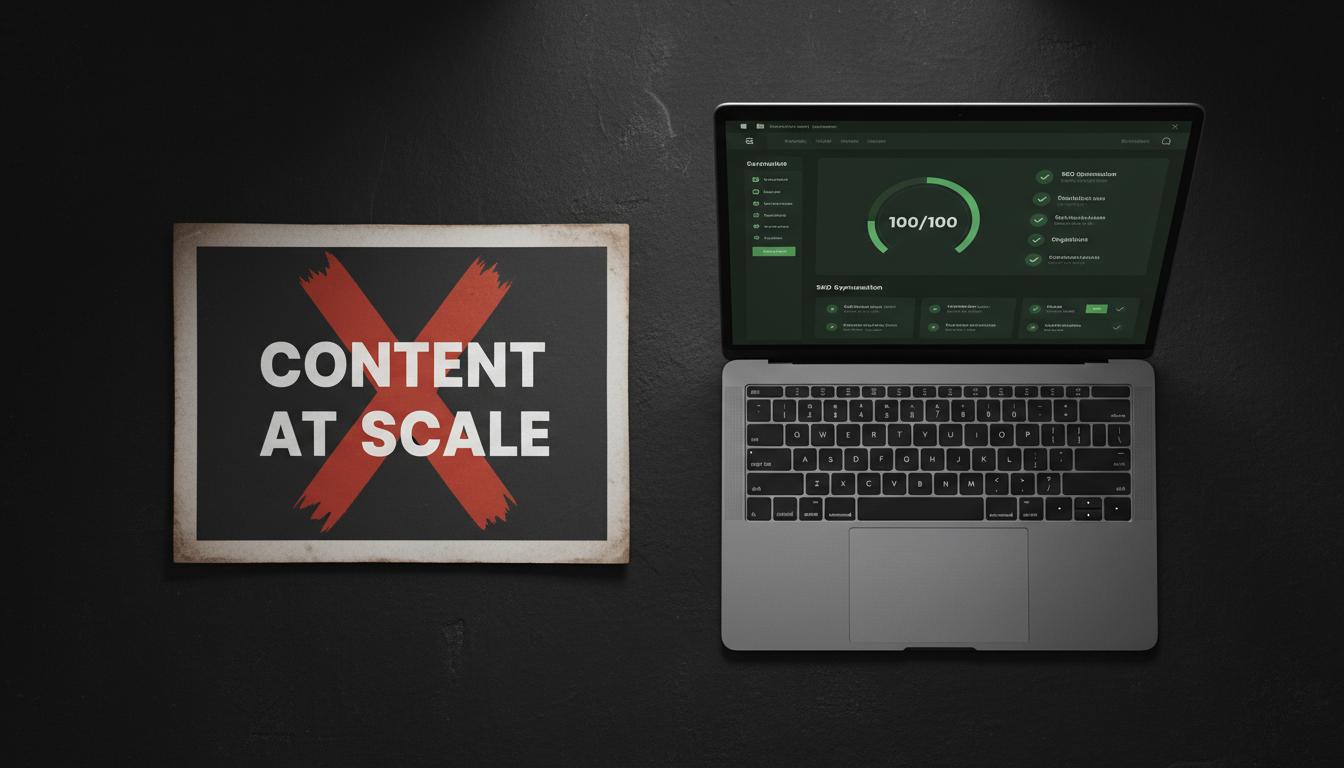
Yes. Content at Scale rebranded to BrandWell in August 2024. The product — an AI writing platform that generated long-form articles from a keyword — continued operating under the new name. If you have an old bookmark, an old invoice, or a half-remembered review for “Content at Scale,” it now points to BrandWell.
If you’re trying to place what you remember: the original Content at Scale was an AI content writer built around Julia McCoy’s CRAFT Framework — Cut the fluff, Review/edit/optimise, Add expertise, Fact-check, and Trust signals — paired with a built-in CopyScape plagiarism check so every draft came back verified original. People genuinely liked it; the AI writer was the product’s strongest feature, and CRAFT became a widely cited standard for editing AI-generated content into something publishable. That tool still exists, under the BrandWell name. What changed is the surrounding landscape, not whether the original writer was good.
The rename was not cosmetic. A company rarely abandons a category-defining, exact-match keyword in its own name unless the keyword has stopped describing where the value is. That is exactly what happened here.
Why Content at Scale Is Now BrandWell
Content at Scale is now BrandWell for one reason: when the company that built its name on producing content at volume no longer leads with it, volume is no longer where the advantage lives. The lesson is not “stop making content” — it is “make each page good enough to be cited.”
The GRAAF Framework builds directly on that lineage rather than replacing it: GRAAF is a 50-point quality foundation (Genuinely Credible, Relevant, Actionable, Accurate, Fresh), combined with the original 30-point CRAFT editing methodology and 20 points of technical SEO, for a 100-point ContentScore. See the full breakdown on the GRAAF Framework and CRAFT Framework pages.
Why the Rebrand Happened
The clearest explanation came from the platform’s own then-president, Julia McCoy, speaking at PubCon. Her point was blunt: in the age of AI, the content itself is no longer the differentiator.
“Content itself is really not a USP in the age of AI because any LLM can now generate content at the touch of a button.”
— Julia McCoy, then-President of Content at Scale, PubCon
▶ Julia McCoy at PubCon on why content volume is no longer a USP — the moment behind the Content at Scale rebrand.
That single sentence explains the rebrand. When a tool’s core promise — “we make content at scale” — becomes something every chatbot can do for free, the promise stops selling. The defensible value moved upstream and downstream of generation: research, brand authority, fact accuracy, and the auditing that decides whether a page is actually good enough to rank and be cited.
⚠️ The trap this creates
Because generation is now instant and cheap, the most common mistake in 2026 is mistaking output for progress — publishing dozens of AI articles that never rank because none of them carry the authority or quality signals an engine needs to cite. More volume is not more visibility.
The 8 Signals That Still Drive Rankings
If volume isn’t the differentiator, what is? The signals below are the ones that survived the shift — the work that AI generation does not do for you. These are the levers a content-at-scale operation has to pull on every page.
- Search-intent match — the page answers the exact question behind the query, not an adjacent one.
- Content depth and structure — comprehensive coverage with scannable headings and short, quotable passages.
- Experience & expertise (E-E-A-T) — a named, credentialed author and real first-hand insight.
- Topical authority & backlinks — the strongest off-page predictor of AI citation, per a 129,000-domain study by SE Ranking (2025).
- Freshness — current dates, current data, current examples.
- A clear, quotable answer — a 40–60 word block an engine can lift verbatim.
- Technical & schema health — fast pages, clean markup, FAQ and Article schema.
- Citation-ready formatting — entity-anchored sentences and question-form headings.
✅ The takeaway
- All eight are quality and authority signals. None of them is “publish more.”
- This is why scoring a page before publishing beats generating another one — and why the GRAAF Framework measures exactly these signals.
BrandWell vs ContentScale: What’s the Difference?
Because the names are similar, this gets confused constantly. They solve opposite halves of the problem: one generates content, the other measures and improves it.
| Factor | BrandWell (formerly Content at Scale) | ContentScale (contentscale.site) |
|---|---|---|
| Core job | Generates long-form AI content | Scores & audits content quality |
| Output | New articles from a keyword | A 100-point quality diagnosis + fixes |
| Best for | Producing drafts at volume | Making existing pages rank & get cited |
| AI-citation focus | Generation-first | Citation & AI-Overview-first |
| Free tier | Limited trial | Free ContentScore scanner |
In short: BrandWell helps you write more; ContentScale helps you make what you write good enough to win. Many teams use a generator for a first draft, then score and rebuild it against quality signals before publishing — that combination is what “content at scale” means in practice today.
Where to Go Next
If you came here looking for the old Content at Scale platform, you have two clear paths depending on what you actually need:
If you want to generate content — that product still exists as BrandWell. The tool didn’t disappear; only the name and positioning changed.
If you want your content to rank and get cited — that’s a quality and authority problem, not a volume one. Run a free ContentScore scan on your weakest page to see exactly which of the eight signals it’s missing, then fix those before producing anything new. Start from the ContentScale homepage to see the scanner, Lead Crawler, and Content Engine.
The Content at Scale Alternative: Score First, Then Engine
Most people searching for the old Content at Scale are really looking for a Content at Scale alternative — something that helps a page actually rank and get cited, not just generate more drafts. The practical answer is two tools used in order — one free, one paid.
1. GRAAF SEO ContentScore — the structure Google Search and AI systems reward
Start by diagnosing, not generating. The free GRAAF SEO ContentScore grades any page on the exact structure Google Search and AI systems look for — Structure, E-E-A-T, schema, quotable answers, freshness and more — and returns a single ContentScore out of 100 before Google ever sees it. It is the clearest way to know whether a page is built to get cited and ranked in 2026 and beyond.
→ Free scan: app.contentscale.site
2. The Content Engine — PULSE + NEXUS, and why it works
Once the score shows the gap, the Content Engine closes it. It is a two-engine intelligence system built on the GRAAF Framework:
- PULSE — the live audit & researcher. It reads your pages, your Google Search Console data, and your live competitors in real time, so every brief starts from evidence, not guesswork.
- NEXUS — the citation engine. It decodes what Google and AI Overviews actually reward, then builds content engineered to beat the current top results — SERP Spy, People-Also-Ask, voice search, competitor entities, and content briefs in one place.
Why this is the real alternative: the renamed BrandWell generates content; PULSE + NEXUS researches, builds, and scores it against the eight ranking signals before you publish. A generator gives you volume — this gives you a page built to get cited.
→ Try the Content Engine: app.contentscale.site/content-engine
Make your content good enough to get cited
Score any page against the 8 signals above — free, in about 30 seconds, no account needed.
→ Try ContentScale FreeOr connect with Ottmar: WhatsApp +31628073996 · Amsterdam, NL
Why Volume Stopped Working — Statistics (2025–2026)
6.49% → ~13% — AI Overviews grew from about 6.49% of Google queries in January 2025 to roughly 13% by March 2025. (Search Engine Land / Semrush, 2025)
~25% of US searches — by late 2025 AI Overviews appeared in roughly a quarter of US searches. (BrightEdge / Conductor, 2025)
~34.5% fewer clicks — top-ranking pages lose around 34.5% of their clicks when an AI Overview appears, across a 300,000-keyword study. (Ahrefs, 2025)
Referring domains = #1 predictor — backlinks were the single strongest predictor of AI citation across 129,000 domains. (SE Ranking, 2025)
~35% higher CTR — brands cited inside AI Overviews earn about 35% higher organic click-through than uncited brands. (Seer Interactive, 2025)
−25% search volume by 2026 — Gartner projected traditional search volume would fall about 25% as AI assistants absorb queries. (Gartner, 2024)
From AI-generated volume to AI citations
Challenge: a services client had published 20+ AI-generated articles that ranked on page 3–5 and were never cited in AI Overviews — classic volume-without-authority.
Solution: instead of generating more, the worst performers were scored with the GRAAF Framework, rebuilt around a quotable answer, named sources, and FAQ schema, and supported with a small number of relevant links.
Result: the rebuilt pages began appearing as cited sources in AI Overviews for their target questions, with recovered organic clicks inside the 90-day window.
Source: ContentScale client data, 2026. Details anonymized at client’s request.
Content at Scale & BrandWell — Questions People Ask
Yes. The AI content platform Content at Scale rebranded to BrandWell in August 2024. The product continued under the new name; the change reflected a shift away from positioning around raw content volume, which large language models had turned into a commodity. For the plain definition of the term, see What Is Content at Scale?
Because volume stopped being a differentiator. Once any large language model could generate long-form content instantly, a name built around producing content at scale no longer described the value. As its then-president Julia McCoy put it at PubCon, content itself is no longer a USP in the age of AI — so the brand repositioned around authority and quality.
No. Content at Scale (now BrandWell) is an AI content-generation platform. ContentScale, at contentscale.site, is a separate AI-powered SEO content-scoring and analysis platform that audits and grades pages against quality signals — it does not bulk-generate articles. Similar names, opposite jobs.
Search-intent match, content depth and structure, experience and expertise (E-E-A-T), topical authority and backlinks, freshness, a clear quotable answer, technical and schema health, and citation-ready formatting. These are the durable signals that survived the shift away from volume — all measured by the GRAAF Framework.
If you want to measure and improve content quality rather than mass-generate it, ContentScale scores any page against 100 quality signals for free at app.contentscale.site. If you specifically want a generation tool, BrandWell is the renamed Content at Scale product.
Content at Scale → BrandWell — Reviewed by Ottmar J.G. Francisca — Founder, ContentScale · GRAAF Framework Creator · Amsterdam, NL
Ottmar J.G. Francisca is an independent SEO specialist and creator of the GRAAF Framework — a deterministic 100-point content-quality methodology built for the AI-search era. He works one-on-one with businesses adapting their content to AI Overviews and answer engines.
Platform: Founder of ContentScale — a free AI-powered SEO content-scoring platform. Free scanner at app.contentscale.site.
Last reviewed: June 18, 2026 · WhatsApp Ottmar · LinkedIn