Last updated: 13 November 2026
How do you get ChatGPT to recommend your business?
Short answer: You can get ChatGPT to recommend your business only by raising the odds; you cannot buy or force a recommendation. Allow OpenAI’s search crawler (OAI-SearchBot), answer the questions buyers ask on your own site, make clear who you are and what you do, get others to write about you, and measure for every question whether you are mentioned, recommended or linked.
Key takeaways
- Being mentioned, being recommended and being cited are three different outcomes. Measure them separately.
- If you block OAI-SearchBot in robots.txt, OpenAI says your site will not be shown in ChatGPT search answers.
- ChatGPT can only recommend what it can find and understand: clear services, prices, audience and service area.
- What others say about you (reviews, mentions) counts too. You build that; you do not buy it.
- Nobody can guarantee a recommendation. Anyone who promises one cannot back it up.
Mentioned, recommended or cited: what do you actually want?
When business owners ask whether ChatGPT recommends them, they often mix up three different things. It helps to separate them, because you measure and improve each one differently.
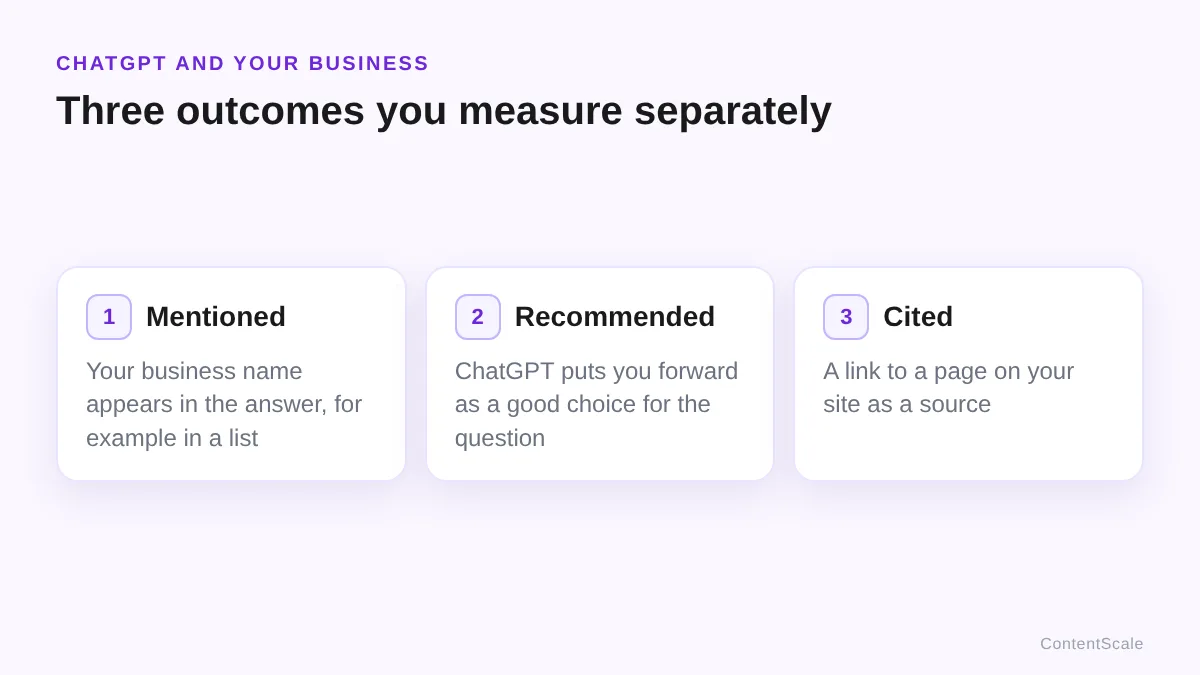
| Outcome | What you see in the answer | What it gives you |
|---|---|---|
| Mentioned | Your business name appears in the answer, for example in a list | Awareness, but not yet a choice |
| Recommended | ChatGPT puts you forward as a good choice for the question | The strongest outcome for a buyer |
| Cited | A link to a page on your site as a source | Visits and verifiability |
A mention without a link is not the same as a link to your page, and a link as a source is not yet a recommendation. In my own measurements I always keep the three apart; otherwise a single mention already looks like success.
How ChatGPT chooses which business to recommend
OpenAI does not publish exactly how ChatGPT chooses. What is clear is that an answer can come from two places: what the model learned earlier, and pages that ChatGPT retrieves with its search feature at the moment of the question. For the second, OpenAI uses its own search crawler, OAI-SearchBot.
For a recommendation this means: ChatGPT has to be able to find you, understand what you do and for whom, and see enough reason to name you ahead of others. How AI answers are put together from retrieved pages is explained in what is GEO.
Why it matters: buyers already ask ChatGPT
So a recommendation is the start, not the finish. Buyers check you afterwards: your site, your reviews and what others write about you. That is why the steps below cover both getting recommended and being worth choosing.
Five steps to get ChatGPT to recommend your business
These are the five steps that are in your hands. None of them guarantees a recommendation; together they raise the odds and let you see what changes.
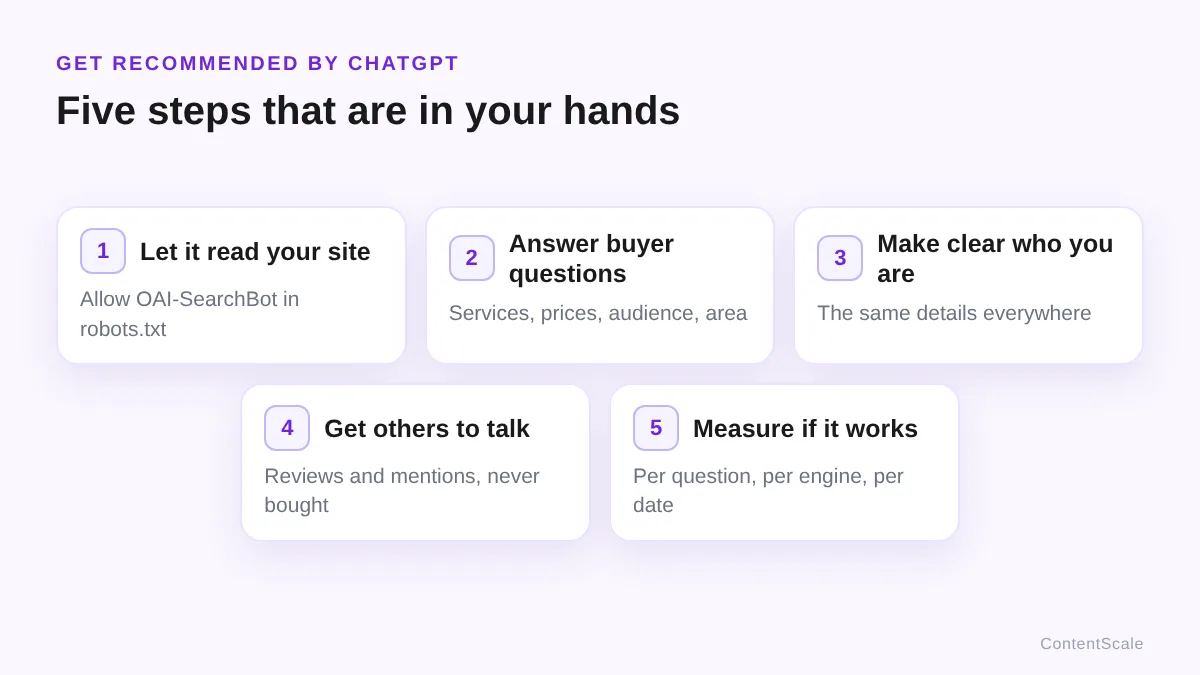
Step 1: let ChatGPT read your site
This is the only step for which OpenAI gives clear rules. Its crawler documentation says OAI-SearchBot is used to surface websites in ChatGPT’s search results, and adds:
“Sites that are opted out of OAI-SearchBot will not be shown in ChatGPT search answers, though can still appear as navigational links.”
OpenAI, Overview of OpenAI Crawlers
So check your robots.txt (yourdomain.com/robots.txt). If a rule blocks OAI-SearchBot or all bots, you shut yourself out of ChatGPT’s search answers. According to OpenAI, a change to robots.txt takes about 24 hours to be picked up.
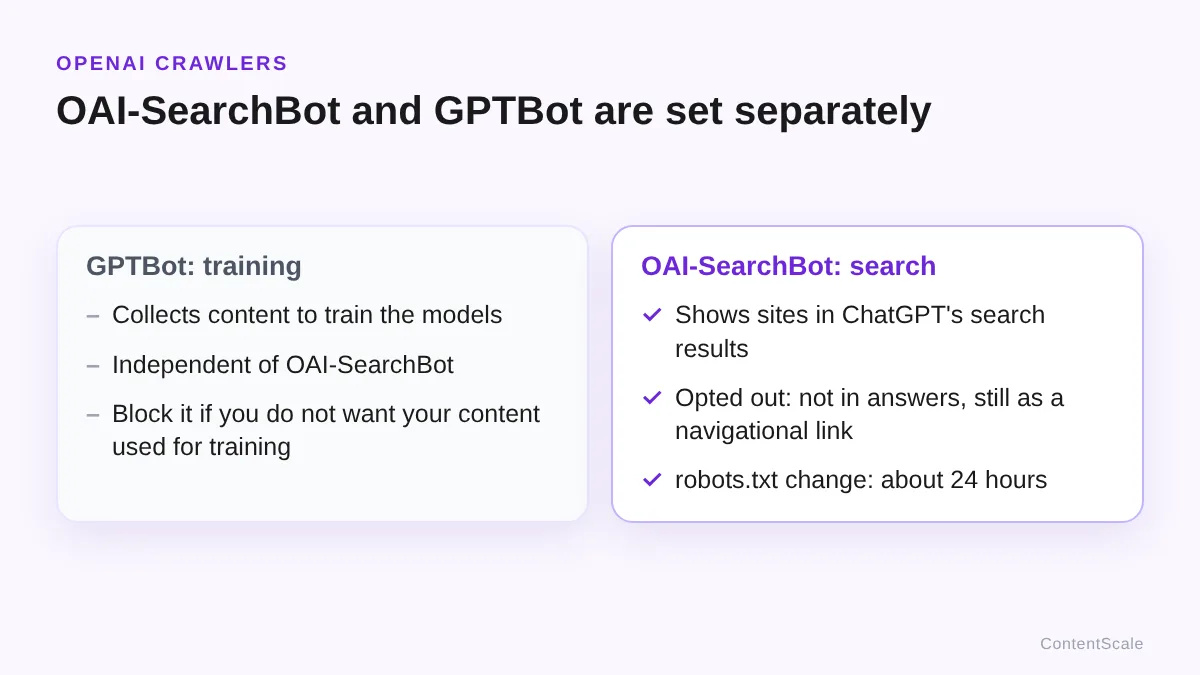
Note the difference with GPTBot. That crawler collects content for training OpenAI’s models. OpenAI says each setting is independent: you can allow OAI-SearchBot for search results and block GPTBot if you do not want your content used for training. On this site I allow all bots; my robots.txt only blocks the WordPress admin area.
Step 2: answer the questions buyers ask
A buyer rarely asks ChatGPT for your business name. They ask something like: who can help me with this problem, what does it cost, and how do the providers differ? If your site does not contain those answers, ChatGPT has little to recommend you on.
- What you do and for whom: describe your services concretely, with the audience and the problem you solve; ideally one page per service.
- Prices or a price guide: buyers ask about cost. A starting price, or an explanation of what drives the price, is an answer you control.
- Service area: say where you work, especially if customers search by location.
- Comparisons and objections: explain honestly when you are a good fit and when you are not.
Write each answer so it stands on its own: the core in a few sentences first, then the explanation. How to build that direct answer is covered in AEO vs GEO vs SEO.
Step 3: make clear who you are
An AI model has to recognise your business as one clear entity: one name, one description of what you do, one address or service area. Use the same name and details everywhere: your website, your Google Business Profile, LinkedIn and the directories in your industry.
On your site, an about page that says who is behind the business helps, as does structured data of type Organization (and LocalBusiness for a local business) with the same details that are visible on the page.
If you serve a local area: keep your Google Business Profile complete and identical to your site (name, address, phone, opening hours, services), and ask customers for recent reviews there. Inconsistent details across profiles are exactly what you want to avoid.
Step 4: get others to talk about you
A business that only talks about itself is less convincing than one that others write about. That is true for people, and it makes sense that it also counts for AI answers that combine several sources.
- Reviews: ask satisfied customers for a review on the platforms your industry uses, such as Google or Trustpilot.
- Mentions: guest articles, interviews, industry associations and trade media where your name and expertise appear.
- Your own proof: cases with real numbers and a date, such as my case study.
In the Idea Grove survey above, trusted press coverage tipped the choice between two otherwise similar recommended brands. Do not buy reviews or mentions. It damages trust, and a recommendation built on fake proof does not last.
Step 5: measure whether it works
Without measurement you do not know whether a change does anything. Make a fixed list of the questions your buyers ask (for example: which [service] in [city] is right for [type of customer]?) and check them regularly in the same way, in a new chat. The full method, with example questions and how to read the result, is in how to check if ChatGPT mentions your business.
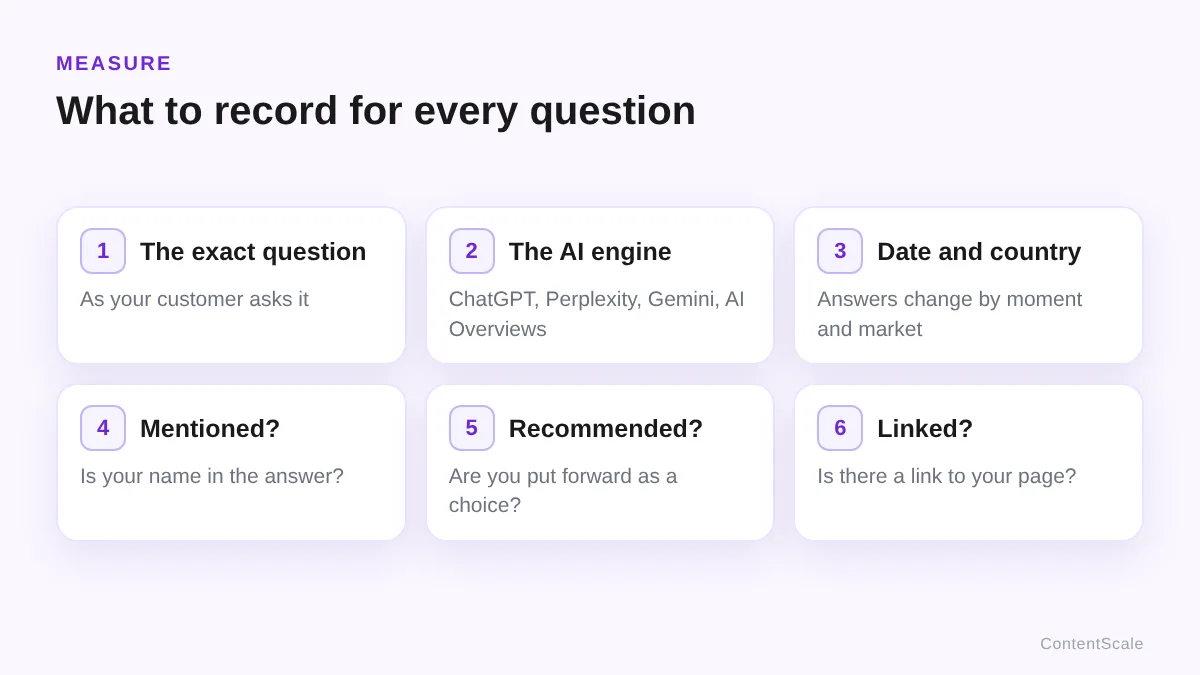
- Record for each question: the exact question, the AI engine (ChatGPT, Perplexity, Gemini, Google AI Overviews), the date and the country.
- Note separately whether you were mentioned, recommended or linked, and which competitors were recommended instead.
- Ask new customers how they found you. It is the only proof that a recommendation also brings business.
I do this with the AI Citations Tracker, which records per question and per engine who is mentioned and linked, next to your Google data. How to set up that measurement step by step is in AI visibility in Google Search and get cited by AI in 48 hours.
Common mistakes
- Blocking OAI-SearchBot without knowing it, for example with a rule that blocks all bots.
- Information only in images or PDFs: put key details (services, prices, area) on the page as text.
- Outdated or conflicting details between your site, your Google profile and directories.
- Judging one answer: answers change; measure several questions on several dates.
- Chasing inauthentic mentions: Google says in its guide to generative AI search that seeking inauthentic mentions across the web is not as helpful as it might seem, because its systems also block spam.
- Tricks aimed at AI: showing crawlers different content than users (cloaking) and mass-producing thin pages (scaled content abuse) are spam under Google’s spam policies.
- Expecting a special file or markup to do the work: Google says its Search, including its AI features, does not use LLMS.txt files and needs no special schema.org markup for generative AI search.
What nobody can promise
ChatGPT does not give everyone the same answer. It can differ by wording, user, country and moment. A recommendation you see today can be gone tomorrow; that is why you measure trends across several questions and dates, not a single answer.
OpenAI does not publish how recommendations are made. Anyone who guarantees one promises something they cannot control. What you do control: that ChatGPT can read your site, that you answer buyers’ questions well, and that you measure what changes.
Want me to look at your situation? See my services or get in touch.
Frequently asked questions
Can I guarantee that ChatGPT recommends my business?
Can I pay to get ChatGPT to recommend my business?
Do I have to allow GPTBot to appear in ChatGPT?
How long does it take to see results?
How do I know if ChatGPT already mentions my business?
Do I need an llms.txt file to be recommended?
Sources: Google, Guide to optimizing for generative AI features on Google Search (updated 10 July 2026) · Google, Spam policies for Google web search · Idea Grove, consumer survey of 1,000 U.S. consumers (August 2026) · OpenAI, Overview of OpenAI Crawlers (accessed 13 November 2026) · Schema.org, Organization

Ottmar J.G. Francisca
AI-Era SEO Specialist · GRAAF Framework Creator · Amsterdam
Ottmar J.G. Francisca built the ContentScale AI Citations Tracker and created the GRAAF Framework, a 100-point content quality system.
✓ Documented case study: CTR from 0.1% to 6.5% · ✓ Verified Google reviews · ✓ Creator of the GRAAF Framework · ✓ 24+ years in systems & operations management