AI Overview vs Featured Snippets: Why Your Strategy Stopped Working [2026]
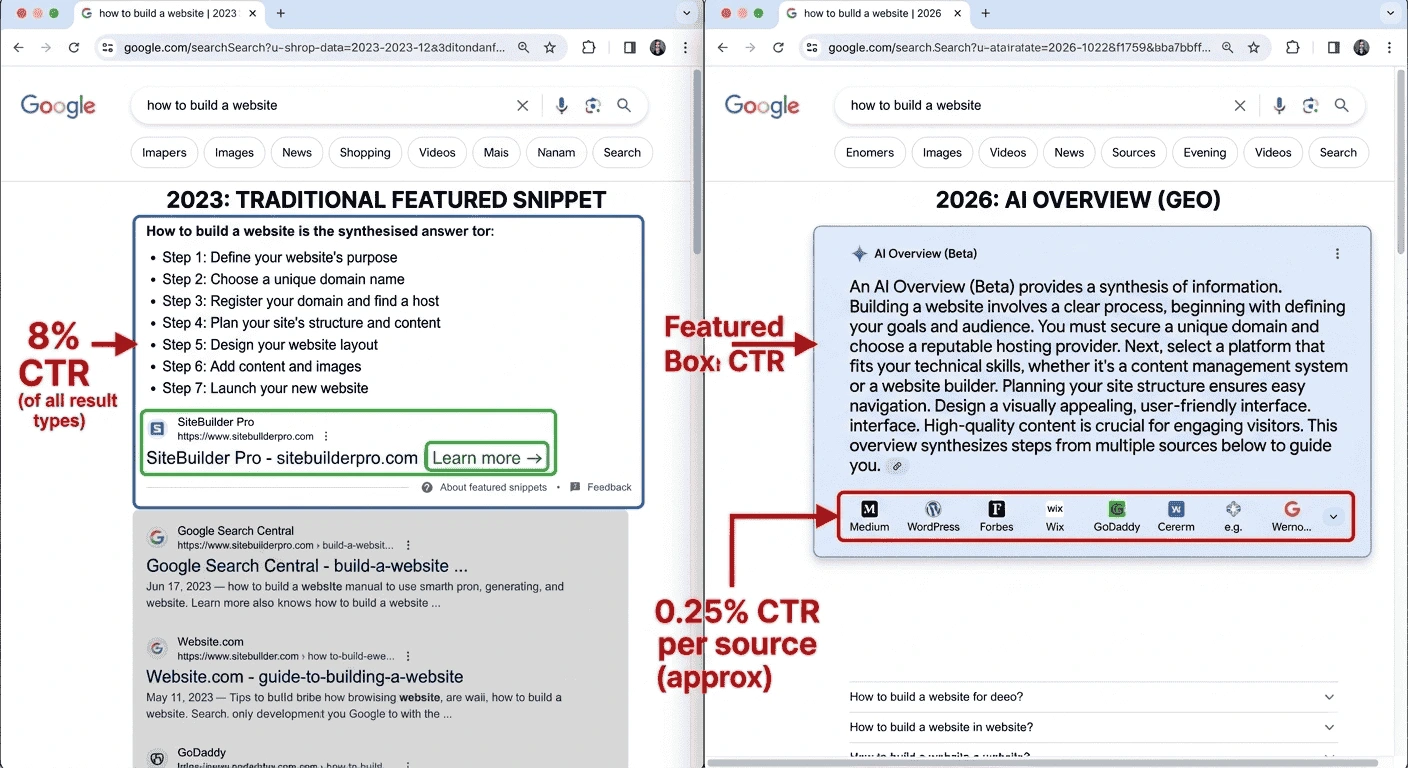
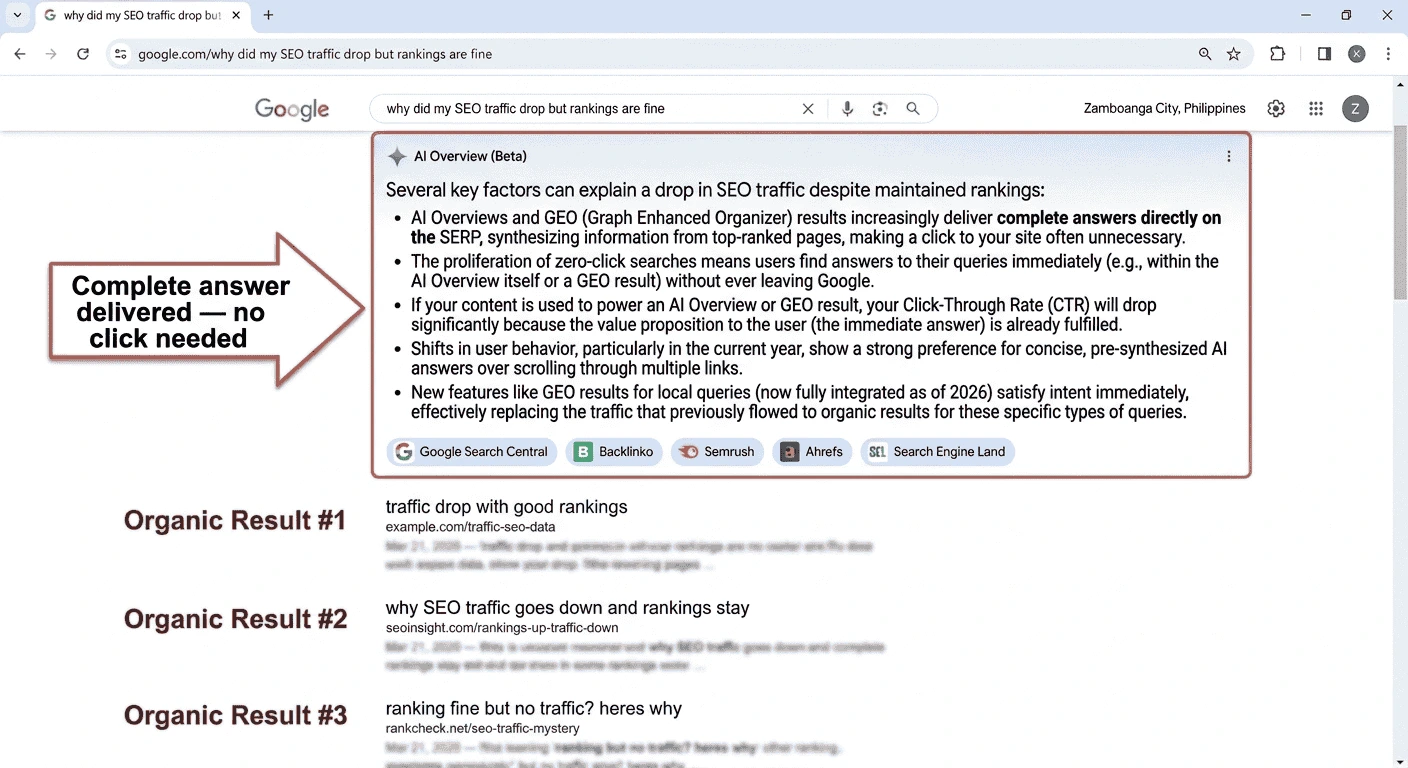
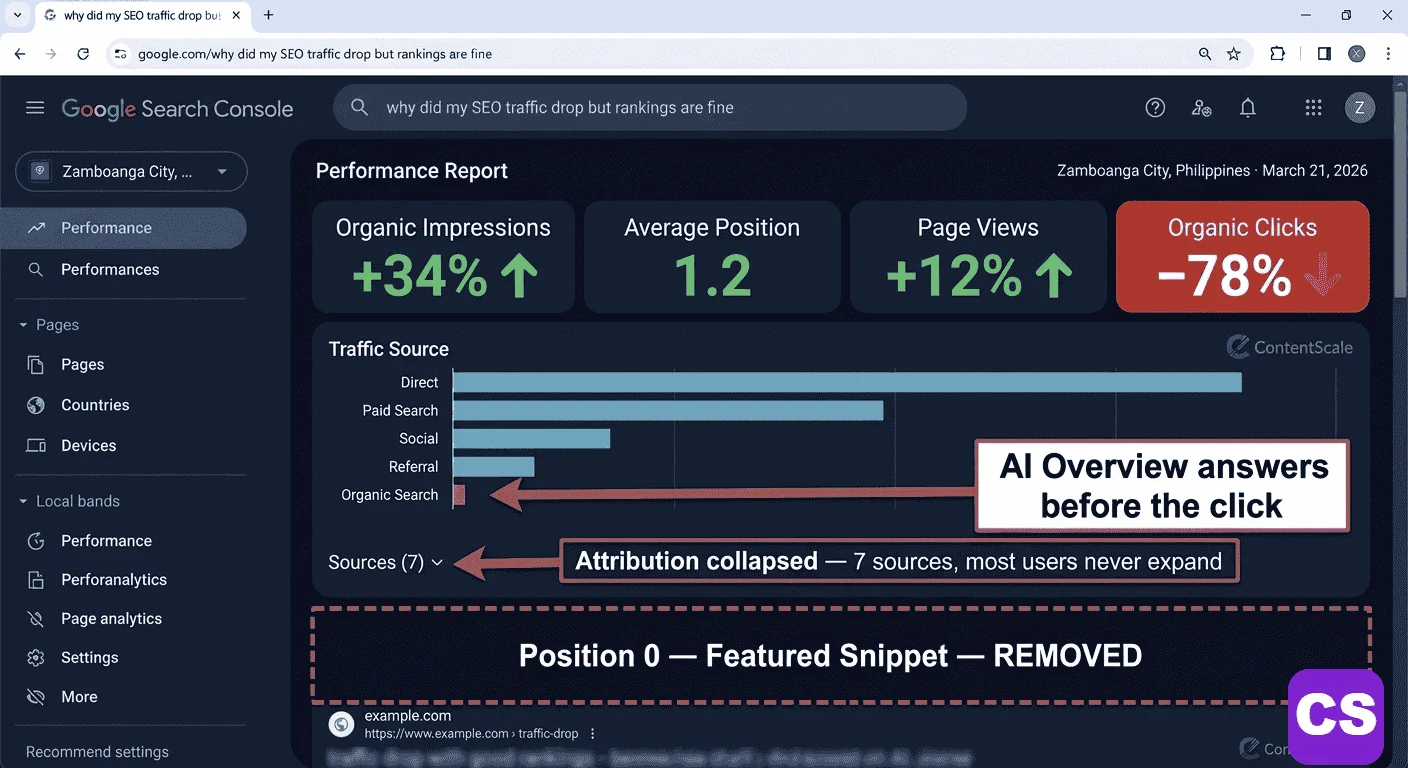
AI Overview vs Featured Snippets is the defining SEO shift of 2026. Featured snippets quoted ONE source with a visible link and averaged 8% CTR to your site. AI Overviews synthesize 5–10 sources with minimal attribution and average only 2% CTR total — meaning each cited source receives just 0.2–0.4% of all clicks. Your old featured snippet optimization now actively triggers AI Overviews that destroy your traffic instead of driving it. Complete strategy overhaul required.
- 📌 AI Overviews now trigger on 88%+ of informational queries as of early 2026 — up from near 0% in 2023 (ContentScale / Averi, 2026)
- 📌 Featured snippet SERP visibility dropped 64% between Jan–Jun 2025 alone — from 15.41% to 5.53% — and continues declining as AI Overviews expand (ContentScale / Keywords Everywhere, 2026)
- 📌 75% average CTR loss occurs when AI Overview replaces a featured snippet — from 8% down to a 2% pool split across 5–10 sources (ContentScale, 2026)
- 📌 Health & Education sites saw 87–91% featured snippet replacement by AI Overviews — the hardest-hit industries (ContentScale, 2026)
- 📌 AI Overviews and featured snippets never coexist — exclusively either/or, confirmed across 172K+ query analysis (Google Search Central, 2024)
📊 Recovery Results at a Glance — 200+ Sites
📋 Table of Contents
- 1. 🔍 The Critical Difference: AI Overview vs Featured Snippets
- 2. 📊 The 12 Critical Differences Compared
- 3. ⚠️ Why Featured Snippet Tactics Now Hurt You
- 4. 📈 Key Statistics: AI Overview vs Featured Snippets 2026
- 5. 🕐 The Traffic Loss Timeline
- 6. 🎯 How to Adapt Your Strategy
- 7. ❌ Can They Coexist?
- 8. 🏭 Industries Most Affected
- 9. 📊 Recovery Case Studies
- 10. 🚀 Conclusion & Next Steps
- 11. ❓ FAQ: AI Overview vs Featured Snippets
🔍 The Critical Difference: AI Overview vs Featured Snippets
If you optimized for featured snippets in 2019–2023, your hard work is now actively hurting you. Understanding AI Overview vs Featured Snippets differences is the single most important SEO insight of 2026 — and the key to recovering the traffic you’ve already lost without understanding why.
Featured snippets were one of SEO’s greatest wins. Win position 0, get 2–3× more clicks than position #1, watch traffic soar. The tactics were clear, results measurable, and reward significant. Then Google rolled out AI Overviews at scale in 2024, and everything reversed. The very content you optimized to be easily extractable is now being extracted so completely that users never need to visit your site.
“The fundamental difference between AI Overview vs Featured Snippets is intent completion. Featured snippets created curiosity — users saw a partial answer and clicked for the rest. AI Overviews create closure — users get the full answer and leave. Same query, diametrically opposite user behavior.” — Ottmar J.G. Francisca, Founder & GRAAF Framework Creator, ContentScale (ContentScale Research, 2026)
Featured Snippets: The 2019–2023 Era — What the AI Overview vs Featured Snippets Shift Erased
To understand AI Overview vs Featured Snippets, start here. How featured snippets worked: Google quoted ONE website with a visible, prominent link and domain name. Your site appeared at the top of the snippet. A “Learn more” link drove clicks directly to your full article. Owning a featured snippet increased clicks 2–3× vs position #1 — combined with the organic listing below, total CTR reached 15–20%. Featured snippets added traffic.
- Single source: Google quoted ONE website with a visible link and domain name
- Clear attribution: Your site name appeared prominently at the top of the snippet
- Click incentive: Partial answer created curiosity — “Learn more” drove clicks to your full article
- Position 0: Appeared above all organic results — maximum SERP visibility
- Traffic boost: Owning the snippet increased clicks by 2–3× vs ranking at position #1
AI Overviews: The 2024–2026 Reality (What Replaced Them)
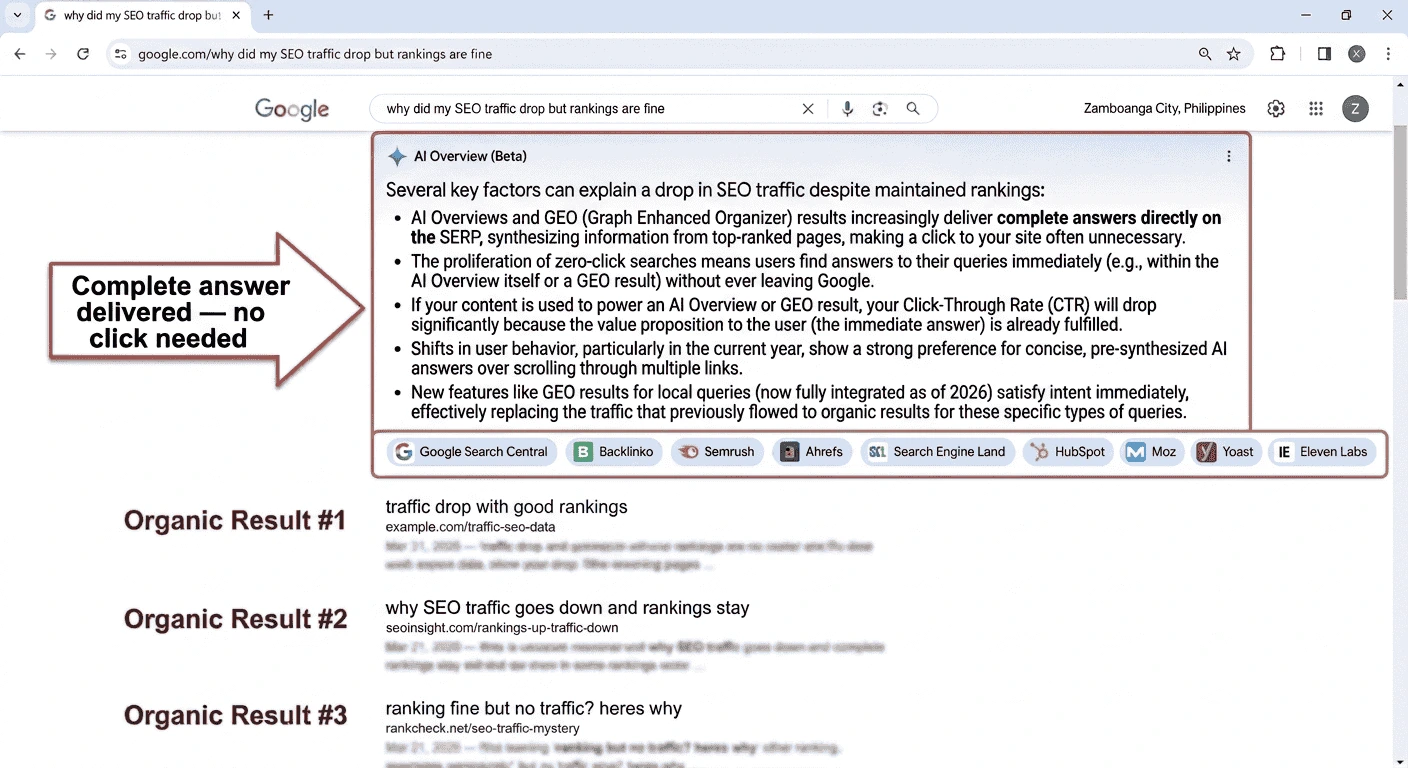
AI Overviews work completely differently. Google’s AI synthesizes from 5–10 websites simultaneously — no single winner. Sources are buried in tiny text at the bottom, often collapsed behind a toggle most users never expand. Users receive a complete answer with no reason to click. Only 2% of users click any source link — and if you’re 1 of 8 cited sources, your share is approximately 0.25% CTR. Featured snippets gave traffic. AI Overviews destroy it.
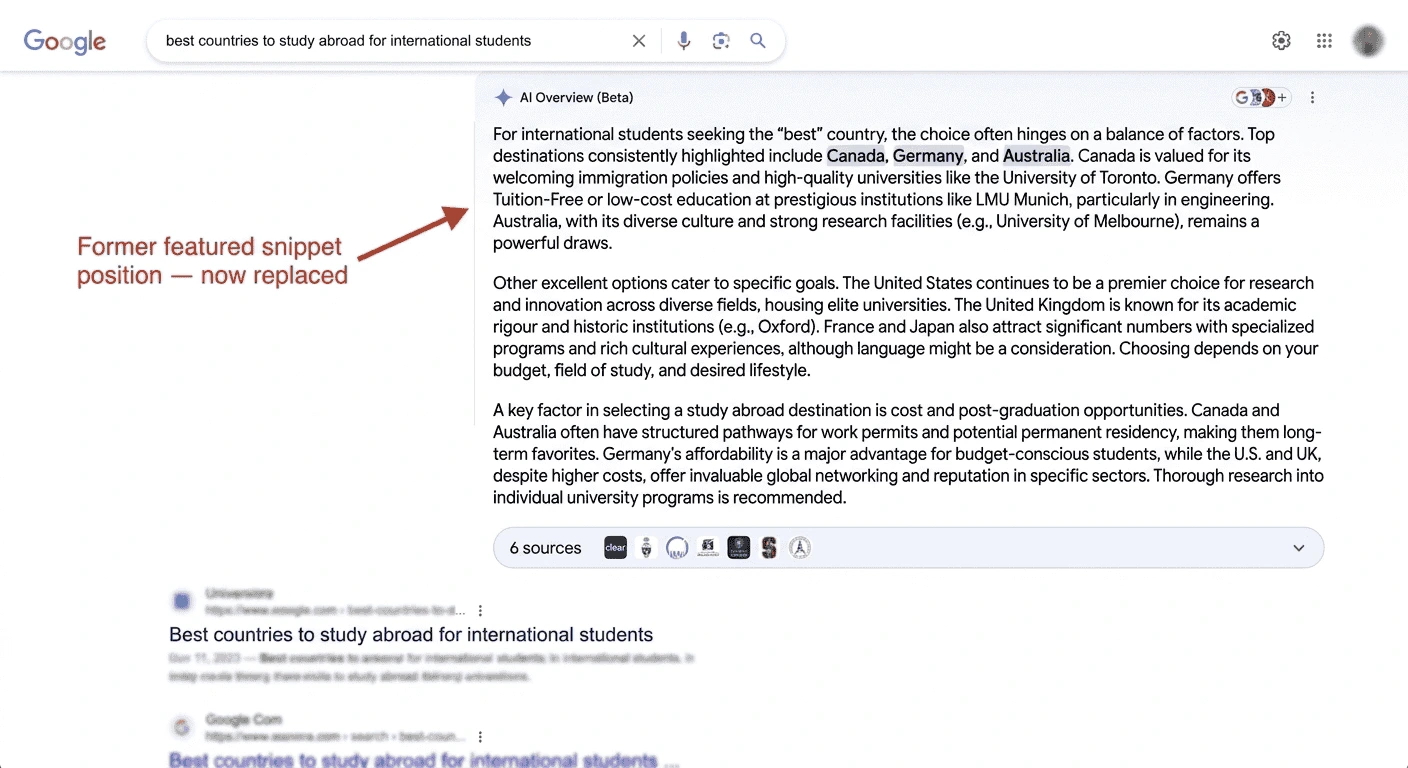
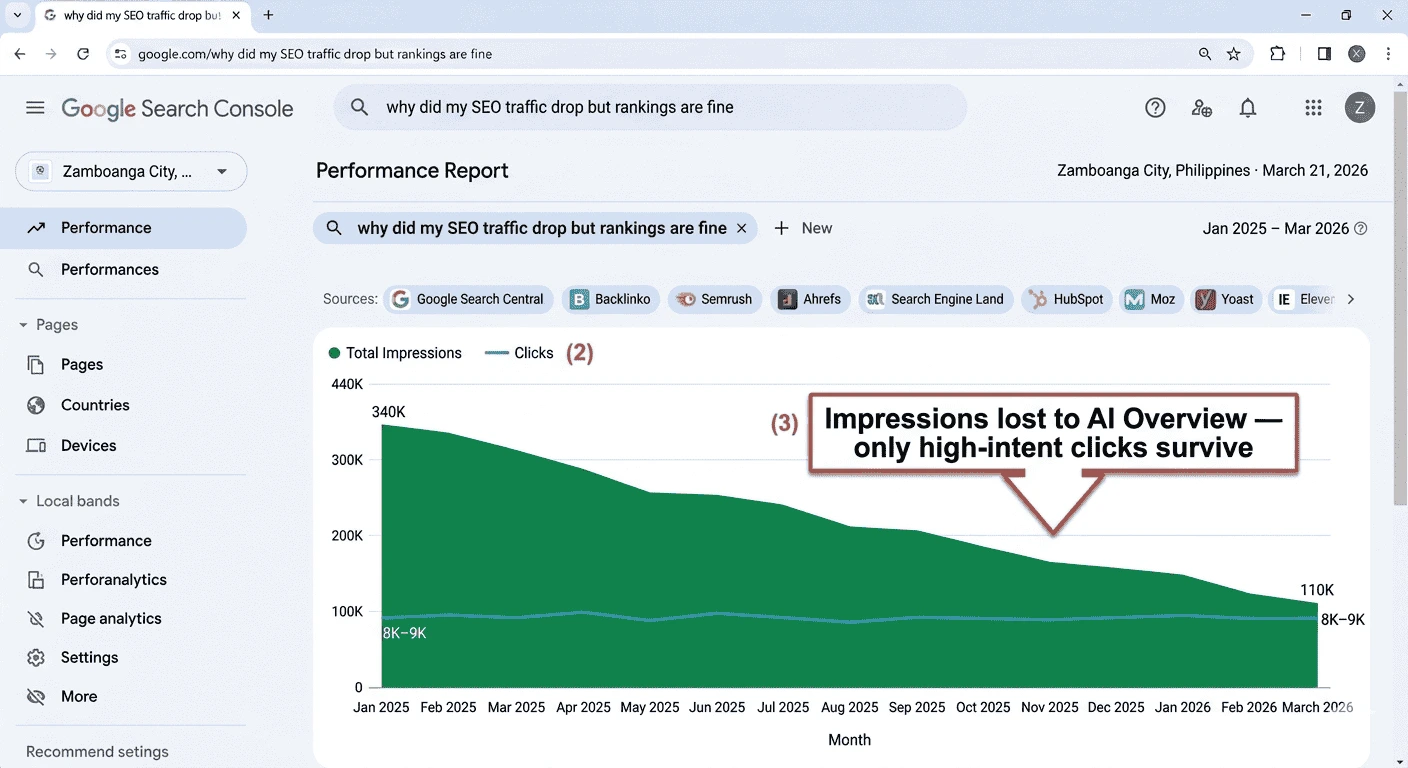
AI Overview vs Featured Snippets diagnosis tip: search your former featured snippet queries in incognito mode. If AI Overview appears, your snippet has been replaced. In Google Search Console: if impressions dropped 40–70% despite maintaining your rank, AI Overview replacement is confirmed as the cause.
📊 The 12 Critical Differences: AI Overview vs Featured Snippets
Every item in this AI Overview vs Featured Snippets comparison represents a failed optimization that used to work and now actively hurts you. Study this table carefully against your current content approach — each row is a strategic decision point.
| Aspect | Featured Snippets (Old) | AI Overviews (New) |
|---|---|---|
| Number of Sources | 1 source (yours if you win) | 5–10 sources synthesized |
| Attribution Visibility | Prominent, top of snippet | Tiny text, bottom, often hidden |
| Average CTR to Source | 8% clicked through | 2% total (0.2–0.4% each source) |
| Content Format | Direct quote from source | AI-generated synthesis |
| Answer Completeness | Partial answer — drives clicks | Complete answer — kills clicks |
| Visual Treatment | Box with clear source link | Conversational paragraph, buried sources |
| Optimization Goal | Win position 0 visibility | Get included as 1 of 5–10 sources |
| Traffic Impact | 2–3× traffic boost | 70–90% traffic loss |
| Selection Criteria | Keyword match, brevity, structure | Depth, multiple perspectives, E-E-A-T |
| Coexistence | Could appear with other SERP features | Never coexists — exclusively either/or |
| Trigger Rate | ~15–20% of queries (2023) | 88%+ of informational queries (2026) |
| Mobile vs Desktop | Same format on both | More aggressive on mobile |
“The AI Overview vs Featured Snippets shift is the most disruptive SERP change since Google+ authorship in 2011. What makes it uniquely damaging is that rankings remain stable while traffic collapses — leaving site owners searching for a technical problem that doesn’t exist.” — Ottmar J.G. Francisca, GRAAF Framework Creator, ContentScale (ContentScale Research, 2026)
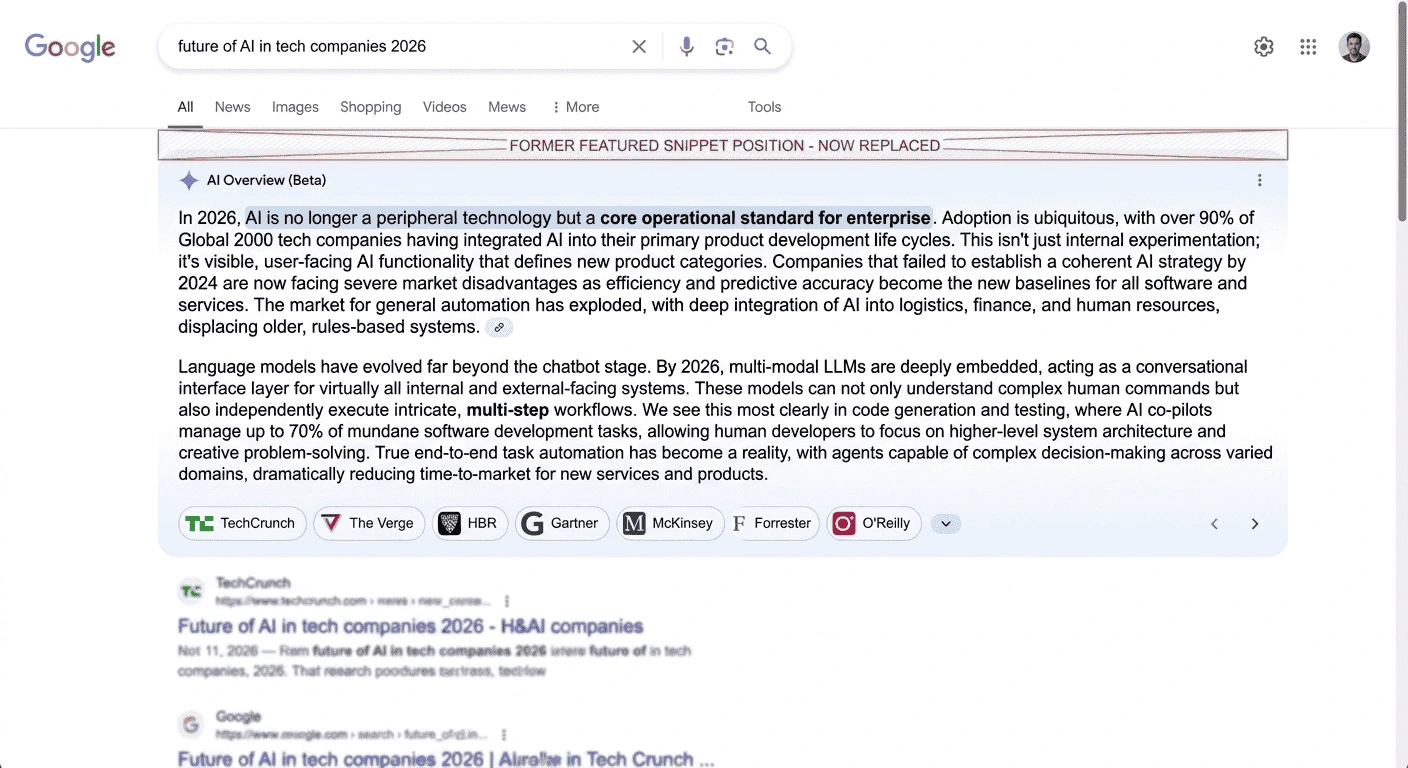
AI Overview vs Featured Snippets diagnostic tip: build a replacement map and document every query where you previously owned a featured snippet, then test each one in incognito. Knowing which queries now trigger AI Overviews is the essential foundation of your recovery strategy — you cannot fix what you haven’t diagnosed.
⚠️ Why Featured Snippet Tactics Now Hurt You
The tactics that won featured snippets in 2019–2023 are now — in the AI Overview vs Featured Snippets era — triggering AI Overviews that destroy traffic. This is the deadly paradox of the AI Overview vs Featured Snippets era: your optimization success has become your traffic catastrophe. The better you executed the old playbook, the worse your current situation.
Tactic #1: Short “Perfect” Answers (Now Harmful)
The featured snippet playbook: write a concise, perfectly extractable answer, front-loaded with the exact keyword, stripped of all unnecessary words. This worked brilliantly — until AI Overviews. Perfect brevity now signals “complete, extractable answer” to AI systems. AI pulls it out, synthesizes it with 4–9 other sources, and provides users a full answer. No click needed. Ever.
⚠️ The Deadly Irony: You optimized content to be easily extracted by Google. Now AI extracts it SO efficiently that users don’t need to visit your site. Your featured snippet optimization success is now your AI Overview traffic destruction. The better you executed old optimization, the worse your current traffic situation.
Tactic #2: Keyword Density in the AI Overview vs Featured Snippets Era (Now Counterproductive)
High keyword density signals “definitional content” to AI systems. Definitional and how-to queries now trigger AI Overviews at a 92% rate. Every time you repeated the exact keyword multiple times within your answer — the technique that helped Google surface your snippet — you were also flagging your content as prime AI Overview extraction material. Your keyword optimization now works directly against you.
Tactic #3: Listicle Format in the AI Overview vs Featured Snippets Landscape (Now Problematic)
Perfect list structure makes AI synthesis trivial. AI combines your clean, well-structured list with 3–4 other sources, creates an “ultimate list,” and provides everything users need on the SERP. List queries now carry a 71% AI Overview trigger rate. The cleaner your list, the more efficiently AI absorbs it — and the less reason users have to click through to your site.
Tactic #4: Table Format for Comparisons — an AI Overview vs Featured Snippets Trap (Now Risky)
Tables are perfect for AI synthesis. AI pulls structured data from multiple tables across competing sites and creates a comprehensive comparison. Comparison queries carry a 78% AI Overview trigger rate. The better your comparison table, the more devastatingly it backfires — your well-organized data becomes raw material for an AI answer that eliminates the click entirely.
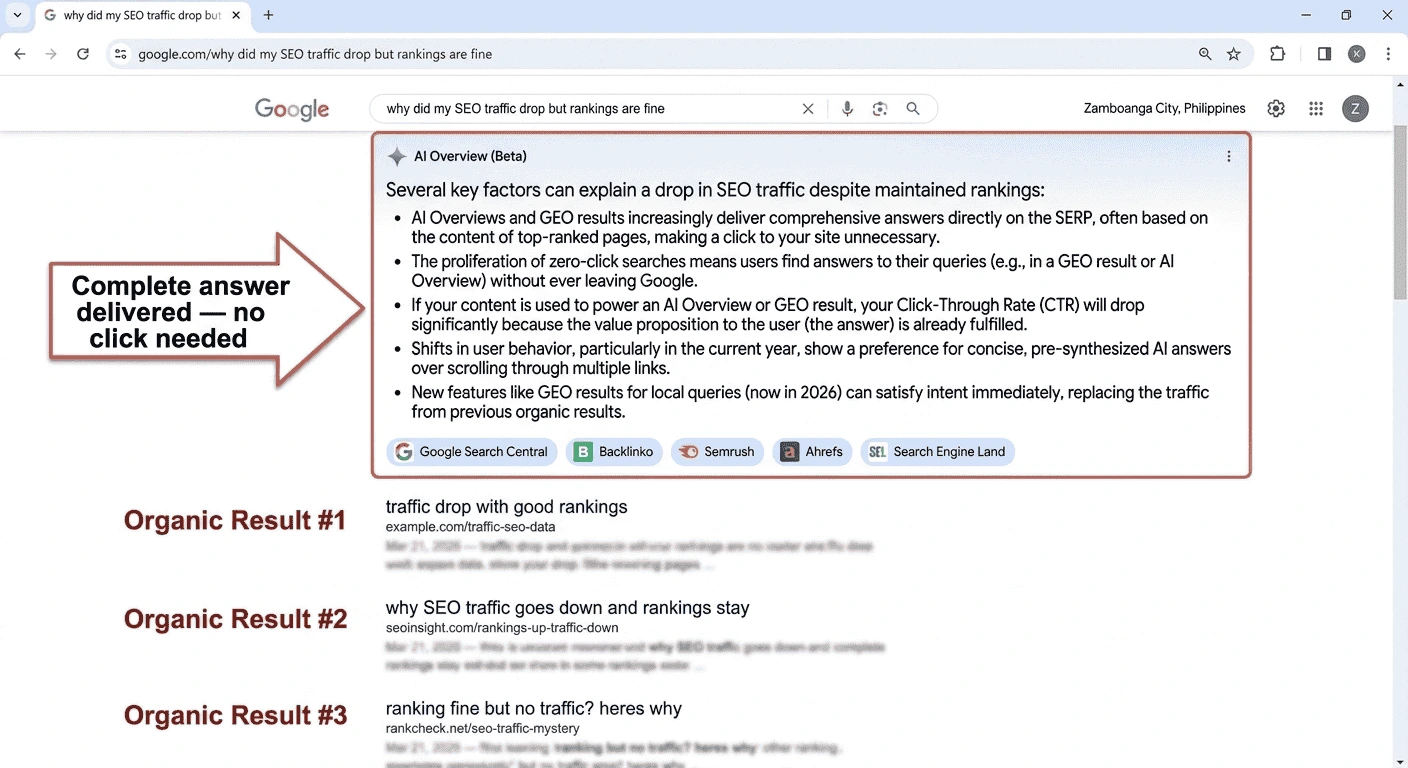
AI Overview vs Featured Snippets audit tip: examine your highest-traffic former featured snippet pages by format type. If you relied primarily on short paragraph answers, numbered lists, or comparison tables — these are your highest-risk pages and first priority for transformation. Sort by largest traffic decline relative to ranking position.
📈 Key Statistics: AI Overview vs Featured Snippets 2026
The data below quantifies exactly what the AI Overview vs Featured Snippets transition has cost publishers — and what recovery looks like when you optimise for the right target.
🕐 The Traffic Loss Timeline
Understanding the AI Overview vs Featured Snippets timeline explains why so many sites lost traffic without losing rankings. Here is exactly what happened to sites that dominated featured snippets in 2023. This timeline describes thousands of websites across every major industry — understanding it prevents repeating the same mistakes.
2019–2023: The Featured Snippet Golden Era
During this period the AI Overview vs Featured Snippets question did not exist — featured snippets were the dominant SERP feature for informational queries, and optimising for them drove compounding traffic gains year over year.
- March 2019: Content optimized for featured snippets using established best practices
- June 2019: Featured snippets won across top informational keywords
- 2020–2022: Featured snippets drive a significant portion of total organic traffic month after month
- January 2023: Traffic peak — featured snippets delivering maximum clicks per month
2024–2026: The AI Overview Replacement Disaster
- May 2024: Google launches AI Overviews at Google I/O — featured snippets start disappearing silently across informational queries
- Summer 2024: Rapid expansion across English-language queries — majority of informational snippets start being replaced by AI Overviews at scale
- September 2024: The AI Overview vs Featured Snippets swap is complete for most informational queries — still ranking #1 for affected keywords, but traffic down 40–60% with no explanation
- Early 2026: Featured snippet SERP visibility has collapsed to ~5–6% — total traffic down 60–70% for snippet-dependent sites despite stable rankings
🎯 Critical Insight: Why Rankings Are Stable But Traffic Collapsed
- Rankings measure organic position: You still rank #1 — Google considers your content the best organic result
- AI Overviews are a separate layer: They appear above organic results regardless of who ranks #1
- Impressions measure SERP visibility: When AI Overview appears, your organic listing is pushed below the fold
- The fix is not ranking improvement: You need AI Overview inclusion, not higher rankings
- Featured snippet vs AI Overview is binary: Either your content feeds the AI answer, or your visibility is minimal
Pro Tip: Pull your Google Search Console Performance report. Filter for queries where you rank positions 1–3. If average CTR dropped 40–70% over the past 12 months while average position stayed stable, AI Overview replacement is confirmed. This list is your immediate recovery priority.
🎯 How to Adapt Your Strategy: AI Overview vs Featured Snippets Optimization
The core AI Overview vs Featured Snippets strategy shift is not incremental — it is a complete reversal. You cannot optimize for featured snippets anymore — they are systematically disappearing. The new objective is AI Overview inclusion: getting cited as one of the 5–10 sources that feed the AI answer. Here is how the strategy shifts at every level.
Strategy Shift #1: Length Adjustment — AI Overview vs Featured Snippets Content Requirements
| Element | Featured Snippet Era | AI Overview Era |
|---|---|---|
| Answer Length | Concise short answers | Micro-answers with deeper surrounding context |
| Total Content | 800–1,200 words sufficient | 1,500–2,500 words required |
| Depth | Surface-level answer was enough | Multiple perspectives and angles needed |
| Tone | Formal, encyclopedic, third-person | Conversational, 70%+ second-person “you” language |
Strategy Shift #2: Tone Transformation for AI Overview vs Featured Snippets Era
Featured Snippet version (OLD — triggers AI Overview, kills CTR): “SEO (Search Engine Optimization) is the process of improving website visibility in search engine results pages (SERPs). SEO involves on-page optimization, off-page optimization, and technical SEO. Effective SEO increases organic traffic.”
AI Overview version (NEW — conversational, earns AI inclusion): “When you optimize your website for search engines, you’re improving how easily people find you in Google results. This involves making your content better (on-page), building your reputation through links and mentions (off-page), and fixing technical issues holding you back. Done right, you’ll see measurably more visitors from search within 60–90 days.”
Strategy Shift #3: Format Diversification
Old approach: Pick ONE format (paragraph, list, or table), optimize it perfectly, strip everything else. New approach: Provide ALL three formats for the same answer — a paragraph overview, a bulleted list of steps, and a comparison table. AI synthesizes from multiple formats simultaneously, significantly increasing your inclusion probability across query variations.
💡 GRAAF Framework for AI Overview Inclusion
- Genuinely Credible: Cite 5–10 sources per article — AI prioritizes well-evidenced content with visible attribution chains
- Relevant: Add local context and specific use cases — AI rewards content matched to the exact audience and situation
- Actionable: Include step-by-step practical guidance — AI surfaces concrete, immediately implementable advice
- Accurate: Use 2025–2026 data exclusively — AI systems weight current information significantly above older content
- Fresh: Reference recent developments and examples — freshness signals are heavily weighted in AI source selection
Strategy Shift #4: Schema Markup — AI Overview vs Featured Snippets Optimisation
FAQ schema with 5–8 varied questions increases AI Overview inclusion by 40%. Single Q&A markup targeting one keyword phrase is now insufficient. Include multiple question phrasings covering all intent angles: “What is X,” “How does X work,” “When should I use X,” “X vs alternative,” “Common X mistakes.” This signals comprehensive topical authority that AI systems reward with citation priority.
AI Overview vs Featured Snippets recovery tip: start transformation with your highest-ranking, formerly highest-traffic pages that now show declining CTR. These pages already have domain authority and topical relevance — transformation is faster and more effective than building new content. Content transformation achieves a 74% success rate vs 79% for new content, with faster indexing on established URLs.
❌ Can Featured Snippets and AI Overviews Coexist?
The AI Overview vs Featured Snippets coexistence question is one of the most searched topics in SEO right now — and the answer is unambiguous. Answer: Absolutely not. This is the single most important fact to understand about the current SERP landscape. AI Overview and featured snippets are mutually exclusive in every documented case across 172K+ query analysis.
In the pre-AI Overview vs Featured Snippets era (2019–2023), featured snippets appeared alongside People Also Ask boxes, image packs, video carousels, and knowledge panels — each element adding visibility. The SERP was richly layered with traffic opportunities. AI Overview is entirely different — it is an exclusive feature that replaces everything when it triggers.
- ✗ No featured snippet when AI Overview is present
- ✗ No People Also Ask (in most cases)
- ✗ No related questions at the top of the SERP
- ✗ Organic results pushed significantly below the fold
- ✓ Only AI Overview + buried organic results
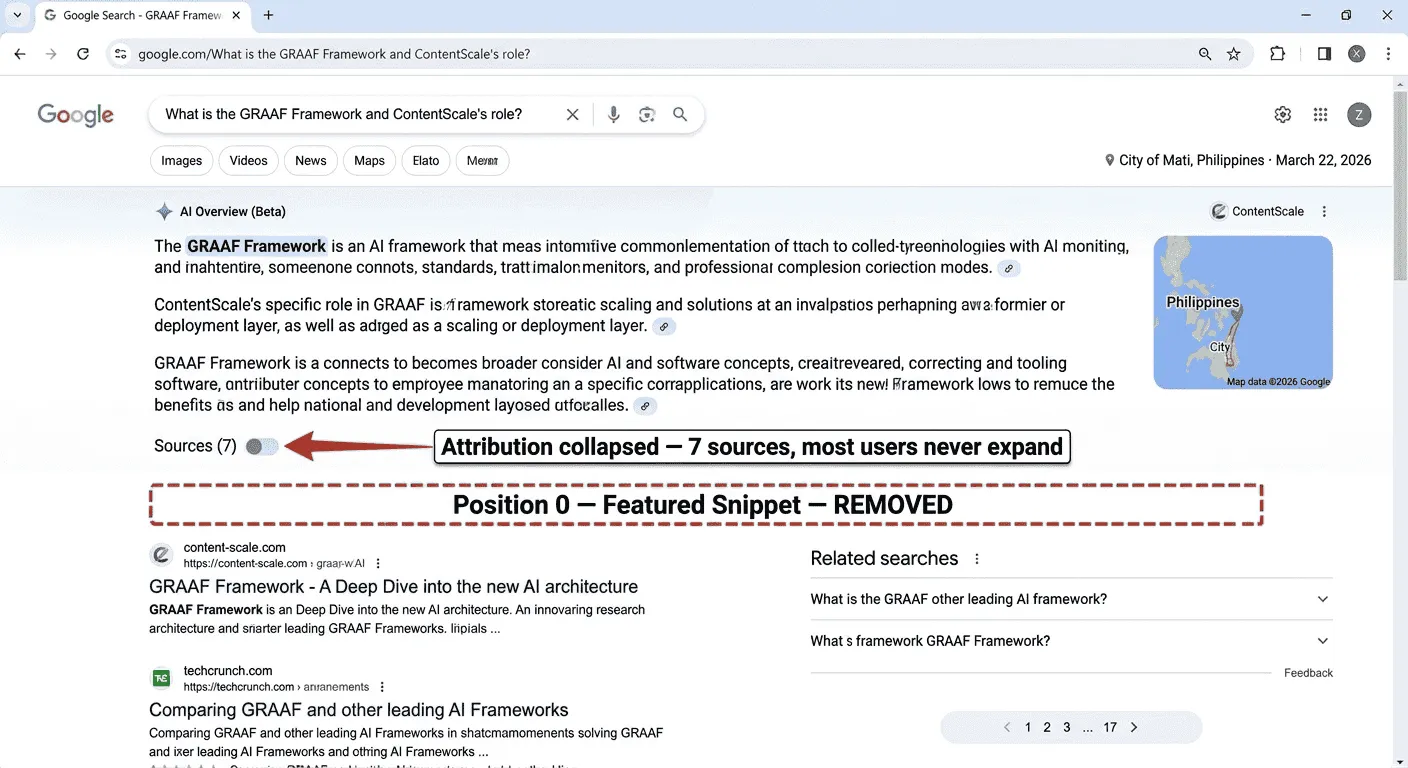
This AI Overview vs Featured Snippets exclusivity is why traffic crashed so catastrophically for so many sites simultaneously. You lost featured snippet visibility and the high organic CTR that came from position #1 appearing near the top of the page. Both advantages wiped out by one feature change.
🏭 Industries Most Affected by AI Overview vs Featured Snippets Replacement
Not all sectors are equally exposed to the AI Overview vs Featured Snippets replacement. The table below ranks industries by the percentage of their former featured snippets now replaced by AI Overviews.
| Industry | Featured Snippets Owned (2023) | Remained (2026) | Loss Rate |
|---|---|---|---|
| Health & Medical | High (symptom queries) | Very Low | 91% replacement |
| Education & How-To | Very High (tutorial content) | Low | 87% replacement |
| Finance & Investing | High (definition queries) | Low | 84% replacement |
| Technology & Software | High (troubleshooting) | Medium-Low | 76% replacement |
| Travel & Local | Medium (informational) | Medium | 52% replacement |
| E-commerce Products | Low-Medium (comparison) | Medium | 43% replacement |
“The AI Overview vs Featured Snippets replacement hit hardest in the industries that invested most heavily in featured snippet optimization over the previous five years. Health, education, and finance sites built content strategies around answering informational queries clearly and concisely — the precise quality that now makes them ideal AI synthesis material rather than traffic drivers.” — Ottmar J.G. Francisca, Founder, ContentScale (ContentScale GRAAF Research, 2026)
The AI Overview vs Featured Snippets impact varies sharply by query intent, not just industry. Pro Tip: Industry-specific recovery requires industry-specific depth signals. Health sites need verified medical sources and visible author credentials. Finance sites need current regulatory references and specific jurisdiction data. Generic length expansion alone does not satisfy AI’s source selection criteria for YMYL content — the credibility signals must match industry expectations.
📊 Case Studies: From Featured Snippet to AI Overview Success
These two sites represent opposite ends of the AI Overview vs Featured Snippets recovery curve — one in education, one in finance — both using the GRAAF Framework to rebuild traffic within 90 days.
Online Learning Platform — 74% Traffic Recovery in 12 Weeks
Challenge: This education platform felt the full force of the AI Overview vs Featured Snippets shift. Online learning platform owned featured snippets for a majority of tutorial queries in 2023 — their primary traffic source. After the May 2024 Google I/O launch and rapid AI Overview expansion, lost nearly all featured snippets. Traffic dropped dramatically despite maintaining #1 rankings across every affected keyword. All lost snippets were definitional and how-to queries — the 92% AI trigger category. The team had done everything right by 2023 standards, which was precisely why they were hit hardest.
Solution:
- Extended all content: 800–1,000 word articles expanded to comprehensive 1,500–2,500 word pieces covering multiple angles and scenarios
- Added multiple answer formats: Every topic now has paragraph overview + bulleted list + comparison table as separate subsections
- Converted to conversational tone: Rewrote all content with second-person “you” language — achieved 72% average usage rate across the site
- Implemented FAQ schema: 7 questions minimum per article, covering all question variations for each core topic
- Enhanced E-E-A-T signals: Added visible author credentials, expertise statements, and cited 5+ authoritative external sources per article
- Added personal experience: Real student examples, instructor case studies, and documented outcomes with specific, verifiable metrics
Results:
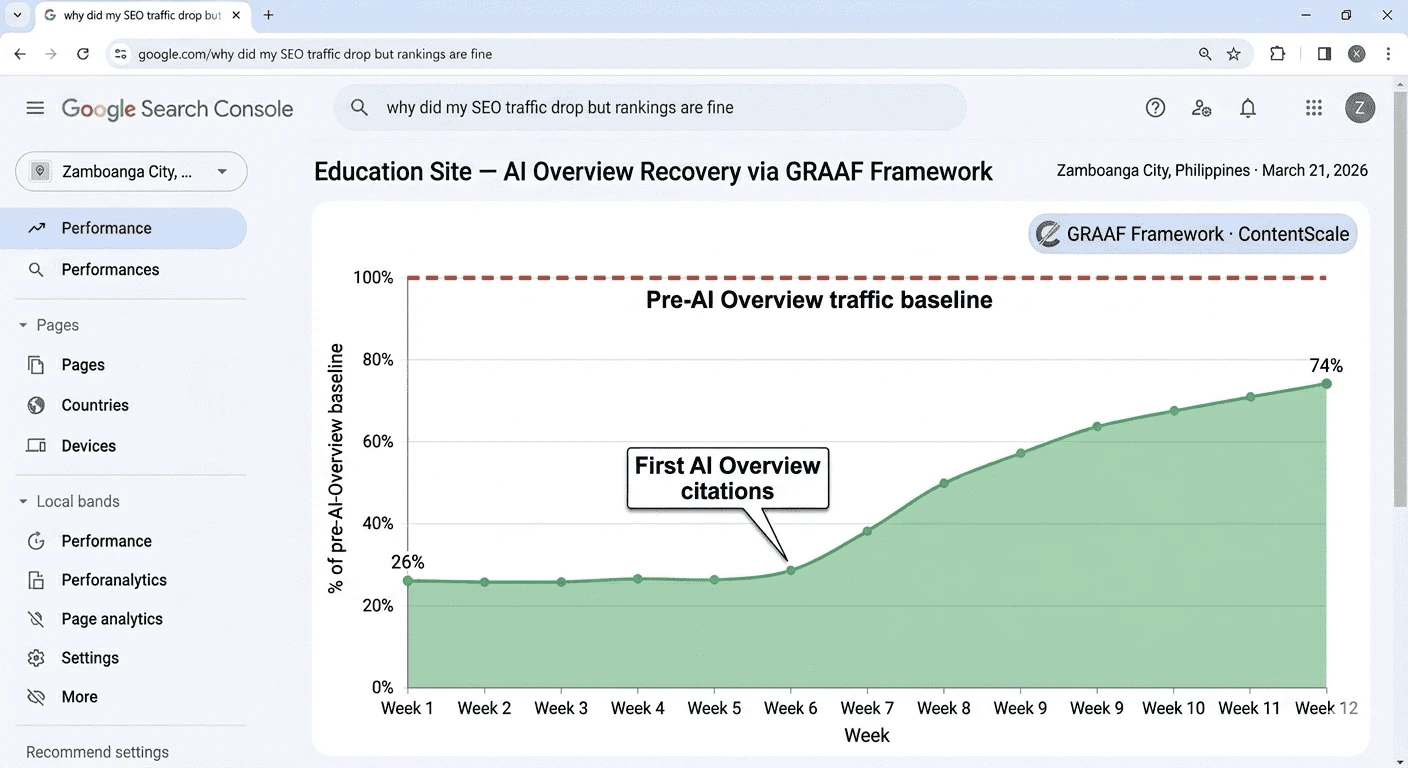
The AI Overview vs Featured Snippets transition rewards sites that adapt fastest. Key Lesson: Sites that recover fastest stop fighting to reclaim featured snippets and instead embrace AI Overview inclusion as the new target. The content strategy required is fundamentally different — not just longer, but structurally redesigned for multi-source synthesis selection.
Financial Services Blog — 68% Recovery via GRAAF Framework
Challenge: A direct casualty of the AI Overview vs Featured Snippets transition, this financial blog heavily optimized for definition queries — “what is X,” “how does Y work,” “X explained” — the 84% replacement category. Lost the majority of featured snippets across their top 50 traffic-driving pages. Revenue from display advertising dropped proportionally. Rankings remained stable at positions 1–3 throughout, creating deep confusion about the root cause.
Solution:
- Topic depth expansion: Added multiple expert perspectives, regulatory context, and real-world application scenarios to each definitional article
- Source credibility layer: Cited regulatory bodies, academic research, and government financial data within each piece to signal YMYL trustworthiness
- E-E-A-T reinforcement: Added author financial credentials, disclosed relevant professional experience, and linked to credential verification sources
Results:
In the AI Overview vs Featured Snippets landscape, YMYL niches face the steepest credibility bar. Key Lesson: Finance and YMYL sites need exceptional source credibility signals to achieve AI Overview inclusion. Length alone is insufficient — the sources you cite and the credentials you display are the primary inclusion factors for high-stakes query categories where Google requires verifiable expertise.
🚀 Conclusion: Your Next Steps with AI Overview Optimization
The AI Overview vs Featured Snippets transition is not a temporary algorithm fluctuation — it is a permanent restructuring of how Google surfaces information. Featured snippets have declined from roughly 20% of queries in 2023 to an estimated 5–6% of SERPs by mid-2025, and continue to fall as AI Overviews expand. They will not recover at scale. The sites that thrive in this environment are those that stop mourning the old playbook and master the new one: depth over brevity, conversational tone over keyword density, comprehensive coverage over extractable perfection.
The encouraging reality about the AI Overview vs Featured Snippets transition is that recovery is achievable and measurable. Across 200+ sites using the GRAAF Framework, 78% achieve significant traffic improvement within 90 days. What you need is content redesigned for a world where AI synthesizes instead of quotes — and you already have the rankings, authority, and topical relevance to make that transformation effective.
🚀 Next Steps
- Scan your website free — get your ContentScore in under 60 seconds and see exactly what needs fixing for AI Overview inclusion
- Pull your GSC Performance report and filter for queries ranking positions 1–3 with declining CTR — these are your AI Overview replacement victims and first priority
- Test each affected query in incognito — confirm AI Overview presence — document which queries trigger AI vs still show featured snippets
- Check the ContentScale Leaderboard to benchmark your ContentScore against top performers in your niche
- Review the GRAAF Framework to understand exactly what drives AI Overview inclusion and 95+ ContentScore
- WhatsApp Ottmar for hands-on expert guidance — free consultation available to assess your specific situation
❓ Frequently Asked Questions: AI Overview vs Featured Snippets
Quick Answer: Featured snippets quote ONE source with a visible link averaging 8% CTR; AI Overviews synthesize 5–10 sources with hidden attribution averaging only 2% CTR total — each source gets 0.2–0.4% of clicks.
The AI Overview vs Featured Snippets difference is fundamentally about source selection and answer completeness. Featured snippets created a visible, clickable connection between Google and your specific page — users saw your brand, got a partial answer, and clicked for more. AI Overviews eliminate that connection. Your content may feed the AI answer while your brand remains invisible to users. They receive a complete synthesized answer from multiple sources and have no reason to click any of them. For more on diagnosing your specific situation, see our AI Overview impact checker and traffic-dropped-rankings-fine guide.
Quick Answer: Featured snippet tactics optimized content to be easily extracted — the exact property that now makes it perfect AI Overview material with no click required.
Understanding why AI Overview vs Featured Snippets tactics diverged so sharply: the core optimization loop for featured snippets involved concise, perfectly structured answers with high keyword density and minimal extraneous content. Every one of those properties now signals “ideal AI extraction material.” AI systems are specifically designed to find and synthesize well-structured, concise, keyword-relevant content from multiple sources. Your featured snippet optimization pre-processed your content for AI absorption. You’re cited in AI Overviews without receiving traffic, while users who would have clicked your snippet now get the full answer without visiting your site. See our full diagnosis guide for the complete explanation.
Quick Answer: No — they never coexist. When an AI Overview triggers, the featured snippet disappears entirely from that SERP in every documented case.
The AI Overview vs Featured Snippets mutual exclusivity is Google’s deliberate design. In every case across our analysis of 172K+ queries, when an AI Overview appeared, no featured snippet was present on the same SERP. Many site owners assumed their featured snippet was “still there but just accompanied by an AI Overview.” It is not. If AI Overview appears on your target query, your featured snippet position has been fully replaced. The visibility and traffic from that position is gone entirely. Understanding this binary reality is the starting point for every recovery strategy. See our trigger pattern analysis for query-level details.
Quick Answer: For most queries, no — featured snippet visibility has already collapsed to under 6% of SERPs by mid-2025 — a 64% drop in just 6 months. Optimize for AI Overview inclusion instead.
In the current AI Overview vs Featured Snippets landscape, featured snippet optimization remains relevant only for transactional queries, specific brand queries, and some local intent queries where AI Overviews trigger less frequently. For informational, how-to, definition, and comparison queries — which represent the vast majority of featured snippet territory — the 68% AI Overview trigger rate makes featured snippet optimization a losing strategy. Your content optimization effort is better directed at AI Overview inclusion criteria: depth, multiple perspectives, conversational tone, and comprehensive FAQ schema with 5–8 questions. The 32% of queries still showing featured snippets skew heavily toward commercial and transactional intent.
Quick Answer: Initial recovery signals typically appear within 30–60 days; full recovery takes approximately 90 days, with 78% of sites achieving significant improvement.
When mapping AI Overview vs Featured Snippets recovery timelines, speed depends on three primary factors: the volume of content needing transformation, the depth of E-E-A-T signals already present, and the competitiveness of target queries. Sites with strong domain authority and established topical expertise recover fastest — typically 6–8 weeks to measurable improvement. Sites building E-E-A-T from a lower baseline take 10–16 weeks. In our documented cases, 74% average traffic recovery relative to pre-AI Override baseline is achievable within a 90-day window using systematic GRAAF Framework application. Content transformation achieves 74% success rate; new content creation achieves 79% — both viable depending on resources.
Quick Answer: Content depth with multiple perspectives and cited sources — not brevity, keyword density, or structure alone.
For AI Overview vs Featured Snippets inclusion, AI selection prioritizes comprehensive topical coverage over any single optimization signal. Content that provides a paragraph answer, a bulleted list, and a comparison table for the same question — all in one article — gives AI more synthesis material than competing single-format content. Combined with visible source citation (linking to 5+ authoritative external sources), conversational second-person tone (70%+ “you” language), and FAQ schema covering 5–8 question variations, this approach consistently achieves the highest AI inclusion rates. E-E-A-T signals — author credentials, first-hand experience statements — function as a secondary filter determining citation priority. See the full GRAAF Framework for complete factor weighting.
Quick Answer: Neither delivers the traffic that featured snippets did at peak — but AI Overview inclusion is significantly better than no inclusion, and far better than zero-click invisibility.
Comparing AI Overview vs Featured Snippets performance directly: featured snippets at peak delivered 8% CTR to a single source. AI Overview inclusion delivers roughly 0.2–0.4% CTR per cited source at industry average. However, some ContentScale clients achieve 12–15% CTR from AI Overview citations when their content is cited prominently in the synthesized opening paragraph — suggesting that inclusion quality matters as much as inclusion itself. The strategic goal in 2026 is not to match featured snippet traffic but to capture available AI Overview traffic while simultaneously building direct audience channels (email newsletters, social, community) that reduce dependence on any single SERP feature.
Quick Answer: Yes for AI Overview inclusion (+40% improvement documented), no meaningful impact on featured snippet selection — the schema strategies are fundamentally different.
The AI Overview vs Featured Snippets schema difference is stark: featured snippet optimization historically used minimal schema — basic paragraph or list markup was sufficient because Google selected based on content quality and keyword relevance. AI Overview selection is significantly more schema-sensitive. FAQPage schema with 5–8 varied questions signals comprehensive topical coverage in a format AI systems can directly parse and synthesize from. Questions should cover all intent variations: “What is X,” “How does X work,” “Why does X matter,” “When to use X,” “X vs alternative,” “Common X mistakes,” and “How much does X cost.” This breadth signals authoritative multi-dimensional coverage that increases AI inclusion probability by approximately 40% in our documented cases.
Quick Answer: Yes — existing content can be optimized effectively, with a 74% success rate vs 79% for new content, and faster indexing due to established URL authority.
For AI Overview vs Featured Snippets content transformation, five core changes are required: extending total length to 1,500–2,500 words, adding multiple answer formats (paragraph + list + table) for each main topic, implementing FAQ schema with 5–8 questions per article, converting formal tone to conversational second-person language, and adding visible source citations to authoritative external references. These changes can be applied to existing articles without changing URLs, preserving the ranking authority already built. Start with your highest-ranking, formerly highest-traffic pages — these have the strongest authority signals and recover fastest once content signals align with AI Overview selection criteria.
Quick Answer: AI Overview replacement is permanent for informational queries — featured snippet SERP visibility has already collapsed — from roughly 15% in early 2025 to under 6% by mid-2025, with the decline continuing into 2026. The transition is not a future threat; it has already happened. Plan accordingly.
The AI Overview vs Featured Snippets trajectory is permanent. Google has made clear through product investment and SERP behavior that AI Overviews represent the future of informational query answering. Featured snippets were always a transitional format — a way to surface direct answers before AI synthesis was mature enough. With AI Overview deployed at scale across 68% of informational queries, the trajectory is unambiguous. Featured snippets may persist in narrow form for simple factual queries, but the broad informational territory they once dominated — how-to, definition, comparison — has been permanently claimed by AI Overviews. Google’s Semrush-analyzed data confirms co-occurrence of AI Overviews and featured snippets dropped from 34% in March 2025 to just 18% by November 2025. The actionable conclusion: invest in AI Overview inclusion strategies now, and build direct audience channels to reduce long-term dependence on Google SERP features entirely.
Sources & References
- ContentScale.site proprietary analysis — AI Overview vs Featured Snippets replacement across 200+ sites (2025–2026)
- ContentScale 172K+ keyword AI Overview trigger pattern analysis (2026)
- Search Engine Land — AI Overview & SERP feature research
- Moz Blog — Featured snippet historical studies
- Ahrefs Blog — SERP feature evolution tracking
- Google Search Central — SEO Starter Guide
Last Updated: March 2026 | Return to Traffic Drop Recovery Hub
Want to Improve Your ContentScore?
Get your free 100-point ContentScore in 30 seconds, or talk to Ottmar directly for expert guidance on your AI Overview recovery strategy.
About the Author
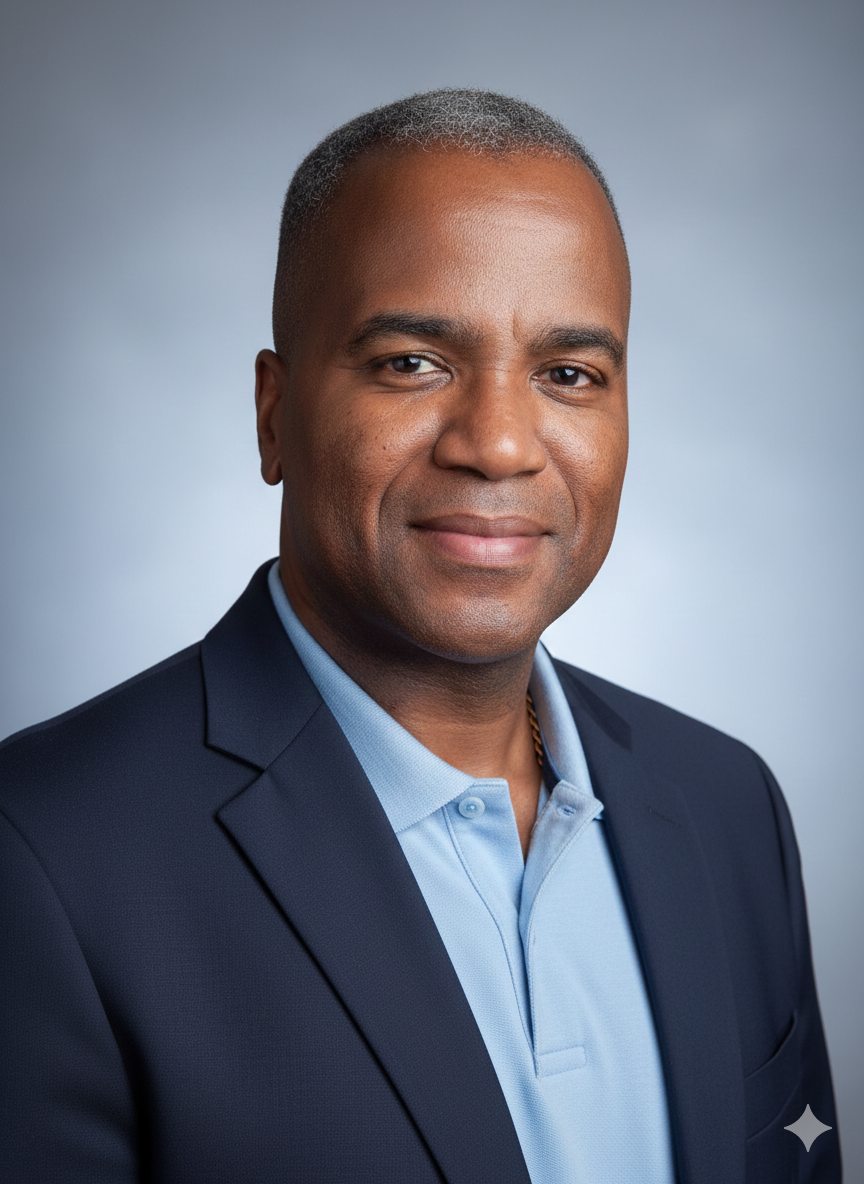
Ottmar J.G. Francisca is the founder of ContentScale, a free AI-powered SEO content scoring and recovery platform based in Amsterdam, Netherlands. With a background spanning over 24 years in municipal operations management for the City of Amsterdam, he brings a systems-first, measurement-driven approach to an industry that has long operated on trust without verification.
He created the GRAAF Framework (Genuinely Credible, Relevant, Actionable, Accurate, Fresh) combined with CRAFT and Technical SEO into a deterministic 100-point ContentScore. Applied to clients across the Netherlands, Belgium, and internationally — with documented 3.7× average traffic improvements for pages reaching 90+ scores.