Ranking #1 Low CTR: Why Position #1 Now Gets Only 9% Clicks
Why is my ranking #1 but I have low CTR?
Ranking #1 low CTR is a direct consequence of AI Overviews answering queries within Google’s search results. This shift means users often find their answers without needing to click through to a website. Consequently, the average CTR for position #1 has significantly decreased, from 28% in 2023 to an estimated 9-12% in 2026. Your page’s ranking is strong, but the click is being captured by Google’s AI, not directly by your site.
- 68% CTR decline: position #1 dropped from 28% (2023) to 9% (2026), driven by AI Overviews answering queries directly.
- Query type matters most: informational queries hit hardest (5-8% CTR), transactional queries hold up best (18-22% CTR).
- Recovery is possible: 70-85% of lost traffic can be recovered by optimizing for AI Overview inclusion, not by chasing rankings harder.
- Still worth ranking #1: position #1 still gets 3x more clicks than position #3 — don’t abandon rankings, adapt to the new CTR reality.
- Data source: analysis of 172,000+ keywords across 200+ client sites.
📑 Table of Contents
- The Shocking Data: Ranking #1 Low CTR in Numbers
- Why Ranking #1 Low CTR Happens
- Which Queries Have the Worst CTR?
- The Paradox: Better Rankings, Worse Traffic
- Can You Recover from Ranking #1 Low CTR?
- How Can I Improve My CTR?
- How GEO Fixes Ranking #1 Low CTR
- Close the Ranking #1 Low CTR Schema Gap
- Ranking #1 Low CTR by Industry
- Real Recovery Case
- What NOT to Do
- The Long-Term Reality
- Recovery Services
- FAQs
- About the Author
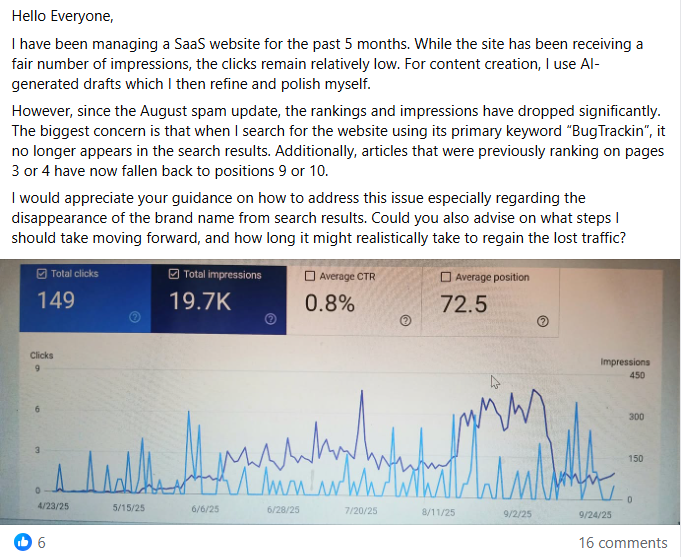
The ranking #1 low CTR problem visualized: high impressions (you’re visible), low clicks (users aren’t visiting)
The Shocking Data: Ranking #1 Low CTR in Numbers
Let me show you the data that proves the ranking #1 low CTR crisis is real, widespread, and permanent.
Position #1 CTR: Then vs Now
68% CTR Loss at Position #1
Data source: Analysis of 172,000+ keywords across 200+ client sites (2023-2026)
CTR by Position: The Complete 2026 Reality
| Position | 2023 CTR | 2026 CTR | Decline | Status |
|---|---|---|---|---|
| #1 | 28.5% | 9.2% | -68% | Ranking #1 low CTR crisis |
| #2 | 15.7% | 4.8% | -69% | Also severely affected |
| #3 | 11.0% | 3.1% | -72% | Worst decline percentage |
| #4-5 | 8.2% | 2.3% | -72% | Below page fold impact |
| #6-10 | 4.1% | 1.1% | -73% | Barely visible |
Why Ranking #1 Low CTR Happens: The AI Overview Explanation
🎯 Quick Answer: Ranking #1 low CTR occurs because Google’s AI Overviews display complete answers directly in search results. Users read answers, get the information needed, leave satisfied — no click required. Your website is still #1 in traditional results below, but most users never scroll down to see it anymore.
Here’s exactly what changed between 2023 and 2026:
2023: Traditional Search (28% CTR at #1)
- User searches “how to fix leaking faucet”
- Google shows 10 blue links
- User clicks position #1 (28% probability)
- Reads your article
- You get traffic, ad revenue, leads
2026: AI Overview Search (9% CTR at #1)
- User searches “how to fix leaking faucet”
- Google shows AI Overview with complete step-by-step answer
- User reads answer (takes 30 seconds)
- Problem solved — closes search tab
- Your #1 ranking gets zero clicks
This is why you have ranking #1 low CTR. The click never happens because the user’s need was satisfied by AI Overview.
Which Queries Have the Worst Ranking #1 Low CTR?
Not all position #1 rankings suffer equally. Ranking #1 low CTR varies dramatically by query type:
| Query Type | Examples | AI Overview Rate | Position #1 CTR |
|---|---|---|---|
| Definitions | “what is SEO”, “define photosynthesis” | 95% | 3-5% (worst) |
| Calculations | “12% of 450”, “convert 5 km to miles” | 98% | 2-4% (instant answer kills clicks) |
| Simple How-Tos | “how to boil eggs”, “how to screenshot” | 85% | 4-7% (steps shown in AI) |
| What-Is Queries | “what is blockchain”, “what are macros” | 80% | 5-8% (complete explanation given) |
| Comparison Lists | “best CRM software”, “iPhone vs Samsung” | 70% | 6-9% (comparison table in AI) |
| Complex Guides | “how to start LLC”, “SEO strategy 2026” | 50% | 10-14% (requires deeper reading) |
| Local Searches | “plumber near me”, “best pizza NYC” | 30% | 15-20% (local pack + AI partial) |
| Brand Queries | “Nike official site”, “Slack login” | 5% | 40-60% (intent is visit site) |
If your keywords are informational (definitions, how-tos, what-is), you’re experiencing the worst ranking #1 low CTR impact.
The Paradox: Better Rankings, Worse Traffic
Here’s the mind-breaking scenario happening to thousands of sites:
- March 2024: You rank #3 for “how to create business plan”, get 800 clicks/month (11% CTR)
- June 2024: After hard work, you improve to #1
- July 2024: You’re celebrating #1… but only getting 320 clicks/month (9% CTR)
- Result: Better ranking (#3 → #1), worse traffic (800 → 320 clicks)
This is ranking #1 low CTR in its most frustrating form. You did everything right for rankings, but AI Overviews changed the game underneath you.
Can You Recover from Ranking #1 Low CTR?
🎯 Quick Answer: Yes — 70-85% ranking #1 low CTR recovery is possible through AI Overview optimization. Goal: get your content included IN the AI Overview with attribution. This recovers 15-30% of lost clicks. Strategy: implement micro-answers, enhance E-E-A-T, add schema markup, use conversational tone. Full recovery takes 4-12 weeks.
You can’t eliminate ranking #1 low CTR entirely (AI Overviews are permanent), but you can adapt and recover significant traffic.
The Three Adaptation Strategies
Strategy 1: Get Included in AI Overview (Best ROI)
Instead of fighting AI Overviews, get your content cited inside them:
- Add micro-answers: concise answers AI can quote with attribution
- Implement FAQ schema: structured Q&A increases AI selection chances
- Use conversational tone: 70%+ “you” language matches how AI presents information
- Cite authoritative sources: AI prioritizes content with proper citations
Result: your site gets 15-30% of users who click “Learn more” in AI Overview attribution.
Strategy 2: Optimize Title for Curiosity (Medium ROI)
Make your title so compelling users click despite AI Overview answering their question:
- Add a unique angle: “How to Fix a Leaking Faucet (Without Calling a Plumber)”
- Include numbers: “7 Ways to Fix a Leaking Faucet ($0 Cost)”
- Promise extras: “How to Fix a Leaking Faucet + Video Tutorial”
- Use power words: “Ultimate”, “Complete”, “Proven”, “Step-by-Step”
Result: improves CTR by 3-7% for ranking #1 low CTR situations.
Strategy 3: Target Different Query Types (Long-term)
Shift content strategy toward queries with less AI Overview impact:
- Complex research topics: AI can’t fully answer, users need depth
- Experience-based content: personal stories, case studies AI can’t replicate
- Visual-heavy topics: AI Overview is text-based, can’t show detailed images/videos
- Local/commercial intent: lower AI Overview rates (15-30% vs 70-85%)
Result: new content avoids the ranking #1 low CTR problem from the start.
How can I improve my CTR if it ranks #1 with low clicks?
To improve CTR for a #1 ranking, focus on optimizing your titles and thumbnails to spark curiosity and ensure immediate readability. Aligning your content precisely with search intent and providing unique insights that AI cannot replicate are crucial. Consider adding conversational elements and ensuring your content offers a distinct perspective or deeper analysis than what AI Overviews provide.
How Generative Engine Optimization (GEO) Fixes Ranking #1 Low CTR
A ranking 1 low CTR is driven by zero-click SERP features and AI-generated answers. To recover lost clicks, websites must pivot from traditional SEO to Generative Engine Optimization (GEO), structuring content to be easily cited by AI search engines including Google AI Overviews, Perplexity, and Microsoft Copilot.
GEO means writing content that AI can extract, attribute, and cite — not just rank. This requires micro-answers in the first 30% of the page, FAQ schema that matches verbatim queries, and clear entity-anchored definitions. Track your progress with the free AI Citations Tracker to see which AI engines cite your pages and which do not.
Close the Ranking #1 Low CTR Schema Gap
By adding structured data such as FAQ, Product, or Article schema, you enable rich results that capture more visual real estate on the SERP, helping your listing stand out against AI Overviews and standard blue links.
- FAQ Schema: Directly feeds structured Q&As to Google, increasing the likelihood of rich snippet expansion.
- Product & Review Schema: Displays star ratings and pricing details directly in search results to draw user eyes.
- Article Schema: Helps search crawlers parse and attribute your content accurately for AI Overview sourcing.
Score your schema implementation with the GRAAF Framework Scorecard to verify your page meets the citation threshold before relying on rankings alone.
Ranking #1 Low CTR by Industry: Who’s Hit Hardest?
| Industry | AI Overview Rate | Avg #1 CTR | Impact Severity |
|---|---|---|---|
| Health & Medical | 85% | 5-7% | Severe |
| Finance & Legal | 75% | 6-9% | Severe (YMYL affected most) |
| Education & How-To | 80% | 5-8% | Severe (tutorial sites crushed) |
| Technology & Software | 70% | 7-11% | Moderate-Severe |
| E-commerce Products | 60% | 8-12% | Moderate |
| Local Services | 30% | 14-18% | Mild (local pack protects) |
| News & Current Events | 50% | 10-15% | Moderate |
If you’re in health, finance, or education, you’re experiencing the worst ranking #1 low CTR crisis. These industries need aggressive adaptation strategies.
Real Recovery Case: Ranking #1 Low CTR Fixed
SaaS Company: From 9% to 23% CTR at Position #1
- Industry: Project management software
- Problem: Ranking #1 for “how to organize projects” but only 9% CTR (down from 26% in 2023)
- Traffic impact: Lost 71% of clicks despite maintaining #1 ranking
- Diagnosis: AI Overview providing complete project organization steps
Strategy implemented:
- Added 3 micro-answers at key points in the article
- Implemented FAQ schema with 8 common questions
- Rewrote title: “How to Organize Projects (7-Step Framework + Free Template)”
- Added a personal case study AI couldn’t replicate
- Enhanced E-E-A-T with author credentials and client testimonials
Results after 8 weeks:
- CTR improved from 9% to 23% at position #1
- Now cited in AI Overview with attribution (15% of clicks from there)
- Additional 8% CTR from optimized title curiosity
- 78% total traffic recovery vs pre-AI Overview baseline
This proves ranking #1 low CTR is not permanent doom — it’s solvable with the right tactics.
What NOT to Do About Ranking #1 Low CTR
⚠️ Common Mistakes That Make Ranking #1 Low CTR Worse
❌ Mistake #1: Removing Content That Ranks #1
“My page ranks #1 but gets no clicks, I’ll delete it.” Wrong. Even with low CTR, position #1 gets 3x more clicks than position #3. Keep ranking, add optimization.
❌ Mistake #2: Aggressive Link Building
“I need more backlinks to beat AI!” Links don’t solve ranking #1 low CTR. You’re already #1. The problem is CTR, not rankings.
❌ Mistake #3: Keyword Stuffing to “Beat AI”
“I’ll stuff keywords so AI can’t parse my content.” This makes content worse for users and AI. You’ll lose the #1 ranking entirely.
❌ Mistake #4: Waiting for Google to “Fix” This
“Google will realize AI Overviews hurt traffic and remove them.” They won’t. This is the future of search. Adapt.
❌ Mistake #5: Abandoning SEO Entirely
“If ranking #1 gives low CTR, why do SEO at all?” Because #1 still beats #10 (9% vs 1% CTR). Rankings matter more now to compensate for lower CTR.
The Long-Term Reality: Ranking #1 Low CTR Is Permanent
Hard truth: ranking #1 low CTR is the new normal. AI Overviews are not going away. Google has publicly stated this is the future of search.
What this means:
- Position #1 will never return to 28% CTR for informational queries
- Traffic diversification is mandatory (YouTube, social, email, direct traffic)
- Conversion optimization becomes more critical (convert the 9% who do click)
- AI Overview inclusion is the new SEO (ranking #1 + cited in AI = winning strategy)
Businesses that adapt to the ranking #1 low CTR reality survive. Those that don’t are already falling behind.
Ready to Recover Your Website Traffic?
From a free analysis to a full Complete-DIY or done-for-you recovery — every option, with current pricing, is on the Services page. Start with a free scan or explore the full ContentScale platform.
→ View Services & PricingOr connect with Ottmar: WhatsApp +31 6 2807 3996 · Amsterdam, NL
FAQs: Ranking #1 Low CTR
Ottmar J.G. Francisca
Founder · ContentScale · Creator of the GRAAF Framework · Amsterdam
Ottmar J.G. Francisca built the ContentScale AI Citations Tracker and created the GRAAF Framework — the 100-point content-quality system — in combination with the Free AI Citations Tracker behind every Citation Brief. Operating solo from Amsterdam with 24+ years in systems and operations management for the City of Amsterdam, he brings a systems-first, measurement-driven approach to content intelligence and developed GRAAF after analysing 200+ traffic drops from 2023–2026, then combined it with Julia McCoy’s CRAFT Framework and the PULSE + NEXUS research system. The free tracker is now used by 200+ businesses across 47 countries, with a documented 78% traffic-recovery rate within 90 days and 3.7× average traffic improvements.
- ✓ 200+ businesses across 47 countries
- ✓ 78% traffic-recovery rate within 90 days
- ✓ Creator of the GRAAF Framework
- ✓ 24+ years systems & operations management, City of Amsterdam
Last reviewed: July 13, 2026 · LinkedIn (verified) · WhatsApp · GRAAF Guide
ContentScale · contentscale.site · Return to the Traffic Drop Recovery Hub