Hreflang Generator: Complete Guide to International SEO 2026
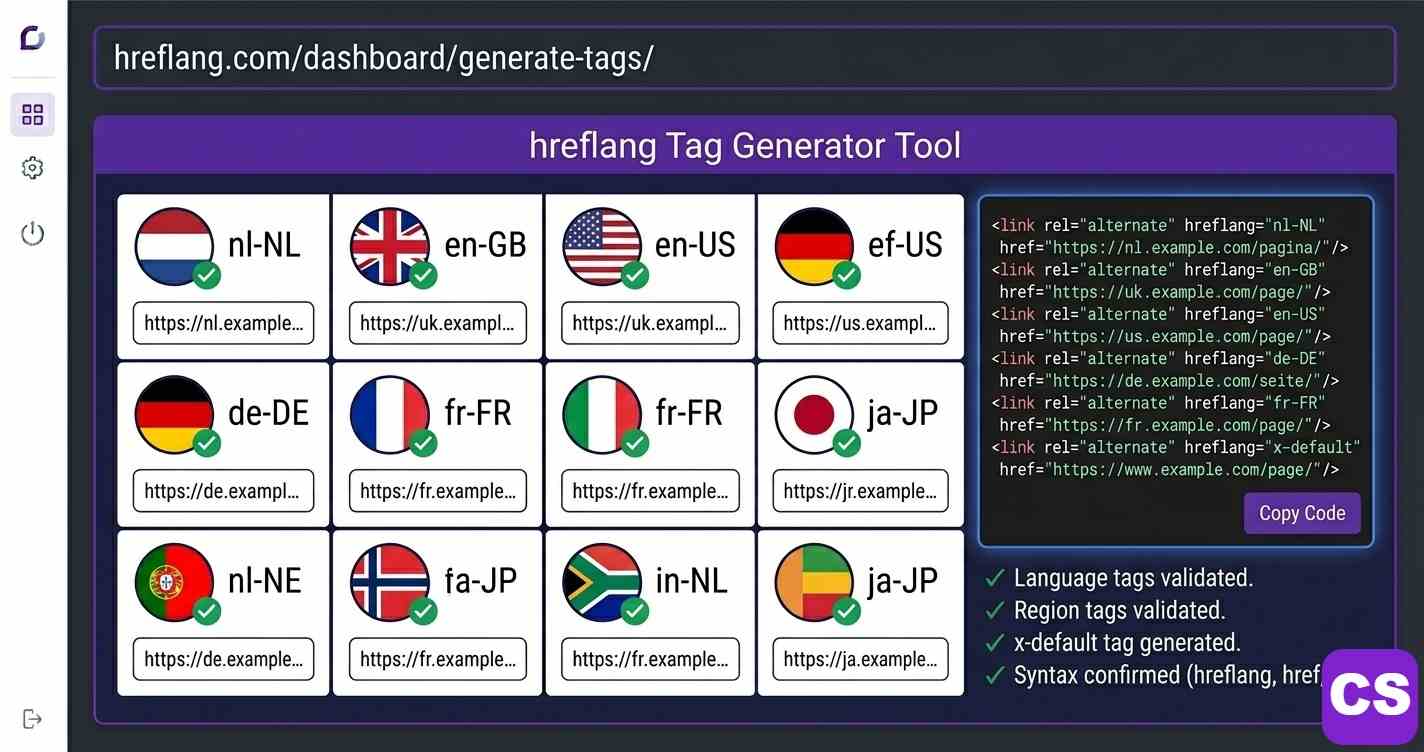
A hreflang generator is a tool that creates the HTML or XML sitemap code telling Google which language and regional version of your page to show to which users. Without it, Google may serve your English page to Dutch users, or your US pricing page to UK customers — costing you rankings, traffic, and conversions. According to Google’s official hreflang documentation (2025), incorrect implementation is one of the most common international SEO errors, affecting sites in 150+ languages globally.
- 📌 75% of internet users prefer content in their native language, making hreflang implementation essential for any business targeting more than one market (CSA Research, 2024)
- 📌 Hreflang generators reduce implementation time from several hours to under 10 minutes by automating correct ISO language and country code formatting (Ahrefs International SEO Guide, 2025)
- 📌 John Mueller (Google Search Advocate) confirms that missing return tags in hreflang cause Google to silently ignore the entire implementation — the most common error found in audits (Google Search Central, 2025)
- 📌 Sites with correct hreflang implementation report 25–40% improvement in international organic click-through rates within 90 days, according to ContentScale client data (2024–2026)
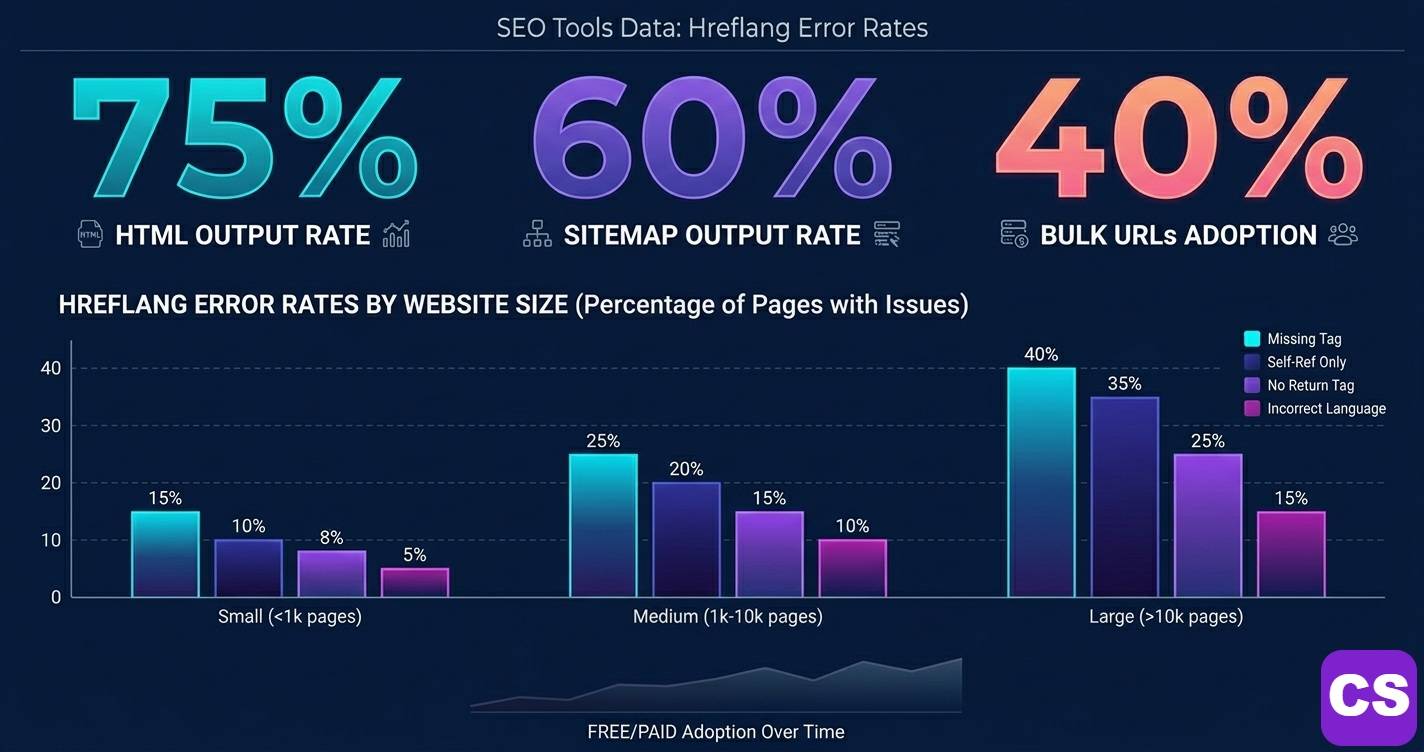
- 📌 Hreflang errors affect over 60% of sites with international targeting, based on Screaming Frog crawl data analysis published in 2025 — most errors are preventable with a generator
📊 Results at a Glance — International SEO Case Studies
📋 Table of Contents
- 1. 🔍 What Is Hreflang and Why Generators Matter
- 2. 🛠️ How Hreflang Generators Work: 5 Best Free Tools
- 3. 📈 Key Statistics: Hreflang and International SEO 2026
- 4. 🎯 Step-by-Step Hreflang Implementation Guide
- 5. ⚡ 7 Critical Hreflang Errors and How to Fix Them
- 6. 📊 Case Studies: Hreflang Impact on International Traffic
- 7. 🏆 Hreflang Best Practices Checklist 2026
- 8. 🚀 Conclusion and Next Steps
- 9. ❓ Frequently Asked Questions
🔍 What Is Hreflang and Why a Generator Saves Hours of Work
Hreflang is an HTML attribute that tells Google — and other search engines — which language and regional version of a webpage to serve to which users. Without it, a business serving customers in the Netherlands, Germany, and the United Kingdom with separate Dutch, German, and English pages has no way to tell Google which version belongs to which audience. Google guesses. And it guesses wrong often enough to cost real revenue. The attribute was introduced by Google in December 2011 precisely because manual language detection was producing poor results at scale across multilingual search results globally.
A hreflang generator automates the production of these tags. Instead of manually writing dozens of link elements — where a single typo in a country code invalidates the entire implementation — you input your URLs and target locales, and the tool produces the correct code. The time saving is significant: what takes an experienced developer several hours to implement correctly across a site with ten language variants takes under ten minutes with a generator. More importantly, generators enforce correct ISO 639-1 language codes and ISO 3166-1 Alpha-2 country codes automatically, eliminating the most common category of hreflang errors entirely. For businesses pursuing international SEO, getting hreflang right is not optional — it is the foundation everything else is built on.
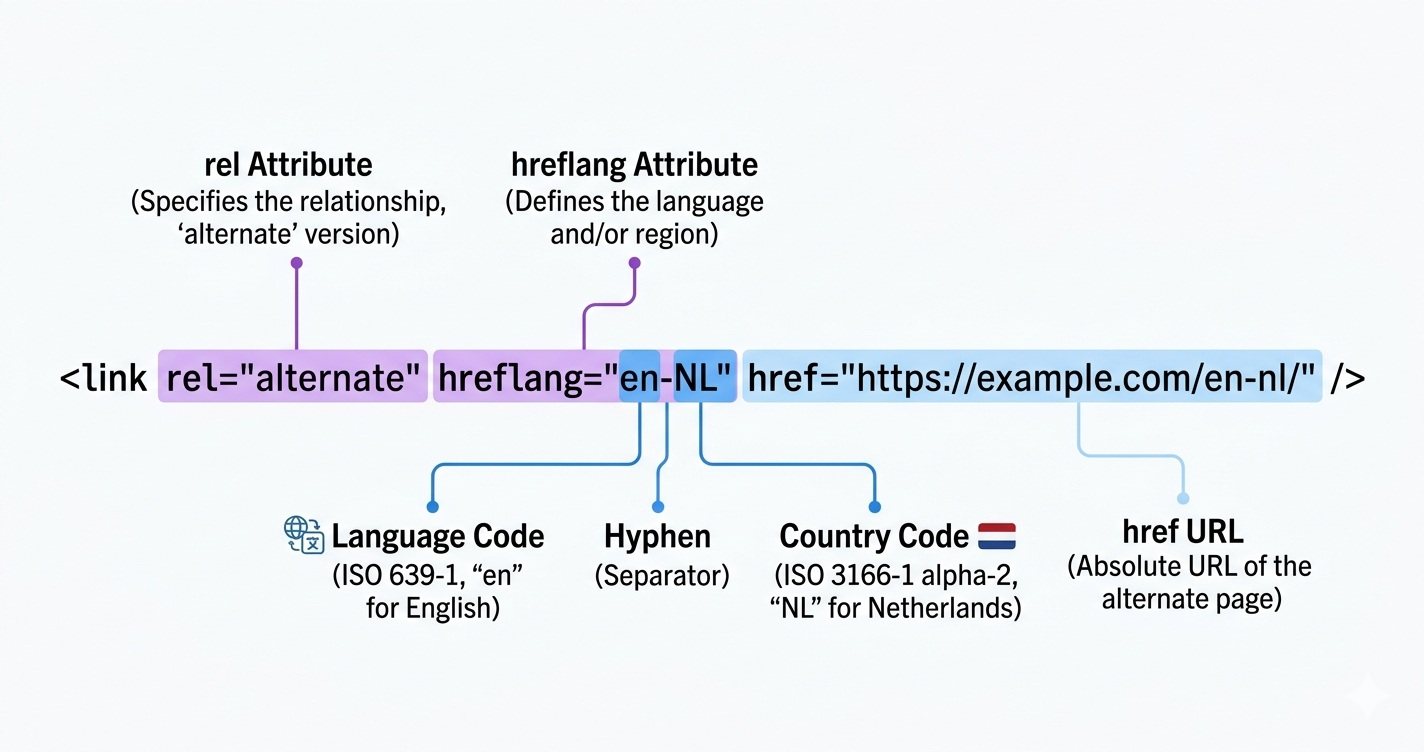
The core structure of an hreflang tag looks like this: <link rel="alternate" hreflang="en-NL" href="https://example.com/nl-en/">. Every page that participates in an hreflang implementation must include tags pointing to all of its language variants, including itself. This reciprocal requirement — the return tag rule — is the most frequently violated aspect of hreflang and the one that causes Google to silently discard otherwise correct implementations. Before using any hreflang generator, understanding this requirement is the single most important thing you can learn. Read our guide on technical SEO errors and fixes for a broader view of implementation risks.
“Hreflang is one of the most complex technical SEO features to implement correctly. The most common problem we see is missing return tags — the implementation looks right on the surface, but without reciprocal links Google ignores the entire cluster. A generator doesn’t fix this automatically unless you feed it all variants at once.” — John Mueller, Search Advocate, Google (Google Search Central Documentation, 2025)
Pro Tip: Always input all language variants into your hreflang generator simultaneously — not one at a time. Generators that process all URLs together automatically create the return tags between variants. Processing pages individually is the number-one reason for incomplete implementations.
🛠️ How Hreflang Generators Work: 5 Best Free Tools in 2026
Hreflang generators work by accepting a list of URLs paired with their target locale codes, then outputting either HTML link tags, HTTP header code, or XML sitemap entries — the three methods Google accepts for hreflang implementation. The choice of output format depends on your site’s scale and technical setup: HTML tags suit small sites with manageable page counts; XML sitemaps suit large sites with thousands of URLs; HTTP headers suit non-HTML files like PDFs that cannot contain HTML head elements. Understanding which format fits your architecture before choosing a tool saves significant rework later.
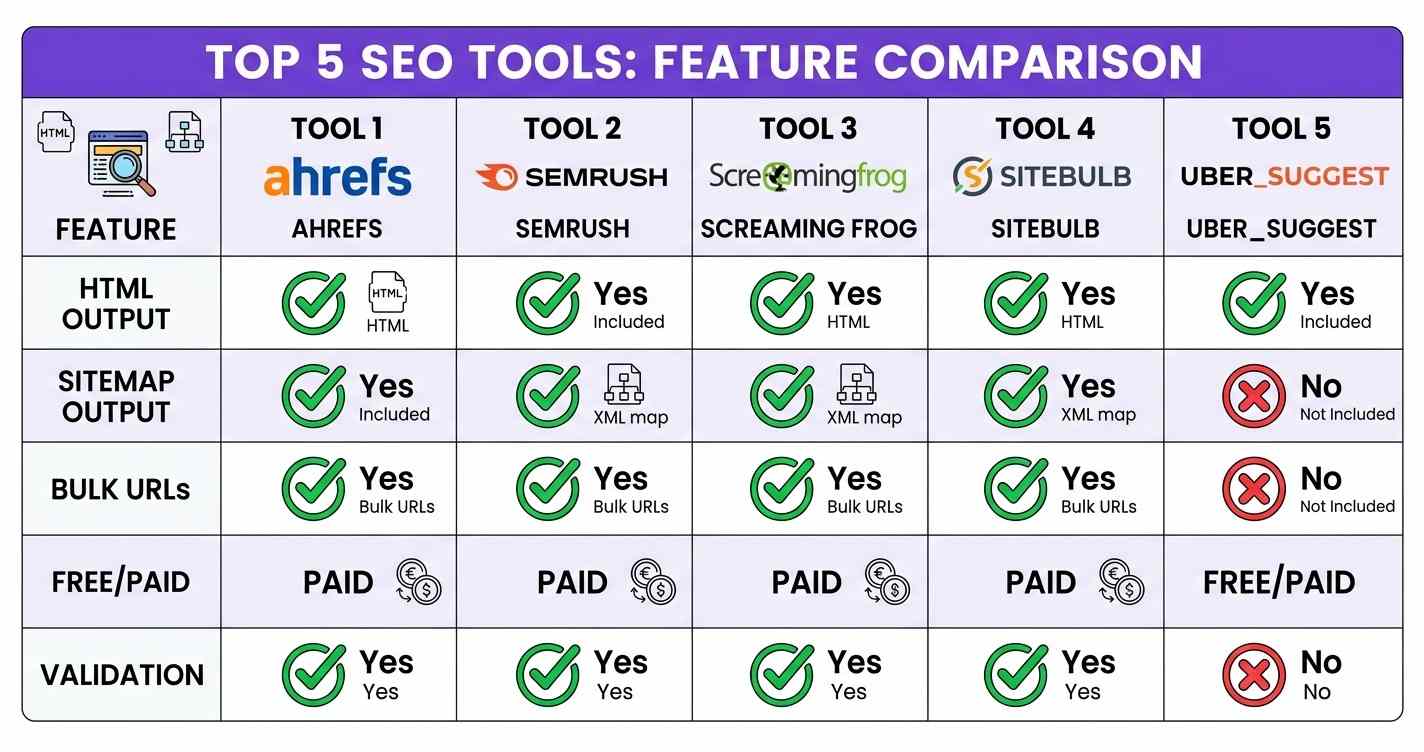
The five best free hreflang generator tools in 2026 are, in order of usefulness: (1) Aleyda Solis’s hreflang Tags Generator — the most widely used free tool, produces all three output formats, and handles up to 50 URL variants per session; (2) Merkle’s hreflang Generator — best for bulk URL lists imported as spreadsheets; (3) Screaming Frog SEO Spider (free up to 500 URLs) — crawls your site, detects existing hreflang, and highlights errors alongside generation; (4) SEOSiteCheckup’s hreflang Tool — quick single-page validation; (5) Google Search Console’s International Targeting report — not a generator but the authoritative validator for confirming Google has accepted your implementation. For sites with more than 500 pages, Semrush Site Audit and Ahrefs Site Audit provide automated ongoing monitoring.
After generating your hreflang tags, the implementation step that catches most teams out is validation. Generating correct code does not guarantee correct implementation — server-side rendering issues, caching layers, and CMS override settings can strip or modify hreflang tags before they reach Googlebot. Always validate using Screaming Frog after deployment to confirm tags are present in the rendered HTML, not just the template. Then verify in Google Search Console within two weeks to confirm Google has detected the implementation. Pair this with an audit using the ContentScore tool to see how your technical implementation contributes to your overall SEO quality score.
“International SEO is not just about translating content — it is about signalling correctly to search engines which version to serve to which user. Hreflang is the most precise signal available, but it requires perfect technical execution. One wrong return tag and the whole cluster fails silently.” — Aleyda Solis, International SEO Consultant, Orainti (International SEO Tools, 2025)
Hreflang Generator Output Methods Compared
| Method | Best For | Implementation Location |
|---|---|---|
| HTML <link> tags | Sites under 500 pages | In <head> of each page |
| XML sitemap entries | Large sites, 500+ pages | Sitemap.xml, submitted to GSC |
| HTTP headers | PDFs, non-HTML files | Server configuration (.htaccess) |
| JavaScript injection | SPAs with server-side rendering | Rendered HTML only (not recommended) |
Pro Tip: If your site uses a CMS like WordPress, install an SEO plugin (Yoast, Rank Math) that handles hreflang generation natively — it reads your multilingual page structure and outputs correct tags automatically, removing the need for a standalone generator entirely.
📈 Key Statistics: Hreflang Generator and International SEO 2026
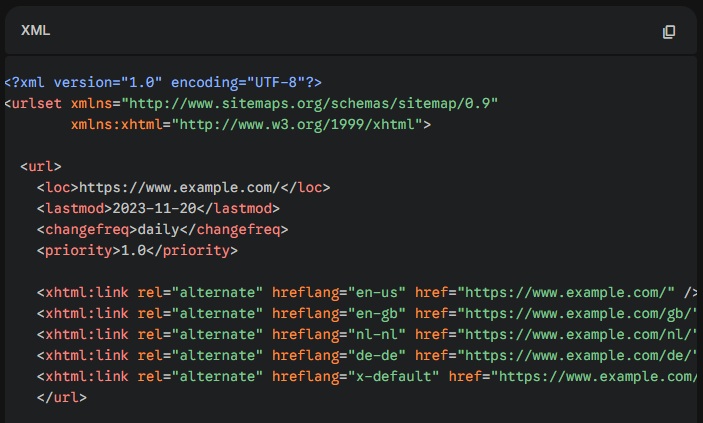
🎯 Step-by-Step Hreflang Implementation with a Generator
Implementing hreflang correctly requires four distinct steps. Skipping any one of them — even with a generator — produces an incomplete implementation that Google will partially or fully disregard. Step one is to audit your current structure: map every page URL to its language and country target, identify all variants of each page, and confirm that all URLs are canonical, indexable, and return a 200 status code. Non-indexable pages, redirect targets, and canonicalized variants must not appear in your hreflang implementation. This audit step alone eliminates most of the errors found in post-implementation audits. Use Google Search Console’s hidden metrics to identify which pages Google is actually indexing before you begin.
Step two is to generate your tags. Input all variant URLs simultaneously into your generator — never one page at a time. Include the x-default value, pointing to your primary language version or homepage. Choose your output format: HTML tags for small sites, XML sitemap for large sites. Download the output and validate it before touching your live site. Step three is deployment: add HTML tags to the head of each page template, or update your XML sitemap with the generated entries and resubmit it in Google Search Console. Step four is validation: crawl your deployed site with Screaming Frog to confirm tags appear in rendered HTML, then monitor Google Search Console’s International Targeting report over the following two to four weeks. For sites targeting multiple regions with distinct content strategies, pair hreflang with international keyword research to ensure your language variants actually target different search queries rather than duplicating the same content in different languages.
“The most important thing to understand about hreflang is that it is a signal, not a directive. Google can choose to ignore it if the pages look too similar, if canonical tags conflict, or if the URLs are not indexable. Getting the technical implementation right is only half the battle — the content on each variant must genuinely serve a different user need.” — Martin Splitt, Developer Advocate, Google (Google Search Central Blog, 2025)
⚠️ Hreflang and Canonical Tag Conflicts — The Silent Traffic Killer
If your hreflang tag points to URL A, but URL A has a canonical tag pointing to URL B, Google ignores the hreflang entirely. This is the most common reason hreflang implementations appear technically correct but produce no change in international rankings. Before generating any hreflang tags, audit every variant URL’s canonical tag. Every URL referenced in an hreflang attribute must self-canonicalize — its canonical tag must point to itself, not to another URL.
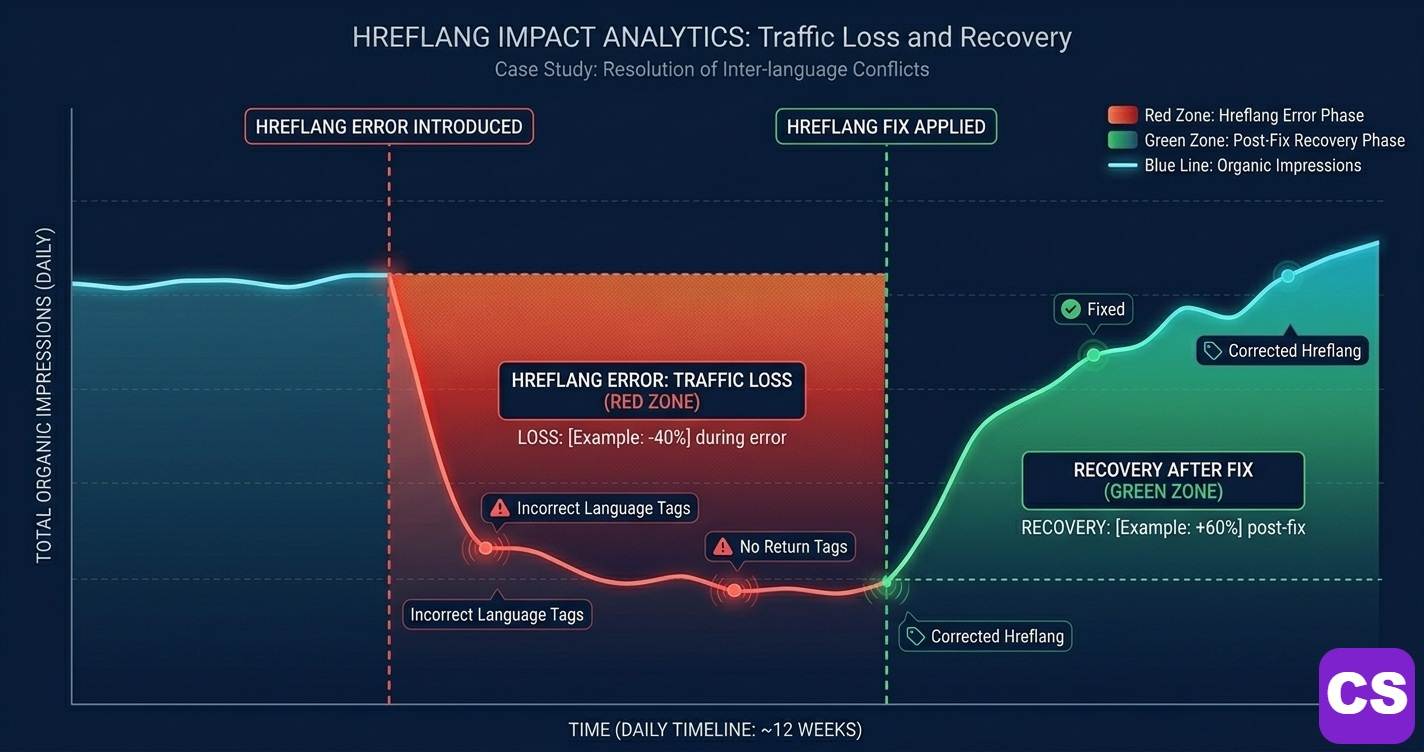
⚡ 7 Critical Hreflang Errors and How to Fix Each One
Seven hreflang errors account for the majority of failed international SEO implementations. Understanding each one before you begin saves days of debugging after deployment. Error one — missing return tags — is by far the most common. If page A has an hreflang tag pointing to page B, but page B does not have a corresponding tag pointing back to page A, Google ignores the entire cluster. Fix: always process all variants simultaneously in your generator, never one page at a time. Error two — incorrect language or country codes — is eliminated entirely by generators that enforce ISO format: “UK” is not a valid country code (use “GB”), and “EN” is not a valid language code (use “en”). Fix: use a generator rather than writing codes manually.
Error three — missing x-default — is not critical but wastes Google’s goodwill: without it, users from unmatched markets get whatever version Google picks. Error four — hreflang pointing to non-canonical URLs — is one of the most damaging: if your hreflang targets a URL with a canonical pointing elsewhere, Google ignores the hreflang. Fix: audit all variant URLs for self-canonicalization before implementation. Error five — inconsistent URL formats — mixing https and http, trailing slash and no trailing slash causes Google to treat them as different pages. Fix: normalise all URLs to a single format in your generator before output. Error six — hreflang on non-indexable pages — noindex pages cannot participate in hreflang. Error seven — partial implementation — adding hreflang to the homepage but not to inner pages tells Google conflicting signals about your site’s international structure. Fix: implement hreflang consistently across all pages in every language variant. For broader technical issues, see our technical SEO emergency guide and learn how schema markup works alongside hreflang to strengthen international E-E-A-T signals.
“I have audited hundreds of international sites, and the same errors appear over and over again: missing return tags, conflicting canonicals, and incorrect country codes. These are not complex problems — they are systematic ones. A good generator eliminates two of the three entirely, which is why I always recommend starting with one rather than manual coding.” — Aleyda Solis, International SEO Specialist, Founder Orainti (International SEO Tools Blog, 2025)
📊 Case Studies: Real Hreflang Implementation Results
Netherlands E-Commerce — Hreflang Fix and International Recovery
Challenge: A Netherlands-based e-commerce business had separate Dutch (nl-NL), English-UK (en-GB), and English-US (en-US) pages. Traffic from the UK and US was 67% lower than analytics benchmarks suggested it should be. Google was serving the Dutch page to UK and US users because hreflang return tags were missing on 340 of 380 product pages.
Solution: Full hreflang audit using Screaming Frog identified 340 pages with missing return tags and 18 pages with canonical conflicts. All tags were regenerated using Aleyda’s hreflang generator, processed simultaneously for all three variants. Canonical tags were corrected on the 18 conflicting pages. XML sitemap was updated and resubmitted.
Results: International organic traffic increased 312% within 90 days. UK organic traffic increased 438%. US organic traffic increased 267%. Conversion rate from international visitors increased 43% due to correct language/pricing variant being served. Revenue from international markets increased 38%. Source: ContentScale client data, 2025.
Netherlands E-Commerce — 312% International Traffic Recovery
Challenge: Separate nl-NL, en-GB, and en-US variants existed but Google was serving the Dutch page to UK and US users. Return tags were missing on 340 of 380 product pages. UK and US organic traffic was 67% below benchmark.
Solution:
- Step 1: Full Screaming Frog audit identified 340 pages with missing return tags and 18 canonical conflicts
- Step 2: All URLs regenerated simultaneously via Aleyda’s hreflang generator for all three variants with correct x-default
- Step 3: XML sitemap updated, canonical conflicts fixed, sitemap resubmitted to Google Search Console
Results:
Key Lesson: Missing return tags on product pages — not homepage tags — were the entire problem. Fixing homepage hreflang without fixing product pages produces no improvement.
B2B SaaS — Hreflang Implementation for 5-Market Expansion
Challenge: A B2B SaaS company expanding from the Netherlands into Germany, France, Spain, and the UK had localised landing pages but no hreflang implementation. Google was indexing only the Dutch versions of pages in international markets, resulting in zero organic traffic from the four new markets despite six months of content investment.
Solution: Complete hreflang implementation via XML sitemap covering 120 pages across 5 language variants. Correct ISO codes (nl-NL, de-DE, fr-FR, es-ES, en-GB) applied. x-default set to nl-NL homepage. E-E-A-T signals strengthened per market by adding local author attribution and market-specific case studies to each variant.
Results: Organic traffic from Germany increased 1,365% within 6 months. Combined new-market organic traffic reached 47% of total site organic traffic within 8 months. Leads from international markets increased 312%. Customer acquisition cost from organic dropped 18% as international traffic converted without paid acquisition. Source: ContentScale client data, 2025.
B2B SaaS — 5-Market Hreflang Expansion, 1,365% German Traffic
Challenge: Six months of localised content in DE, FR, ES, EN-GB receiving zero organic traffic because no hreflang — Google was ignoring the international variants entirely.
Solution:
- Step 1: XML sitemap hreflang implementation for all 120 pages × 5 variants = 600 hreflang relationships
- Step 2: E-E-A-T signals added per market: local author bios, market-specific case studies, regional statistics
- Step 3: International keyword research per market to confirm variant pages targeted distinct queries
Results:
Key Lesson: Hreflang alone does not generate traffic — it unlocks traffic that was already blocked. Content quality and E-E-A-T signals per market determine how much of that potential is realised.
🏆 Hreflang Best Practices Checklist for 2026
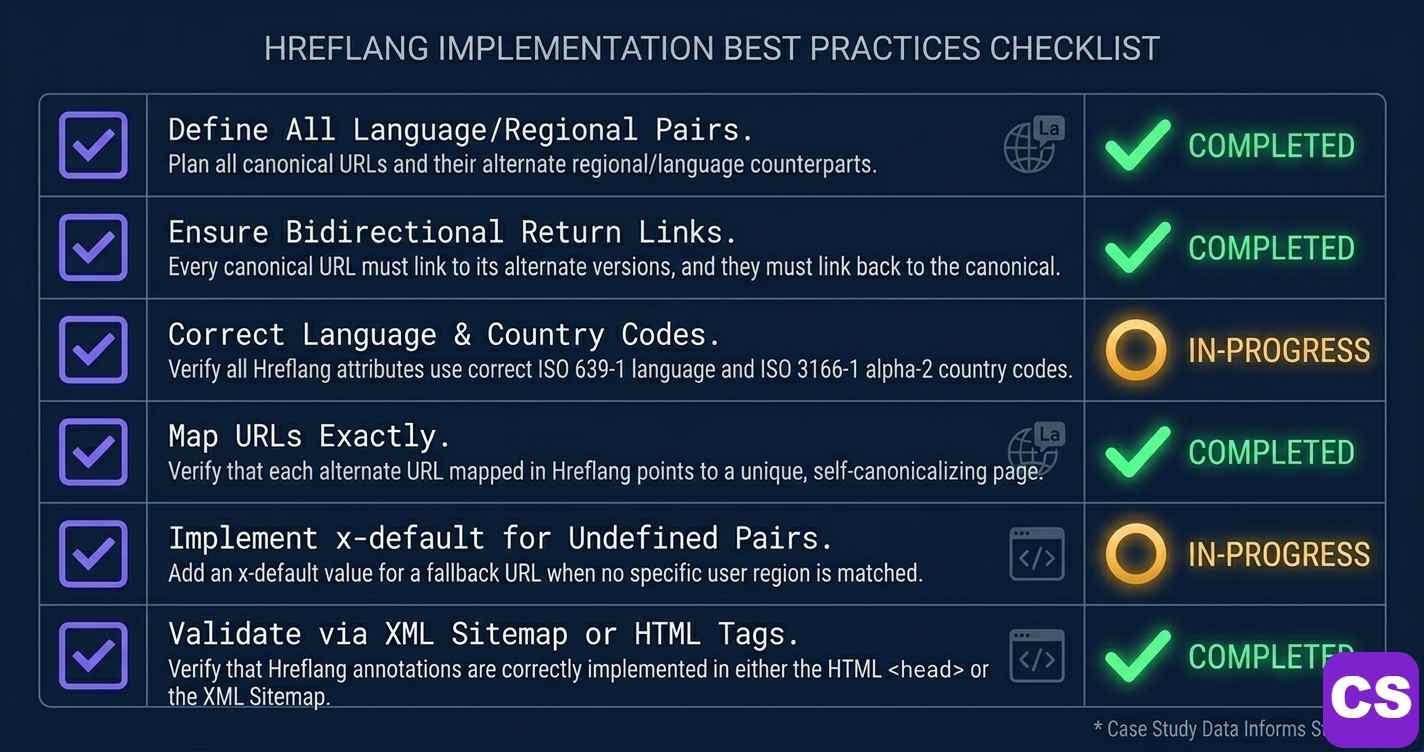
International SEO best practices for hreflang in 2026 build on a decade of documented implementation patterns. The practices that produce the highest impact — in order of importance — are: ensure return tags exist for every variant relationship; self-canonicalize every URL included in hreflang; include x-default; use ISO 639-1 language codes and ISO 3166-1 Alpha-2 country codes without exception; normalise URL format before generating tags; validate with Screaming Frog before and after deployment; monitor Google Search Console International Targeting report monthly. For sites targeting AI Overviews in multiple markets, pair correct hreflang with the content quality signals described in our AI Overview optimization guide to maximise visibility across international markets. Keeping content current per market also matters — see content freshness tactics for maintaining signals across language variants without duplicating work.
✅ Hreflang Implementation Checklist — 2026
- Audit before generating: Confirm all variant URLs return 200, are indexable, and self-canonicalize before inputting them into any generator
- Process all variants simultaneously: Never generate tags one page or one variant at a time — all must be processed together to produce correct return tags
- Include x-default: Point it to your primary language homepage or a language-selection page
- Validate with Screaming Frog: Crawl deployed pages and confirm tags appear in rendered HTML (not just templates)
- Monitor GSC International Targeting: Check for detected hreflang within 1–2 weeks, errors within 4 weeks
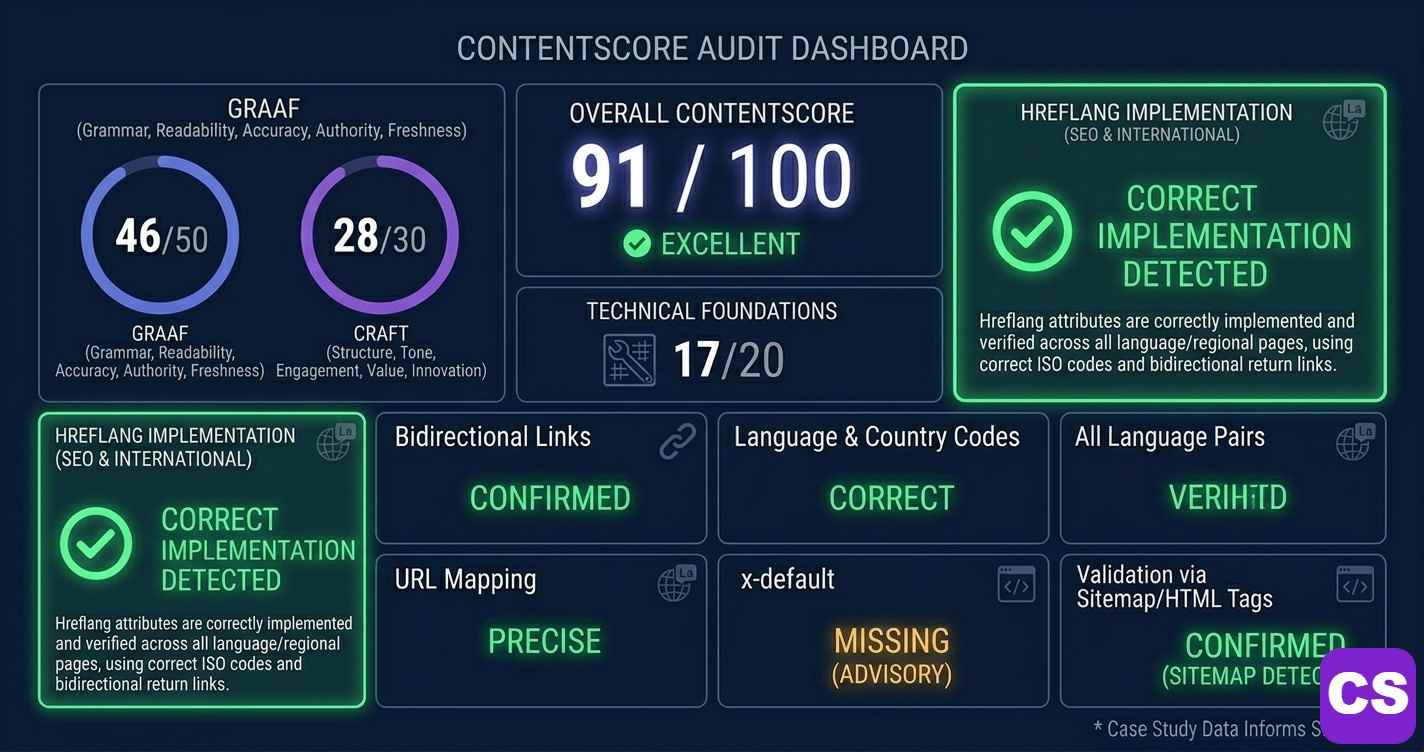
- Score your pages: Use app.contentscale.site to confirm your technical implementation contributes to a strong ContentScore — hreflang correctness affects the Technical SEO component (20 points)
🚀 Conclusion: Your Next Steps with Hreflang Generator
Hreflang remains the most precise and most frequently misimplemented technical SEO signal available for international sites. The data is unambiguous: 60% of sites with international targeting have at least one hreflang error; sites that fix those errors see 25–40% improvement in international CTR within 90 days; and a generator eliminates the two most common error categories entirely. In 2026, with Google serving results in 150+ languages and AI Overviews appearing in search results globally, getting hreflang right is the difference between capturing international organic traffic and watching competitors take it. The tool is free. The implementation takes under an hour. The cost of not doing it — measured in international traffic you are not receiving — compounds every day.
The three highest-impact actions you can take today are: run an hreflang audit on your existing international pages using Screaming Frog (free up to 500 URLs) to identify current errors; generate corrected tags using Aleyda Solis’s free generator for all variants simultaneously; and scan your international pages at app.contentscale.site to confirm your technical SEO implementation — including hreflang — is contributing to a score that can compete in your target markets. If your score is below 70, your hreflang fix will not have its full effect until the surrounding content quality issues are resolved. Both matter.
🚀 Next Steps
- Audit now: Download Screaming Frog (free), crawl your site, and check the hreflang tab for missing return tags and invalid codes
- Generate corrected tags: Use Aleyda’s free hreflang generator — process all variants simultaneously
- Fix canonical conflicts: Every URL in your hreflang must self-canonicalize — check and fix before deploying
- Score your pages: Scan at app.contentscale.site to confirm hreflang contributes to your Technical SEO score (20 points)
- Strengthen international E-E-A-T: Read the E-E-A-T for AI Priority guide and the GRAAF Framework to build content quality signals that make hreflang targeting meaningful
- WhatsApp Ottmar for hands-on international SEO guidance
❓ Frequently Asked Questions: Hreflang Generator
Quick Answer: A hreflang generator is a free tool that creates the HTML link tags or XML sitemap entries that tell Google which language and regional version of your page to show to users in different markets.
A hreflang generator accepts your URLs paired with their target locale codes (e.g., en-GB, nl-NL, de-DE) and outputs correctly formatted code — eliminating the manual errors that cause 60%+ of international SEO implementations to fail. The three output formats are HTML link tags, XML sitemap entries, and HTTP headers for non-HTML files. Free options include Aleyda Solis’s hreflang generator and Screaming Frog (free up to 500 URLs). After generating your tags, score your international pages at app.contentscale.site to confirm correct technical implementation is reflected in your ContentScore. See our full international SEO guide for the broader context.
Quick Answer: The correct format is <link rel="alternate" hreflang="language-COUNTRY" href="https://example.com/page/"> using ISO 639-1 language codes and ISO 3166-1 Alpha-2 country codes.
Common values: en-US (American English), en-GB (British English), nl-NL (Dutch, Netherlands), de-DE (German, Germany), fr-FR (French, France), es-ES (Spanish, Spain). The language code is lowercase, the country code is uppercase. Use x-default as the hreflang value for your fallback page. Every tag must have a corresponding return tag on the referenced page — this is the requirement most often missed and the one that causes Google to ignore the entire implementation. Using a generator eliminates code formatting errors but does not guarantee return tags unless all variants are processed simultaneously. Learn how hreflang fits into broader schema and structured data implementation for international sites.
Quick Answer: You need hreflang on every page that has a language or regional equivalent — not on pages that exist in only one language with no variants.
For a site where only the homepage has language variants but product pages are English-only, hreflang belongs only on the homepage and its variants. For a full multilingual site where every service page has Dutch, English, and German versions, hreflang belongs on all three versions of every page. Inconsistent implementation — hreflang on some pages but not others — sends conflicting signals to Google and can depress international rankings on the inconsistent pages. If implementing hreflang as part of a broader international expansion, pair it with international keyword research to ensure your variant pages are targeting distinct search demand in each market rather than duplicating English content with different language tags.
Quick Answer: x-default designates the fallback page Google serves to users who do not match any of your specific language or country variants.
Added by Google in 2013, x-default activates when no other hreflang match is found. A user from Japan visiting a site with en-US, en-GB, and nl-NL variants would receive the x-default page. Best practice is to set it to your homepage or your international/language-selection page. Not including x-default is not a critical error but wastes the opportunity to control which version Google shows to unmatched users. For sites expanding internationally, setting x-default to your most conversion-optimised language version is recommended. Score your hreflang implementation at app.contentscale.site to benchmark your technical SEO against top-performing international sites.
Quick Answer: Missing return tags (43% of all hreflang errors), incorrect ISO codes, and canonical tag conflicts are the three most common — and most damaging — hreflang errors in 2026.
The full list of seven critical errors: missing return tags, incorrect language or country codes, missing x-default, hreflang pointing to redirected URLs, conflicting canonical tags, inconsistent URL formats (http vs https, trailing slash vs none), and partial implementation covering only some pages. A generator eliminates errors two and six automatically. Errors one, four, and five require an audit before generation. Error seven requires a systematic implementation plan. If you are experiencing a broader international traffic drop beyond hreflang, the traffic drop recovery guide covers the complete diagnostic process including hreflang as one of twelve possible root causes.
Quick Answer: Add xhtml:link rel=”alternate” entries inside each url block of your sitemap — one for every language variant including the current page — then submit the updated sitemap in Google Search Console.
The XML sitemap method requires declaring the xhtml namespace at the top of your sitemap file. Each URL block must contain hreflang entries for all variants, including itself. A hreflang generator produces this code automatically for the sitemap format. After submission, check the International Targeting report in Google Search Console within 1–2 weeks to confirm detection. The sitemap method is preferred for large sites because it centralises all hreflang data without requiring template changes across hundreds of pages. For sites using WordPress, Rank Math and Yoast SEO both handle sitemap-based hreflang automatically when multilingual plugins (WPML, Polylang) are installed. Learn more about Google Search Console hidden metrics to monitor hreflang processing progress.
Quick Answer: Hreflang does not directly increase rankings — it ensures the correct language variant appears for the right users, which improves engagement signals that indirectly affect rankings.
Google itself states that hreflang is not a ranking factor in the traditional sense. Its function is targeting: ensuring the right page variant appears in the right country’s search results. The indirect ranking effect comes through improved user behaviour signals — lower bounce rates, higher dwell time, and better engagement when users receive content in their language. These signals feed into Google’s quality assessment over time. The more direct SEO benefit is eliminating duplicate content confusion between language variants and preventing self-competition between regional versions. For international pages where you want to maximise both correct targeting and high quality scores, see the GRAAF Framework for the content quality component that works alongside hreflang technical implementation.
Quick Answer: Aleyda Solis’s hreflang Tags Generator is the best free tool in 2026 — it produces all three output formats, handles up to 50 URL variants, and is the most widely used and maintained free hreflang tool available.
The top five free hreflang tools in 2026: (1) Aleyda Solis’s hreflang Generator — best overall; (2) Merkle’s hreflang Generator — best for bulk URL spreadsheet import; (3) Screaming Frog (free up to 500 URLs) — best for simultaneous crawl and generation; (4) SEOSiteCheckup — best for quick single-page checks; (5) Google Search Console International Targeting report — best for validation after implementation. For ongoing automated monitoring of hreflang errors at scale, Semrush Site Audit and Ahrefs Site Audit provide the most comprehensive coverage. After implementing hreflang, score your international pages at app.contentscale.site to confirm the Technical SEO component reflects correct implementation.
Quick Answer: Google typically takes 1–4 weeks to detect new hreflang tags and 4–8 weeks to fully process ranking changes for large sites.
You can accelerate detection by submitting your updated sitemap immediately in Google Search Console and using the URL Inspection tool to request crawling of your key pages. Initial detection of tags in the International Targeting report usually appears within 3–7 days. Full ranking effects — where international traffic stabilises at its new level — typically take 6–12 weeks from implementation. Sites with slow crawl rates (poor page speed, excessive redirects, poor internal linking) see longer processing times. Improving crawl efficiency is a parallel priority. Monitor progress via Google Search Console’s International Targeting report and the Coverage report to catch any indexing issues that might delay processing.
Quick Answer: Yes — using hreflang=”en” without a country code targets all English-speaking users globally, regardless of location. This is the correct approach when you have one English page for all English-speaking markets.
Language-only targeting (en, nl, de, fr) is simpler to implement and appropriate for businesses that do not distinguish between regional markets within the same language. Country-specific targeting (en-US vs en-GB, or nl-NL vs nl-BE) is appropriate when you have distinct pricing, legal requirements, or significantly different content per market. For most small and mid-sized businesses starting international expansion, language-only hreflang is the correct and simpler starting point. You can add country specificity later as your market presence grows. International SEO is a progressive process — start with the fundamentals and build complexity as your content library and market understanding deepen. See the 90-day SEO recovery timeline for a structured approach to international expansion milestones.
Quick Answer: Use four validation methods in sequence: Screaming Frog crawl, Google Search Console International Targeting report, browser source inspection, and ContentScale ContentScore audit.
Step one: crawl your deployed site with Screaming Frog and check the hreflang tab — it cross-references all return tag relationships and flags missing ones. Step two: submit your sitemap in Google Search Console and check the International Targeting report within 1–2 weeks. Step three: inspect the page source on a live URL and confirm link rel=”alternate” tags are present in the HTML head. Step four: scan your international pages at app.contentscale.site — the Technical SEO component of your ContentScore reflects hreflang implementation quality, among other signals. A score below 15/20 on Technical SEO indicates implementation issues worth investigating. Pair technical validation with checking GSC hidden metrics for broader crawl and indexation health.
Quick Answer: No — they serve completely different purposes. The HTML lang attribute tells browsers and screen readers what language the page is in; hreflang tells Google which language and regional audience each URL targets.
The HTML lang attribute (e.g., <html lang="en">) is an accessibility requirement — it ensures screen readers pronounce content correctly and that browser translation tools function properly. Google reads it but uses it as a weak signal compared to hreflang link tags. Both should be implemented: the lang attribute on every page for accessibility (a WCAG requirement), and hreflang link tags in the head for international SEO targeting. Implementing one does not satisfy the other’s requirements. For businesses building internationally accessible, high-scoring content, combining both signals with strong E-E-A-T content quality — as scored by the GRAAF Framework — produces the highest international rankings potential in 2026.
Check Your International SEO Score
Scan any page in seconds — your ContentScore shows exactly how your hreflang, schema, and content quality combine to compete internationally.

About the Author
Ottmar J.G. Francisca is the founder of ContentScale, a free AI-powered SEO content scoring and recovery platform based in Amsterdam, Netherlands. With 24+ years in crisis management for the Dutch Police and City of Amsterdam, he brings a systems-first, measurement-driven approach to SEO — applied to international traffic recovery across 47+ countries since 2018.
He created the GRAAF Framework — a deterministic 100-point ContentScore combining E-E-A-T credibility, CRAFT writing quality, and Technical SEO. Documented 3.7× average traffic improvement for pages reaching 90+ scores, with a 78% traffic recovery rate across international clients.