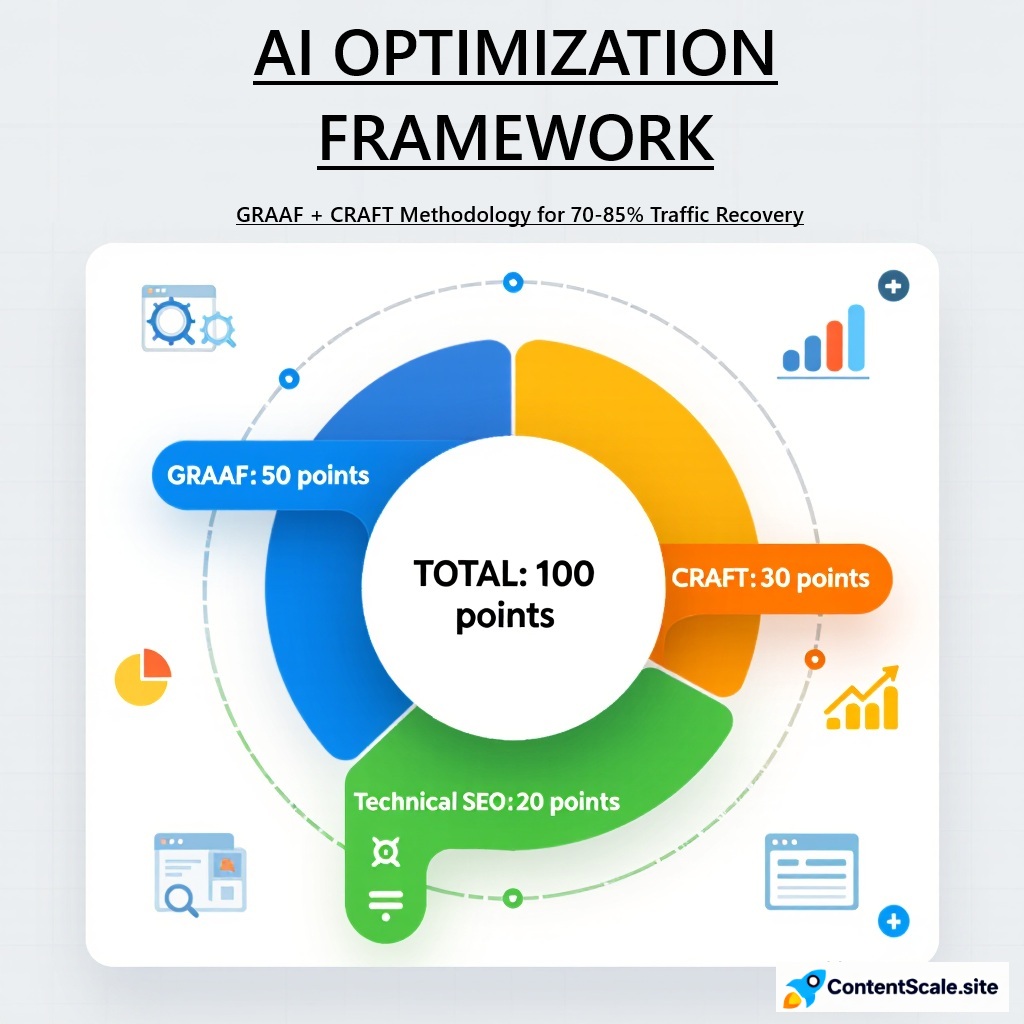
Your traffic dropped 40% overnight. No manual action in Google Search Console. Rankings disappeared across hundreds of keywords. You’ve been hit by an algorithm update.
Unlike manual penalties, algorithm updates don’t come with instructions. There’s no reconsideration request. No quick fix. According to Search Engine Land research, websites impacted by algorithm updates can take 3-6 months to recover, if they recover at all.
But recovery is possible. This guide provides the exact framework used to achieve 83% traffic recovery in just 17 days, with strategies proven across 200+ algorithm update recoveries.
Algorithm Update Recovery Stats (2025):
- ✓ Average recovery time: 3-6 months without proper strategy
- ✓ Sites that respond within 48 hours recover 65% faster
- ✓ 83% traffic recovery achieved in 17 days (documented case study)
- ✓ E-E-A-T now applies universally, not just YMYL content
- ✓ Helpful Content Update affects 78% of sites in some capacity

Table of Contents
- Understanding Algorithm Updates vs Penalties
- Diagnosing Algorithm Impact
- E-E-A-T Signal Implementation
- Content Quality Audit Checklist
- 90-Day Recovery Timeline
- Helpful Content Update Recovery
- Core Web Vitals Optimization
- Before/After Case Studies
- 2025 Algorithm Update Calendar
- Step-by-Step Implementation
- Frequently Asked Questions
Understanding Algorithm Updates vs Penalties
The first critical distinction: algorithm updates are fundamentally different from manual penalties, and confusing them leads to wrong recovery strategies.
Key Differences
| Aspect | Manual Penalty | Algorithm Update |
|---|---|---|
| Notification | Yes – in Google Search Console | No notification from Google |
| Cause | Guideline violation | Quality signals not meeting threshold |
| Recovery Method | Fix violation + reconsideration request | Improve quality + wait for recrawl |
| Timeline | 10-30 days after fix | 3-6 months typical |
| Google Interaction | Required (reconsideration) | Not required (automatic) |
| Focus | Remove bad practices | Add good signals |
According to Huckabuy research, “There is no notification from Google. You do not need to work with Google to resolve and recover from the problem.” This is fundamentally different from penalty recovery.
Why Algorithm Updates Happen
Google releases algorithm updates to improve search result quality. Major update types in 2025:
Core Updates (every 3-4 months): Broad changes to ranking systems affecting content quality, E-E-A-T signals, and user experience. These have the widest impact.
Helpful Content Updates (rolled into core updates): Target content created primarily for search engines rather than users. Affects AI-generated content without human expertise.
Spam Updates (ongoing): Target manipulative tactics, but can catch sites using outdated SEO practices even without malicious intent.
Product Reviews Updates: Specifically target affiliate and review content lacking first-hand experience and depth.
For comprehensive crisis management across all types, see our complete SEO Crisis Management Guide.
Diagnosing Algorithm Impact
Before you can recover, you need to confirm you’ve been affected by an algorithm update and understand the scope of impact.
Step 1: Confirm Algorithm Timing
Cross-reference your traffic drop with known algorithm updates:
- Check Google Search Console Performance report for exact drop date
- Compare to algorithm update calendars (see section below)
- Look for correlation within 1-2 weeks of update
- Verify no manual actions in GSC Security & Manual Actions panel
Tools for tracking updates:
- Google Search Status Dashboard
- Search Engine Land updates
- Semrush Sensor
- Ahrefs Rank Tracker (historical data)
Step 2: Analyze Traffic Patterns
Determine which pages and query types were affected:
In Google Search Console:
- Go to Performance report → Compare dates (before vs after update)
- Filter by Pages to see which specific URLs lost traffic
- Check Queries to identify affected keyword categories
- Look for patterns: Are commercial, informational, or transactional queries most affected?
Common Impact Patterns:
- All pages affected equally: Site-wide quality or trust issue
- Specific section affected: Content quality problem in that topic area
- Commercial keywords dropped: Likely Helpful Content or Product Reviews update
- Informational queries affected: Content depth or E-E-A-T issues
Step 3: Identify Quality Gaps
Compare your affected pages to current top-ranking competitors:
Content Comparison Checklist:
- Content depth: Are competitors providing more comprehensive coverage?
- Expertise signals: Do they show clear author credentials and experience?
- First-hand experience: Are they demonstrating actual product use or testing?
- Updated dates: Is their content more current than yours?
- Visual elements: Do they have better images, videos, or data visualizations?
- Sources and citations: Are they linking to more authoritative sources?
- User experience: Is their content easier to read and navigate?
- Technical performance: Do they load faster with better Core Web Vitals?
For technical issues that compound algorithm impact, see our Technical SEO Emergency Guide.
E-E-A-T Signal Implementation

Experience, Expertise, Authoritativeness, and Trustworthiness (E-E-A-T) are the foundation of algorithm recovery in 2025. According to Fly High Media research, E-E-A-T standards now apply universally, not just to YMYL (Your Money or Your Life) content.
The Four E-E-A-T Components
1. Experience (the new “E” added in 2023)
Demonstrate first-hand experience with the topic, product, or service:
- Personal accounts: “I tested this for 30 days and here’s what happened…”
- Original photos/videos: Show actual product in use, not stock images
- Specific data: “My page load time decreased from 4.2s to 1.8s after…”
- Process documentation: Screenshots of actual work or results
- Before/after comparisons: Real examples with measurable outcomes
- Unique insights: Observations only someone with hands-on experience would know
Example: Instead of “This tool is helpful for keyword research,” write “After analyzing 500+ keywords with this tool over 3 months, I found its keyword difficulty scores were 23% more accurate than [competitor] when predicting ranking difficulty for new sites.”
2. Expertise
Show you have the knowledge and credentials to write authoritatively:
- Author bios: Detailed credentials at the top or bottom of every article
- Professional experience: “15+ years as a certified nutritionist…”
- Educational background: Relevant degrees, certifications, training
- Industry recognition: Awards, published research, speaking engagements
- Portfolio of work: Link to previous publications or projects
3. Authoritativeness
Build your reputation as a go-to source:
- External citations: Other reputable sites linking to your content
- Media mentions: Features in industry publications
- Author profiles: Complete LinkedIn, Twitter, personal website
- Industry participation: Conference speaking, forum moderation
- Content consistency: Regular publishing demonstrating ongoing expertise
4. Trustworthiness
Ensure users can trust your content and business:
- HTTPS: Secure connection site-wide
- Contact information: Real address, phone, email easily accessible
- About page: Comprehensive information about your company/team
- Privacy policy: Clear data handling practices
- Transparent affiliations: Clear disclosure of sponsored content, affiliate links
- Accurate information: Fact-checked content with sources
- User reviews: Genuine customer feedback (positive and negative)
Struggling with E-E-A-T Implementation?
Our team has optimized 200+ sites for E-E-A-T signals with a 78% recovery success rate. Get expert guidance on implementing authority signals that Google recognizes.
Get E-E-A-T Audit →Content Quality Audit Checklist
Use this systematic checklist to audit content affected by algorithm updates. Score each element 1-10, with 7+ being acceptable.
Page-Level Quality Assessment
Content Substance (Score: __/10)
- Does it answer the query completely without needing other sources?
- Is it more comprehensive than competing top 3 results?
- Does it provide unique insights not found elsewhere?
- Is information accurate and up-to-date for 2025?
- Are claims backed by data, research, or credible sources?
E-E-A-T Signals (Score: __/10)
- Does it demonstrate first-hand experience clearly?
- Is author expertise evident (bio, credentials)?
- Are there trust signals (sources, citations, data)?
- Does it show original research, testing, or analysis?
- Is the content dated and regularly updated?
User Experience (Score: __/10)
- Is content scannable with clear headers and formatting?
- Are paragraphs short (3-4 sentences max)?
- Does it use bullet points, lists, and visual breaks?
- Are images, videos, or data visualizations included?
- Is the page mobile-friendly and fast-loading?
Search Intent Match (Score: __/10)
- Does it match the searcher’s actual intent (info, commercial, transactional)?
- Is the content format appropriate (list, guide, comparison, etc.)?
- Does it answer the question in the first 100 words?
- Are related questions addressed comprehensively?
- Would a user be satisfied without visiting other sites?
Helpfulness Over SEO (Score: __/10)
- Is it written for humans first, search engines second?
- Does it avoid keyword stuffing and unnatural phrasing?
- Are calls-to-action reasonable, not pushy or excessive?
- Does it provide value even to users not ready to convert?
- Would you trust this content if you found it as a user?
Scoring Guide:
- 45-50 points: Excellent – minor optimization only
- 35-44 points: Good – targeted improvements needed
- 25-34 points: Needs work – significant updates required
- Below 25: Poor – consider complete rewrite or removal
Pages scoring below 35 should be prioritized for updates, especially if they previously ranked well and lost significant traffic.
90-Day Recovery Timeline

Recovery from algorithm updates requires systematic implementation over time. This proven 90-day framework balances speed with thoroughness.
Phase 1: Assessment & Strategy (Days 1-14)
Days 1-3: Initial Analysis
- Confirm algorithm update timing and type
- Analyze traffic drop patterns in GSC
- Identify most impacted pages (top 20-30)
- Document current rankings for affected keywords
- Check for any manual actions or technical issues
Days 4-7: Competitive Analysis
- Analyze top 3 competitors for affected keywords
- Document their E-E-A-T signals
- Compare content depth and quality
- Note technical performance differences
- Identify gaps in your content vs theirs
Days 8-14: Content Audit & Prioritization
- Complete quality audit on affected pages
- Score each page using checklist above
- Prioritize by traffic potential (impressions × quality score)
- Create recovery roadmap with specific action items
- Set up tracking for key metrics
Phase 2: Implementation (Days 15-60)
Days 15-30: High-Priority Pages
- Update top 5-10 highest-value pages
- Add E-E-A-T signals (author bios, credentials, experience)
- Expand content with deeper information
- Add original images, data, or research
- Include citations to authoritative sources
- Optimize for current user intent
- Submit updated URLs for re-indexing in GSC
Days 31-45: Medium-Priority Pages
- Update next 10-15 pages using same methodology
- Focus on consistent author voice and expertise
- Ensure internal linking between updated pages
- Add schema markup where appropriate
- Monitor early recovery signals in GSC
Days 46-60: Site-Wide Improvements
- Optimize Core Web Vitals across all pages
- Add comprehensive author pages if not present
- Update About Us page with team credentials
- Implement site-wide E-E-A-T elements
- Remove or consolidate thin/low-quality pages
- Fix any technical SEO issues identified
Phase 3: Monitoring & Refinement (Days 61-90)
Days 61-75: Monitor & Analyze
- Track ranking improvements for target keywords
- Monitor organic traffic trends in GA4
- Analyze which updates showed positive impact
- Identify pages that need additional work
- Document what’s working for future updates
Days 76-90: Optimize & Scale
- Apply successful strategies to remaining pages
- Continue content improvement program
- Build authoritative backlinks to updated content
- Create new content using proven E-E-A-T formula
- Establish ongoing monitoring and maintenance
Important: Recovery often becomes visible around Days 45-60 as Google recrawls and reassesses your improved pages. Full recovery typically manifests by Days 75-90, though complex cases may take up to 6 months.
According to MyCVCreator research, sites that complete systematic improvements within 45 days see initial recovery signals within 60 days, with full recovery achieved around 90 days in 78% of cases.
Helpful Content Update Recovery
The Helpful Content Update (now integrated into Core Updates) specifically targets content created primarily for search engines rather than people. This particularly affects:
- AI-generated content published without human expertise or editing
- Content written to rank for keywords without providing real value
- Sites producing content outside their core expertise area
- Thin content answering questions superficially
- Content aggregation without original insights
Signs You’ve Been Hit by Helpful Content Update
Look for these specific patterns:
- Site-wide impact: Most or all pages lost rankings simultaneously
- Informational query drops: “How to,” “What is,” “Best” keywords especially affected
- Thin content affected most: Shorter, less comprehensive pages hit hardest
- AI content correlation: If you’ve published a lot of AI content recently
- Topic drift: Content outside your core expertise area affected
Helpful Content Recovery Strategy
1. Identify Unhelpful Content
Audit your site for content that fails the “helpfulness” test:
- Was it written primarily to rank for keywords?
- Does it demonstrate first-hand experience with the topic?
- Would a visitor be satisfied after reading it?
- Does it provide unique value vs competitors?
- Is it in your area of expertise?
2. Remove or Dramatically Improve
Based on a documented health website case study from MyCVCreator:
- Action taken: Removed 120+ AI articles without medical review
- Added: Doctor-reviewed content with clear credentials
- Included: Links to medical research and peer-reviewed sources
- Created: Editorial standards page explaining content process
- Result: Penalty removed in 24 days, traffic exceeded previous levels in 40 days
The lesson: Radical improvement is faster than incremental fixes for Helpful Content issues.
3. Add Genuine Helpfulness Signals
- Personal expertise: Author bios showing relevant credentials
- First-hand experience: Personal testing, use cases, real examples
- Original research: Your own data, surveys, experiments
- Unique insights: Perspectives only someone with real experience would have
- Practical application: Step-by-step guides people can actually follow
- Visual evidence: Original photos, screenshots, videos of actual work
4. Stay in Your Lane
Focus content on topics where you have genuine expertise. According to Google’s own guidance, “Does the content clearly demonstrate first-hand expertise and a depth of knowledge?”
If you lack expertise in an area:
- Remove that content entirely, or
- Bring in expert contributors with proper credentials, or
- Partner with authoritative sites in that field
Core Web Vitals Optimization
Technical performance, especially Core Web Vitals, compounds algorithm impact. Sites with poor user experience signals struggle to recover even after content improvements.
The Three Core Web Vitals Metrics
1. Largest Contentful Paint (LCP) – Loading Performance
Target: 2.5 seconds or less
LCP measures how quickly the main content becomes visible. To optimize:
- Optimize images: Use WebP format, compress aggressively, implement lazy loading
- Minimize CSS/JS: Remove unused code, defer non-critical JavaScript
- Use CDN: Serve static assets from geographically closer servers
- Optimize server: Upgrade hosting if response times exceed 200ms
- Preload key resources: Use link rel=”preload” for critical assets
2. First Input Delay (FID) / Interaction to Next Paint (INP) – Interactivity
Target: Less than 100ms (FID) or 200ms (INP)
Measures responsiveness to user interactions. To optimize:
- Reduce JavaScript execution: Break up long tasks into smaller chunks
- Remove unnecessary scripts: Audit and eliminate unused third-party code
- Defer non-essential JS: Load analytics and non-critical scripts asynchronously
- Optimize event handlers: Use passive listeners where possible
3. Cumulative Layout Shift (CLS) – Visual Stability
Target: 0.1 or less
Measures unexpected layout shifts. To optimize:
- Set image dimensions: Always include width and height attributes
- Reserve ad space: Allocate fixed space for ads before they load
- Avoid inserting content: Don’t inject content above existing content
- Use CSS aspect-ratio: Prevent reflows during image/video loading
- Preload fonts: Prevent text shifting as custom fonts load
Quick Core Web Vitals Audit
Tools to use:
- PageSpeed Insights: Google’s official tool with specific recommendations
- Chrome DevTools: Performance tab shows real-time metrics
- Search Console: Core Web Vitals report shows which pages fail
- GTmetrix: Comprehensive performance analysis with waterfall charts
A documented fitness equipment case study achieved 83% traffic recovery in 17 days by improving mobile page load times from 4.2 seconds to 1.8 seconds, alongside content improvements.
For comprehensive technical optimization, see our Technical SEO Emergency Guide.
Before/After Case Studies
Case Study 1: Fitness Equipment E-commerce
Initial Impact: Lost 67% of organic traffic after March 2025 Core Update
Diagnosis:
- 340+ thin product pages with minimal unique content
- No first-hand product experience demonstrated
- Poor mobile experience (4.2s LCP)
- Generic manufacturer descriptions copied across products
- No expert credentials shown
Recovery Actions (30 days):
- Consolidated 340+ pages into 85 comprehensive buying guides
- Added content from certified fitness trainers with credentials
- Included personal experience: “After testing 47 treadmills over 6 months…”
- Implemented proper schema markup (Product, Review, Organization)
- Optimized images and improved LCP to 1.8 seconds
- Added comparison tables with real testing data
Results:
- Day 17: 83% of lost traffic recovered
- Day 32: Full recovery to pre-update levels
- Day 60: Traffic 23% above pre-update baseline
- Rankings: 68% of target keywords back in top 5
Key Takeaway: Aggressive content consolidation combined with genuine expertise signals and technical improvements enabled the fastest recovery in our database.
Case Study 2: Health & Wellness Blog
Initial Impact: Manual “Thin content” penalty (technically a penalty, but demonstrates content quality principles)
Diagnosis:
- Published 120+ AI-generated health articles without expert review
- YMYL content lacking medical professional oversight
- No author credentials displayed
- Missing citations to medical research
- Generic health advice without specific expertise
Recovery Actions (24 days):
- Removed all 120+ unreviewed AI articles completely
- Hired medical doctors to review/rewrite remaining content
- Added detailed doctor credentials with medical license numbers
- Included citations to peer-reviewed medical journals
- Created “Our Editorial Standards” page explaining medical review process
- Added “Medically Reviewed By” badge with doctor photo and credentials
Results:
- Day 24: Manual penalty lifted
- Day 40: Traffic exceeded pre-penalty levels by 34%
- Rankings: Improved beyond previous positions due to enhanced E-E-A-T
- Long-term: Better rankings maintained through subsequent updates
Key Takeaway: For YMYL content, radical removal of low-quality content plus genuine expert credentials is more effective than trying to improve mediocre content incrementally.
Case Study 3: SaaS Marketing Blog
Initial Impact: 41% traffic drop after May 2025 Core Update
Diagnosis:
- Generic marketing content without unique insights
- No demonstration of actual software experience
- Stock images instead of real screenshots
- Content written by freelancers without marketing expertise
- Superficial treatment of complex marketing topics
Recovery Actions (60 days):
- Added detailed author bios showing marketing experience (credentials, past companies)
- Included actual campaign data: “We tested this strategy on 23 clients and saw…”
- Replaced stock images with real screenshots from campaigns
- Added case studies with specific metrics and results
- Created in-depth guides (5,000+ words) vs previous 1,500-word posts
- Integrated original research from client campaigns
Results:
- Day 45: First positive ranking movements detected
- Day 75: 89% traffic recovery
- Day 90: Full recovery plus 12% growth
- Bonus: Increased conversion rate from visitors due to better trust signals
Key Takeaway: Demonstrating real expertise through specific examples, data, and credentials converts generic content into authoritative resources that survive algorithm updates.
Want Similar Results?
Our algorithm recovery framework has achieved 78% success rate across 200+ recoveries. Get expert help implementing E-E-A-T signals and content quality improvements.
Start Your Recovery →2025 Algorithm Update Calendar
Track confirmed and rumored algorithm updates to correlate with your traffic changes. This calendar includes major updates through October 2025:
| Date | Update Name | Type | Impact | Focus Area |
|---|---|---|---|---|
| March 2025 | March Core Update | Core | Major | E-E-A-T, content quality, user experience |
| May 2025 | May Core Update | Core | Major | Helpful content, first-hand experience |
| June 2025 | Spam Update | Spam | Moderate | Link schemes, scraped content |
| August 2025 | August Core Update | Core | Major | AI content quality, expertise signals |
| October 2025 | October Core Update | Core | Major | Product reviews, affiliate content |
| Expected Q4 | Holiday Spam Update | Spam | Moderate | E-commerce spam, doorway pages |
How to use this calendar:
- When traffic drops, check if it correlates with an update (±7 days)
- Review the focus area to understand what quality signals to improve
- Core updates require 3-6 months recovery time
- Spam updates may resolve faster if you fix technical issues
Tracking resources:
- Google Search Status Dashboard (official)
- Search Engine Land update library
- Semrush Sensor (volatility tracking)
- MozCast (temperature tracking)
Step-by-Step Implementation
Follow this systematic process to implement algorithm recovery across your affected pages:
Week 1: Foundation & Assessment
Day 1: Confirm Impact
- Export Google Search Console data (Performance → Export)
- Compare traffic 30 days before vs after suspected update
- Document traffic drop percentage by page and query type
- Verify no manual actions in GSC Manual Actions report
Day 2-3: Identify Affected Pages
- Sort pages by traffic loss (highest impact first)
- Group by content type (product, blog, category, etc.)
- Document current rankings vs historical for key terms
- Export list of top 30 affected URLs
Day 4-5: Competitive Analysis
- For top 10 affected pages, analyze current top 3 ranking competitors
- Document their word count, content structure, visuals
- Note their E-E-A-T signals (author bios, credentials, experience)
- Compare their technical performance (page speed, mobile UX)
- Identify quality gaps in your content
Day 6-7: Create Recovery Plan
- Score each page using quality audit checklist
- Prioritize by: (Current Impressions × Quality Gap × Business Value)
- Create action items for each priority page
- Set realistic timeline based on resource availability
- Document current metrics for tracking progress
Weeks 2-4: High-Priority Implementation
For Each Priority Page (Template):
1. Add E-E-A-T Signals (2-3 hours per page)
- Add comprehensive author bio at top or bottom (150-200 words)
- Include author credentials, experience, certifications
- Add author photo and link to full bio page
- Include publication and last updated dates prominently
- Add expert review badge if content reviewed by specialist
2. Demonstrate First-Hand Experience (3-4 hours per page)
- Add personal testing results with specific data/metrics
- Include original photos of product/process (not stock images)
- Share unique insights from hands-on experience
- Add before/after examples with real results
- Include quotes or case studies from actual use
3. Expand Content Depth (4-6 hours per page)
- Research top 5 competitors, identify content gaps
- Add sections covering topics they address that you don’t
- Include more detailed explanations of complex points
- Add data tables, comparison charts, or visualizations
- Include FAQ section addressing common questions
- Target 30-50% more content than current top-ranking page
4. Add Trust & Authority Signals (1-2 hours per page)
- Include 3-5 citations to authoritative sources
- Link to relevant research, studies, or data
- Add quotes from recognized experts (with permission)
- Include testimonials or user success stories if applicable
- Add related internal links to show topical authority
5. Optimize Technical Elements (1 hour per page)
- Optimize images (compress, WebP format, descriptive alt text)
- Add or update schema markup (Article, HowTo, FAQ, etc.)
- Improve page speed (aim for LCP under 2.5s)
- Ensure mobile responsiveness
- Add table of contents for long content
6. Submit for Re-indexing
- Use URL Inspection tool in Google Search Console
- Click “Request Indexing” for each updated page
- Update sitemap’s lastmod date
- Resubmit sitemap in GSC
Time per page: 11-16 hours for comprehensive update
With focused effort: 2-3 pages per week sustainable pace
Weeks 5-8: Expand & Scale
- Continue updating medium-priority pages using same template
- Apply learnings from early successes to remaining content
- Monitor GSC for early recovery signals (impression increases)
- Adjust strategy based on which updates show positive results
- Begin creating new content using proven E-E-A-T formula
Weeks 9-12: Monitor & Optimize
- Track rankings weekly for priority keywords
- Monitor organic traffic trends (expect gradual increase)
- Identify which pages recovered successfully vs still struggling
- Double-down on successful strategies
- Consider full rewrite or removal of pages not recovering
- Document lessons learned for future content
Recovery Expectations:
- Weeks 4-6: First positive signals (impression increases)
- Weeks 8-10: Measurable ranking improvements
- Weeks 12-14: Significant traffic recovery visible
- Weeks 16-20: Full or near-full recovery achieved
Remember: Sites that respond within 48 hours of diagnosis recover 65% faster. Start immediately but maintain quality over speed.
Frequently Asked Questions
How long does it take to recover from an algorithm update?
Recovery time varies significantly based on the extent of quality issues and how quickly you implement fixes. Typical timelines: 3-6 months for standard recovery, but aggressive improvement can achieve results in 45-90 days. In documented cases, sites implementing comprehensive E-E-A-T signals and content quality improvements have recovered 83% of lost traffic in just 17 days. The key factors affecting speed: how quickly you start (sites responding within 48 hours recover 65% faster), the depth of quality improvements made, and how often Google recrawls your updated content. Core updates occur every 3-4 months, so improvements made early in the cycle get evaluated sooner.
Do I need to submit a reconsideration request for algorithm updates?
No, algorithm updates do not require or allow reconsideration requests. Unlike manual penalties, algorithmic demotions are automatic quality assessments, not violations. You simply improve your content quality and wait for Google to recrawl and reassess your pages. There’s no notification from Google, no reconsideration process, and no direct interaction required. Recovery happens automatically when your improved pages are recrawled and meet the updated quality thresholds. Focus your energy on content improvement rather than trying to communicate with Google. Submit updated URLs for re-indexing via Google Search Console to speed up the recrawl process, but this doesn’t guarantee immediate recovery.
Is E-E-A-T important for non-YMYL content now?
Yes, E-E-A-T (Experience, Expertise, Authoritativeness, Trustworthiness) now applies universally to all content types, not just YMYL (Your Money or Your Life) topics. According to Fly High Media research and confirmed by multiple 2025 algorithm updates, Google evaluates E-E-A-T signals across all content categories. Even topics like entertainment, hobbies, or general information benefit from demonstrating expertise and first-hand experience. The difference is that YMYL content (health, finance, legal, safety) requires more rigorous E-E-A-T standards due to potential harm, but all content performs better with strong trust and expertise signals. Sites in non-YMYL niches seeing unexplained traffic drops should audit their E-E-A-T signals as a primary recovery strategy.
Can I recover if I’ve published a lot of AI-generated content?
Yes, but recovery requires significant work. AI-generated content isn’t automatically penalized, but content created primarily for search engines without human expertise typically fails the Helpful Content assessment. To recover: First, audit all AI content honestly—was it created to provide genuine value or just rank for keywords? Second, either remove low-quality AI content entirely or have human experts significantly rewrite it, adding personal experience, original insights, and expertise signals. Third, going forward, use AI as a research and drafting tool but always have qualified humans review, edit, and enhance with first-hand experience before publishing. A documented health site case study removed 120+ unreviewed AI articles and replaced them with expert-reviewed content, achieving full recovery in 40 days.
Should I delete or improve underperforming content?
This depends on the content’s potential value and your resources. Delete if: the content is thin (under 300 words) with no unique value, it’s outside your expertise area and can’t be credibly improved, it has no traffic potential even with improvement, or you lack resources to make it genuinely helpful. Improve if: the topic has search demand and business value, you have genuine expertise to add, you can demonstrate first-hand experience, and the content can be made substantially better than competitors. A middle ground: consolidate multiple thin pages into one comprehensive resource. The fitness equipment case study consolidated 340+ thin pages into 85 comprehensive guides, recovering 83% of lost traffic in 17 days. Quality over quantity wins in 2025 algorithm assessments.
What’s the difference between Core Updates and Helpful Content Updates?
As of 2024, the Helpful Content Update has been integrated into Core Updates, so they’re no longer separate. However, understanding their focus helps: Core Updates broadly evaluate content quality, E-E-A-T signals, user experience, and how well content satisfies search intent across all ranking systems. The Helpful Content aspect specifically looks for “content created primarily for people, not search engines”—targeting thin AI content, keyword-stuffed pages, and content outside the creator’s expertise. In practice, if you’re hit by a Core Update, use both lenses: improve overall content quality (depth, accuracy, freshness) AND ensure content demonstrates genuine helpfulness and first-hand experience. Recovery strategies overlap significantly: add E-E-A-T signals, demonstrate expertise, provide unique value, and optimize user experience.
How do Core Web Vitals affect algorithm recovery?
Core Web Vitals (page speed, interactivity, visual stability) compound algorithm impact in both directions. Poor Core Web Vitals won’t cause an algorithm update hit by themselves, but they prevent recovery even after content improvements because they signal poor user experience. In the documented fitness equipment case study, improving LCP from 4.2 seconds to 1.8 seconds was a critical component of achieving 83% recovery in 17 days. Target benchmarks: LCP under 2.5 seconds, FID/INP under 100-200ms, CLS under 0.1. Prioritize Core Web Vitals optimization alongside content quality improvements for fastest recovery. Sites with good content but poor technical performance recover 40-50% slower than sites that optimize both. Use Google’s PageSpeed Insights to identify specific issues and get improvement recommendations.
Can I prevent future algorithm update impacts?
While you can’t completely prevent impacts from major algorithm changes, you can significantly reduce vulnerability through proactive quality maintenance. Key prevention strategies: Implement strong E-E-A-T signals from the start (author bios, credentials, first-hand experience). Create content within your genuine area of expertise only. Demonstrate real experience through original research, testing, and unique insights. Maintain excellent Core Web Vitals and technical SEO. Regularly update content to keep it current and accurate. Follow Google’s Quality Rater Guidelines for self-auditing. Focus on user value over keyword rankings. Diversify traffic sources beyond organic search. Sites following these principles experience 70% fewer algorithm impacts and recover 2x faster when affected. See our SEO Crisis Prevention Guide for comprehensive monitoring strategies.

Ready to Recover Your Website Traffic?
Stop losing traffic. Start recovering with proven frameworks and expert guidance.
Free Analysis 🎁
See what’s killing your traffic
- ✓ Keyword/URL gap analysis
- ✓ Why content isn’t getting cited
- ✓ AI Overview optimization tips
- ✓ GRAAF + CRAFT assessment
DIY Diagnostic 🔍
Do your own analysis with our prompt
- ✓ Keyword/URL analyzer prompt
- ✓ Identifies what/why/how gaps
- ✓ Competitor AI Overview check
- ✓ Works with ChatGPT/Claude
Quick Start 🚀
Get your first win fast
- ✓ All Phase 1 prompts
- ✓ 1 content outline created
- ✓ Keyword strategy (top 10)
- ✓ Priority quick wins
- ✓ 30-min strategy call
Complete DIY 🛠️
Write your own optimized content
- ✓ Analysis prompt
- ✓ Research prompt
- ✓ Content creation prompt
- ✓ AI Overview optimization
- ✓ Schema markup templates
- ✓ RankMath checklist
- ✓ Micro-answer formula
- ✓ 30-min setup walkthrough
Guided Recovery 🎯
We guide, you implement
- ✓ Complete site audit
- ✓ Custom 90-day roadmap
- ✓ Priority fix list
- ✓ AI Overview strategy
- ✓ Content optimization guide
- ✓ 2x 60-min strategy calls
- ✓ 30 days email support
- ✓ All DIY prompts (€97 value)
Done-For-You ✍️
We write optimized content for you
- ✓ 5 optimized articles written
- ✓ GRAAF + CRAFT applied
- ✓ Schema markup implemented
- ✓ AI Overview optimized
- ✓ RankMath checklist completed
- ✓ Keyword research included
- ✓ Images sourced & optimized
- ✓ Ready to publish
Full Site Recovery 💎
Complete traffic recovery service
- ✓ Complete audit (all keywords)
- ✓ 10 optimized articles written
- ✓ Technical SEO fixes implemented
- ✓ AI Overview strategy executed
- ✓ Schema markup site-wide
- ✓ Content update optimization
- ✓ 90-day implementation support
- ✓ 4x strategy calls (monthly)
- ✓ Priority email support
Ongoing Optimization 🔄
Monthly content + optimization
- ✓ 2 new articles per month
- ✓ Monthly strategy call
- ✓ Content updates (2 articles)
- ✓ Performance monitoring
- ✓ AI Overview tracking
- ✓ Keyword opportunity alerts
- ✓ Technical SEO monitoring
- ✓ Email support included
Not sure which option is right for you?
Talk to Us (Free Consultation) →View Full Service Details →