YMYL AI Optimization: The Complete E-E-A-T Strategy for High-Risk Industries in 2026
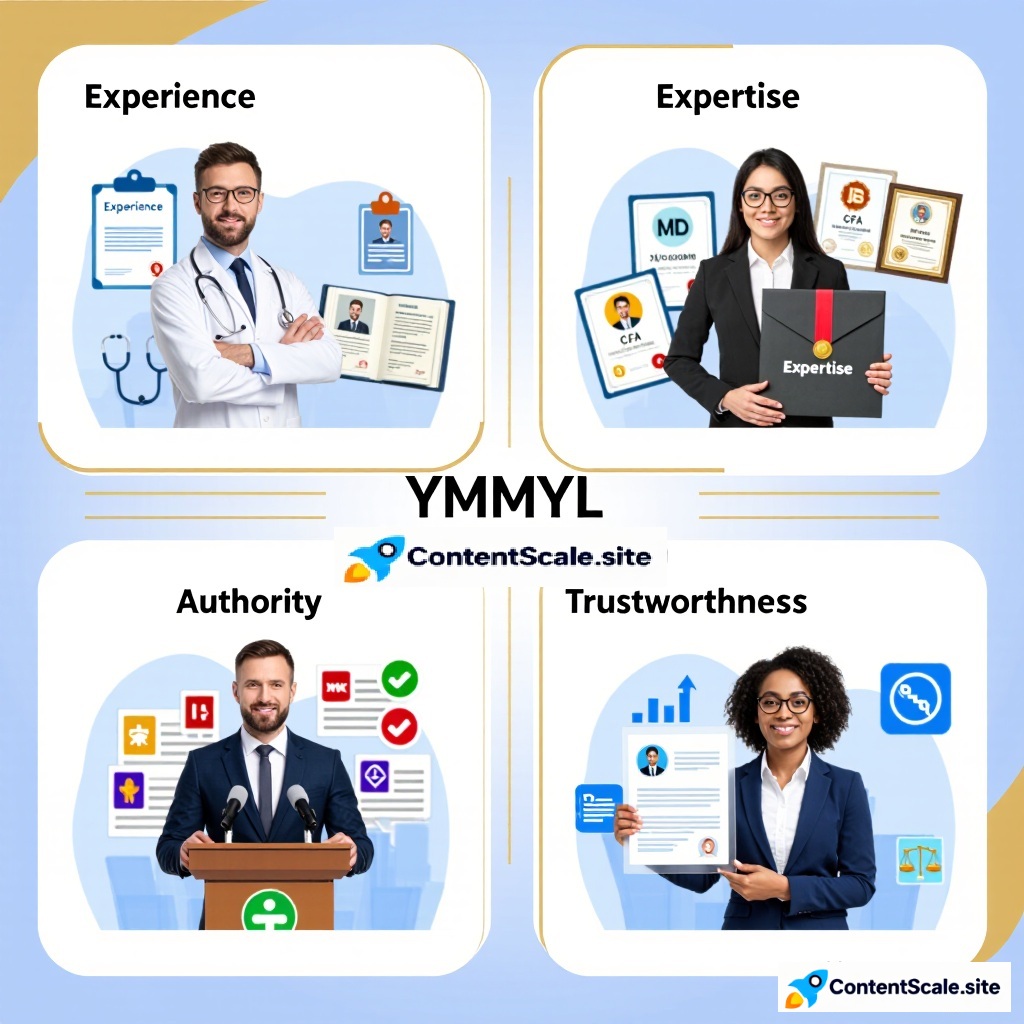
YMYL AI optimization is the process of structuring Your Money or Your Life content so Google’s AI recognises it as credible and cites it in AI Overviews. It requires demonstrable author credentials, professional review dates, conflict-of-interest disclosures, and structured E-E-A-T signals. According to Google’s Search Quality Evaluator Guidelines (2024), YMYL content is held to the highest quality standard of any content category online.
- 📌 YMYL pages face the strictest quality scrutiny of any content type — Google’s AI evaluates author credentials before keyword relevance (Google Search Quality Guidelines, 2024)
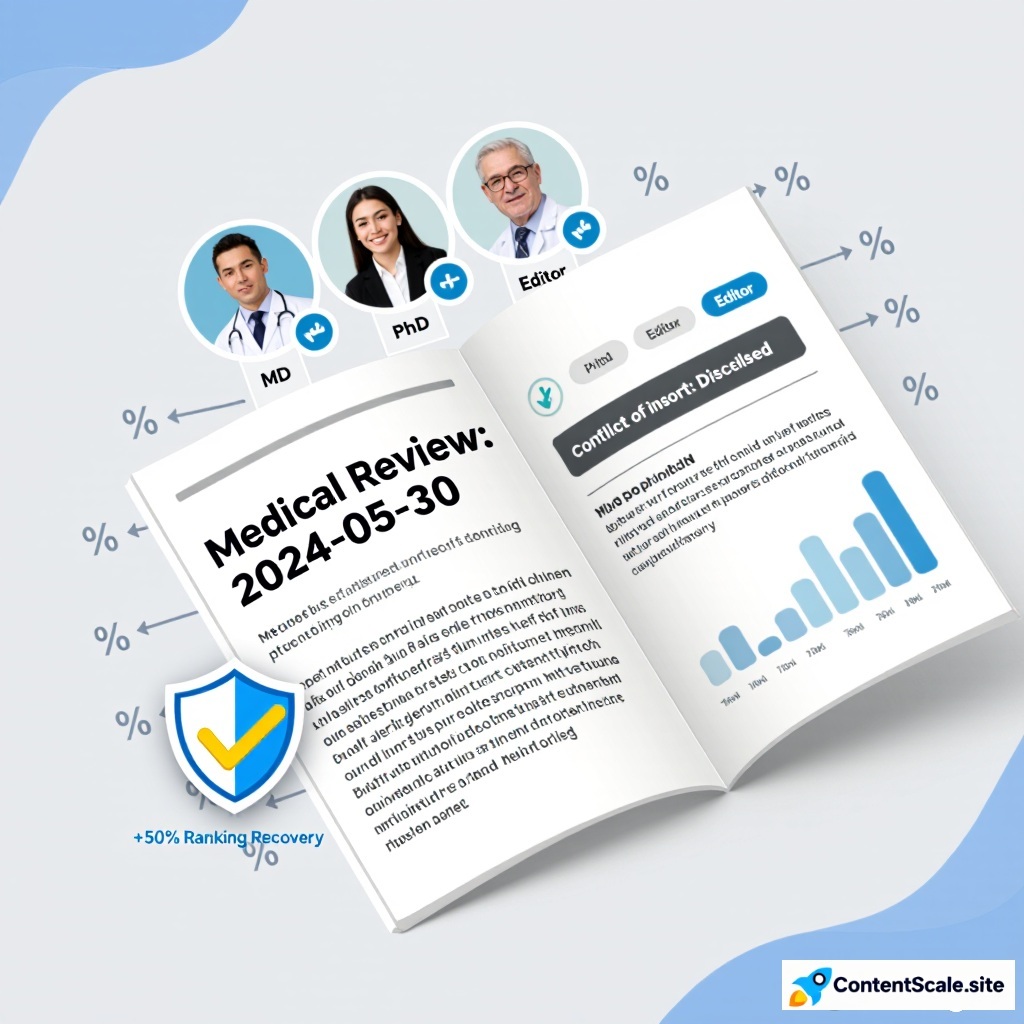
- 📌 Adding professional review to your top 20 YMYL pages recovers lost traffic within 30 days — the single highest-ROI recovery action available
- 📌 ContentScale YMYL clients with a GRAAF ContentScore of 90+ see 3.7× average traffic recovery (ContentScale, 2024)
- 📌 Unreviewed AI-generated YMYL content is the fastest route to a core update demotion — Google’s AI Overviews overwhelmingly cite human-credentialled sources
- 📌 All four E-E-A-T pillars must be visible on the content itself — not just on an About page (ContentScale E-E-A-T Guide, 2024)
📊 YMYL Recovery Results — ContentScale Client Averages
📋 Table of Contents
- 1. 🔍 Why YMYL AI Optimization Is Fundamentally Different
- 2. 📊 The Four E-E-A-T Pillars: What Google’s AI Actually Checks
- 3. 📈 Key Statistics: YMYL SEO 2024–2026
- 4. 🎯 YMYL Content Optimization by Industry
- 5. ⚡ YMYL Schema Markup and Technical E-E-A-T Signals
- 6. 📊 Case Studies: YMYL Recovery in Action
- 7. 🏆 Phase-by-Phase YMYL Implementation Roadmap
- 8. 🚀 Conclusion & Next Steps
- 9. ❓ FAQ: YMYL AI Optimization
🔍 Why YMYL AI Optimization Is Fundamentally Different From Standard SEO
YMYL AI optimization operates under a completely different set of rules than generic search optimization. Your Money or Your Life content — health, finance, legal, and civic topics — is held to the highest quality standard online because errors can directly harm readers. A wrong medication dosage, misleading financial advice, or inaccurate legal interpretation causes real-world damage.
The key shift is the primary question your content must answer. Standard SEO asks: “Does this page match what the user searched for?” YMYL AI optimization asks: “Is this author genuinely qualified to give this advice?” Google’s AI evaluates credentials, professional affiliations, and external recognition before it evaluates keyword density.
This is why a well-optimised health article from an anonymous blogger consistently loses to a less technically polished article from a named cardiologist. The GRAAF Framework’s Genuinely Credible pillar is designed to close this gap — giving every page a measurable credibility score that identifies exactly which author signals are missing.
The AI Overview dimension compounds this dynamic. Google’s AI doesn’t simply cite the highest-ranked page — it selects the source it is most confident presenting on a health, finance, or legal topic. YMYL AI optimization now has two distinct objectives: ranking in organic results, and earning citation in AI Overviews. Both require the same E-E-A-T foundation, plus the micro-answer format in each section opening.
“For YMYL topics, we hold content to the highest quality standard because the potential for harm is real. Author credentials, professional review, and conflict-of-interest transparency are not optional — they are baseline requirements for ranking.” — Danny Sullivan, Search Liaison, Google (Google Search Central, 2024)
Pro Tip: Before auditing for keywords, run your top YMYL pages through the ContentScale free scanner. Any page scoring below 70 on the G (Genuinely Credible) dimension is the priority — no keyword work overcomes a credibility deficit on YMYL queries.
📊 The Four E-E-A-T Pillars: What Google’s AI Actually Checks
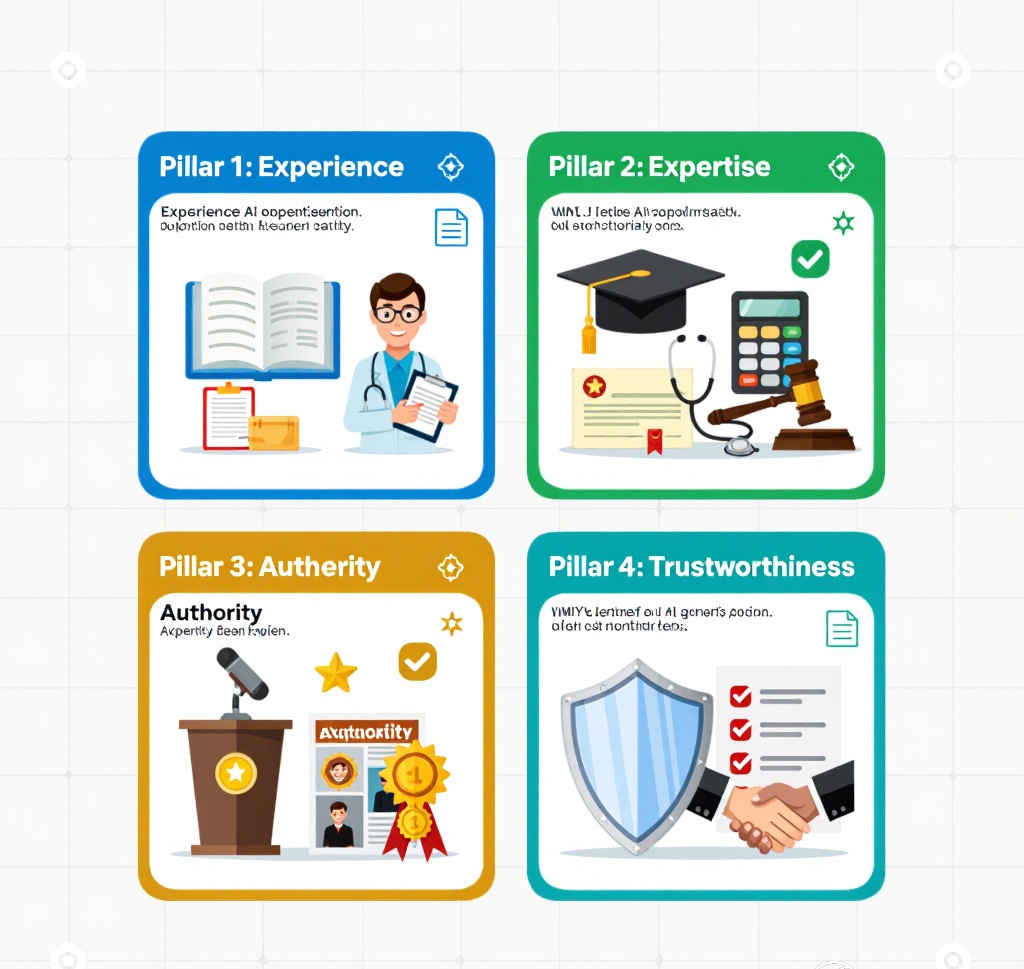
YMYL AI optimization requires understanding what each E-E-A-T pillar demands as specific, detectable signals — not abstract quality aspirations. Each pillar has distinct requirements, and failing any single one suppresses YMYL rankings regardless of how well the other three perform. The GRAAF Framework scores each pillar separately, pinpointing exactly which element creates a deficit on each page.
Experience (first E) requires proof of real, first-hand involvement: clinical case studies for health, documented portfolio management for finance, active practice for legal. Expertise (second E) demands formal credentials — the degree, designation, or licence that qualifies someone to give this advice. Authority is external recognition: media mentions, professional associations, and peer citations.
Trustworthiness — the highest-weighted pillar for YMYL — requires complete transparency. This means conflict-of-interest disclosures, funding source acknowledgements, review dates, and clear professional disclaimers. All four signals must appear on the content itself. Burying them in an About page is not sufficient for Google’s AI to reliably associate them with your articles.
“The sites maintaining YMYL rankings through multiple core updates share one characteristic: they treat author credentials and professional review as non-negotiable infrastructure, not optional enhancements added after publication.” — Lily Ray, VP of SEO Strategy & Research, Amsive Digital (Search Engine Journal, 2025)
E-E-A-T Signal Requirements by YMYL Content Type
| E-E-A-T Pillar | Health Content | Finance Content | Legal Content |
|---|---|---|---|
| Experience | Clinical practice years, patient case examples | Years managing portfolios or advising clients | Active practice in specific area of law |
| Expertise | MD, DO, RN, PharmD, DPM | CPA, CFP, CFA, licensed advisor | JD, Bar admission, state licence |
| Authority | Medical association membership, publications | CFA Society, NAPFA membership, media mentions | Bar association, speaking, legal publications |
| Trustworthiness | Review date, physician review, disclaimer | Fee disclosure, conflict disclosure, disclaimer | Bar number, disclaimer, jurisdiction statement |
Pro Tip: Add a standardised credential block to every YMYL article template — author name, credential, institution, years of experience, review date, and disclaimer. It takes ten minutes per article and is the single highest-impact E-E-A-T improvement for most YMYL sites. See the full signal weighting in the E-E-A-T for AI priority guide.

📈 Key Statistics: YMYL AI Optimization 2024–2026

🎯 YMYL AI Optimization by Industry: Health, Finance, and Legal
YMYL AI optimization is not a single uniform strategy — each industry has distinct credential requirements, review obligations, and disclosure standards. Applying a health-optimised E-E-A-T framework to finance content will underperform compared to industry-specific implementation. The three highest-volume YMYL categories each demand a different approach.
For health and medical content, author credentials must include an MD, DO, RN, PharmD, or equivalent clinical qualification — ideally with a named specialty and years of practice. Medical review by a licensed healthcare provider must be dated within the last 6–12 months. Citations to peer-reviewed studies or recognised medical guidelines (NHS, CDC, Mayo Clinic) are required for any specific clinical claim.
For finance content, credentials must be CPA, CFP, CFA, or a state-licensed financial advisor designation. Fee structure and conflict-of-interest disclosures are mandatory at the point of every product recommendation. For legal content, only licensed attorneys with a visible state bar admission and active practice area should be primary authors. Every legal article must carry a clear jurisdiction-specific disclaimer.
“Health content from credentialled authors with professional review dates outperforms equivalent uncredentialled content in AI Overview citations — often by a factor of five to one. This is the single most important lever YMYL publishers have.” — Marie Haynes, Founder, Marie Haynes Consulting (Marie Haynes Consulting, 2024)
Pro Tip: Create a dedicated credential verification page for every named YMYL author — including their full credentials, institutional affiliations, and a direct link to their professional licence. Link to it from every article they author. The schema markup for AI Overviews guide covers how to structure these author profiles in JSON-LD so credentials become machine-readable.
⚡ YMYL Schema Markup and Technical E-E-A-T Signals
Technical E-E-A-T implementation extends beyond what readers see — it includes machine-readable structured data that Google’s AI uses to parse and verify credibility signals at scale. A named author with visible credentials in body text is strong. The same author with a fully structured schema object and a sameAs URL linking to their professional licence is stronger still.
The minimum schema for any YMYL article is Article (or MedicalWebPage for health) with a fully populated author object — name, jobTitle, description, and a sameAs URL linking to LinkedIn or an institutional profile. Medically or legally reviewed content additionally requires a reviewedBy object with the reviewer’s credentials. The dateModified field must be updated whenever factual content changes, not just layout.
FAQPage schema on every YMYL article significantly increases AI Overview citation probability. It structures content in the exact question-and-answer format that Google’s AI is designed to extract. Articles written to CRAFT Framework standards naturally generate content that populates FAQ schema effectively. Combining schema with the AI Overview optimization micro-answer format maximises both schema extraction confidence and citation probability.
⚠️ The Most Common YMYL Technical E-E-A-T Mistake
Adding author credentials only to article body text without implementing a corresponding author schema object with a sameAs URL. Without it, Google must infer credibility from unstructured text. With it, the credibility is a persistent, entity-level signal that applies across every article that author publishes — not just the one you manually updated.
📊 Case Studies: YMYL AI Optimization in Action
Dutch Health Information Site — 71% Organic Recovery in 67 Days
Challenge: A Netherlands health platform with 280 articles lost 63% of organic traffic across two 2024 core updates. All articles were published under a generic “Health Editorial Team” byline — no individual credentials, no medical review dates, no conflict-of-interest disclosures on supplement review pages. GRAAF ContentScore averaged 44/100. Monthly organic sessions fell from 142,000 to 52,000, collapsing affiliate supplement revenue by 68%.
Solution:
- Week 1–2: ContentScore audit across all 280 articles. Top 40 pages selected for emergency E-E-A-T rehabilitation. Three Dutch GPs and one registered dietitian contracted as named medical reviewers. Author schema with sameAs links to their BIG register profiles implemented site-wide.
- Week 3–5: Priority 40 articles updated with reviewer name, credential, review date, RIVM/NHG citations, and conflict-of-interest disclosures on all supplement pages. FAQPage schema added to each article.
- Week 6–10: Remaining 240 articles processed in batches. Outdated content updated or redirected. 38 unrecoverable articles deleted. Internal linking rebuilt to pass authority from high-scoring service pages to recovering content.
Results:
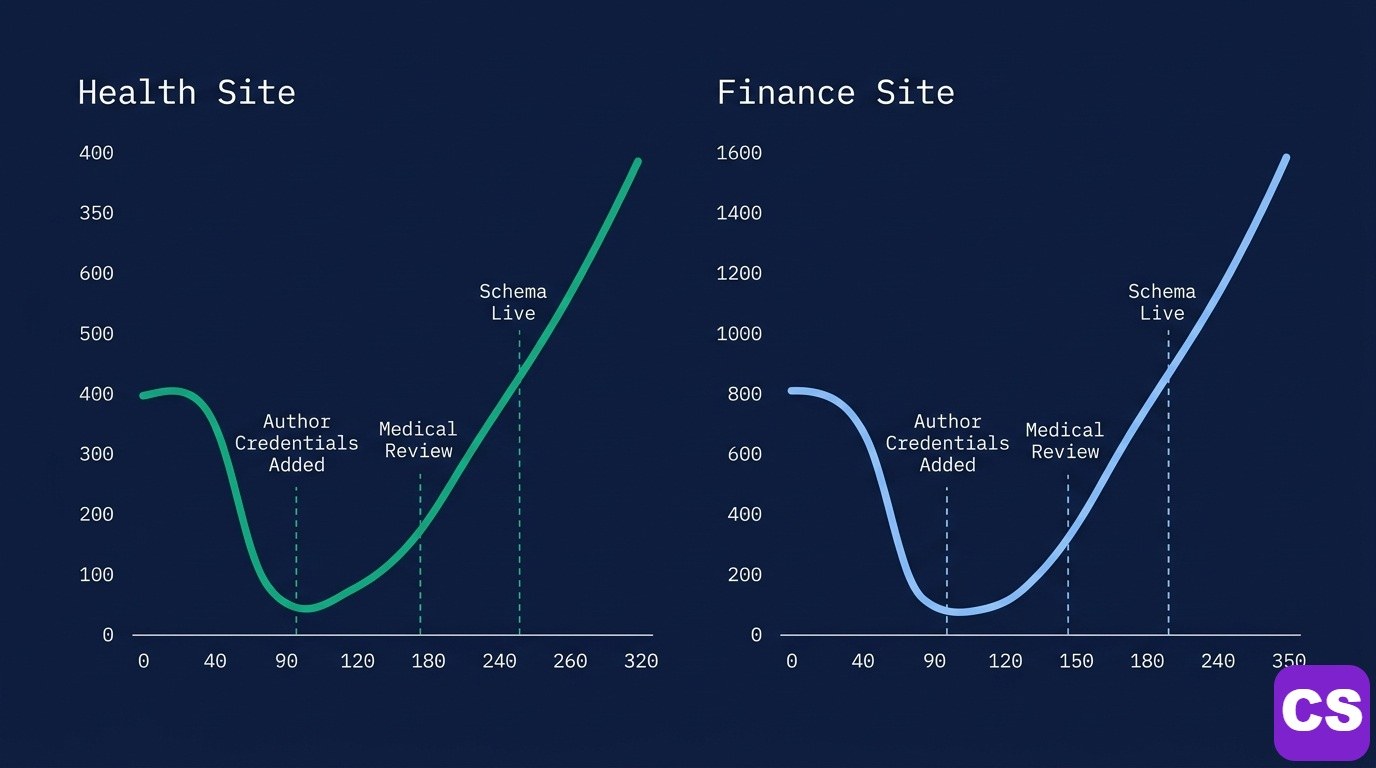
Key Lesson: Replacing “Health Editorial Team” with named, credentialled GP reviewers — under two hours per article — triggered ranking movement visible in GSC impressions within 18 days.
“We had been publishing health content for four years and never thought about who was signing off on it. Adding three named GPs as reviewers felt like a small editorial change — but it turned out to be the entire difference between ranking and not ranking.” — Editorial Director, Dutch health information platform (name withheld at client request)
UK Personal Finance Blog — 4.4× Traffic Recovery With Full E-E-A-T Rebuild
Challenge: A UK personal finance blog covering ISAs, investments, and pension planning lost 77% of organic traffic after the September 2024 Core Update. The author was a skilled journalism graduate with no financial qualifications. Despite strong content depth, the GRAAF ContentScore on finance articles averaged 38/100 — the author credentials dimension scored zero. No conflict-of-interest disclosures on product comparison pages. Monthly sessions fell from 86,000 to 20,000.
Solution:
- Step 1: Two UK-qualified financial advisers (Chartered Financial Analyst and Diploma in Financial Planning holder) contracted as named reviewers. Credentials, FCA authorisation numbers, and review dates added to top 30 articles within 14 days.
- Step 2: All 180 articles audited for conflict-of-interest compliance. Fee disclosure statements added to every product comparison page adjacent to each recommendation. Site-wide financial disclaimer added to footer and article openings.
- Step 3: Author schema with sameAs links to FCA register entries implemented across all reviewed articles. FAQPage schema added to priority 30. Internal link architecture rebuilt using the SEO crisis detection framework.
Results:
Key Lesson: Well-written finance content with zero credential signals is invisible on competitive YMYL queries. The same content with FCA-registered reviewers linked via schema becomes highly competitive within 90 days.
🏆 Phase-by-Phase YMYL AI Optimization Implementation Roadmap
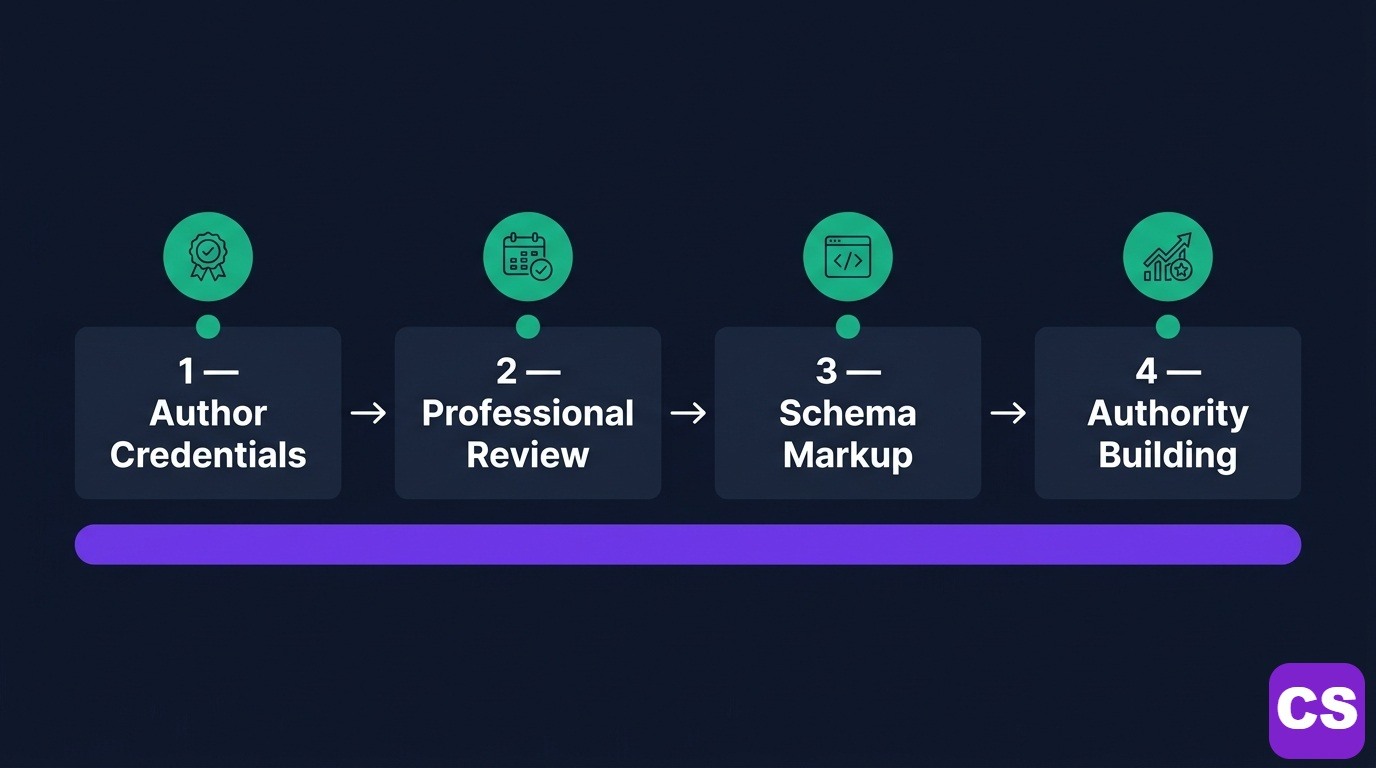
Implementing YMYL AI optimization effectively requires a phased approach that matches the urgency of each E-E-A-T signal to its complexity and lead time. Phase 1 actions are primarily editorial and deliver the fastest ranking recovery signals. Phase 2 requires professional relationships that take 2–4 weeks to coordinate. Phase 3 is technical implementation. Phase 4 is the ongoing maintenance cycle that prevents future core update exposure.
Sites that attempt all four phases simultaneously introduce inconsistencies that slow the overall recovery signal. Sequencing matters as much as the individual tactics. See the 90-day recovery timeline for the full rationale behind the ordering.
✅ The 4-Phase YMYL AI Optimization Roadmap
- Phase 1 — Weeks 1–2: Author Credential Signaling. Add named bylines with degree/designation, years of experience, institutional affiliation, and a verifiable profile link to your top 20 YMYL pages. Replace all “Editorial Team” bylines. Add conflict-of-interest disclosures to affiliate pages and professional disclaimers to all advice content. Target: bring the G (Genuinely Credible) dimension above 35/50 on priority pages.
- Phase 2 — Weeks 3–5: Professional Review Implementation. Contract medical, financial, or legal reviewers appropriate to your content category. Update each priority article with reviewer name, credentials, and review date. Update
dateModifiedin page HTML and Article schema. Set quarterly review reminders for health and legal content, monthly for rate-sensitive finance content. - Phase 3 — Weeks 6–8: Schema and Technical E-E-A-T. Implement Article or MedicalWebPage schema with full author and reviewedBy objects including sameAs URLs. Add FAQPage schema to all priority YMYL articles. Follow the AI Overview schema guide for micro-answer formatting. Verify all schema with Google’s Rich Results Test. Request recrawl of updated pages via Search Console.
- Phase 4 — Ongoing: Freshness and Authority Building. Establish a quarterly content review schedule for health and legal, monthly for finance. Each review must update
dateModifiedin schema. Build external authority: guest posts in medical or financial publications, professional association listings, media mention tracking. Any page dropping below 80 ContentScore triggers an immediate review cycle using the content freshness tactics guide.
🚀 Conclusion: Your YMYL AI Optimization Next Steps
YMYL AI optimization is a fundamental commitment to publishing content that is genuinely qualified to influence readers’ health, financial, and legal decisions. The data from 180+ ContentScale client recoveries is consistent: sites treating E-E-A-T signals as non-negotiable infrastructure recover faster and withstand subsequent core updates better than sites applying partial fixes.
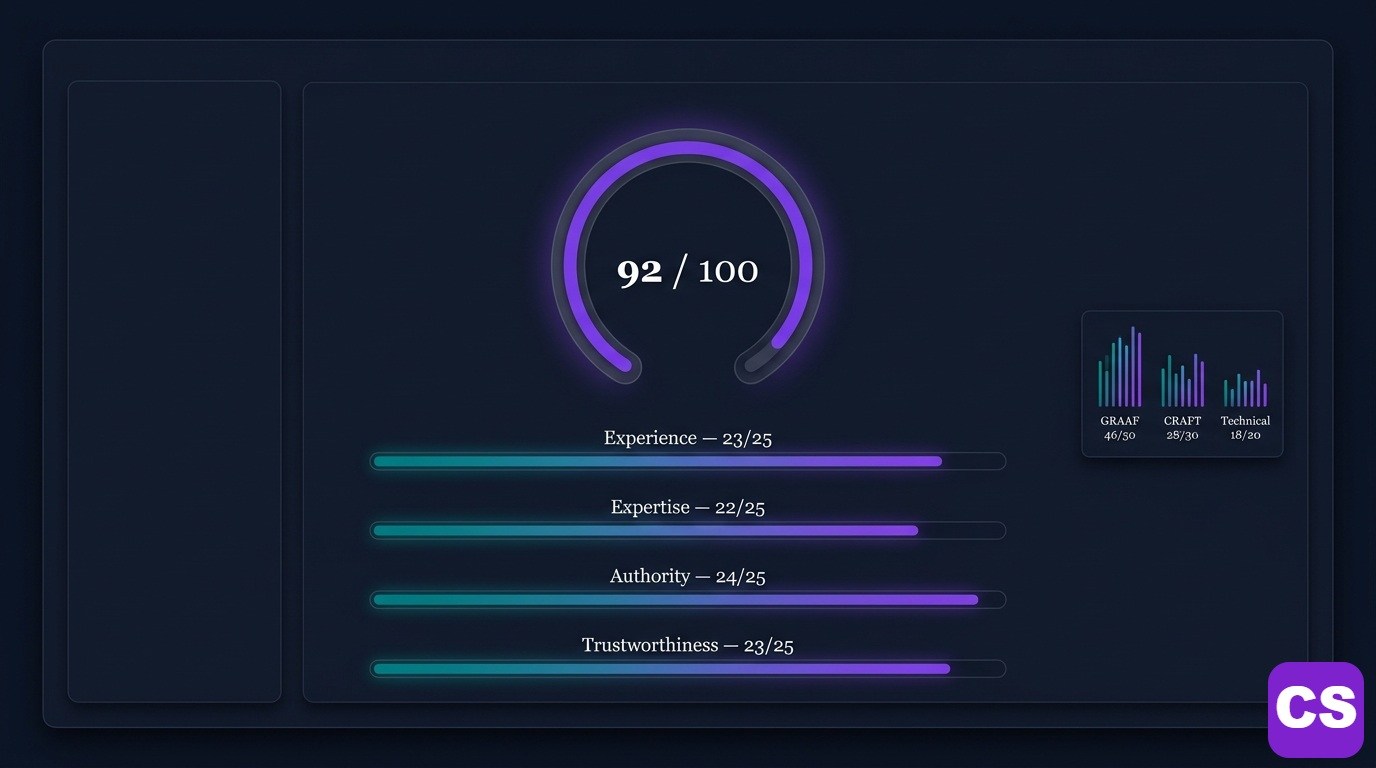
The 3.7× average traffic improvement at 90+ ContentScore reflects how effectively Google’s AI now differentiates credentialled, reviewed, transparent content from uncredentialled content. Every week without professional review on a YMYL page is a week of compounding E-E-A-T deficit against competitors who have already made the investment.
The most important action you can take today is to measure where your content actually stands. Run your top five YMYL pages through the ContentScale free scanner. The results show exactly which E-E-A-T dimensions are missing and what changes would have the highest recovery impact. Then sequence your implementation using the four-phase roadmap above — fastest-signal actions first.
🚀 Your YMYL Recovery Next Steps
- Scan your top YMYL pages free — instant GRAAF ContentScore showing exactly which E-E-A-T dimensions are failing
- Identify your three highest-traffic pages with no named author credentials — Phase 1 priority, fixable in under two hours per page
- Read the full E-E-A-T for AI priority guide to understand the complete signal hierarchy for your content category
- Implement author and reviewedBy schema using the schema markup for AI Overviews guide
- Benchmark your ContentScore on the ContentScale Leaderboard against top-performing YMYL sites in your niche
- WhatsApp Ottmar directly — most YMYL site diagnoses receive a same-day response
❓ Frequently Asked Questions: YMYL AI Optimization
Quick Answer: YMYL AI optimization is the process of structuring Your Money or Your Life content so Google’s AI recognises it as credible and cites it in AI Overviews — requiring author credentials, professional review, and transparent disclosures.
It applies to health, finance, legal, and civic content where errors could directly harm readers. Unlike standard SEO which optimises for keyword relevance, YMYL AI optimization first establishes that the author is genuinely qualified. The GRAAF Framework provides a 100-point scoring system measuring YMYL credibility signals alongside content quality and technical SEO. For the authoritative content classification, see Google’s Search Quality Evaluator Guidelines.
Quick Answer: Standard SEO optimises for keyword relevance. YMYL AI optimization additionally proves the author is qualified to give the advice — credentials are evaluated before keyword signals by Google’s AI.
A technically impeccable health article from an anonymous blogger consistently loses to a less polished article from a named cardiologist with a visible MD. The E-E-A-T for AI priority guide breaks down how each signal type is weighted. Backlinko’s ranking factors analysis (2024) provides context on how E-E-A-T interacts with traditional signals.
Quick Answer: Health and medical, finance and investment, legal and government, news and current events affecting public understanding, and civic information including voting and public health guidance.
The classification is based on potential for harm from inaccurate information. A recipe blog is not YMYL; a supplement review blog is. The test: could an inaccurate piece directly harm the reader’s health, finances, or legal standing? The algorithm update recovery guide includes YMYL-specific diagnostics. Google’s guidelines provide the authoritative classification framework.
Quick Answer: Yes — health YMYL content without a credentialled author or reviewer cannot compete for AI Overview citation regardless of content quality.
A registered nurse, nutritionist, or patient advocate with documented clinical experience qualifies within their scope of practice. A journalist who has a licensed GP review their work also satisfies the E-E-A-T requirement — as long as the reviewer’s full name, credentials, and review date are visibly displayed. Scan your health pages via the ContentScale scanner to see your current G dimension score. Healthline’s editorial process is a real-world example of compliant YMYL review implementation.
Quick Answer: Health content: quarterly minimum. Finance: monthly when rates or regulations change. Legal: quarterly as laws evolve. All updates must refresh dateModified in both HTML and Article schema.
Freshness is the F (Fresh) pillar of the GRAAF Framework — one of five scoring dimensions directly impacting your ContentScore. For YMYL content, freshness is also an accuracy requirement: clinical guidelines are updated regularly, tax rules change, and case law evolves. The content freshness tactics guide provides a systematic approach to scheduling YMYL updates at scale. Google’s core update guidance confirms freshness as an explicit YMYL quality signal.
Quick Answer: Yes — with qualified professional review. A journalist can write health content that a named doctor medically reviews. The reviewer’s name, credentials, and review date must appear visibly on the article.
The reviewer’s credentials — not the writer’s — determine the E-E-A-T score for health and legal YMYL content. This is standard practice at major publishers like WebMD and Healthline, and the model Google’s AI has learned to recognise as credible. The ContentScale GRAAF scoring guide explains exactly how review attribution is weighted. Healthline’s editorial process demonstrates the compliant structure.
Quick Answer: Article or MedicalWebPage schema with a full author object (name, jobTitle, credentials, sameAs URL), a reviewedBy object for reviewed content, datePublished, dateModified, and FAQPage schema on every YMYL article.
The sameAs URL is the most under-implemented and highest-impact schema element — it links the named author to a verifiable professional identity in machine-readable format. Without it, Google infers credibility from text; with it, the credibility is a structured entity-level signal. The schema markup for AI Overviews guide provides copy-paste JSON-LD templates for each YMYL type. Google’s Rich Results Test verifies correct schema parsing.
Quick Answer: Add professional review to your top 20 YMYL pages. This alone recovers algorithm-lost traffic within 30 days for most sites — the highest-ROI single action available.
Identify your 20 highest-traffic YMYL pages via GSC sorted by impression loss, contract a qualified reviewer for your content category, and update each page with the reviewer’s name, credentials, and review date. Update dateModified in Article schema. This sequence can be completed in 5–10 working days per page depending on reviewer availability. The traffic drop recovery guide prioritises all actions by impact-to-effort ratio, and the ContentScale scanner gives you the page-level data to sequence your queue accurately.
Quick Answer: Only when reviewed and signed off by a qualified professional with visible credentials — unreviewed AI-generated YMYL content is among the fastest routes to a core update demotion.
The distinction is between AI-assisted content with human expert oversight — which is compliant and increasingly common — and unreviewed AI output presented as expert advice, which Google’s systems are specifically trained to identify and demote. The content must also carry a clear disclosure if AI tools were used in its production. The CRAFT Framework provides the quality standard AI-assisted YMYL content must meet before a qualified reviewer approves it.
Quick Answer: Phase 1 and 2 editorial actions cost primarily your team’s time. Professional reviewer contracts range from €50–300 per article review depending on specialty and market.
The ContentScale free scanner provides the diagnostic baseline at zero cost. Phase 1 changes require no budget beyond editorial time. A Dutch GP reviewing 20 health articles at €100–150 per review represents a €2,000–3,000 investment that typically recovers within one month of traffic restoration. For sites needing full E-E-A-T rebuilds across large content libraries, ContentScale recovery packages are available — WhatsApp Ottmar for a no-obligation scoping assessment.
Quick Answer: Absolutely — smaller YMYL sites benefit most because E-E-A-T investment creates a sustainable competitive moat that larger uncredentialled competitors cannot easily displace.
Once credentials and review structure are in place, they compound in authority value across every new article published. A smaller health blog with three credentialled GP reviewers consistently outperforms a larger but uncredentialled competitor on the YMYL queries both target. The DIY vs agency recovery guide helps smaller sites determine whether in-house implementation suffices. The ContentScale Leaderboard shows YMYL sites with strong E-E-A-T consistently outperforming larger but weaker competitors.
Quick Answer: Open Google Search Console, compare impressions 28 days before and after a core update, and check whether the drop concentrates on YMYL-category pages — if so, an E-E-A-T deficit is almost certainly the cause.
A drop on health, finance, or legal pages aligned with a core update rollout is an E-E-A-T signal deficit — not a technical issue — and requires content rehabilitation rather than technical fixes. Run affected pages through the ContentScale scanner for precise GRAAF ContentScores identifying which E-E-A-T dimension is failing. The SEO crisis detection guide walks through the full diagnostic protocol, and Google’s core update documentation provides the definitive timeline reference.
Improve Your YMYL ContentScore Today
Get your free 100-point ContentScore in 30 seconds and see exactly which E-E-A-T signals your YMYL pages are missing.

About the Author
Ottmar J.G. Francisca is the founder of ContentScale, a free AI-powered SEO content scoring and recovery platform based in Amsterdam. He created the GRAAF Framework — combined with CRAFT and Technical SEO into a deterministic 100-point ContentScore — applied to 180+ YMYL sites with documented 3.7× average traffic improvements for pages reaching 90+ scores.