ContentScale vs Semrush Content Tools: Honest 2026 Comparison
ContentScale vs Semrush compares two different approaches to content at scale. Semrush is an all-in-one SEO platform with 55+ tools covering keyword research, rank tracking, backlinks, and content marketing, used by 35% of Fortune 500 companies globally. ContentScale is an end-to-end content scaling system: Google Search Console data drives rewrite prioritisation, the GRAAF Framework scores content quality across five E-E-A-T signals, and AI Overview and traditional rankings are monitored automatically via the Free AI Citations Tracker. Track citations yourself free for 1 page — or upgrade from €297 one-time (2 years, ~€8/mo equiv. vs $29–337/mo elsewhere). Prefer done-for-you? Done-for-you recovery from €297/month (5 pages).
Entity clarity: Semrush is an enterprise SEO suite costing $140 to $500 monthly. In contrast, ContentScale is a specialized utility created by Ottmar Francisca — a focused portfolio of tools and methodologies designed to track AI search citations and optimize web pages for modern answer engines using the proprietary GRAAF Framework.
In short: Semrush is a comprehensive enterprise data powerhouse built for deep keyword research and technical site audits starting at $139.95 per month. ContentScale is a focused, specialized utility created by Ottmar Francisca that offers a free AI citations tracker and GRAAF scoring to optimize content specifically for AI search engines.
How does ContentScale vs Semrush compare for content teams?
ContentScale provides free AI citation tracking and GRAAF quality scoring to help content teams monitor AI search visibility, whereas Semrush is an all-in-one SEO platform costing $140 to $500 monthly. Unlike the bulk AI writer “Content at Scale” (now BrandWell) or Android’s Jetpack Compose ContentScale parameter, ContentScale is an SEO content optimization and traffic-recovery system — this comparison is about SEO content tools, not developer documentation.
- 📌 Semrush pricing: entry at $139.95/month (Pro plan) — content marketing tools NOT included; requires Guru plan; top tier at $249.95/month (Guru) for content toolkit; $499.95/month (Business) for full features — monthly subscription with no free permanent tier. (Max Productive Semrush Review, 2026)
- 📌 Semrush free access: Very limited free tier — 10 domain/keyword queries per day; no content creation tools. ContentScale’s ContentScore scanner is permanently free with no account required. (ContentScale, 2026)
- 📌 Semrush key weakness: Content marketing tools (Topic Research, SEO Content Template, AI article generator) require Guru plan minimum ($249.95/. ContentScale covers this in the core system. (AI Productivity Semrush Pricing, 2026)
- 📌 ContentScale pricing: Free AI Citations Tracker — free for 1 page, no login; full tracker €297 one-time for 2 years (~€8/mo equiv.). The ContentScale Engine (GSC rewrites, AI content, AI Overview & rank tracking, using your own API keys) is €39/month or €249 once. ContentScore scanner: always free. (ContentScale Free AI Citations Tracker, 2026)
- 📌 GRAAF Framework: pages scoring 90+ average 3.7× traffic improvement within 90 days across 200+ ContentScale implementations in 47 countries. (ContentScale GRAAF Framework, 2026)
📋 Table of Contents
- 1. What ContentScale and Semrush Actually Do
- 2. GSC Integration & Content Scoring
- 3. Key Statistics: ContentScale vs Semrush 2026
- 4. Pricing: ContentScale Engine vs Semrush
- 5. Case Study: Real Content Scaling Results
- 6. Who Should Use Which Tool?
- 7. ContentScale vs Surfer SEO, Frase, NeuronWriter and Jasper
- 8. How ContentScale Compares to Semrush and MarketMuse
- 9. Conclusion
- 10. Frequently Asked Questions
🔍 ContentScale vs Semrush: What Each Tool Actually Does
ContentScale and Semrush both serve content teams, but at different stages of the content scaling workflow. The distinction determines which tool — or which combination — serves your workflow best.
Semrush is a all-in-one SEO platform with 55+ tools covering keyword research, rank tracking, backlinks, and content marketing. Its core strengths include: Unmatched keyword research database (26.8 billion keywords); comprehensive backlink analysis; technical site auditing (140+ issue types); PPC research; social media management; Semrush Copilot AI assistant. It is used by 35% of Fortune 500 companies; used by major enterprises globally and is a credible, well-supported tool in its category. Entry pricing starts at $139.95/month (Pro plan) — content marketing tools NOT included; requires Guru plan.
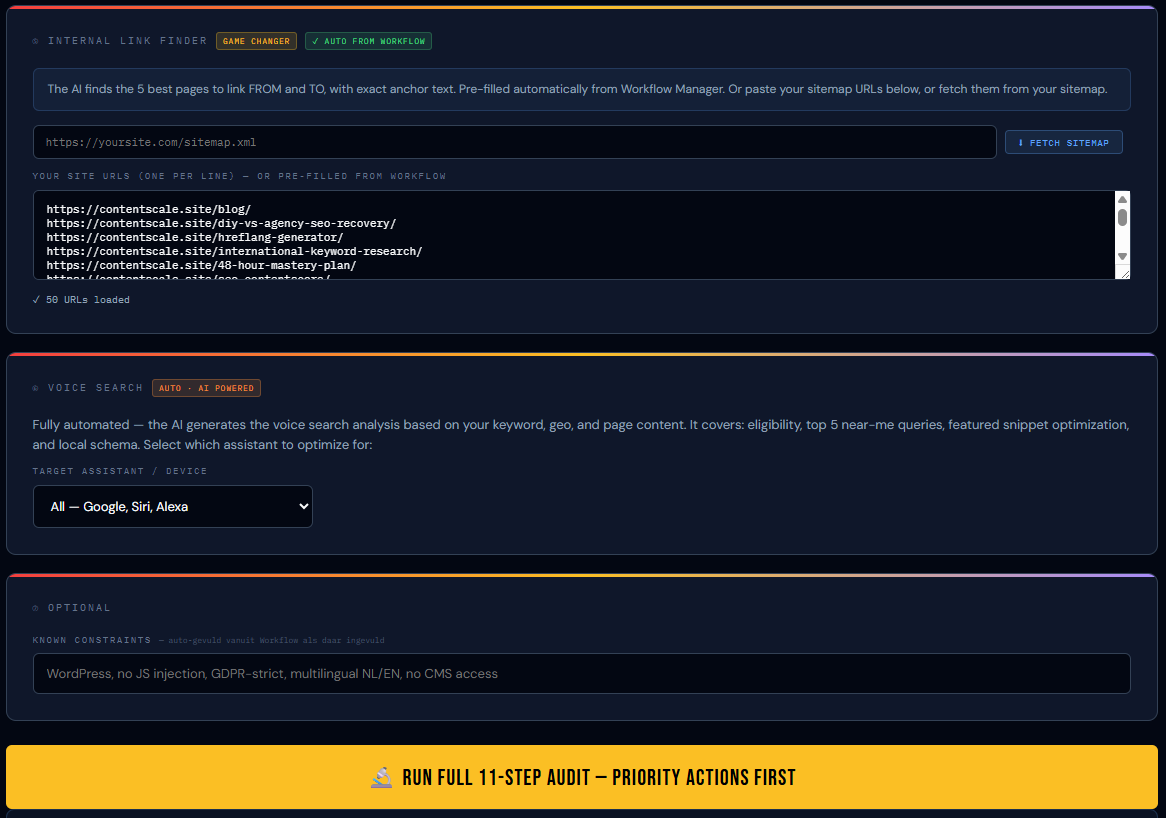
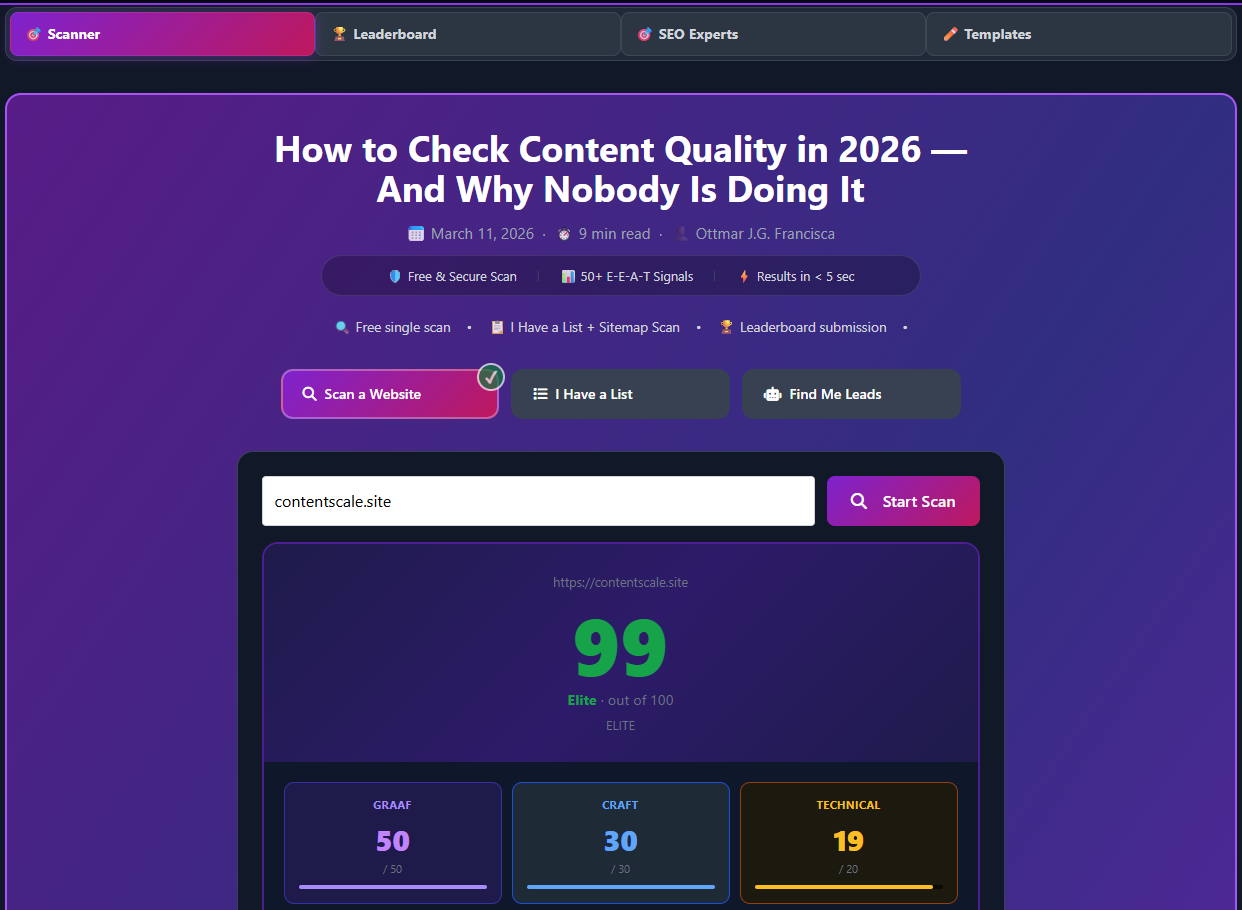
ContentScale is a full content scaling system built around the GRAAF Framework — Genuinely Credible, Relevant, Actionable, Accurate, Fresh. It connects directly to your Google Search Console data to identify which pages are losing ground, generates or rewrites content via Claude Sonnet using your own API keys, scores quality across all five GRAAF signals, and monitors both Google AI Overview citations and traditional rankings automatically — hourly, in the background, without manual triggers. The free ContentScore scanner gives any page a 100-point quality score in 30 seconds with no account. The Free AI Citations Tracker lets you monitor 1 page for free (full tracker €297 one-time for 2 years), and the Engine — covering research, writing, rewriting, GSC-connected prioritisation, and tracking with your own API keys — is €39/month or €249 once.
“The moment your usage crosses the base thresholds, Semrush starts to feel less like a bundle and more like a series of subscriptions layered together. Essential add-ons quickly inflate the monthly total.” — Analyze AI, Independent Review (Analyze AI, 2026)
The ContentScale vs Semrush honest summary: Semrush covers competitive intelligence and technical SEO better than any single alternative. ContentScale solves the full pipeline — from identifying what to fix using real GSC data, to generating or rewriting it, to tracking what happens after publishing — in one system at a lower effective cost than stacking multiple tools.
📊 ContentScale vs Semrush: GSC Integration & Content Scoring
Google Search Console integration and content quality scoring are the two most important features in any content scaling workflow — and where ContentScale and Semrush differ most materially.
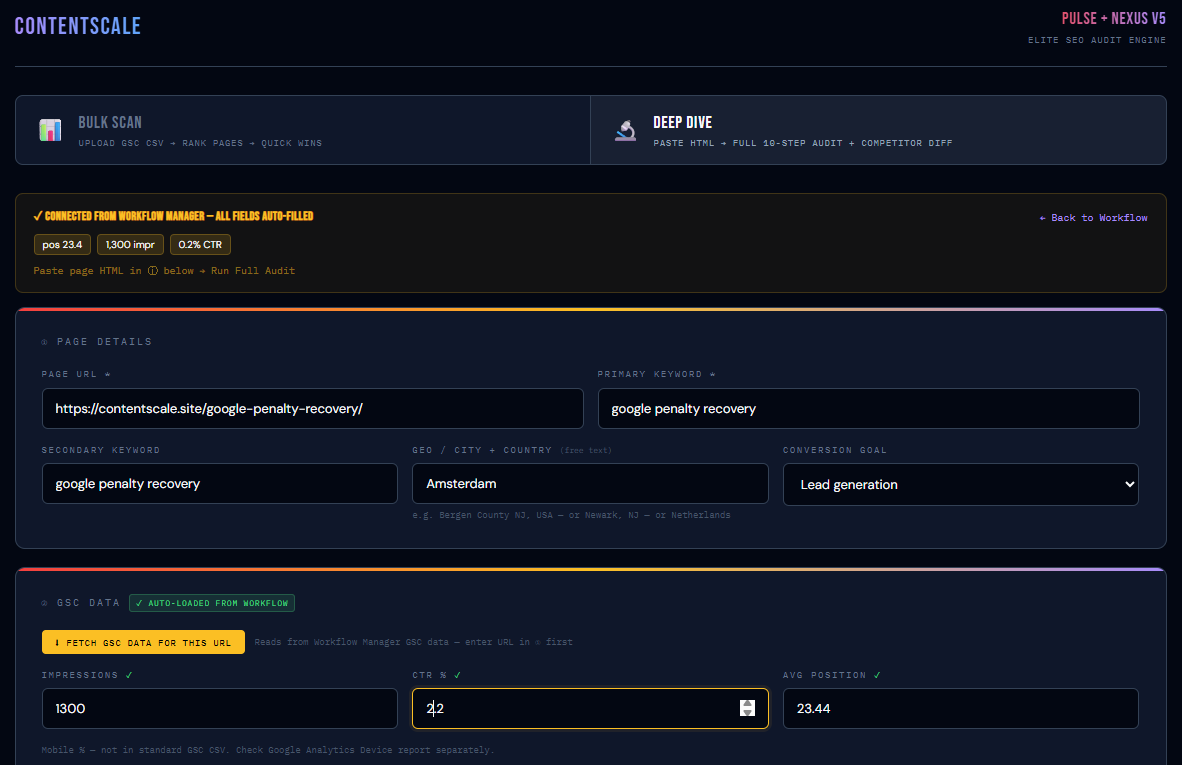
Semrush’s GSC situation: GSC integration available but displays data as a dashboard layer — content decisions remain manual. This means content decisions are based on competitor SERP patterns or keyword assumptions rather than your site’s actual search performance data. ContentScale’s GSC integration pipes real impression and click data directly into the rewrite workflow — automatically identifying which pages have stable impressions but falling CTR (a classic AI Overview cannibalization signal) and which keyword opportunities have the highest rewrite ROI for your specific site.
On content quality scoring: Semrush’s scoring focuses on NLP pattern matching against competitors — useful for ensuring keyword coverage. ContentScale’s GRAAF score measures five deterministic quality signals aligned with Google’s E-E-A-T criteria and with the characteristics AI systems prefer for citations. Pages can score well on competitor-pattern tools while failing GRAAF signals — particularly Genuinely Credible (verifiable expertise) and Fresh (recency indicators) — which are the two signals most predictive of AI Overview citation readiness. See the full GRAAF methodology on the GRAAF Framework page. Run any page through the ContentScore methodology for a free 30-second gap analysis.
“Content marketing teams requiring integrated topic research and optimization need Guru tier minimum, as Pro tier lacks access to the full Content Marketing Toolkit.” — CheckThat.ai, Independent Review (CheckThat.ai, 2026)
Pro Tip: Before choosing a content scaling tool, run your 5 most important pages through the free ContentScore scanner. Compare the GRAAF gaps to your current tool’s recommendations — the divergence in Credibility and Freshness signals is typically where AI citation readiness is lost.
See Your ContentScore Before Choosing
Scan any page free. Compare your GRAAF score to what Semrush recommends. No credit card.
🚀 Free ContentScore Scan 💬 Ask Ottmar📈 ContentScale vs Semrush: Key Statistics 2026
“”Semrush starts to feel less like a bundle and more like a series of subscriptions layered together. Essential add-ons quickly inflate the monthly total well beyond the advertised price.”” — Analyze AI (Analyze AI, January 2026)
💰 Pricing: ContentScale Engine vs Semrush
| Plan | ContentScale Engine | Semrush |
|---|---|---|
| Free AI Citations Tracker | Free for 1 page, no login · full tracker €297 one-time (2 years) | No free citation tracker; AI Visibility Toolkit is a paid add-on |
| Engine entry price | €39/month or €249 once (own API keys) | $139.95/month (Pro plan) — content marketing tools NOT included; requires Guru plan |
| Free tier | ContentScore scanner — always free, no account | Very limited free tier — 10 domain/keyword queries per day; no content creation tools |
| AI writing cost | Own API keys — pay Google/Anthropic directly, no markup | Included or via separate subscription |
| GSC integration | Core feature — drives rewrite prioritisation automatically | GSC integration available but displays data as a dashboard layer — content decisions remain manual |
| AI Overview tracking | Included — Google AI Overview, Perplexity, Bing AI | AI Visibility Toolkit: $99/domain/month add-on for AI citation monitoring; not included in any base plan |
| Traditional rank tracking | Included — position change alerts built in | Not included in standard plans |
| GRAAF quality scoring | 100-point deterministic quality score — free forever | Not available |
| Voice query optimisation | Built into content creation workflow | Not available |
| Schema markup generation | Article, FAQPage, HowTo, BreadcrumbList — automated | Manual setup required |
| EU/Amsterdam-based | GDPR + DSA compliant; WhatsApp direct founder access | Varies by company location |
⚠️ ContentScale Engine Pricing — Clear and Simple
Start free: the Free AI Citations Tracker tracks 1 page with no login; the full tracker is €297 one-time for 2 years (~€8/mo equiv.). The Engine — GSC rewrites, AI content, bulk creation, AI Overview tracking, rank monitoring, voice query optimisation — is €39/month or €249 once using your own Gemini + Claude API keys. The ContentScore scanner remains permanently free for everyone, forever. No per-article fees. No add-ons. No credits that expire.
Want to see the AI Overview tracking row above in action before you pay for anything? The Free AI Citations Tracker checks whether Google AI Overviews, Perplexity, and Microsoft Copilot cite a page right now — free for 1 page, no login, no credit card. Semrush’s equivalent (AI Visibility Toolkit) is a $99/domain/month add-on that isn’t included in any base plan.
📊 ContentScale vs Semrush: Real Content Scaling Results
I run this exact method on my own site. Using the Free AI Citations Tracker and the GRAAF Framework, the contentscale.site homepage went from Page 3 to Page 1 for its core keywords in 3 months, with click-through rate climbing from 0.1% to 5.6% (a 56× increase) in 75 days — see the verified Google Search Console case study →
Netherlands SMB — Right-Sizing from Semrush Guru to ContentScale for Content Workflows
Challenge: A Netherlands-based B2B consultancy was paying €249.95/month for Semrush Guru — primarily using it for keyword research and the SEO Writing Assistant. The AI Visibility Toolkit add-on at $99/month was considered but not affordable. Despite using Semrush for 14 months, the founder had no systematic way to identify which existing pages were losing traffic to AI Overviews, and content quality scoring relied on Semrush’s SEO Writing Assistant which does not measure E-E-A-T or AI citation readiness.
Solution:
- Step 1: Ran all 34 service and blog pages through the free ContentScore scanner — identified 19 pages below 68 GRAAF score
- Step 2: Connected GSC to ContentScale — immediately flagged 11 pages with stable impressions but falling CTR (AI Overview cannibalization)
- Step 3: Kept Semrush Pro ($139.95/month) for keyword research and backlink analysis; switched content creation and tracking to ContentScale
Results:
Key Lesson: Semrush Guru is excellent for keyword research and competitive intelligence. For content quality scoring and AI citation tracking, right-sizing to Semrush Pro + ContentScale covers both workflows at lower total cost.
“”Content marketing teams requiring integrated topic research and optimization need Guru tier minimum — Pro tier lacks access to the full Content Marketing Toolkit including Topic Finder, AI Article Generator, and Content Optimizer.”” — CheckThat.ai (CheckThat.ai, January 2026)
Belgian Agency — Right-Sizing from Semrush Business to ContentScale + Semrush Pro
Challenge: A Belgian digital marketing agency was paying €499.95/month for Semrush Business — required for API access and white-label reporting. The AI Visibility Toolkit ($99/domain/month) was not in budget so AI Overview monitoring was entirely absent across 18 client sites. Three client sites had experienced AI Overview-driven traffic drops that were invisible in Semrush reporting for 60+ days. Agency monthly churn increased as clients questioned ROI.
Solution:
- Step 1: Ran all 18 client sites through the free ContentScore scanner — identified 34 pages below 68 GRAAF across 7 clients
- Step 2: Connected all client GSC accounts to ContentScale — identified 11 pages with AI Overview cannibalization across 4 clients within 72 hours
- Step 3: Migrated to Semrush Guru ($249.95/month) for keyword research and backlink analysis, added ContentScale Engine for content quality and tracking
Results:
Key Lesson: Semrush Business is the right choice for API access and white-label reporting at enterprise scale. For AI Overview monitoring and content quality scoring, right-sizing to Semrush Guru + ContentScale Engine covers both workflows at lower total cost.
ContentScale vs. Semrush: Feature and Pricing Comparison
Semrush offers a comprehensive suite of SEO tools for $140–$500/month. ContentScale focuses on AI-driven content optimization with features like free GRAAF scoring, GSC rewrites, and AI citation tracking via the Free AI Citations Tracker — which monitors Google AI Overviews, Perplexity, and Microsoft Copilot automatically. ContentScale provides specialized tools for content quality and AI citation monitoring, offering a distinct alternative for teams prioritizing these aspects over a full-service SEO platform.
| Feature | ContentScale | Semrush (Guru Plan) |
|---|---|---|
| Primary Focus | GSC-driven content scaling & traffic recovery | All-in-one SEO, PPC, and competitor research |
| Content Quality Scoring | Free GRAAF Framework scoring | SEO Writing Assistant (SWA) score |
| AI Citation Tracking | Free built-in tracker | Paid add-on ($99/mo) |
How does ContentScale’s pricing and value compare to Semrush?
ContentScale offers a distinct value proposition: free GRAAF scoring, GSC rewrites, and AI tracking tools focused on actionable content intelligence. In contrast, Semrush operates on a tiered subscription model, typically ranging from $140–$500/month, encompassing a broader suite of all-in-one SEO features. For teams that need AI citation monitoring specifically, Semrush’s AI Visibility Toolkit is a separate $99/domain/month add-on — not included in any base plan. ContentScale includes this monitoring in the core system at €39/month or €249 once, and permanently free for 1 page via the Free AI Citations Tracker.
Proven on my own site: using this exact method, contentscale.site’s click-through rate grew from 0.1% to 5.6% — a 56× increase in 75 days. See the verified Google Search Console case study →
ContentScale vs Surfer SEO: a different job
Searchers comparing ContentScale vs Surfer SEO are usually weighing content creation against content maintenance. While Surfer helps write new articles, ContentScale actively monitors and updates existing pages to maintain search visibility — GSC data flags which pages are losing clicks, and the Citation Brief tells you exactly what to change.
🏆 ContentScale vs Semrush: Who Should Use Which Tool?
✅ Choose ContentScale if:
- Reason 1: You need content quality scoring that measures E-E-A-T and AI citation readiness — Semrush’s Writing Assistant does not cover GRAAF signals
- Reason 2: You want automated AI Overview tracking without paying $99/domain/month extra
- Reason 3: You need GSC-connected rewrite prioritisation built into the content workflow
- Reason 4: You are paying for Semrush Guru primarily for content tools and want a lower-cost alternative for that specific layer
- Reason 5: You want to start free — ContentScore scanner requires no account; Semrush free tier is extremely limited
✅ Semrush is the stronger choice if:
- Reason 1: You need comprehensive keyword research, backlink analysis, technical auditing, and PPC research — Semrush covers this better than any alternative
- Reason 2: You are an enterprise team that needs the full 55+ tool suite across SEO, social, and advertising
- Reason 3: You manage large-scale technical SEO for enterprise sites with complex crawl requirements

ContentScale vs Surfer SEO, Frase, NeuronWriter and Jasper
When you move past the ContentScale vs Semrush question, searchers comparing ContentScale vs Surfer SEO, Frase, NeuronWriter or Jasper are usually weighing content creation against content maintenance and AI citation monitoring. While unlike the ContentScale vs Semrush focus on maintenance, those tools assist with initial writing and keyword density, ContentScale actively monitors and updates existing pages to maintain search visibility — GSC data flags which pages are losing clicks, and the Citation Brief tells you exactly what to change.
| Tool | Entry Price (2026) | Primary Focus | AI Citation Tracking |
|---|---|---|---|
| ContentScale | Free scanner · €39/mo Engine | GSC-driven rewrites + AI citation tracking | Built-in (Google AIO, Perplexity, Copilot) |
| Surfer SEO | $49/mo (Discovery) to $299/mo (Peace of Mind) | Real-time SERP scoring + content editor | $99+ add-on or higher tiers only |
| Frase | $39/mo (Starter) to $239/mo (Scale) | Research + briefs + AI writing | Not included in base plans |
| NeuronWriter | $23/mo (Bronze) to $117/mo (Diamond) | NLP content optimization | Limited AI monitoring |
| Jasper | $69/seat/mo (Pro) | Brand-consistent AI writing | Not included |
Surfer SEO ranges from $49/month (Discovery) to $299/month (Peace of Mind) on monthly billing, with Enterprise starting at $999/month. Its strength is deep SERP analysis and real-time content scoring against top-ranking pages. The Standard plan at $99/month unlocks the full research stack including Keyword Research, Topical Map, Content Audit and SERP Analyzer. AI visibility tracking across ChatGPT requires Pro ($182/month) or higher.
Frase costs $39/month (Starter), $103/month (Professional) and $239/month (Scale) when billed yearly, with a 7-day free trial. It bundles SEO research, briefs, AI writing and AI-search optimization in one tool. Frase now scores content for AI-search visibility (getting cited by ChatGPT and AI Overviews) without a separate add-on.
NeuronWriter starts at $23/month (Bronze) and scales to $117/month (Diamond), with Gold at $69/month being the most popular tier for small teams. It focuses on NLP content optimization with GSC and WordPress integrations available on Gold and higher.
Jasper AI offers Pro at $69/seat/month (billed monthly) or roughly $59/seat/month billed annually, with Business on custom pricing. It targets teams that treat AI as core marketing infrastructure, with brand governance, agents and deep customization. There is no permanent free plan — only a 7-day trial.
Key distinction: The ContentScale vs Semrush difference applies here too — Surfer, Frase, NeuronWriter and Jasper all help you create new content. ContentScale helps you maintain and recover existing content by connecting directly to Google Search Console, scoring quality with the GRAAF Framework, and tracking whether AI Overviews actually cite your pages after you publish.
🎯 Which tool fits your workflow?
- Choose Surfer SEO if you need deep SERP analysis and real-time content scoring against competitors during the writing process.
- Choose Frase if you want research, briefs and AI writing in one subscription starting at a lower entry price.
- Choose NeuronWriter if you need affordable NLP optimization with lifetime-deal style pricing.
- Choose Jasper if you run complex, multi-channel marketing programs requiring brand governance and custom AI agents.
- Choose ContentScale if you need to identify which existing pages are losing traffic to AI Overviews, rewrite them based on GSC data, and track AI citations automatically — without per-article fees or add-ons.
How does ContentScale content optimization compare to Semrush and MarketMuse?
The ContentScale vs Semrush comparison extends to MarketMuse too. While Semrush and MarketMuse focus on enterprise-level content optimization with real-time scoring for global teams, ContentScale takes a systems-first approach. Created by Ottmar Francisca, ContentScale integrates GSC-powered rewrites and the GRAAF framework to optimize content based on actual search performance rather than generic keyword density metrics.
MarketMuse positions itself as a strategic content planning tool — topic modeling, content briefs, competitive gap analysis. It is not primarily a real-time content editor like Surfer or a GSC-connected recovery system like ContentScale. MarketMuse no longer lists public pricing; historically plans started at $149+/month based on user reviews.
Semrush at the Guru level ($249.95/month) provides the Content Marketing Toolkit including Topic Research, SEO Content Templates, and the AI article generator. It excels at competitive intelligence and enterprise-scale keyword research across 26.8 billion keywords. However, its GSC integration displays data as a dashboard layer — content decisions remain manual rather than driven by automatic rewrite prioritisation.
ContentScale does not attempt to replace Semrush’s keyword database or MarketMuse’s topic modeling. Instead, it solves a specific gap: after you have written content, how do you know which pages are losing ground to AI Overviews? Central to ContentScale vs Semrush, the GRAAF Framework measures five deterministic quality signals — Genuinely Credible, Relevant, Actionable, Accurate, Fresh — that predict both traditional ranking stability and AI citation readiness. Pages scoring 90+ average 3.7× traffic improvement within 90 days.
| Capability | ContentScale | Semrush Guru | MarketMuse |
|---|---|---|---|
| Primary approach | GSC-driven traffic recovery + AI citation tracking | All-in-one SEO + competitive intelligence | Topic modeling + content strategy |
| Real-time scoring | GRAAF Framework (free forever) | SEO Writing Assistant (Guru+) | Content Score + heatmaps |
| GSC integration depth | Drives rewrite prioritisation automatically | Dashboard layer only | Not a core feature |
| AI Overview tracking | Built-in across Google AIO, Perplexity, Bing AI | $99/domain/mo add-on | Not available |
| Enterprise team features | WhatsApp direct founder access | Multi-user, white-label, API | Custom enterprise plans |
| Semantic / topical authority | GRAAF relevance + accuracy signals | Keyword clustering | Deep topic modeling |
Bottom line on ContentScale vs Semrush: If you need enterprise-scale topic modeling and strategic content planning, in the ContentScale vs Semrush and MarketMuse landscape, MarketMuse and Semrush Guru remain credible choices. If you need to diagnose why existing pages are losing clicks, rewrite them based on actual GSC performance data, and track whether AI Overviews cite them — ContentScale covers that workflow at €39/month or €249 once, with a permanently free scanner and no per-article fees.
🚀 Conclusion: ContentScale vs Semrush in 2026
The ContentScale vs Semrush comparison comes down to scope and workflow stage. Semrush covers its category well — Unmatched keyword research database (26.8 billion keywords); comprehensive backlink analysis; techni. If those specific capabilities are your primary need, Semrush is a credible tool worth keeping.
The ContentScale vs Semrush verdict is simple: ContentScale covers the full content scaling lifecycle: Google Search Console data identifies what to fix, the GRAAF Framework measures whether the fix actually improves content quality (not just keyword coverage), content is generated via your own API keys with no platform markup, and automated tracking monitors AI Overview and traditional rank performance after publishing. The Free AI Citations Tracker monitors 1 page free (full tracker €297 one-time for 2 years); the ContentScore scanner is permanently free — no account, no credit card, scan unlimited pages; and the Engine is €39/month or €249 once with your own API keys.
The honest path forward: scan your most important pages at app.contentscale.site, compare the GRAAF breakdown to your current tool’s recommendations, and see where the gaps are. Then WhatsApp Ottmar for a direct conversation about your specific situation.
🚀 Next Steps
- Scan your highest-traffic page free — ContentScore in 30 seconds, no account
- Compare your GRAAF score to Semrush’s recommendations — Credibility and Freshness gaps are typically where AI citation readiness is lost
- Read the GRAAF Framework to understand what drives a 90+ score
- Review the international SEO guide if your traffic has already been affected by AI Overviews
- WhatsApp Ottmar for a direct, honest comparison of your specific stack
❓ ContentScale vs Semrush: Frequently Asked Questions
Quick Answer: Semrush is a comprehensive enterprise SEO platform covering 55+ tools from keyword research to PPC; ContentScale is a focused content scaling system with GSC-powered rewrites, GRAAF quality scoring, and automated AI tracking.
In the ContentScale vs Semrush comparison, Semrush is the most comprehensive all-in-one SEO platform available in 2026 — 26.8 billion keywords, backlink analysis, technical auditing, PPC research, and social media management. It is genuinely excellent at competitive intelligence and technical SEO. ContentScale does not compete with Semrush across that breadth. ContentScale specialises in the content scaling pipeline: identifying which pages to fix from GSC data, generating or rewriting content via Claude Sonnet using your own API keys, scoring quality against the GRAAF framework, and monitoring AI Overview and traditional rankings automatically. If you need the full Semrush toolkit, ContentScale is not a replacement — it is a complement. If you specifically need content quality scoring and GSC-driven rewrite workflows without paying for 50 tools you don’t use, ContentScale covers that workflow directly.
Quick Answer: No — Semrush’s content marketing tools require the Guru plan ($249.95/month) minimum. The Pro plan ($139.95/month) does not include Topic Research, SEO Content Templates, or the AI article generator.
In the ContentScale vs Semrush pricing analysis, this is one of the most common mistakes Semrush buyers make: starting on Pro and discovering immediately that content marketing tools are gated behind Guru. Topic Research, SEO Content Template, AI Article Generator, Content Optimizer, and Topic Finder are all Guru-minimum features. For a content team that needs integrated topic research and optimization, the Pro plan is not a viable option. Guru at $249.95/month is the minimum viable tier. Adding two user seats ($80–$160/month on Guru) and the AI Visibility Toolkit ($99/domain/month) can bring the effective monthly cost to $430–$510 before hitting Business tier. ContentScale’s GRAAF quality scoring, GSC-connected rewrites, and AI tracking are included in the core system without feature gating by plan.
Quick Answer: Yes — but the AI Visibility Toolkit is a separate add-on costing $99/domain/month on top of any base plan, not included in Pro, Guru, or Business.
On AI tracking — the key ContentScale vs Semrush add-on gap — Semrush’s AI Visibility Toolkit monitors brand presence across ChatGPT and Google AI Overviews. It is a well-built feature launched in 2026. The significant caveat: it costs $99 per domain per month on top of the base subscription. For an agency managing 5 client domains on Guru ($249.95/month), adding AI Visibility Toolkit brings the effective cost to $745/month before user seats. ContentScale includes automated AI citation monitoring across Google AI Overview, Perplexity, and Bing AI in the core system — with hourly automated checks and change detection built in. For the full AI Overview recovery methodology, see the AI Overview crisis recovery guide.
Quick Answer: The ContentScore scanner is permanently free — no account, no credit card, no time limit. Scan any URL and get a full 100-point GRAAF quality breakdown in 30 seconds.
The free ContentScore scanner at app.contentscale.site is available to everyone without registration. The Free AI Citations Tracker monitors 1 page for free (full tracker €297 one-time for 2 years). The ContentScale Engine — covering GSC-connected rewrites, AI content generation via your own API keys, automated AI Overview and rank tracking, bulk content creation, and voice query optimisation — is priced at €39/month or €249 once. Your Gemini and Claude API costs go directly to Google and Anthropic at published rates with no ContentScale markup. Gemini has a free tier covering most research tasks, and generating a full article with your own API key typically costs only a few cents to a few tens of cents at current rates, depending on length and model — a fraction of per-article credits on other platforms.
Quick Answer: GRAAF measures five deterministic quality signals — Genuinely Credible, Relevant, Actionable, Accurate, Fresh — that predict both traditional ranking and AI citation readiness. Semrush’s scoring focuses on different criteria.
The GRAAF Framework goes beyond keyword and NLP pattern matching. It measures whether your content has verifiable expertise signals (Genuinely Credible), matches exact user intent (Relevant), gives readers concrete actions (Actionable), cites verifiable and current data (Accurate), and shows recency signals AI systems weight heavily (Fresh). Pages scoring 90+ on GRAAF average 3.7× traffic improvement within 90 days. The full methodology is documented on the GRAAF Framework page. The free ContentScore scanner applies GRAAF to any URL in 30 seconds.
Quick Answer: It depends on which Semrush features you actually use. For content quality scoring, GSC-powered rewrites, and AI tracking, ContentScale covers those workflows. For features unique to Semrush, you may want both.
Unmatched keyword research database (26.8 billion keywords); comprehensive backlink analysis; technical site auditing (140+ issue types); PPC research; social media management; Semrush Copilot AI assistant — these are genuine strengths worth keeping if they are core to your workflow. ContentScale covers the full content scaling pipeline: GSC-connected prioritisation, GRAAF quality scoring, AI content generation, and automated AI Overview and rank tracking. Whether to switch, stack, or consolidate depends on which features you use weekly. WhatsApp Ottmar for an honest assessment of your specific situation: +31 6 2807 3996.