Ranking #1 Low CTR: Why Position #1 Gets Fewer Clicks Now
Why is my ranking #1 but I have low CTR?
Ranking #1 low CTR is a direct consequence of AI Overviews answering queries within Google’s search results. This shift means users often find their answers without needing to click through to a website. Your page’s ranking is strong, but the click is being captured by Google’s AI, not directly by your site.
- Recovery is possible:
- Data source:
📑 Table of Contents
- The Shocking Data: Ranking #1 Low CTR in Numbers
- Why Ranking #1 Low CTR Happens
- Which Queries Have the Worst CTR?
- The Paradox: Better Rankings, Worse Traffic
- Can You Recover from Ranking #1 Low CTR?
- How Can I Improve My CTR?
- How GEO Fixes Ranking #1 Low CTR
- Close the Ranking #1 Low CTR Schema Gap
- Ranking #1 Low CTR by Industry
- Real Recovery Case
- What NOT to Do
- The Long-Term Reality
- Recovery Services
- FAQs
- About the Author
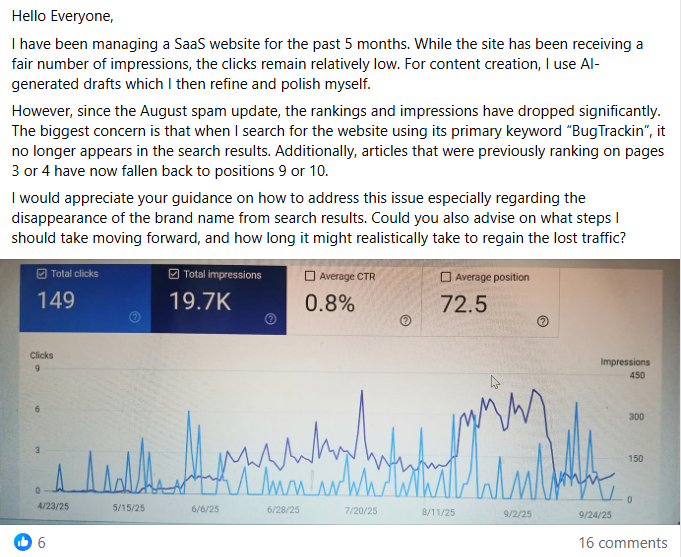
The ranking #1 low CTR problem visualized: high impressions (you’re visible), low clicks (users aren’t visiting)
The Shocking Data: Ranking #1 Low CTR in Numbers
Let me show you the data that proves the ranking #1 low CTR crisis is real, widespread, and permanent.
Position #1 CTR: Then vs Now
CTR by Position: The Complete 2026 Reality
Why Ranking #1 Low CTR Happens: The AI Overview Explanation
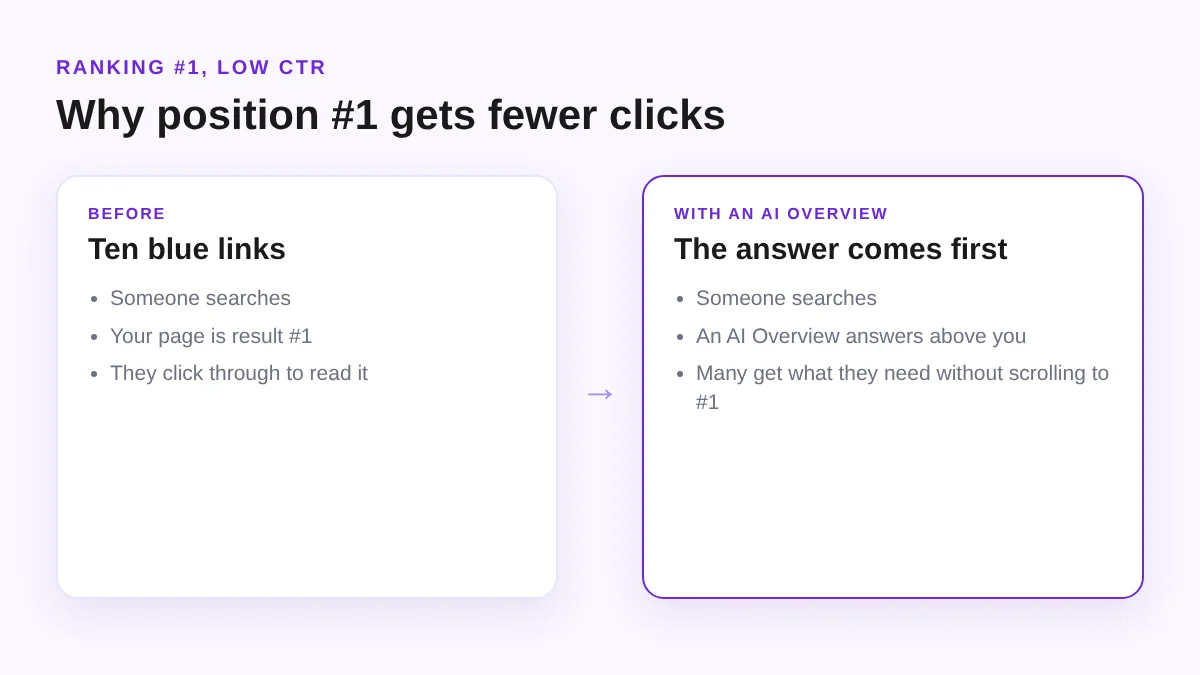
🎯 Quick Answer: Ranking #1 low CTR occurs because Google’s AI Overviews display complete answers directly in search results. Users read answers, get the information needed, leave satisfied — no click required. Your website is still #1 in traditional results below, but most users never scroll down to see it anymore.
Here’s exactly what changed between 2023 and 2026:
2023: Traditional Search
- User searches “how to fix leaking faucet”
- Google shows 10 blue links
- Reads your article
- You get traffic, ad revenue, leads
2026: AI Overview Search
- User searches “how to fix leaking faucet”
- Google shows AI Overview with complete step-by-step answer
- User reads answer (takes 30 seconds)
- Problem solved — closes search tab
- Your #1 ranking gets zero clicks
This is why you have ranking #1 low CTR. The click never happens because the user’s need was satisfied by AI Overview.
Which Queries Have the Worst Ranking #1 Low CTR?
Not all position #1 rankings suffer equally. Ranking #1 low CTR varies dramatically by query type:
If your keywords are informational (definitions, how-tos, what-is), you’re experiencing the worst ranking #1 low CTR impact.
The Paradox: Better Rankings, Worse Traffic
Here’s the mind-breaking scenario happening to thousands of sites:
- June 2024: After hard work, you improve to #1
This is ranking #1 low CTR in its most frustrating form. You did everything right for rankings, but AI Overviews changed the game underneath you.
Can You Recover from Ranking #1 Low CTR?
🎯 Quick Answer:ranking #1 low CTR recovery is possible through AI Overview optimization. Goal: get your content included IN the AI Overview with attribution. Strategy: implement micro-answers, enhance E-E-A-T, add schema markup, use conversational tone. Full recovery takes 4-12 weeks.
You can’t eliminate ranking #1 low CTR entirely (AI Overviews are permanent), but you can adapt and recover significant traffic.
The Three Adaptation Strategies
Strategy 1: Get Included in AI Overview (Best ROI)
Instead of fighting AI Overviews, get your content cited inside them:
- Add micro-answers: concise answers AI can quote with attribution
- Implement FAQ schema: structured Q&A increases AI selection chances
- Cite authoritative sources: AI prioritizes content with proper citations
Strategy 2: Optimize Title for Curiosity (Medium ROI)
Make your title so compelling users click despite AI Overview answering their question:
- Add a unique angle: “How to Fix a Leaking Faucet (Without Calling a Plumber)”
- Promise extras: “How to Fix a Leaking Faucet + Video Tutorial”
- Use power words: “Ultimate”, “Complete”, “Proven”, “Step-by-Step”
Strategy 3: Target Different Query Types (Long-term)
Shift content strategy toward queries with less AI Overview impact:
- Complex research topics: AI can’t fully answer, users need depth
- Experience-based content: personal stories, case studies AI can’t replicate
- Visual-heavy topics: AI Overview is text-based, can’t show detailed images/videos
- Local/commercial intent:
Result: new content avoids the ranking #1 low CTR problem from the start.
How can I improve my CTR if it ranks #1 with low clicks?
To improve CTR for a #1 ranking, focus on optimizing your titles and thumbnails to spark curiosity and ensure immediate readability. Aligning your content precisely with search intent and providing unique insights that AI cannot replicate are crucial. Consider adding conversational elements and ensuring your content offers a distinct perspective or deeper analysis than what AI Overviews provide.
How Generative Engine Optimization (GEO) Fixes Ranking #1 Low CTR
A ranking 1 low CTR is driven by zero-click SERP features and AI-generated answers. To recover lost clicks, websites must pivot from traditional SEO to Generative Engine Optimization (GEO), structuring content to be easily cited by AI search engines including Google AI Overviews, Perplexity, and Microsoft Copilot.
GEO means writing content that AI can extract, attribute, and cite — not just rank. Track your progress with the free AI Citations Tracker to see which AI engines cite your pages and which do not.
Close the Ranking #1 Low CTR Schema Gap
By adding structured data such as FAQ, Product, or Article schema, you enable rich results that capture more visual real estate on the SERP, helping your listing stand out against AI Overviews and standard blue links.
- FAQ Schema: Directly feeds structured Q&As to Google, increasing the likelihood of rich snippet expansion.
- Product & Review Schema: Displays star ratings and pricing details directly in search results to draw user eyes.
- Article Schema: Helps search crawlers parse and attribute your content accurately for AI Overview sourcing.
Score your schema implementation with the GRAAF Framework Scorecard to verify your page meets the citation threshold before relying on rankings alone.
Ranking #1 Low CTR by Industry: Who’s Hit Hardest?
If you’re in health, finance, or education, you’re experiencing the worst ranking #1 low CTR crisis. These industries need aggressive adaptation strategies.
contentscale.site — from 0.1% to 6.5% CTR. My own homepage sat at a 0.1% click-through rate around position 24, on page 3. I ran the same loop for 90 days: scan with the AI Citations Tracker, apply the Citation Brief fixes, re-scan. Search Console CTR was 6.5% for the three-month window ending 1 August 2026. The effect of each individual change cannot be isolated. Read the case study.
New Jersey roofing contractor — site rebuilt, measurement pending. All 21 New Jersey county pages and 31 town pages added, 15 service pages rebuilt, every unsourced figure removed, and internal links pointed straight to their final pages. The first measurement follows 28 days after the work; no results are claimed before Google has indexed the pages. Read the roofing case study.
Results depend on the site, the query, the competition and the implementation. No figure is shown here without a source.
What NOT to Do About Ranking #1 Low CTR
⚠️ Common Mistakes That Make Ranking #1 Low CTR Worse
❌ Mistake #1: Removing Content That Ranks #1
“My page ranks #1 but gets no clicks, I’ll delete it.” Wrong. Keep ranking, add optimization.
❌ Mistake #2: Aggressive Link Building
“I need more backlinks to beat AI!” Links don’t solve ranking #1 low CTR. You’re already #1. The problem is CTR, not rankings.
❌ Mistake #3: Keyword Stuffing to “Beat AI”
“I’ll stuff keywords so AI can’t parse my content.” This makes content worse for users and AI. You’ll lose the #1 ranking entirely.
❌ Mistake #4: Waiting for Google to “Fix” This
“Google will realize AI Overviews hurt traffic and remove them.” They won’t. This is the future of search. Adapt.
❌ Mistake #5: Abandoning SEO Entirely
Rankings matter more now to compensate for lower CTR.
The Long-Term Reality: Ranking #1 Low CTR Is Permanent
Hard truth: ranking #1 low CTR is the new normal. AI Overviews are not going away. Google has publicly stated this is the future of search.
What this means:
- Traffic diversification is mandatory (YouTube, social, email, direct traffic)
- AI Overview inclusion is the new SEO (ranking #1 + cited in AI = winning strategy)
Businesses that adapt to the ranking #1 low CTR reality survive. Those that don’t are already falling behind.
Ready to Recover Your Website Traffic?
From a free analysis to a full Complete-DIY or done-for-you recovery — every option, with current pricing, is on the Services page. Start with a free scan or explore the full ContentScale platform.
→ View Services & PricingOr connect with Ottmar: WhatsApp +31 6 2807 3996 · Amsterdam, NL
FAQs: Ranking #1 Low CTR
Ottmar J.G. Francisca
SEO Specialist & GEO Strategist · Creator of the GRAAF Framework · Amsterdam
Ottmar J.G. Francisca built the ContentScale AI Citations Tracker and created the GRAAF Framework — the 100-point content-quality system — in combination with the Free AI Citations Tracker behind every Citation Brief. Operating solo from Amsterdam with 24+ years in systems and operations management for the City of Amsterdam, he brings a systems-first, measurement-driven approach to content intelligence and developed GRAAF and combined it with Julia McCoy’s CRAFT Framework and the PULSE + NEXUS research system.
- ✓ Documented case study: CTR from 0.1% to 6.5%
- ✓ Verified Google reviews
- ✓ Creator of the GRAAF Framework
- ✓ 24+ years systems & operations management, City of Amsterdam
Last reviewed: July 13, 2026 · LinkedIn (verified) · WhatsApp · GRAAF Guide
ContentScale · contentscale.site · Return to the Traffic Drop Recovery Hub