What is an AI Overview?
The complete guide: how Google’s AI-generated answers work under the hood, what they do to your organic traffic, and how to structure content so you get cited as a source.
What is an AI Overview? An AI Overview is an AI-generated summary that appears at the top of Google’s search results, above the organic links. Google synthesizes it with a language model from multiple web sources and displays clickable citations to those pages. Instead of just links, the user gets a direct, concise answer to their query — a feature that sits at “position zero” on the results page.
In this article
- What is an AI Overview in Google Search?
- How Google AI Overviews work: Gemini and generative AI
- The evolution of SGE to AI Overviews
- Key features: multi-modal search and source links
- SERP real estate impact: desktop vs. mobile
- How to optimize your content for AI Overview citations
- Frequently asked questions
What is an AI Overview in Google Search?
An AI Overview is the AI-generated answer block that Google increasingly places at the very top of the search results. Where you once saw ten blue links, you now first see a synthesized answer — built from multiple sources at once, with clickable citations alongside it. It occupies what SEOs call “position zero”, above every organic result.
Google’s goal is to answer the query directly, without the user having to click through first. To understand what an AI Overview is in practice, just look at any informational search: the answer is already there before you click a single link.
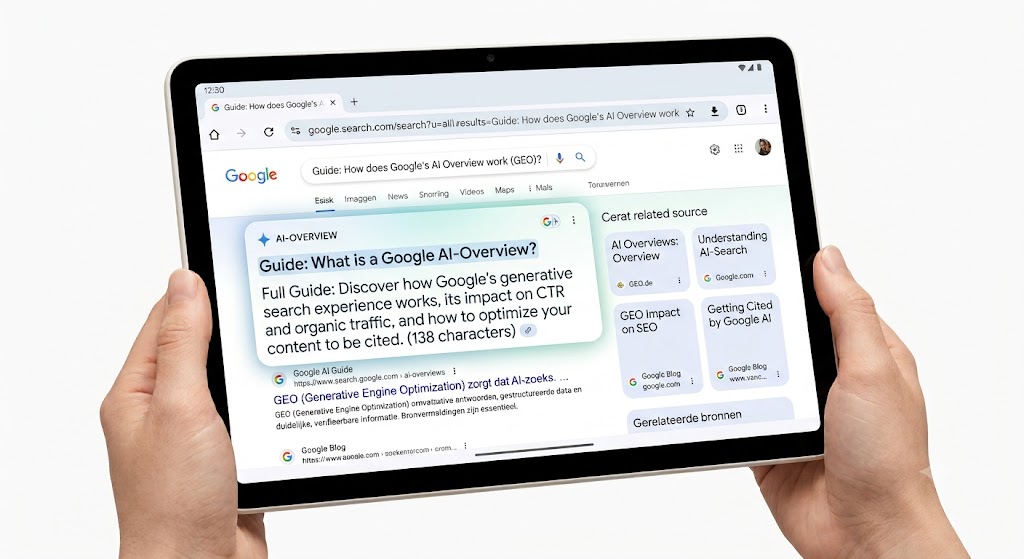
The difference from a classic Featured Snippet is fundamental. A snippet lifts one passage from a single page; an AI Overview writes a new answer by combining and rephrasing information from several sources. That makes it more powerful, but also less predictable — which sources Google picks and how it summarizes them varies by query, country, and even session.
How Google AI Overviews work: Gemini and generative AI
So what is an AI Overview actually doing behind the scenes? This is where most guides stay vague. To be cited as a source, you need to understand how the system actually decides who it cites. The process runs in three technical layers, powered by Google’s Gemini models.
1. Crawling & indexing
Google’s crawler reads your page and stores it in the search index. Without correct indexing — crawlable HTML, a logical heading structure, and fast load times — you’re not even in the running. This is the gateway: no index, no citation.
2. NLP & entity recognition
Using natural language processing, the model breaks your text down into meaning: it recognizes entities and the semantic relationships between them. Pages that name concepts clearly and connect them are understood — and cited — more easily.
3. Synthesis & source selection
The Gemini model weighs the understood sources by relevance, clarity, and trust, then writes a new answer. Pages with a standalone, directly quotable answer block near the top have the best odds of being included in the synthesis.
Crucially, Gemini can handle complex, multi-part queries — breaking a single question into sub-questions and aggregating sources for each. That is why understanding what an AI Overview is means understanding that Google is no longer just matching keywords; it is reasoning across your content.
The evolution of SGE to AI Overviews: a brief history
AI Overviews began life as the Search Generative Experience (SGE), unveiled by Google in May 2023 at Google I/O. It started as a Search Labs experiment and, through 2024, rolled out globally to more than 120 countries and multiple languages, officially becoming AI Overviews in May 2024.
The full answer to what is an AI Overview includes this history. This transition marks a deep shift in search: from an engine that returns links to one that writes answers. Understanding what an AI Overview is means recognizing that Google has moved from being an index of pages to a synthesizer of answers — with everything that implies for your site’s visibility.
Key features: multi-modal search, complex queries, and source links
Three capabilities define what is an AI Overview at the product level. First, multi-modal input: AI Overviews respond not only to typed text but to voice and images via Google Lens, so a photo or spoken question can trigger a generated answer. Second, complex query handling: a single search can bundle several sub-questions that Gemini answers together. Third, source links: each overview shows clickable citations, and being one of those cited sources is the entire game for publishers.
SERP real estate impact: desktop vs. mobile screen space
The numbers make the urgency concrete. According to research by Botify and Demandsphere, AI Overviews and featured snippets occupy 67.1% of the desktop screen and 75.7% of mobile before the first organic link. On mobile, that means three-quarters of the visible screen is taken by the AI answer before a user sees a single classic result.
The consequence is a falling CTR on informational queries — the so-called zero-click search. To grasp what an AI Overview is doing to your traffic, look at who wins: the publishers who suffer least are precisely those cited as a source inside the overview. Visibility shifts from ranking at position 1 to being cited within the answer — the core of Answer Engine Optimization (AEO).
How to optimize your content for AI Overview citations
Once you know what an AI Overview is and how it works, the question becomes: how do you get in? Getting cited is no accident — it is the result of deliberate content structure. Three techniques make the difference.
First: place a clear, directly quotable definition of 40 to 60 words at the top of the page, ideally right under a question-form H2. The model favors standalone answer blocks that literally answer the query within the first 30% of the content.
Second: implement full structured data in JSON-LD — both Article and FAQPage schema — so the algorithm can read your entities and Q&A structure unambiguously.
Third: use semantic HTML with logically nested H2s and H3s, where each section covers one clear subtopic. And technically, if you want to control your appearance, the nosnippet tag lets you limit which snippets Google uses without losing all organic visibility.
Frequently asked questions about AI Overviews
Still wondering what is an AI Overview versus other search features? These are the questions we hear most.
What is the difference between an AI Overview and a Featured Snippet?
Can you opt out of Google AI Overviews?
How do AI Overviews affect website traffic and CTR?
Now you know what an AI Overview is. Measure it.
Knowing what is an AI Overview is only step one. Scan your page free with the ContentScale AI Citations Tracker and see whether Google, Perplexity, and Copilot cite you — and why they don’t, if they don’t.
Now that you know what is an AI Overview, go deeper:
Related articles
What is GEO? →
Generative Engine Optimization: how to get AI engines to cite your content.
AEO vs GEO vs SEO →
The difference between the three disciplines. Which do you need in 2026?

Ottmar J.G. Francisca
Ottmar J.G. Francisca built the ContentScale AI Citations Tracker and created the GRAAF Framework — the 100-point content quality system behind the free AI Citations Tracker. Working solo from Amsterdam, he developed GRAAF after analyzing more than 200 traffic drops.
✓ 200+ businesses across 47 countries · ✓ 78% traffic recovery in 90 days · ✓ Creator of the GRAAF Framework