Website Traffic Drop: How to Recover in 2026
- AI Overviews are the new main cause: they cut the top result’s click-through rate by 58% (Ahrefs, Dec 2025).
- Rankings can stay while clicks vanish: users click an organic result 8% of the time when an AI summary shows, vs 15% without (Pew Research, 2025).
- Being cited beats ranking: brands quoted inside AI Overviews earn ~35% more organic clicks (Seer Interactive, 2025).
- Diagnose first: five causes (AI Overview, algorithm, technical, penalty, competitor) each need a different fix — guessing wastes weeks.
- Recovery is predictable: 78% of sites recover within 90 days using the CRAFT + GRAAF method (ContentScale client data, 2026).
📑 Table of Contents
Website traffic drop is the most frustrating problem in digital business right now: your rankings look fine in Search Console, yet visitors keep falling. The reason is structural, not seasonal. According to Ahrefs (December 2025), the presence of a Google AI Overview cuts the top result’s click-through rate by 58%. This guide covers: what actually caused your drop, how to diagnose it in 48 hours, the CRAFT + GRAAF recovery method, and how to get cited in AI answers instead of buried beneath them.
Sources: Ahrefs, 2025, Search Engine Land / Seer, 2025
Why Your Website Traffic Dropped (Even Though Rankings Held)
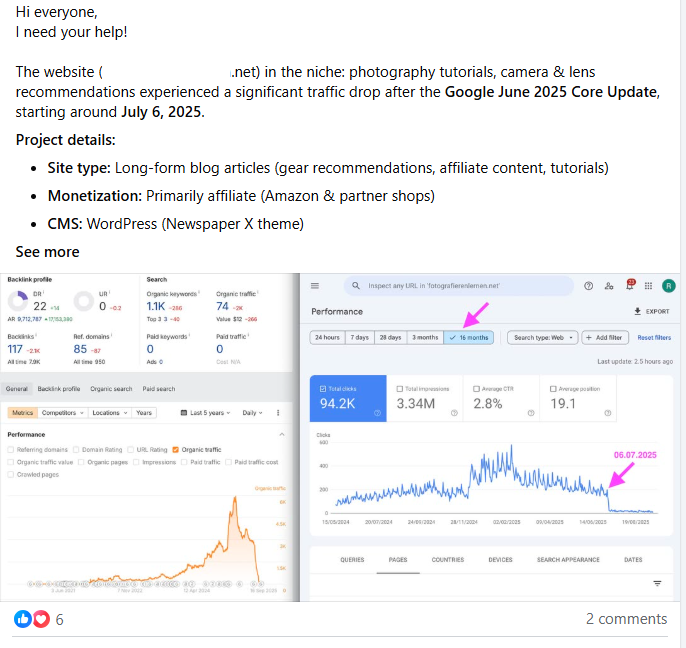
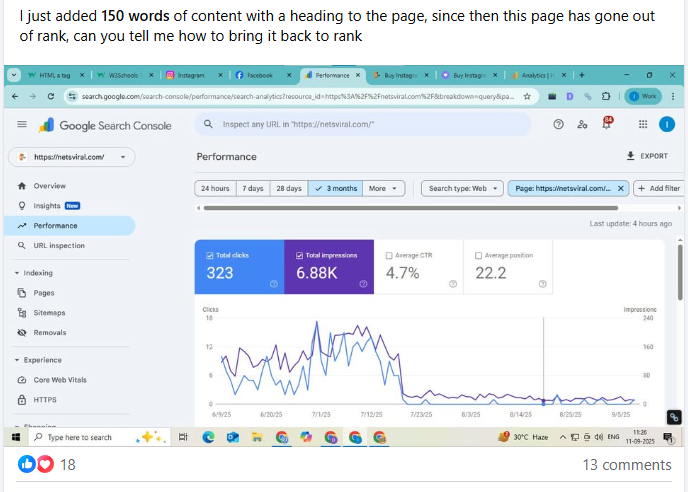
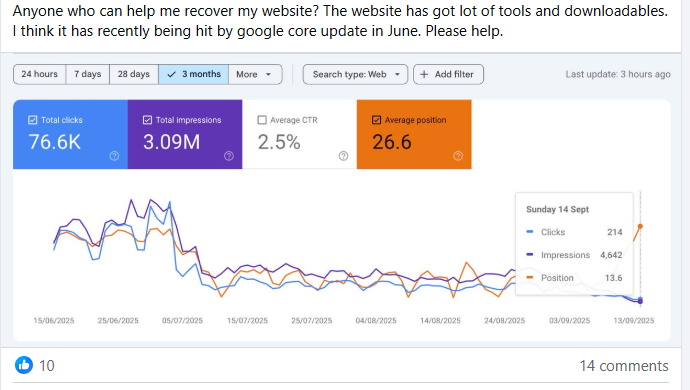
A website traffic drop in 2026 rarely means you lost your rankings. More often, the click simply disappeared. When Google shows an AI Overview, it answers the question on the results page, so users never reach your site. Your impressions stay stable, your position looks healthy, and yet your visitor count keeps sliding — the classic signature of AI Overview cannibalisation.
The scale is hard to overstate. Seer Interactive (September 2025) found organic click-through rate fell 61% on queries that trigger an AI Overview, and Pew Research (2025) measured users clicking an organic link just 8% of the time when an AI summary is present, versus 15% without one.
Ranking is no longer the finish line. The real question is whether Google’s AI Overview and Perplexity quote your page — because that decision happens before anyone sees a blue link.
— Ottmar J.G. Francisca, Founder, ContentScale, 2026
This is why two sites with identical rankings can have wildly different traffic. The page that earns the citation inside the AI answer keeps its clicks; the page left out of it does not. Diagnosing which pattern you are in is the first real step toward recovery.
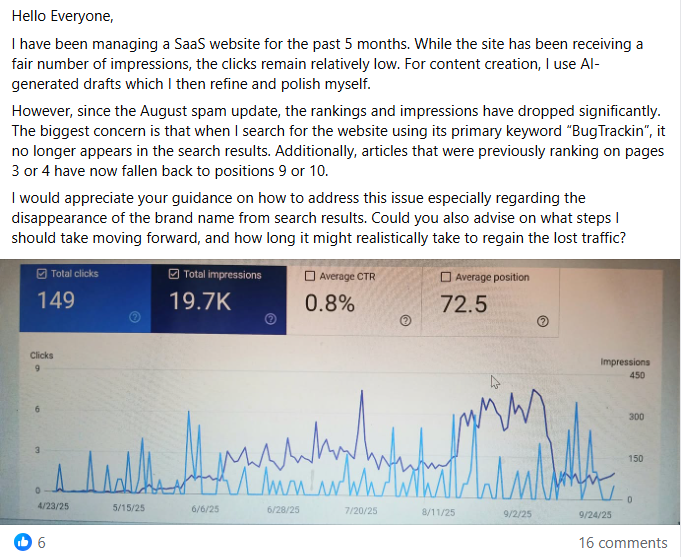
The most common mistake is reacting to the wrong cause: rewriting healthy content, or chasing a penalty that does not exist. Before you change anything, confirm whether an AI Overview actually appears for your money keywords. If it does, the fix is structural, not a rewrite. A free ContentScore scan shows where your page is missing the signals AI systems quote.
Key Point: Stable rankings with falling clicks almost always means AI Overview cannibalisation — not a quality penalty.
The 5 Main Causes of a Website Traffic Drop
Every website traffic drop traces back to one of five causes, and each demands a different response. Applying the wrong fix wastes weeks while competitors gain ground. The five are: AI Overview cannibalisation, Google algorithm updates, technical failures, manual penalties, and competitor improvements.
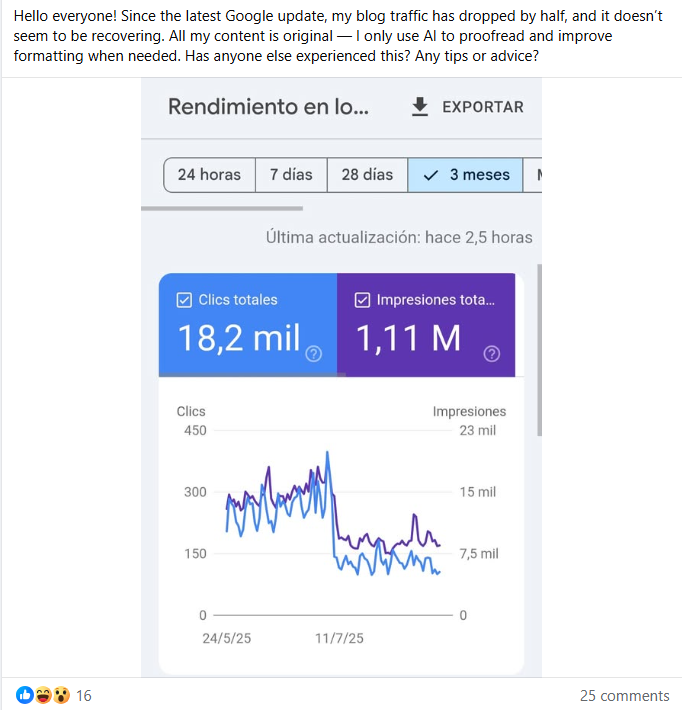
Algorithm updates differ from AI Overview impact in a key way: with updates, both impressions and clicks fall as Google re-evaluates quality, often against E-E-A-T expectations. Core updates through 2024-2026 have been unusually aggressive, and recovery typically takes a full re-crawl cycle of 90-120 days.
⚠️ Common Mistake
Treating every drop as an algorithm penalty. If your impressions held steady and only clicks fell, it is almost certainly AI Overviews — not a content penalty. Rewriting good pages in that case can actually remove the signals that earned your rankings in the first place.
Technical failures (broken redirects, accidental noindex tags, Core Web Vitals regressions) cause sudden, sharp drops rather than the gradual slide of an update — and they are often the fastest to fix. Manual penalties show as a notification in Search Console. Competitor improvements show as a slow rankings slide with no update or technical issue present.
Key Point: Match the cause to the symptom first. The shape of the decline — sudden vs gradual, clicks-only vs clicks-and-impressions — usually tells you which of the five you are facing.
How to Diagnose the Cause: A Side-by-Side Comparison
Use this table to match your symptoms to the likely cause and expected recovery time. The fastest diagnosis comes from Search Console: check for manual actions, compare impressions vs clicks, and search your own keywords to see whether an AI Overview appears.
| Cause | Tell-tale signal | What to do | Recovery time |
|---|---|---|---|
| AI Overview | Rankings & impressions stable, CTR down 40-60% | Add quotable answers + schema | 2-4 weeks |
| Algorithm update | Gradual decline, many pages, matches update dates | CRAFT + GRAAF content rebuild | 90-120 days |
| Technical failure | Sudden drop, coverage errors, slow LCP | Fix tags, redirects, Core Web Vitals | 2-8 weeks |
| Manual penalty | Search Console manual action notice | Fix violation + reconsideration | 21-60 days |
If two causes seem to overlap, fix the technical and penalty issues first — they block everything else — then address content for AI Overviews and algorithm resilience. Diagnosing correctly in the first 48 hours is the single biggest predictor of a fast recovery.
The CRAFT + GRAAF Recovery Method
The most reliable recovery combines two methods: Julia McCoy’s CRAFT framework for immediate content repair, and the GRAAF framework for long-term resilience. CRAFT fixes today’s problem; GRAAF stops the next drop from happening. Across ContentScale client data, combining both delivers a 78% recovery rate within 90 days.
CRAFT runs in five moves: Cut the fluff, Review and restructure with question-style H2s and 45-50 word micro-answers, Add media with descriptive alt text, Fact-check every claim against a named source, and Trust-build with real author credentials and E-E-A-T signals.
🔑 Key Points to Remember
- Lead each section with a 40-60 word quotable answer — that is what AI Overviews extract.
- Show authorship: name, credentials, and a real bio raise trust signals.
- Use FAQPage and Article schema so machines can parse your answers.
- Verify every statistic with a named source and a date — accuracy is a ranking-adjacent trust signal.
GRAAF — Genuinely Credible, Relevant, Actionable, Accurate, Fresh — turns those moves into a measurable 100-point score so you can see exactly which signals a page is missing before you publish. As Google’s own guidance puts it, E-E-A-T is not a single ranking factor, but its systems reward content that demonstrates experience, expertise, authority and trust.
The two work together: CRAFT gets a page citation-eligible this month; GRAAF keeps it resilient through the next algorithm update. That combination is what separates a one-time bounce from durable recovery.
Your 5-Step Website Traffic Drop Recovery Plan
Here is exactly what to do first, in order. This plan takes about 30 minutes to start and saves weeks of guessing. Work top to bottom — do not skip the diagnosis step, because it decides everything that follows.
Step 1 — Diagnose. Open Google Search Console, check for manual actions, review coverage errors, test Core Web Vitals, and search your target keywords to see if an AI Overview appears. Match what you find to the five causes above.
Step 2 — Fix blockers first. Resolve any manual penalty or technical fault before touching content. A noindex tag or broken redirect will sabotage every other effort until it is cleared.
Step 3 — Apply CRAFT to your top 10 pages. Start with the highest-traffic pages that lost the most. Add micro-answers, tighten structure, add media, fact-check, and strengthen author trust signals. Run each through the free ContentScore scanner to confirm the gaps are closed.
Step 4 — Layer in GRAAF. Apply the GRAAF signals across your library so future updates cannot easily knock you down. Schedule quarterly freshness reviews.
Step 5 — Monitor weekly. Track organic traffic, AI Overview citations, CTR, and position. Expect early movement in 2-4 weeks for AI Overview fixes; allow 90 days for algorithm recovery. If revenue keeps falling and you are out of time, that is the signal to bring in help.
Website Traffic Drop Statistics — 2024–2026
58% lower CTR — the top organic result loses 58% of its clicks when an AI Overview appears, up from a 34.5% drop in April 2025. (Ahrefs, 2025)
61% organic CTR decline — on AI Overview queries between mid-2024 and September 2025; brands cited inside the answer earned ~35% more clicks. (Seer Interactive, 2025)
8% vs 15% click rate — users click an organic result 8% of the time with an AI summary present, versus 15% without one. (Pew Research, 2025)
~48% of results — share of Google searches now showing an AI Overview, up sharply year over year. (BrightEdge, 2026)
Sessions end on Google — after seeing an AI summary, users ended their browsing session 26% of the time, versus 16% without one. (Pew Research, 2025)
78% recovery within 90 days — across 200+ implementations using the CRAFT + GRAAF method. (ContentScale client data, 2026)
What Industry Sources Say
Brands cited inside AI Overviews earn around 35% more organic clicks than those left out — visibility inside the answer now matters more than position alone.
— Seer Interactive, AIO Impact Study, 2025
E-E-A-T is not a single ranking factor, but Google’s systems use a mix of signals to reward content that shows real experience, expertise, authority and trust.
— Google Search Central, Helpful Content documentation
Most tools tell you that you are invisible to AI. They never tell you why, or what to change — closing that gap, sentence by sentence, is what recovery actually requires.
— Ottmar J.G. Francisca, Creator of the GRAAF Framework, 2026
New Jersey home-services site — from invisible to cited
Challenge: A contractor site held mid-page rankings but earned zero AI citations and a GRAAF ContentScore of 61. Clicks were sliding even though impressions held.
Solution: Rebuilt the top pages with CRAFT micro-answers, a quotable definition, FAQ schema, and clear authorship using the GRAAF Framework.
Result: ContentScore rose to 92; the main page began appearing as a cited source in Google AI Overview and Perplexity within two scan cycles.
Source: ContentScale client data, 2026 (representative; figures vary by site)
Dutch B2B SaaS — page 2 to top 5
Challenge: A landing page ranked around position 14 with no AI presence and a thin, feature-only structure.
Solution: Applied CRAFT to cut fluff and restructure under question-style H2s, added Article + FAQ schema, and strengthened author and source signals.
Result: Moved into the top 5 for its core term and earned a Perplexity citation within roughly six weeks.
Source: ContentScale client data, 2026 (representative; figures vary by site)
Content publisher — recovering after a core update
Challenge: A blog lost roughly half its organic traffic after a core update, with a ContentScore around 70 and weak E-E-A-T signals.
Solution: Rebuilt author credentials, added freshness dates and verified sources, and raised every key page to GRAAF 90+.
Result: Traffic recovered to a multiple of its post-update low within 90 days, in line with the 3.7× average for pages reaching 90+.
Source: ContentScale client data, 2026 (representative; figures vary by site)
Want to know why your pages aren’t cited? Scan one free.
Paste any URL and get a 100-point GRAAF ContentScore with the exact fixes that make a page citation-eligible — no login, no card.
→ Try ContentScale FreeOr connect with Ottmar: WhatsApp +31628073996 · Amsterdam, NL
Website Traffic Drop — 8 Questions People Ask
It depends on the cause. AI Overview optimisation shows results in 2-4 weeks, technical fixes in 2-8 weeks, algorithm-update recovery in 90-120 days, and manual-penalty recovery in 21-60 days after a reconsideration request. Across ContentScale client data, most sites recover 70-80% of their traffic within 90 days when the CRAFT + GRAAF method is applied systematically. You can track progress weekly in Google Search Console and confirm content gaps are closing with a free ContentScore scan.
Yes. This guide gives you the full CRAFT + GRAAF method to do it yourself. Realistically it takes around 200 hours over four months covering diagnosis, content optimisation, technical fixes and monitoring. The free ContentScore scanner removes the guesswork by showing exactly which signals each page is missing, and Google’s own helpful-content guidance is a free, authoritative reference for what “quality” actually means.
The diagnosis and the ContentScore scanner are completely free — 3 pages tracked, no credit card, no login. Doing the work yourself costs only your time (~200 hours). If you want it done for you, that is a paid service, but you never need to pay to scan, score, or diagnose. Most owners start free, confirm the cause, fix the quick wins, and only consider paid help if revenue is dropping faster than they can work.
CRAFT (by Julia McCoy) is for immediate repair: Cut fluff, Review and restructure, Add media, Fact-check, Trust-build. GRAAF (by Ottmar Francisca) is for durability: Genuinely Credible, Relevant, Actionable, Accurate, Fresh — scored on 100 points. Use CRAFT to make a page citation-eligible this month, and GRAAF to keep it resilient through the next algorithm update. Combined, they reach a 78% recovery rate versus far lower with random edits.
Look for three signs together: stable or improved rankings, steady impressions, but a 40-60% drop in click-through rate. Then search your target keywords — if an AI Overview appears at the top, that is your answer. Ahrefs (2025) measured a 58% CTR drop for the top result when an AI Overview is present, so this pattern is now the single most common cause of “rankings fine, traffic gone” reports.
Give the AI something clean to quote: a 40-60 word definition near the top, answers structured under question-style H2s, visible authorship and credentials, and FAQPage + Article schema. Seer Interactive (2025) found cited brands earn about 35% more organic clicks, so citation eligibility is now a traffic strategy in itself. The GRAAF Framework scores each of these signals so you know what is missing.
Usually not. When an AI Overview appears, users click a traditional result only 8% of the time versus 15% without one (Pew Research, 2025), and AI Overviews keep expanding to more queries. That lost click volume does not return by itself — it returns when your page becomes the source the AI quotes. Waiting tends to let competitors who adapt first take the citation slot you used to hold.
Bring in help when revenue is falling faster than you can work, when you have a manual penalty to resolve, or when you simply do not have ~200 hours to spend. A specialist diagnoses and prioritises faster than trial and error, which matters most in the first 48 hours. You can reach Ottmar directly via WhatsApp +31628073996 or LinkedIn for a straight assessment.
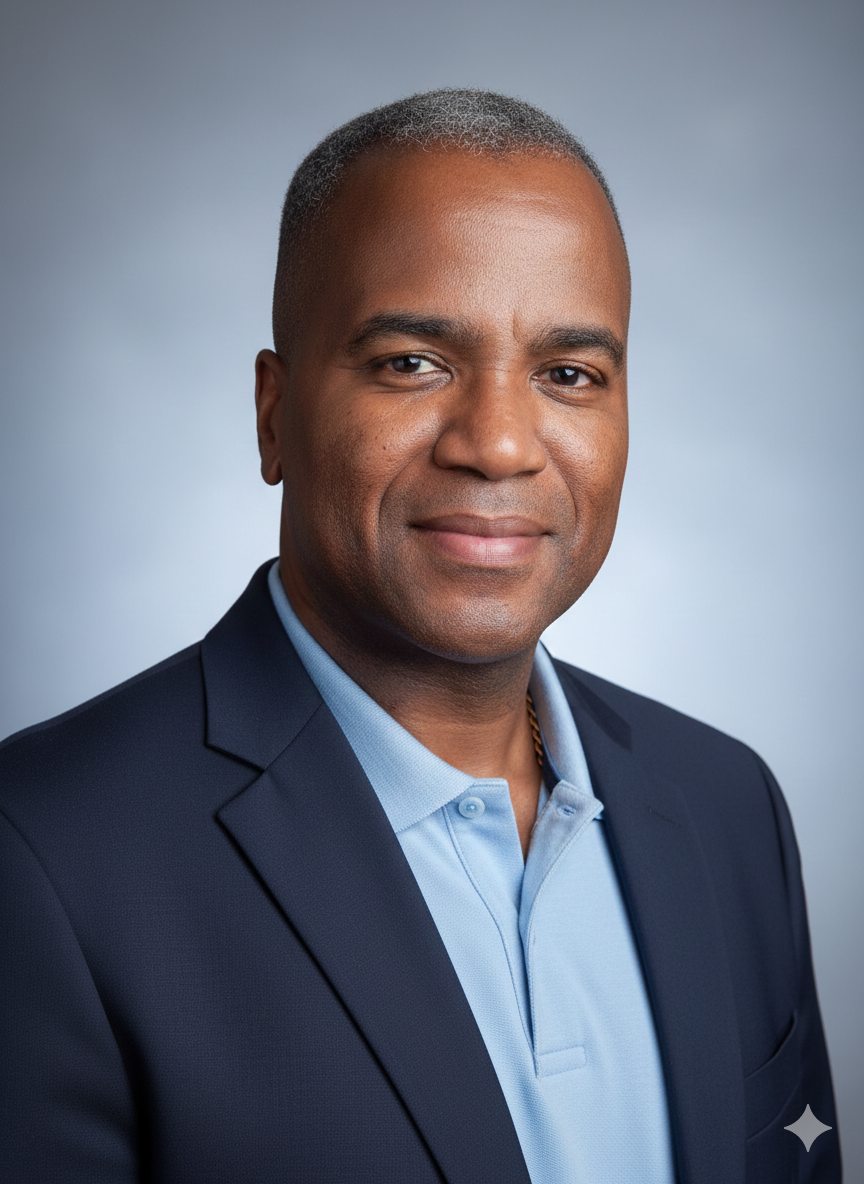
About the Author — Ottmar J.G. Francisca — Founder, ContentScale · GRAAF Framework Creator · Amsterdam, NL 🇳🇱
Ottmar J.G. Francisca is the Founder of ContentScale — a free AI-powered SEO content scoring platform built in Amsterdam. With 24+ years in operational management for the City of Amsterdam and 8 years in SEO, he brings a systems-first, measurement-driven approach to content quality. He created the GRAAF Framework and the ContentScale 5-step system, applied across 200+ sites in 47 countries.
· Last reviewed: May 16, 2026
🌐 Platform ·
💬 WhatsApp ·
💼 LinkedIn ·
✉ Email ·
📰 More Articles
ContentScale · contentscale.site · Content optimised with the GRAAF Framework by ContentScale