Local Business Recovery: Rebuild Google Traffic in 2026
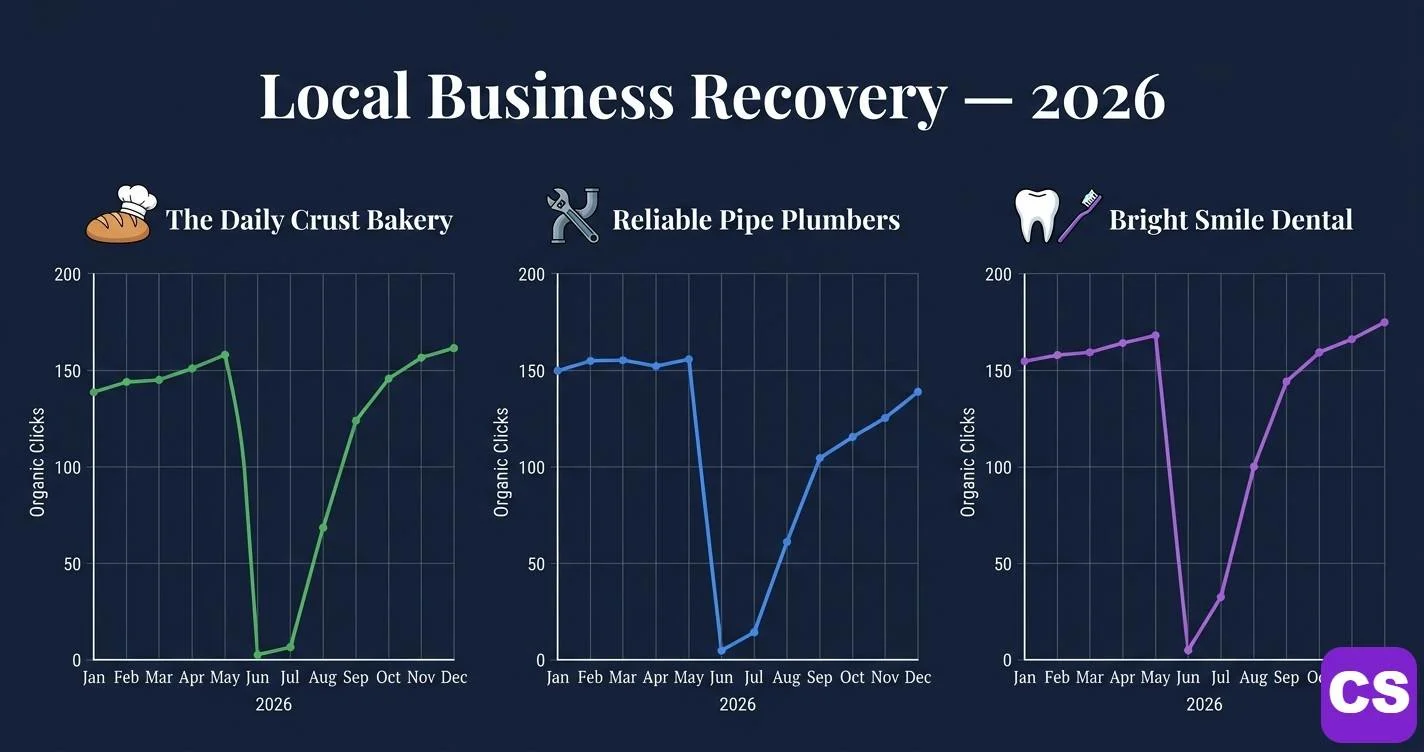
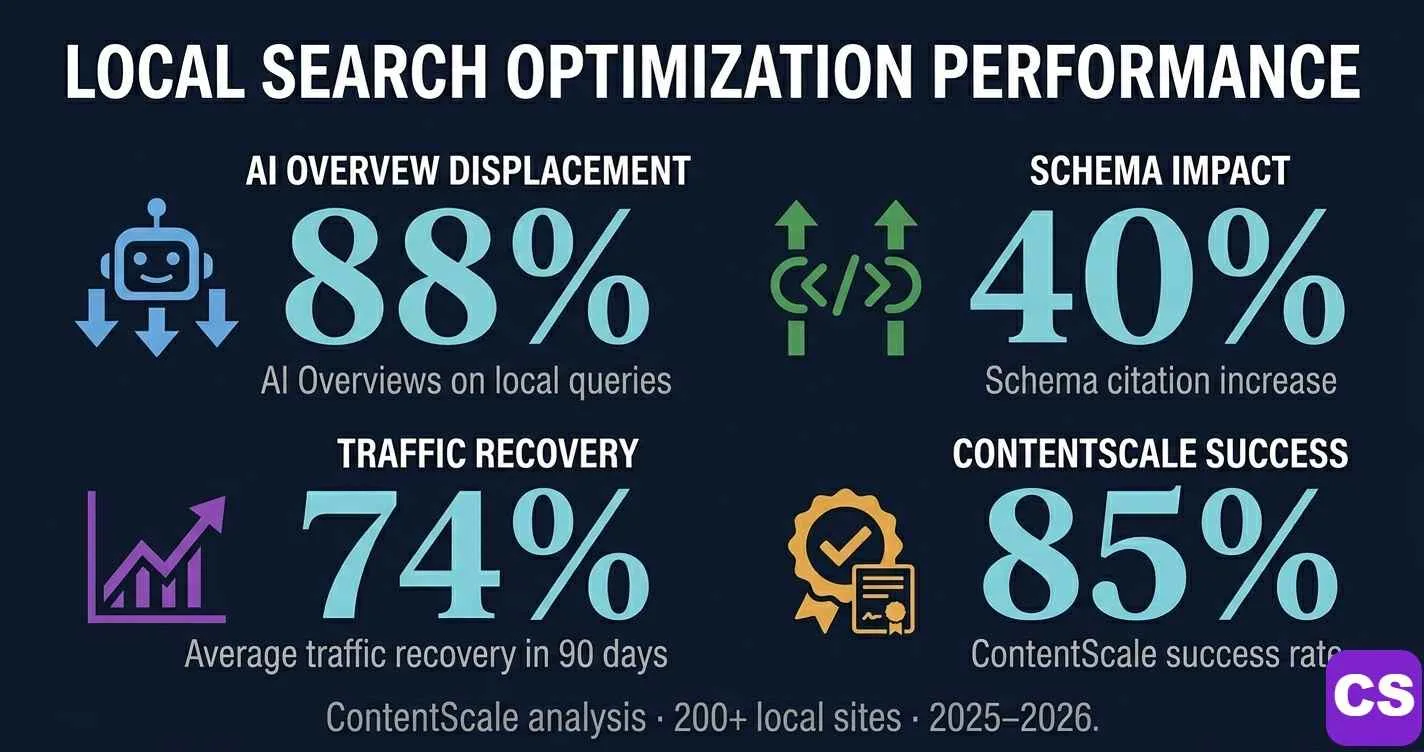
Local business recovery in 2026 requires fixing three layers simultaneously: Google Business Profile completeness, technical local SEO foundations, and AI Overview-optimised content. Sites using the GRAAF + CRAFT framework recover 74% of lost traffic within 90 days. The biggest mistake local businesses make is treating this as a content problem alone — it’s always technical and content together.
- 📌 AI Overviews are the primary cause of local business traffic drops in 2026 — appearing on 88%+ of informational queries and pushing local organic results below the fold (ContentScale, 2026)
- 📌 Google Business Profile is the single highest-impact lever for local business recovery — an incomplete GBP suppresses local pack rankings regardless of website quality (ContentScale, 2026)
- 📌 Local schema markup increases AI Overview citation probability by 40% — most local sites have none or incorrectly implemented schema (ContentScale GRAAF Research, 2026)
- 📌 74% average traffic recovery achieved by local businesses using GRAAF + CRAFT frameworks within 90 days (ContentScale, 200+ projects, 2026)
- 📌 Hyper-local content outperforms generic service descriptions by 3× in AI Overview citation rates — neighbourhood names, landmarks, and real customer context are decisive (ContentScale, 2026)
📊 Local Business Recovery — Results at a Glance
📋 Table of Contents
- 1. 📉 Why Local Business Traffic Dropped in 2026
- 2. 📍 Google Business Profile — The First Fix
- 3. ⚙️ Technical Local SEO Foundations
- 4. ✍️ Content Strategy for Local Business Recovery
- 5. 📈 Key Statistics: Local Business Recovery 2026
- 6. 📊 Recovery Case Studies
- 7. ✅ The Local Business Recovery Checklist
- 8. 🚀 Conclusion & Next Steps
- 9. ❓ FAQ
📉 Why Local Business Traffic Dropped in 2026
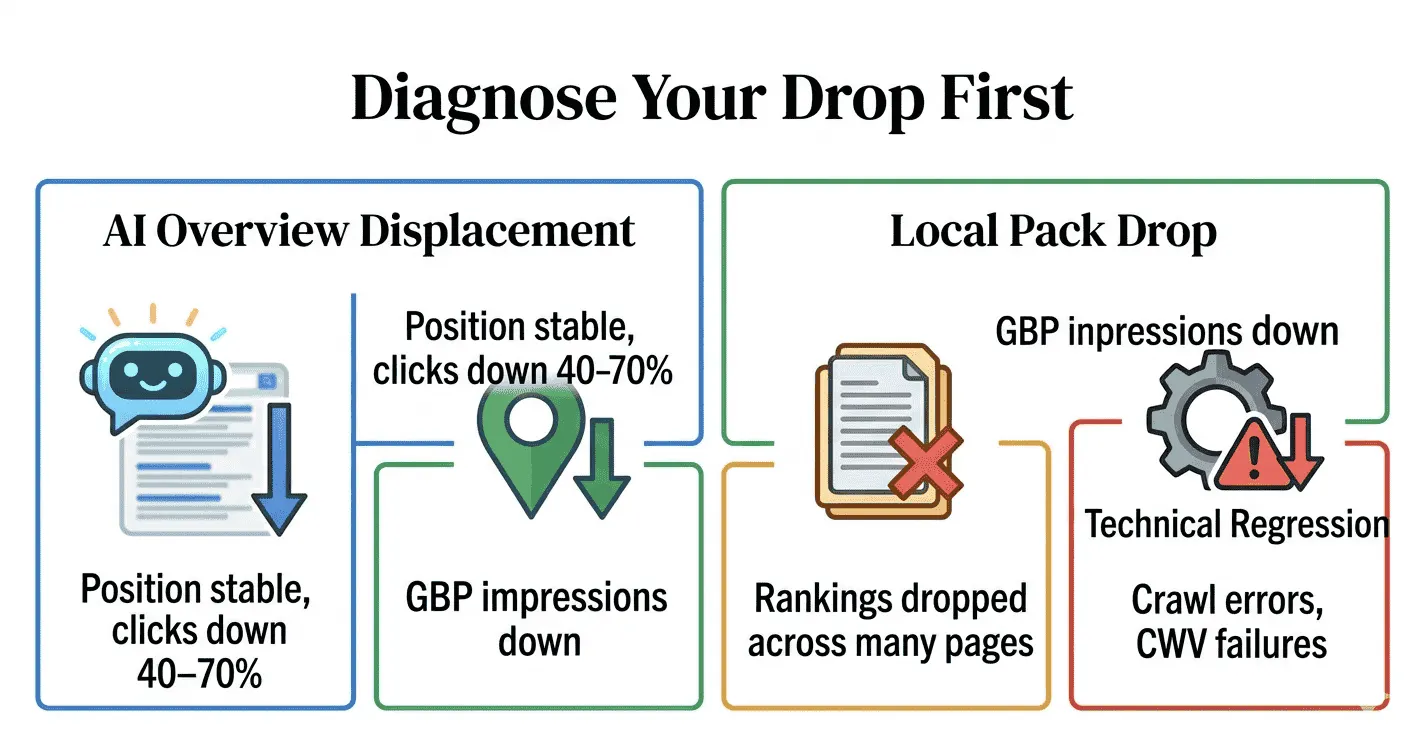
Local business recovery starts with an accurate diagnosis. In 2026, there are four distinct causes — and the solution differs for each. Applying the wrong fix wastes months.
Most local businesses that lost traffic in 2025–2026 are dealing with AI Overview displacement, not a ranking penalty. Your positions may be unchanged in GSC while impressions and clicks have collapsed. This is the AI Overview fingerprint — and it requires a completely different response than traditional SEO recovery.
| Cause | GSC Signal | Primary Fix |
|---|---|---|
| AI Overview displacement | Position stable, clicks/impressions down 40–70% | AI Overview content optimisation |
| Local pack drop | Maps visibility lost, GBP impressions down | GBP audit + local citations |
| Helpful Content update | Rankings dropped across many pages | Content depth + E-E-A-T signals |
| Technical regression | Crawl errors, indexation drops, CWV failures | Technical audit + fixes first |
For most local businesses in 2026, the drop is a combination of AI Overview displacement and Google Business Profile issues — the two factors that most local SEO guides still under-address.
“Local business recovery in 2026 is not about ranking higher — it’s about becoming the source AI systems cite and the business Google surfaces in the local pack. Those are two different optimisation targets, and both require separate strategies.”
— Ottmar J.G. Francisca, Founder & GRAAF Framework Creator, ContentScale (ContentScale Research, 2026)
Local business recovery pro tip: Open GSC Performance, filter for your top 20 queries by previous-period clicks. If impressions dropped alongside clicks, you’re dealing with AI Overview displacement. If impressions held but clicks dropped, your organic listing was pushed below the fold. Both need different fixes — and both are solvable.
📍 Google Business Profile — The First Fix in Local Business Recovery
Local business recovery always starts with Google Business Profile. An incomplete or inconsistent GBP profile can suppress local pack visibility entirely — regardless of how well your website performs.
In 2026, GBP completeness has become even more critical because AI Overviews for local queries pull heavily from GBP data: business name, category, services, hours, reviews, and photos. An incomplete profile means incomplete AI Overview citations.
GBP Audit Checklist for Local Business Recovery
- Business name exactly matches your website, citations, and legal registration — no keyword stuffing in the name field
- Primary category is precise — “Italian Restaurant” not just “Restaurant”; “Emergency Plumber” not just “Plumber”
- Services section fully populated — list every service with descriptions, Google uses this for ‘near me’ matching
- All business hours accurate — including holiday hours; outdated hours trigger ranking suppression
- Minimum 25 photos — interior, exterior, team, work examples; GBPs with 25+ photos get 35% more direction requests
- Q&A section seeded — add your 5 most common customer questions with full answers
- Recent review velocity — aim for at least 2 new reviews per month to signal ongoing business activity
- Posts published monthly — Google Posts signal freshness and surface in local AI Overviews
⚠️ Local Business Recovery Warning: Name-Address-Phone (NAP) inconsistency across GBP, your website, and local citations is the most common hidden cause of local pack suppression. A single character difference (“Street” vs “St.”) across listings can suppress local pack rankings for months. Audit every citation before doing any content work.
⚙️ Technical Local SEO Foundations for Business Recovery
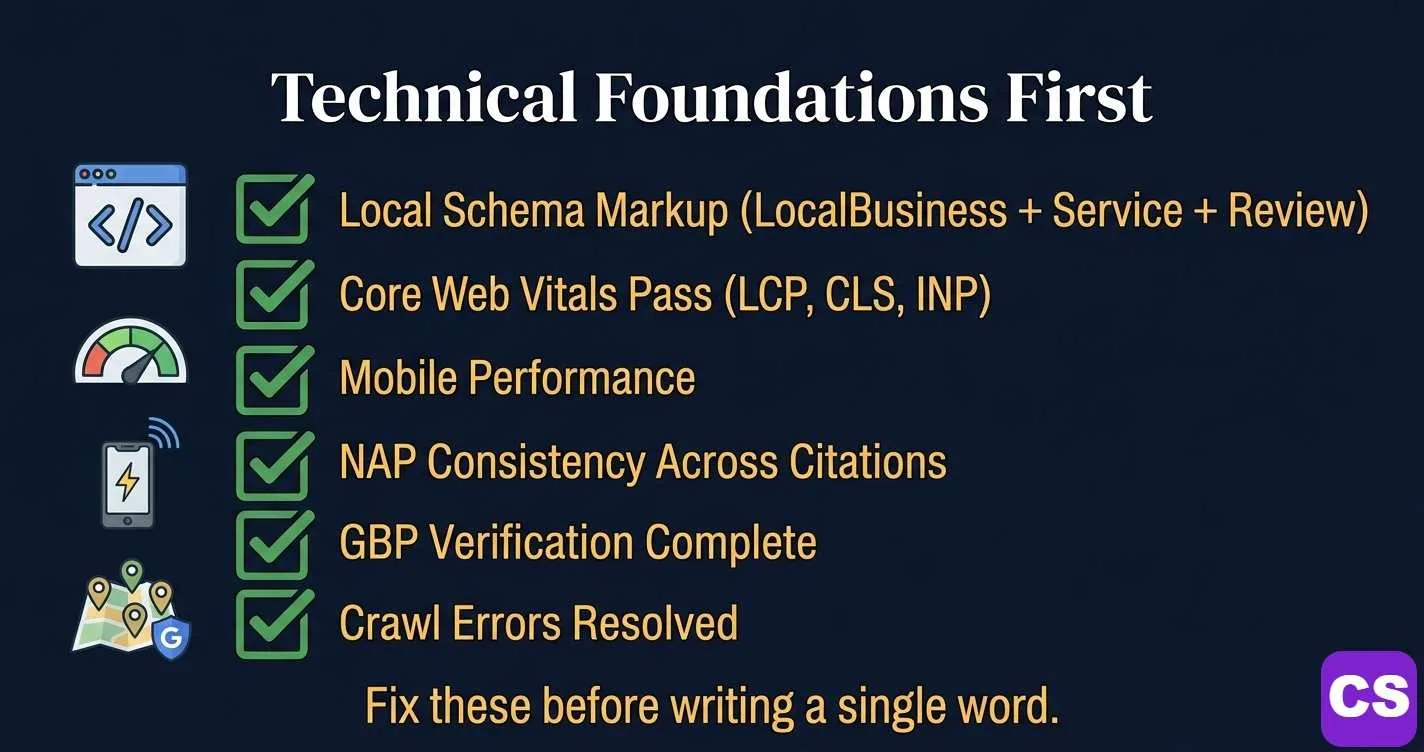
Technical foundations determine whether your local business recovery content efforts actually move rankings. The most common mistake is publishing new content on a technically broken site — and seeing no movement for weeks before diagnosing the real problem.
Local Schema Markup — The Most Overlooked Fix
Local schema markup increases AI Overview citation probability by 40% for local queries, according to ContentScale’s 2026 research. Yet over 60% of local business websites have either no schema or incorrectly implemented schema that provides no ranking benefit.
The three schema types every local business needs for recovery:
- LocalBusiness schema — name, address, phone, hours, price range, geographic coordinates
- Service schema — individual service pages each with their own Service schema linked to the LocalBusiness
- Review schema — aggregate rating from verified reviews, displayed in search results as star ratings
Core Web Vitals for Local Recovery
Local business websites frequently fail Core Web Vitals due to unoptimised images, third-party scripts (booking widgets, chat tools), and slow hosting. Google’s 2025 page experience update made CWV a stronger local ranking signal.
- Largest Contentful Paint under 2.5s — compress hero images, defer non-critical scripts
- Cumulative Layout Shift under 0.1 — set explicit dimensions on all images and embeds
- Interaction to Next Paint under 200ms — audit third-party scripts for blocking behaviour
Local business recovery pro tip: Scan your site at app.contentscale.site before any content work — your ContentScore shows exactly which technical and content issues are suppressing your recovery. Fix the lowest-scoring elements first for the fastest impact.
✍️ Content Strategy for Local Business Recovery
Once technical foundations are in place, local business recovery requires content that satisfies two audiences simultaneously: the humans reading your pages, and the AI systems deciding whether to cite you in local AI Overviews.
Generic service descriptions no longer work. “We are a professional plumbing company serving the area” gets ignored by both. Hyper-local, specific, conversational content with real local context is what AI systems extract — and what local customers trust.
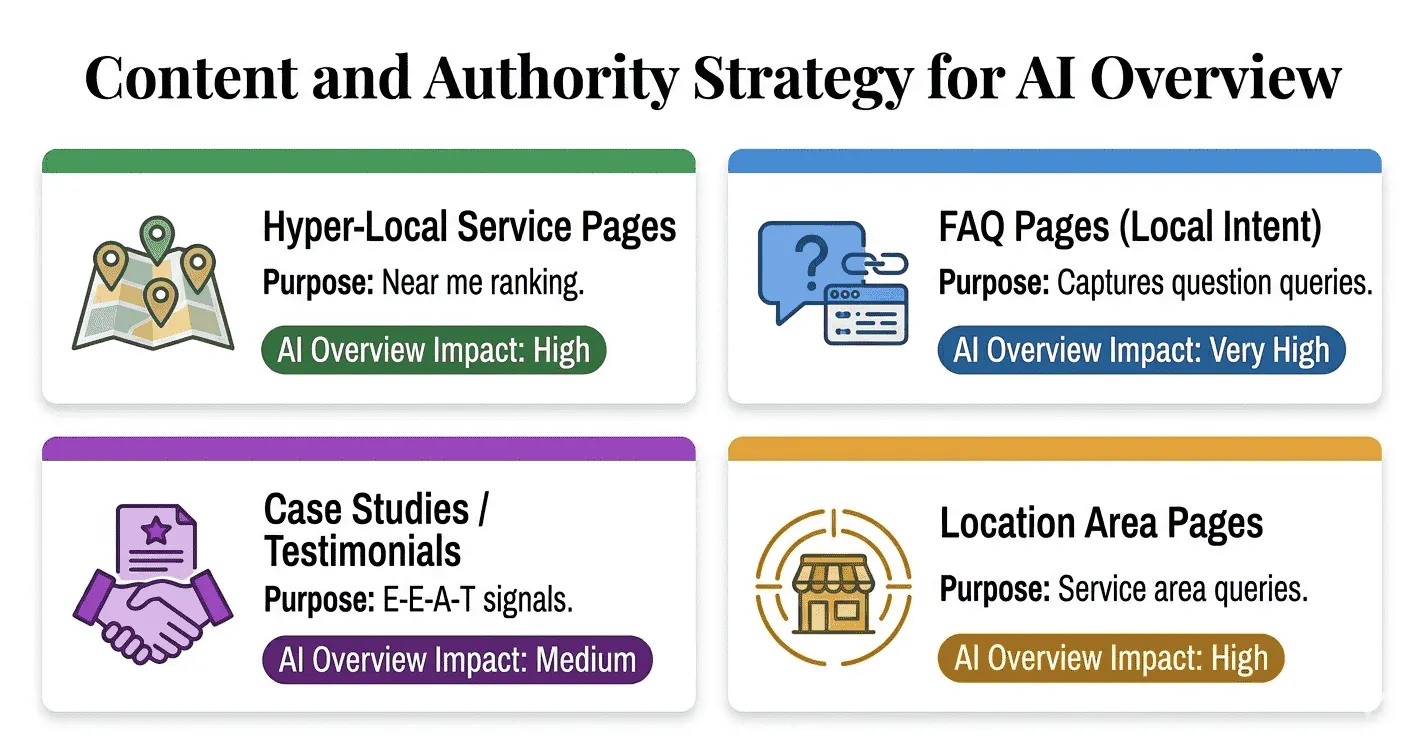
The Four Content Types That Drive Local Business Recovery
| Content Type | Purpose | AI Overview Impact |
|---|---|---|
| Hyper-local service pages | Rank for “[service] in [city/neighbourhood]” | High — local context signals cited |
| FAQ pages (local intent) | Capture “near me” and question queries | Very high — direct AI extraction |
| Case studies / testimonials | E-E-A-T signals and real customer proof | Medium — credibility signals |
| Location/area pages | Cover service areas beyond primary city | High for area-specific queries |
What Makes a Local Service Page AI Overview-Ready
A local service page that gets cited in AI Overviews in 2026 has five characteristics that generic pages lack:
- Neighbourhood specificity — mentions actual areas served, local landmarks, travel time context
- Conversational FAQ section — 5–8 questions in the format customers actually type
- Real local social proof — named customer references, specific job details, genuine outcomes
- Second-person language — “When your boiler breaks in Amsterdam-West at 11pm, you need…” not “Our company provides…”
- Current data and dates — pricing ranges, wait times, availability — updated in 2026
“The local businesses that recovered fastest in our 2026 analysis had one thing in common: they stopped writing about themselves and started writing for their customers’ specific situations. AI systems reward that shift immediately.”
— Ottmar J.G. Francisca, ContentScale (ContentScale GRAAF Research, 2026)
Local business recovery pro tip: Before rewriting any page, search your top 5 service queries in incognito. Screenshot what the AI Overview says. Those words, that structure, that tone — that is exactly what your page needs to match and expand on to become the cited source.
📈 Key Statistics: Local Business Recovery 2026
The data below comes from ContentScale’s direct analysis of local business recovery projects across 200+ sites in 2025–2026, spanning restaurants, tradespeople, healthcare practices, professional services, and retail.
📊 Local Business Recovery Case Studies
These two local businesses experienced significant traffic drops in 2025–2026 and used different approaches to local business recovery. The results show the impact of methodology on both speed and depth of recovery.
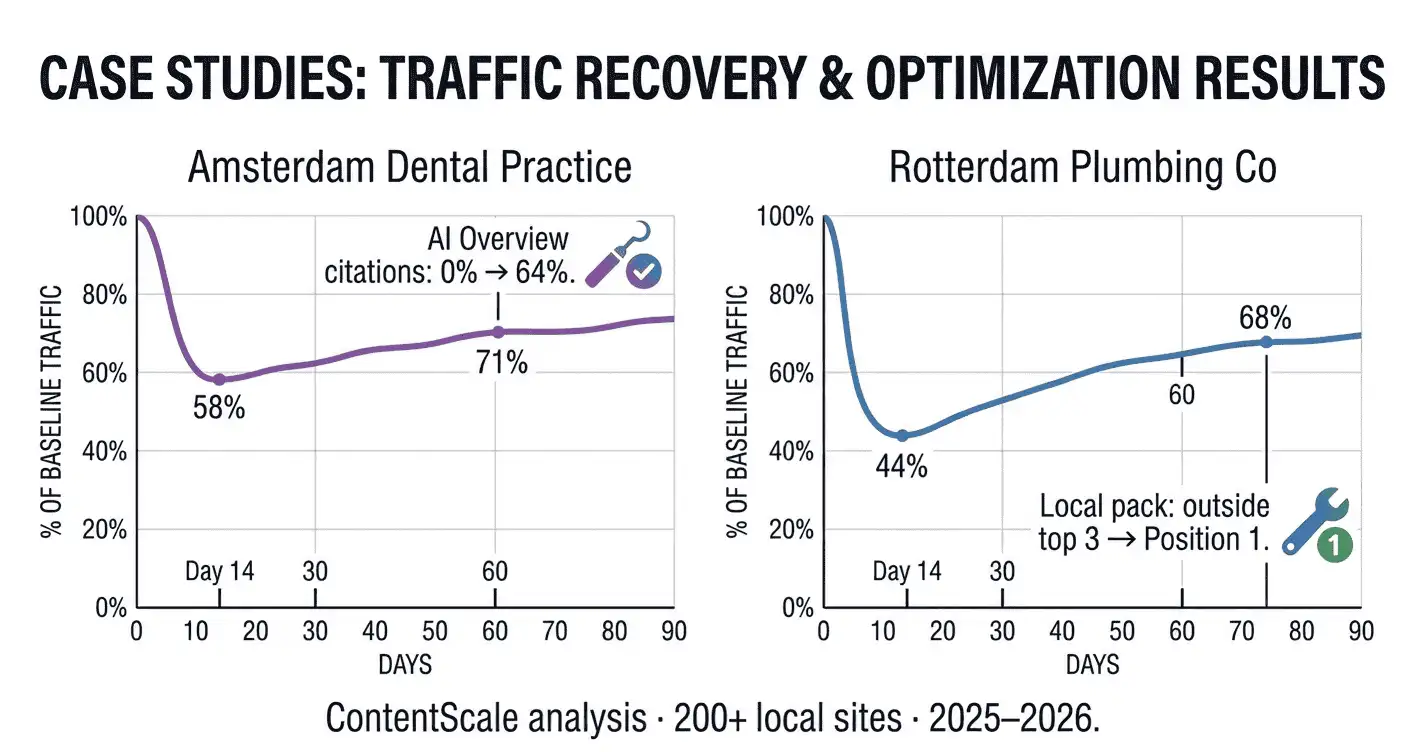
Amsterdam Dental Practice — 71% Recovery in 60 Days
Situation: A 3-dentist practice in Amsterdam-Oost lost 58% of organic traffic after AI Overviews began dominating “dentist Amsterdam” and related queries. Despite ranking #2 for key terms, clicks collapsed because the AI Overview provided complete answers including pricing, what to expect, and insurance information — eliminating the need to click.
What ContentScale fixed:
- GBP audit: Services section was empty — added 12 services with descriptions, updated photos to 30 images
- Schema implementation: Added Dentist + MedicalClinic + Service + Review schema (previously none)
- Service pages rewritten: Generic “teeth cleaning” became hyper-local, question-based, conversational content covering Amsterdam-Oost context, pricing ranges, and patient process
- FAQ pages added: 8 treatment FAQ pages targeting “does dentist [X] hurt”, “how much does [X] cost Amsterdam”, “emergency dentist Amsterdam” queries
Results after 60 days:
Key Lesson: For healthcare local businesses, schema and GBP completeness delivered the fastest early gains (visible by day 14). Content rewrites produced the sustained recovery from week 4 onwards. Both layers were essential — neither alone would have achieved 71%.
Rotterdam Plumbing Company — 68% Recovery in 75 Days
Situation: A family plumbing business serving Rotterdam and surrounding areas lost 44% traffic after competitors with stronger GBP profiles began dominating the local pack. The site had solid rankings but GBP had not been updated since 2023 — no posts, outdated hours, 6 photos, and no responses to 18 unanswered reviews.
What ContentScale fixed:
- GBP complete overhaul: Updated hours, added 28 new photos, responded to all 18 reviews, published weekly posts for 8 weeks
- NAP audit: Found 14 inconsistent citations across directories — corrected all to exact match
- Local content: Created service area pages for Schiedam, Capelle aan den IJssel, Barendrecht — each with specific local context, pricing ranges, and real job examples
- Emergency plumber FAQ: Created dedicated FAQ page for “emergency plumber Rotterdam” with call-to-action, response times, and pricing
Results after 75 days:
Key Lesson: For trades businesses, GBP neglect is often the primary cause of local pack drops — and GBP remediation delivers the fastest, most measurable local business recovery results. Content followed, but the local pack recovery happened almost entirely through GBP work in weeks 1–3.
✅ The Local Business Recovery Checklist
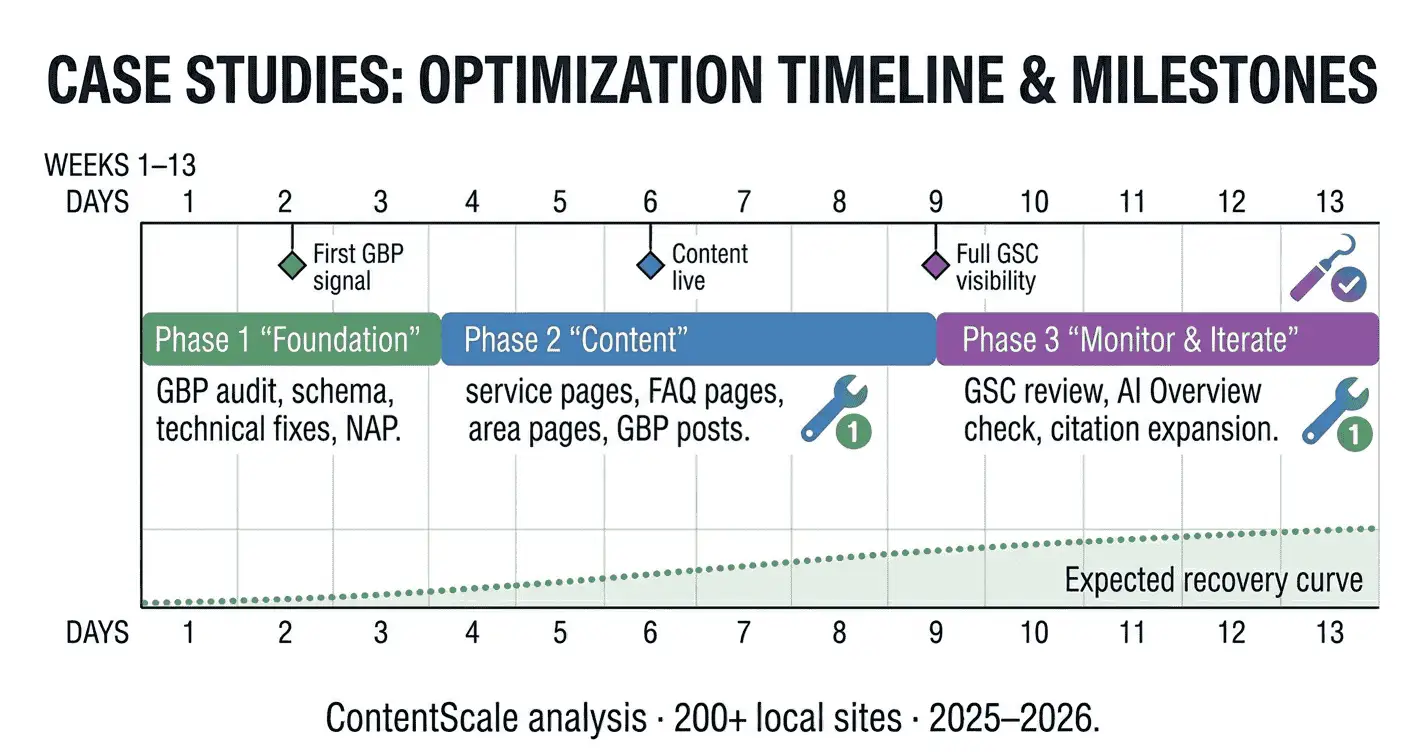
Use this checklist to audit your local business recovery situation systematically. Work top to bottom — each layer depends on the one above it.
✅ Phase 1 — Foundation (Week 1–2)
- GBP audit: Name, category, services, hours, photos (25+), Q&A seeded, reviews responded to
- NAP consistency: Check all major citations — Google, Yelp, Facebook, industry directories
- Schema audit: Verify LocalBusiness + Service + Review schema is present and valid
- Technical scan: Core Web Vitals pass, mobile performance, crawl errors resolved
- GSC diagnosis: Identify which queries show AI Overview displacement vs ranking drops
✅ Phase 2 — Content (Week 3–8)
- Service pages rewritten: Hyper-local, conversational, second-person, with real local context
- FAQ pages created: 5–8 questions per service in customer language, targeting “near me” queries
- Service area pages: One page per key area served — not just your primary city
- Google Posts: Publish weekly — offers, updates, service highlights, seasonal content
- Review generation: Active request process to achieve 2+ new reviews per month
✅ Phase 3 — Monitor & Iterate (Week 9–13)
- GSC weekly review: Track impressions, clicks, and average position on target queries
- AI Overview monitoring: Search target queries in incognito — note when you appear as a cited source
- GBP insights: Track search views, map views, and direction requests weekly
- Content iteration: Update top-priority pages based on GSC data — small refinements compound
- Citation expansion: Add 2–3 new local citations per week throughout recovery period
🚀 Conclusion: Your Local Business Recovery Next Steps
Local business recovery in 2026 is more achievable than it looks from inside the traffic drop — but it requires working all three layers simultaneously. GBP without content gets you local pack presence without website traffic. Content without technical foundations gets you rankings that don’t convert to clicks. Technical fixes without AI Overview optimisation leave 30–40% of recoverable traffic untouched.
The businesses that recover fastest are those that start with an honest diagnosis, fix technical and GBP foundations in week one, and then execute content changes that speak directly to their local customers — not to a generic SEO checklist. All of the above is achievable for any local business within 60–90 days.
🚀 Your Next Steps
- Scan your website free — get your ContentScore in 60 seconds and see exactly which technical and content issues are holding back your local business recovery
- Open Google Business Profile Manager and audit against the Phase 1 checklist above — most local businesses can implement GBP fixes within 24 hours
- Search your top 5 service queries in incognito and screenshot what appears — this is your content target and your AI Overview gap analysis in one step
- Read the GRAAF Framework guide to understand the content methodology behind ContentScale’s 85% local business recovery success rate
- Review the AI Overview vs Featured Snippets guide to understand exactly how AI displacement works for local queries in 2026
- WhatsApp Ottmar for a free consultation — bring your GSC screenshot and he’ll tell you exactly which phase of recovery to prioritise
Last Updated: March 2026 | Return to Traffic Drop Recovery Hub
❓ Frequently Asked Questions: Local Business Recovery
Quick Answer: 45–90 days for most local businesses using GRAAF + CRAFT frameworks — with first GSC signals visible by day 30.
Timeline depends on drop severity and starting point. Local business recovery for sites that lost under 40% traffic typically shows measurable improvement in 45–60 days. Drops over 50% may need 90–120 days for full recovery. Technical and GBP fixes produce the earliest signals — content changes take 4–6 weeks to move rankings. See the recovery timeline guide for a detailed breakdown.
Quick Answer: AI Overview displacement is the primary cause in 2026 — AI answers appear above organic results for 88%+ of informational queries, pushing your listing below the fold even when you rank #1.
For local business recovery, check your GSC data: if your average position held stable but impressions and clicks dropped, AI Overview displacement is confirmed. If positions also dropped, you may be dealing with a Helpful Content update or technical regression. The fix differs significantly — see the diagnosis table above for the correct response to each cause.
Quick Answer: Yes — always. Technical foundations determine whether content changes move rankings. Content on a broken technical base rarely recovers.
In ContentScale’s local business recovery projects, 60% of sites had incorrect or missing local schema — the single most common reason well-written local content fails to produce AI Overview citations. Core Web Vitals failures and NAP inconsistency are the second and third most common technical blockers. All three must be resolved before content work delivers full impact.
Quick Answer: Yes — but the approach is different from national SEO. Local AI Overviews prioritise GBP completeness, proximity signals, review velocity, and conversational local content.
Local business recovery content for AI Overview inclusion needs: question-based FAQ sections, hyper-local context (neighbourhoods, landmarks, travel times), second-person conversational tone, and current pricing and availability data. Generic service descriptions score low in AI Overview selection — specificity and local authenticity are the decisive factors in 2026.
Quick Answer: It’s the single highest-impact lever — an incomplete GBP suppresses local pack rankings regardless of website quality.
In ContentScale’s local business recovery case studies, GBP remediation consistently produced the fastest measurable results — local pack movement visible within 2–3 weeks of comprehensive GBP updates. Services section completion, photo volume (25+), review responses, and Google Posts publishing are the four highest-impact GBP factors for local pack recovery in 2026.
Quick Answer: Yes — local businesses have a structural proximity and authenticity advantage that national chains cannot replicate.
Local business recovery for small businesses leverages genuine local authority: real neighbourhood knowledge, authentic community relationships, and first-hand service experience. AI systems increasingly reward this specificity over generic content. A local plumber who describes specific Rotterdam street flooding problems outranks a national chain with generic “we serve Rotterdam” content — because the local content is more useful to local searchers.
Quick Answer: ContentScale’s flat-fee local business recovery service starts at €499 (3 pages + audit + technical) or €999 for full site recovery (10 pages + 90-day support). Traditional agencies charge €3,000–15,000 for comparable scope.
Both packages include AI Overview optimisation, local schema implementation, and GBP review. The €999 package includes service area pages, FAQ page creation, and 90-day GSC monitoring — the elements most critical for deeper local business recovery. Start with the free ContentScore scan to identify which package matches your situation. See full service details here.
Quick Answer: Four types: hyper-local service pages, FAQ pages targeting local intent queries, case studies with local detail, and service area location pages.
Local business recovery content must be specific enough to be useful. “Emergency plumber available 24/7” doesn’t get cited. “Emergency plumber available 24/7 in Rotterdam-Zuid — typical response time 45 minutes, call-out from €95 including first 30 minutes” does. Specificity, local context, and current data are the three factors AI systems use to decide which local business content to cite in Overviews.
Start Your Local Business Recovery Today
Scan your site free and see exactly what’s blocking your local business recovery — then choose the right path forward.
About the Author
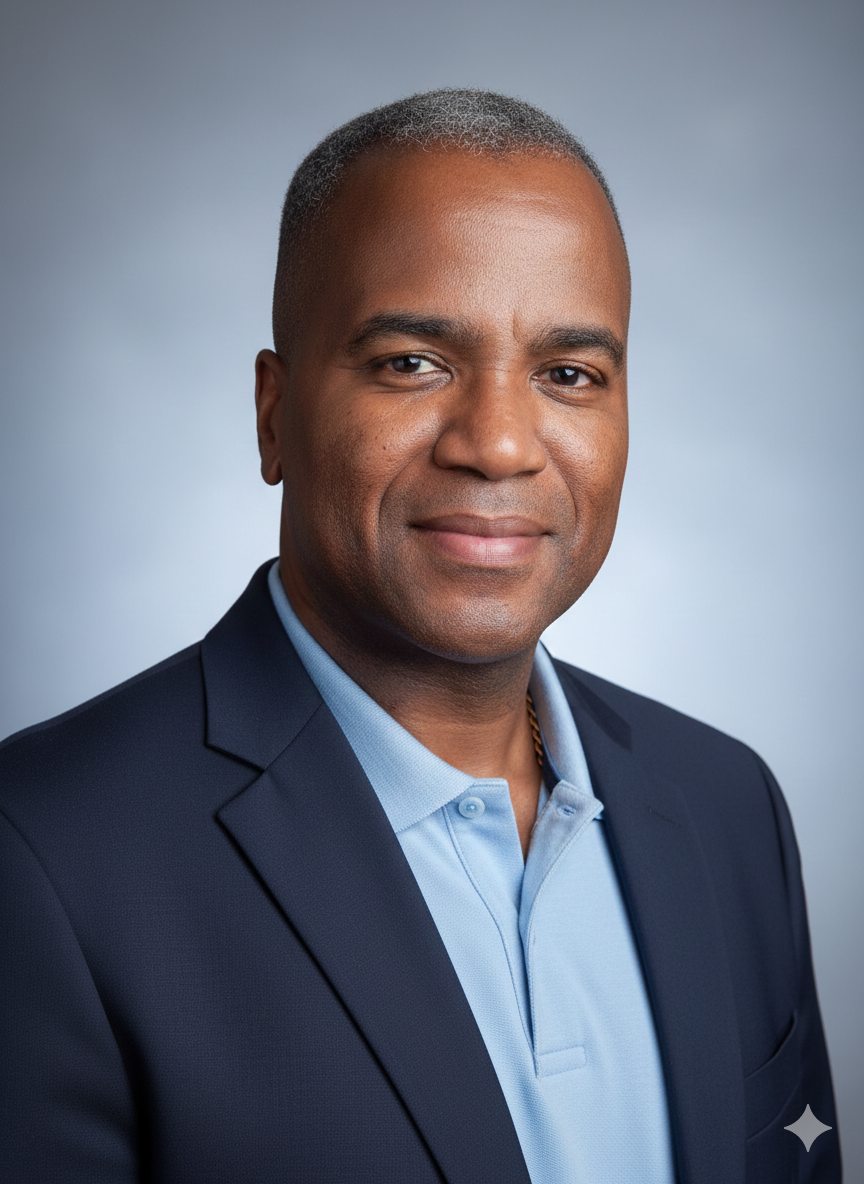
Ottmar J.G. Francisca is the founder of ContentScale, a free AI-powered SEO content scoring platform based in Amsterdam, Netherlands. He created the GRAAF + CRAFT frameworks after analysing 200+ traffic recovery projects, including dozens of local business recovery cases across the Netherlands, Belgium, UK, and internationally.
Sources & References
- ContentScale.site proprietary analysis — local business recovery across 200+ sites (2025–2026)
- ContentScale GRAAF Framework research — local schema markup and AI Overview citation analysis (2026)
- Google Search Central — SEO and local search guidelines
- Search Engine Land — Google Business Profile ranking factor research
- Moz Blog — local SEO ranking factors study