Generative Engine Optimization Consultant — Cited by AI
- Citations beat clicks: With ~68% of U.S. Google searches now ending without a click, being named in an AI answer is the new first-touch. (SparkToro / Bain, 2026)
- GEO is different from SEO: AI systems evaluate entity clarity, source authority and factual density — not keyword density or backlink counts. (Princeton GEO Study, 2023)
- Most “GEO experts” are rebadged: In 2026, most agencies updated their SEO copy and called it GEO. Proof is a named method, live citation tracking and before/after data — not marketing claims.
- The GRAAF Framework is verifiable: A 100-point per-page standard I created and publish openly — you can check every scored page at app.contentscale.site.
- You can start free: Check your current citation status across AI platforms now with the free AI Citations Tracker before spending anything.
📑 On This Page
- What I Do as a GEO Consultant to Secure AI Citations
- Why Search Changed — and What Replaced the Click
- GEO vs. SEO vs. AEO — What’s Actually Different
- How AI Systems Decide Who to Cite
- The GRAAF Framework — How I Score Pages
- Existing Content vs. New Content — What I Do Differently
- Who I Work With
- What a 90-Day Engagement Delivers
- GEO Statistics 2025–2026
- FAQ — 8 Questions People Ask
GEO consulting is the discipline of making your brand the cited source inside AI-generated answers — not just a blue link someone might click. In 2026, most discovery happens before a user ever reaches your site: Google’s AI Overviews now appear in up to 60% of searches, Perplexity processed 780 million queries in May 2025 alone, and ChatGPT is the first stop for a growing share of B2B buying research. If your brand isn’t named in those answers, you’re invisible at the decision moment. This page explains exactly how I approach that problem — what I check, what I change, and how you can verify results.
Sources: SparkToro / Bain, 2026 · Gartner, 2025 · Princeton GEO Paper, 2023
What I Do as a GEO Consultant to Secure AI Citations
My work maps to the four capabilities AI answer engines look for when they decide which source to cite:
- AI Visibility Audits. I measure how often, and in what context, large language models mention your brand across Google AI Overviews, Perplexity, Copilot and ChatGPT — establishing a Yes/No baseline per platform before any work starts.
- Entity & Context Mapping. I structure your content with high factual density and clear schema markup so AI crawlers can parse, trust and attribute your data — the entity clarity that earns citations.
- Citation Strategy. I focus on source authority and the third-party signals that feed retrieval-augmented generation (RAG), so conversational engines encounter your brand as a trusted source, not just your own page.
- Prompt Coverage Tracking. I track AI mention rates, sentiment and share of answer — not just keyword rankings — so you can see, query by query, whether the citation actually landed.
Why Search Changed — and What Replaced the Click
The discovery process your buyers use has structurally changed in the last 24 months. Google AI Overviews, ChatGPT, Perplexity and Copilot now answer a significant share of commercial queries directly — synthesizing multiple sources into one response, naming 3–7 trusted citations, and rarely sending the user to a results page at all. Gartner (2025) projects traditional search engine volume will drop 25% by 2026 as AI tools absorb that traffic.
For businesses, this creates a new hierarchy: rank in Google blue links and get cited in the AI answer above them — or cede the first impression entirely to whoever does. According to 6sense’s 2025 Buyer Experience Report, 94% of B2B buyers now use generative AI tools during their purchase process, making AI search a critical channel for reaching prospects while they’re actively evaluating options.
“GEO is the practice of optimizing content to be cited and surfaced inside generative engines. Techniques such as citing sources, including statistics, promoting semantic clarity and quoting experts are extensions of existing SEO practices — but they must be done with AI retrieval behavior in mind.”
— Progress Sitefinity, SEO and GEO: A Practical Guide for 2026
The practical consequence: pages that used to earn impressions and clicks from organic rankings now need to satisfy two additional audiences — the AI crawlers that index them for retrieval, and the language models that synthesize them into answers. Ignoring either audience means being ranked but not cited — which is increasingly the same as being invisible.
Key Point: A brand that earns 10,000 impressions but zero AI citations has a GEO gap, not an SEO gap. Fixing that gap is different from fixing a ranking — it requires a different diagnosis and different changes.
GEO vs. SEO vs. AEO — What’s Actually Different
These three terms get conflated constantly in 2026, often by agencies using all three interchangeably. They’re related, but they optimize for different outcomes and require different techniques:
| Factor | SEO | AEO | GEO |
|---|---|---|---|
| Target | Google blue-link rankings | Featured snippets, PAA boxes | AI-synthesized citations (ChatGPT, Perplexity, AI Overviews) |
| Success metric | Ranking position, clicks | Snippet ownership, PAA frequency | Citation frequency + sentiment across AI platforms |
| Key signals | Backlinks, keywords, Core Web Vitals | Concise answers, schema markup | Entity clarity, factual density, source authority, structured data |
| Tracking tool | Google Search Console, Ahrefs | SERP feature tracking tools | AI Citations Tracker, Profound, Evertune |
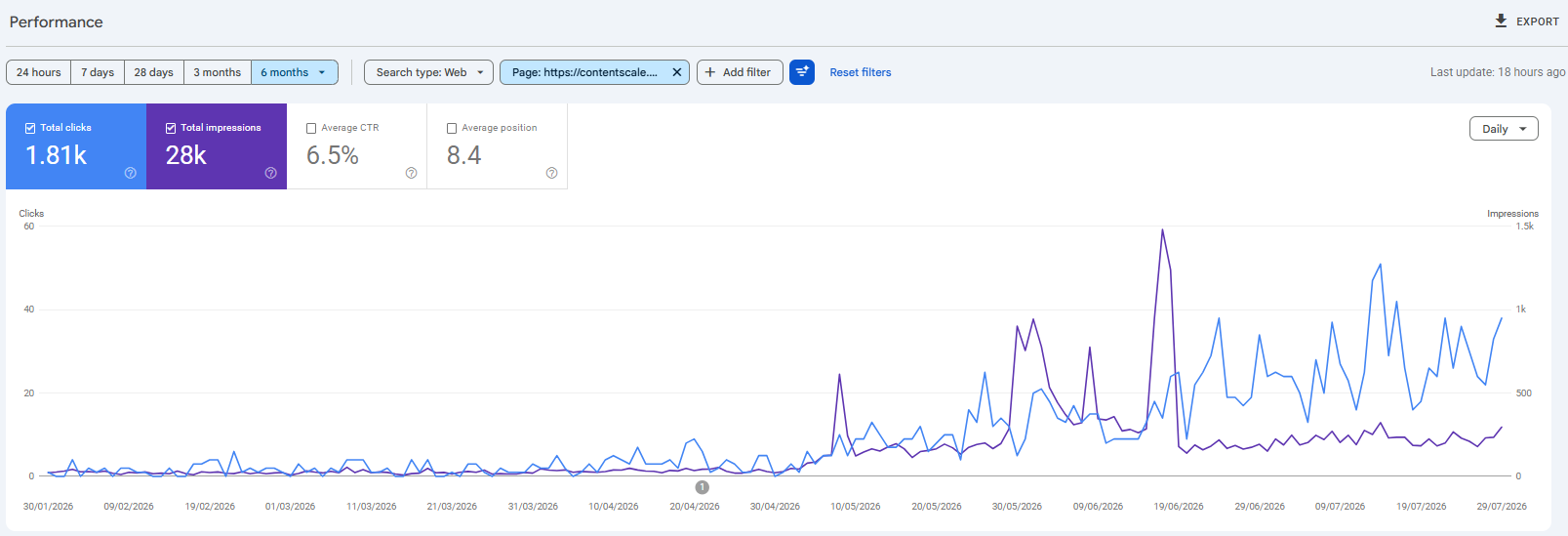
Real GSC data — ContentScale.site CTR improvement tracked over 90 days as pages moved up in rankings and began appearing in AI Overviews. This is my own site, not a client.
⚠️ Common Mistake
Most teams treat GEO as a content refresh — rewriting a page to “sound more AI-friendly” without changing the underlying signals AI systems actually evaluate: entity consistency, source attribution, factual verifiability and schema completeness. Surface-level rewriting without those changes produces no measurable citation lift.
Key Point: You don’t have to choose between SEO and GEO — the best approach optimizes for both simultaneously. A page that earns a Google ranking AND gets cited in the AI Overview for the same query earns more total visibility than either alone.
How AI Systems Decide Who to Cite
Large language models and retrieval-augmented systems don’t rank pages the way Google does. They evaluate potential source content on a different set of signals before deciding what to quote, paraphrase or name in a response. Understanding this is the foundation of any GEO strategy that actually works.
The Princeton GEO paper (Aggarwal et al., 2023) — the study that coined the term — tested nine optimization techniques and measured which produced the highest citation lift. The top four: citing authoritative sources (+40% visibility improvement), adding verifiable statistics, including fluent expert quotations, and improving content clarity. Keyword stuffing and backlink-style signals produced no measurable improvement in AI citation rates.
🔑 What AI Systems Evaluate Before Citing
- Entity clarity — is the person, organization or topic described with consistent, verifiable attributes across the page and across the web?
- Factual density and verifiability — does the content include specific, checkable statistics with named sources? Vague claims are skipped.
- Source authority signals — is the author identified with credentials? Are external citations linked to recognized publications?
- Structured data completeness — Schema.org markup (FAQPage, Person, ProfessionalService) helps AI retrieval systems classify and trust content.
- Topical depth — does the page fully answer the query or just scratch the surface? AI systems prefer comprehensive single-source answers over scattered content.
- Content freshness — last-updated timestamps, current year data points and recent references signal to AI crawlers that content is current.

These signals align directly with what Google’s Quality Rater Guidelines call E-E-A-T (Experience, Expertise, Authoritativeness, Trustworthiness). The overlap isn’t accidental — both Google AI Overviews and independent AI systems like ChatGPT and Perplexity were trained on corpora where high-E-E-A-T content dominated the signals for trustworthy answers. Improving one improves the other.
Key Point: AI systems don’t “choose” sources at random. They apply a consistent preference for entity-clear, source-attributed, factually dense content. That preference is diagnosable and fixable — and that’s exactly what GEO consulting addresses.
The GRAAF Framework — How I Score Pages Before Optimizing
I created the GRAAF Framework after analysing 200+ traffic recovery cases. It scores every page on 100 points across five quality signals that both Google and large language models use to evaluate source trustworthiness. Nothing is published without a GRAAF score — quality is measured, not assumed.
- G — Genuinely Credible (20 pts): Author credentials, linked citations, verifiable claims. No anonymous expertise, no unattributed statistics.
- R — Relevant (20 pts): Topical alignment between the headline, body content and search intent. No keyword-stuffed padding.
- A — Actionable (20 pts): Does the page give the reader something concrete to do? AI systems prefer content that answers the full query, not just the first half.
- A — Accurate (20 pts): Factual consistency, up-to-date data, no contradictions across the page. Errors here are the fastest way to lose citations.
- F — Fresh (20 pts): Last-updated signals, current-year references, content that reflects the actual state of the topic in 2026 — not 2022.

A GRAAF ContentScore of 65/100 is a problem — pages below 75 consistently fail to earn AI citations. The per-signal breakdown shows exactly which of the five signals is dragging the score and what to fix before publishing or rewriting.
The GRAAF ContentScore scanner is available free at app.contentscale.site. Paste any URL and get a per-signal breakdown with specific fix recommendations. I use the same tool at the start of every engagement to establish a baseline — so you know exactly what’s being fixed and why.
You can read the full methodology at contentscale.site/graaf-framework/. Every signal is documented, every score is explained. That transparency is intentional — the framework has to be reproducible to be useful.
Existing Content vs. New Content — Two Different Workflows
GEO work splits into two distinct tracks — and the tools, trackers and brief types are different for each. Getting this diagnosis right first determines where the fastest citation gains are and what the engagement actually involves.
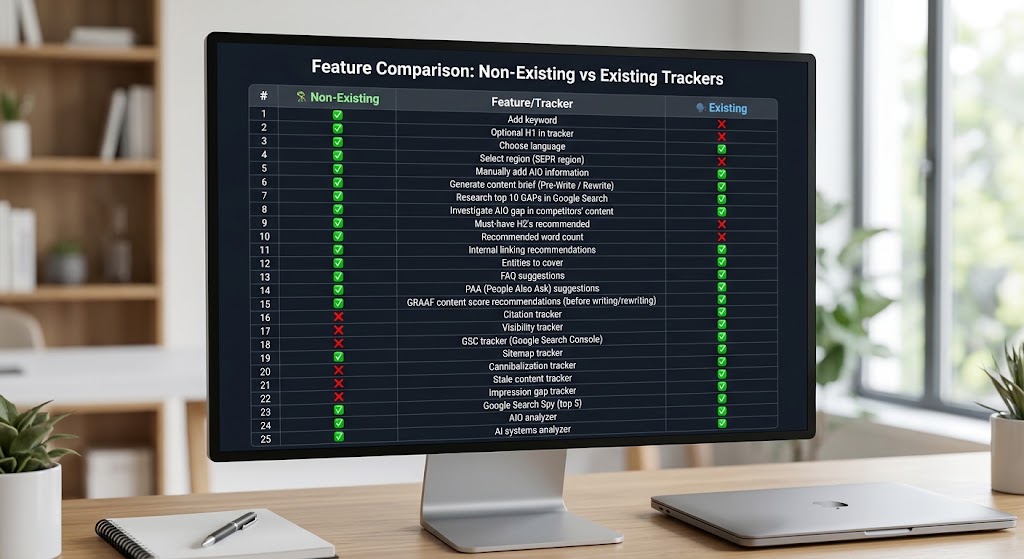
For pages already published, the AI Citations Tracker runs ten dedicated trackers against the live page: Citation Tracker (Google AIO, Perplexity, Copilot), Visibility Tracker, GSC Tracker, Cannibalization Tracker, Stale Content Tracker, Impression Gap Tracker, Sitemap Tracker, Google Search Spy (top 5), AIO Analyzer and AI Systems Analyzer. These feed a rewrite brief — a prioritised, ready-to-paste fix list per page showing exactly what to change and where in the HTML.
Fastest ROI: pages already ranking but not cited. The ranking proves relevance — the trackers diagnose why the citation is missing.
How I Work: a Work Log You Can Read, Not a Black Box
Most GEO work is a black box: you pay, something happens, a report arrives with numbers you can’t check. I work the opposite way. For every page I optimise I keep a work log you’re welcome to read — you don’t have to, but it exists so nothing is hidden. Each page gets a card with five blocks:
- GRAAF scan — before: the starting score (0–100) and the specific gaps, in priority order. Reproducible with the free GRAAF ContentScore scanner.
- The brief: what I decided to do before writing — search intent, the gap to close, entities and questions to cover.
- What I did: my decisions in plain language, including what I deliberately chose not to do (for example, skipping a claim I couldn’t verify).
- What changed, exactly: the heading added, the schema, the internal links.
- GRAAF scan — after: the new score, and what moved and why.
Think of it like a doctor’s note: you get a clear record of what was found, what was done, and the result. The full technical file exists too — I show it in complete detail the moment you ask “what exactly did you change?” Others promise transparency; I give you a log you can verify, with every number reproducible in the scanner.
For pages that don’t yet exist, the GRAAF AIO Brief is generated before a word is written. You add a keyword, optional H1, language and SERP region, manually paste the current AI Overview — the system then researches the top 10 Google content gaps, investigates what AIO, Perplexity and Copilot cite that competitors miss, and outputs a structured spec: must-have H2s, recommended word count, entities to cover, PAA clusters, FAQ targets, internal linking recommendations and a GRAAF ContentScore target before publishing.
Prevents the gap from existing: the brief builds citation-readiness in before drafting starts, not as a fix after.
The AI Citations Tracker — existing pages show citation status per platform (Google AIO, Perplexity, Copilot) alongside the 10 tracker outputs that feed the rewrite brief.
| Existing content | New content | |
|---|---|---|
| Starting point | Live published URL | Keyword + language + SERP region |
| Primary tool | AI Citations Tracker (10 trackers) | GRAAF AIO Brief (Pre-Write) |
| GRAAF score | Before rewrite — baseline of live page | Target score set before writing starts |
| Brief output | Ready-to-paste HTML fix list per page | H2 structure, word count, entities, FAQs, PAAs, schema spec |
| Citation tracking | Live — before and after rewrite | Starts after publishing |
Most engagements start with existing content — the trackers identify which published pages are already close to citation-ready and need the smallest intervention for the fastest result. New-content briefs then fill the topic gaps that no existing page covers. Both use the same underlying GRAAF methodology; the difference is whether the score measures a live page or sets a target for a page not yet written.
“Treating GEO as a one-time content tweak is the biggest mistake you can make. GEO demands the same ongoing discipline as SEO — AI engines weigh recency when selecting sources, and a guide published in 2024 with no updates loses ground to a 2026 article on the same topic.”
— Search Engine Land, Mastering GEO in 2026
Key point: You can verify both tracks yourself before committing to an engagement. Run any existing URL through the free AI Citations Tracker to see citation status and the first fix recommendations. For new content, the GRAAF ContentScore scanner shows what a finished page must score before publishing — no black box, no guesswork.
Check Your Current Citation Status — Free
Before any engagement, I recommend checking where your brand actually stands across AI platforms. The tracker takes 60 seconds and shows YES/NO citation status for Google AI Overviews, Perplexity and Copilot.
→ Run the Free Citation CheckOr talk to me directly: WhatsApp +31 6 2807 3996 · Amsterdam, NL
Who I Work With
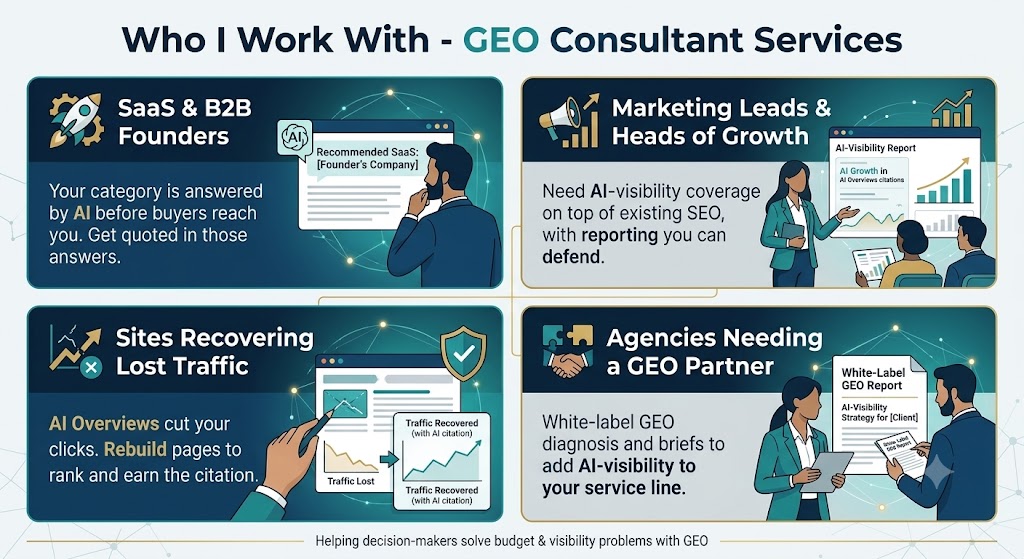
I work one-on-one with decision-makers who have a measurable visibility problem and want to understand exactly what’s being done to fix it — not a black-box retainer. These situations fit best:
Your category is already being answered by AI before buyers reach you. Getting quoted in those answers is now part of the buying process.
You need AI-visibility reporting you can defend to leadership — not vague “brand awareness” claims with no before/after data.
AI Overviews reduced your organic clicks. The fix is ranking in Google and earning the citation in the AI answer above — not picking one or the other.
White-label GEO audits, GRAAF scoring and citation briefs — so you can offer AI-visibility services without building new methodology in-house.
What a 90-Day Generative Engine Optimization Engagement Delivers
A GEO engagement is a systematic citation loop: measure the gap, diagnose why competitors get cited instead, ship the changes, and verify the result. Here’s exactly what that includes:
- AI-visibility audit (Week 1–2). Citation check across Google AI Overviews, Perplexity and Copilot for your priority queries — where your brand appears, where competitors are quoted instead, and the specific signals causing each gap.
- GRAAF scoring (Week 2–3). Every priority page scored on 100 points using the GRAAF Framework. You receive the scores with line-by-line fix priorities — not a vague list of “recommendations.”
- Entity & schema remediation (Week 3–6). Entity consistency, structured data and author attribution updated on priority pages. This is the technical foundation that AI retrieval systems evaluate first.
- Citation-ready content passes (Week 4–8). Direct-answer passages, FAQ schema, sourced statistics and structured H2 architecture added so pages fit the citation format AI systems prefer. This is where existing content gets its GEO fix.
- AIO Briefs for new content gaps (Week 6–10). For queries where you have no page at all, I produce GRAAF AIO Briefs — structured content briefs your writer or AI tool follows to produce citation-ready pages from the first draft.
- Weekly citation tracking & monthly report (ongoing). Before/after citation frequency and sentiment tracked weekly. Monthly report shows the data — no traffic chart substitutes, just citation movement on the platforms that matter.
💰 Independent Consultant Pricing Context
Full-service GEO agencies typically quote €7,000–€25,000/month with junior staff executing. A senior in-house “Head of AI Search” runs €160,000–€250,000/year. As an independent consultant you get senior implementation directly — scoped to the pages that matter. Pricing depends on the number of priority pages and platforms. View services & enquire here or WhatsApp me directly.
GEO & AI Search Statistics — 2025–2026
~68% of U.S. Google searches end without a click — AI answer boxes, ChatGPT and Perplexity intercept queries before users reach organic results. (SparkToro / Bain, 2026)
25% projected drop in traditional search volume by 2026 — Gartner attributes this shift to AI chatbots and virtual agents absorbing commercial queries. (Gartner, 2025)
Up to 40% citation-lift with targeted GEO optimization — The Princeton study demonstrated that citing sources, adding statistics and quoting experts produced the highest measurable improvement in AI-generated source citation. (Aggarwal et al., Princeton / Georgia Tech / IIT Delhi, 2023)
94% of B2B buyers use generative AI during purchase research — AI search is no longer a consumer novelty; it’s the dominant discovery channel for B2B commercial intent. (6sense Buyer Experience Report, 2025)
AI search queries average 23 words vs. 4 words for traditional Google — longer, conversational queries mean AI systems need deeper topical coverage from cited sources, not short keyword-matched pages. (Andreessen Horowitz, via Geoptie, 2026)
Google AI Overviews appear in 15–60% of searches — coverage varies by query type and region, but for commercial and informational queries — the exact queries your buyers use — AI Overview presence is now the norm, not the exception. (Semrush, 2026)
What the Research Says
“GEO strategies focus on expanding a brand’s semantic footprint, improving fact-density, and enhancing structured data signals so that AI systems can retrieve and cite that content with confidence.”
— Go Fish Digital, Generative Engine Optimization Strategies, 2026
“AI engines strongly favor earned media — authoritative third-party sources — over brand-owned content. Understanding this dynamic isn’t optional. It’s the foundation of any effective GEO strategy.”
— Search Engine Land, Mastering GEO in 2026
“Being cited is not the same as being chosen — that distinction is essential to credible GEO measurement. Citation frequency tells you how often you appear; citation sentiment tells you whether it’s helping or hurting.”
— Profound / Lily Ray, Top GEO Experts, 2026
The 48-Hour Plan to Get Cited by AI
I’ve published a step-by-step plan that walks through every phase: AI citation audit → entity fix → GRAAF scoring → citation tracking loop. It uses the free tracker and scanner at every step.
→ Open the Free 48-Hour PlanGenerative Engine Optimization Consultant — 8 Questions People Ask
Ready to get cited by AI?
Start with a free citation check — or message me to discuss your brand’s AI visibility gap and what it would take to close it.
💬 WhatsApp Ottmar → Free citation checkOr email info@contentscale.site · Services & enquiry page
📚 Related
- The GRAAF Framework — the full 100-point methodology behind every GEO engagement.
- Free AI Citations Tracker — check your page’s citation status across AI platforms, free, in 60 seconds.
- What is an AI Overview? — how Google selects and cites sources in AI-generated answers.
- Case Study: CTR Recovery — documented Google Search Console data showing ranking and CTR improvement over 90 days.
- 48-Hour Plan to Get Cited by AI — step-by-step: audit, entity fix, GRAAF score, citation tracking loop.
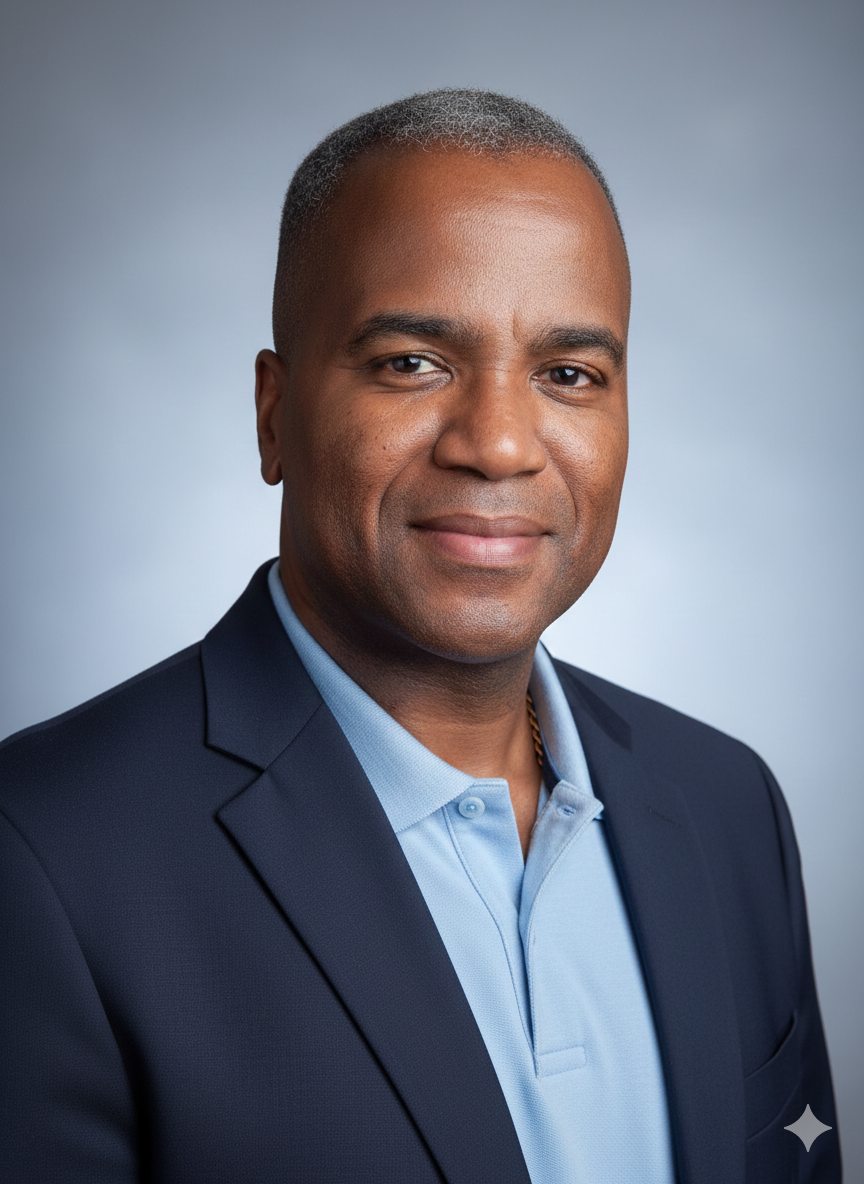
GEO Consultant — Ottmar J.G. Francisca · Independent SEO & GEO Consultant · GRAAF Framework Creator · Amsterdam, NL
I’m an independent consultant with 24+ years in systems and operations management (formerly City of Amsterdam) and SEO experience across 200+ websites. I specialize in Technical SEO, AI Search Optimization (GEO/AEO), and Local SEO. I created the GRAAF Framework after analysing 200+ traffic recovery cases — it’s the method I use on every page I work on, including this one. SEO professionals from 47 countries use ContentScale.
Verified: linkedin.com/in/ottmar-joseph-gregory-francisca
Free tool: app.contentscale.site — GRAAF ContentScore scanner, free.
Last reviewed: August 2026 · WhatsApp +31 6 2807 3996 · LinkedIn
Content scored and optimised with the GRAAF Framework by Ottmar J.G. Francisca · contentscale.site