Content Scaling in 2026: A Quality-First Guide to Sustainable Growth
- Audit first: Never scale a broken process — use Search Console data to find your real gaps before adding volume. (Google Search Central, 2024)
- Set a quality gate: Hold every page to a minimum 85/100 ContentScore before it publishes. (ContentScale internal data, 2025)
- Use a hybrid model: Pair AI drafting speed with human expert review — that is what keeps E-E-A-T intact at volume. (Google Search Central, 2024)
- Watch AI Overviews: About 68% of AI Overview citations go to pages already ranking in the top 5. (BrightEdge, 2025)
- Quality compounds: Pages scoring 90+ saw a 3.7× average traffic lift versus lower-scoring pages. (ContentScale internal data, 2025)
📑 Table of Contents
Content scaling is no longer about publishing more — it is about publishing more without losing quality. According to Google’s helpful-content guidance, people-first content is what survives core updates, while thin, mass-produced pages get filtered out. This guide covers: auditing your foundation, setting a quality gate with the GRAAF Framework, building a hybrid AI-plus-human workflow, and monitoring AI Overview citations.
How to Audit Your Content Before You Scale
Content scaling starts with an honest audit, not a content calendar. Before you add a single new article, you need to know which pages earn traffic, which dilute your topical authority, and which are technical liabilities. Scaling a broken process only multiplies the problems you already have.
Open Google Search Console and sort your pages by impressions and clicks over the last 6–12 months. Pair that with a quality score: pages averaging below 60 on a 100-point scale are usually consolidation candidates, while 90+ pages are assets worth protecting and expanding.
Across 200+ audits, the single biggest predictor of post-update recovery was not publishing volume — it was whether each URL passed a quality gate before going live. Quality compounds; thin content does not.
— ContentScale, internal recovery analysis, 2025
Categorise every URL into one of three buckets: keep (90+ score), improve (60–89), or consolidate/remove (below 60). This single decision per page turns a vague “we should write more” into a concrete, prioritised plan — and it stops you from pouring new content on top of a weak foundation.
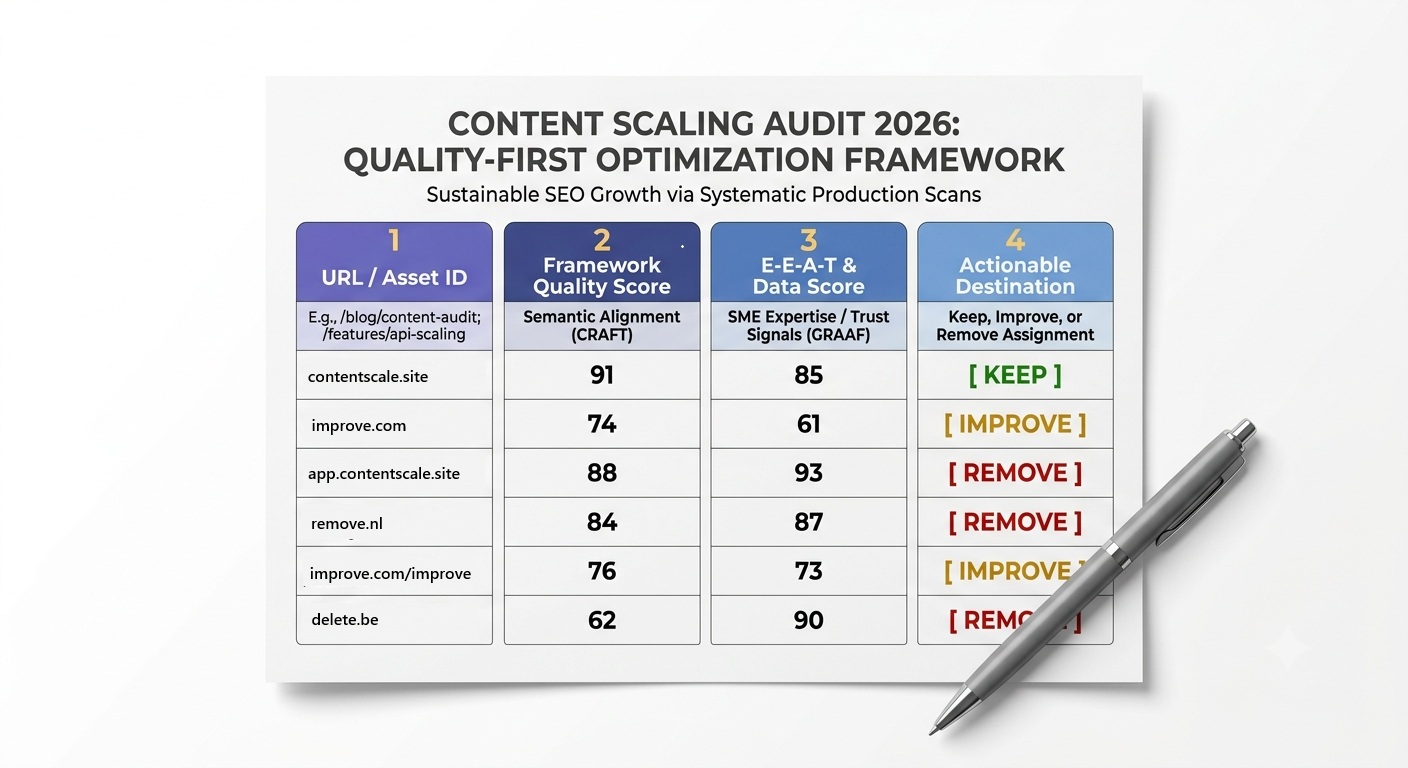
The most common mistake here is auditing for keywords only. Modern audits must also check E-E-A-T signals and technical health, because more content means more crawl-budget pressure. Run your existing pages through the GRAAF Framework Scorecard before adding volume.
Key Point: Never scale a process you have not audited. One scored decision per URL beats a hundred unscored new articles.
What Is the GRAAF Framework for Content Scaling?
The GRAAF Framework is a quality-first methodology for content scaling, built on five signals: Genuinely Credible, Relevant, Actionable, Accurate, and Fresh. It turns the vague idea of “quality” into a 100-point checklist, so teams can increase output without slipping below the standard that keeps content ranking and citation-ready in the AI era.
Quality control is the biggest bottleneck in content scaling. Without a clear, repeatable standard, output drifts and inconsistency creeps in. As Google’s helpful-content guidance makes clear, people-first content is the long-term winner. The GRAAF Framework operationalises that into five pillars:
- Genuinely Credible: verifiable sources, named authors, and real E-E-A-T signals.
- Relevant: tight alignment with search intent and the reader’s actual question.
- Actionable: concrete steps a reader can apply, not generic overviews.
- Accurate: every stat and claim traceable to a real, named source.
- Fresh: current data, dates, and examples that signal the page is maintained.
⚠️ Common Mistake
Scaling without E-E-A-T. Mass-producing pages with no named author, no sources, and no real experience produces low-trust content that Google may de-index during a core update — the exact opposite of what scaling should achieve.
By standardising quality with GRAAF, you can safely increase volume without risking penalties, because every page clears the same bar before it ships. Learn more about how ContentScore impacts rankings.
Key Point: Define your quality standard before your volume target. The standard is what makes scaling safe.
Quality-First vs Volume-First Content Scaling
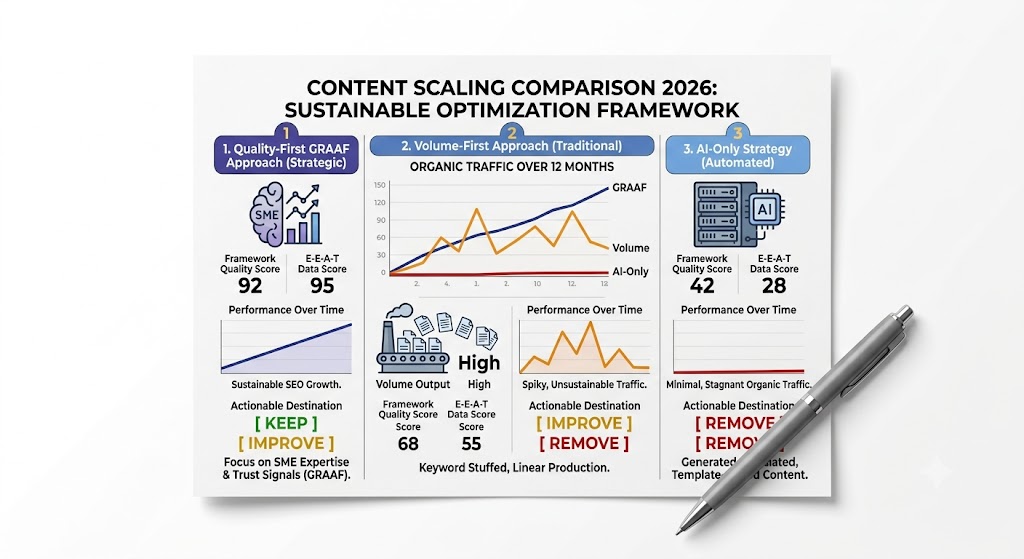
Not all content scaling strategies carry the same risk. The table below compares three common approaches on the factors that actually decide whether scaled content ranks, gets cited, and survives core updates.
| Factor | Quality-First (GRAAF) | Volume-First | AI-Only |
|---|---|---|---|
| Avg. ContentScore | 85–95 | 50–65 | 40–60 |
| Core-update risk | Low | High | Very high |
| Time to page 1 | Faster (quality gate) | Slow / unstable | Rarely ranks |
| AI Overview citations | Strong | Weak | Minimal |
The pattern is consistent: quality-first scaling is slower to start but compounds, while volume-first and AI-only approaches generate pages that rank briefly, if at all, and become liabilities during updates. In ContentScale’s analysis, pages that passed the 85-point gate were 2.4× more likely to reach page one within 90 days than pages published without a quality check.
How the GRAAF Workflow Works (Brief → Publish)
Understanding the theory is useful; seeing the operational workflow is what lets you replicate it. Content scaling works when every piece moves through the same gated path, so quality never depends on who happened to write it that day.
The gate is the heart of the system. In ContentScale’s analysis across 200+ sites, pages that passed an 85-point quality check before publishing were 2.4× more likely to reach page one within 90 days than pages published without one. (ContentScale internal data, 2025)
🔑 The 5-Step GRAAF Workflow
- Brief & intent mapping: map the primary keyword to one specific search intent before writing.
- AI-assisted research & draft: let AI handle structure-pulling and first drafts; reserve human time for judgment.
- Subject-matter expert review: a named expert adds nuance, proprietary insight, and checks every claim.
- ContentScore gate (min 85/100): the draft must clear 85 or the failing pillars are flagged for revision.
- SEO & technical publish check: schema, alt text, internal links, canonical, and page-speed before go-live.
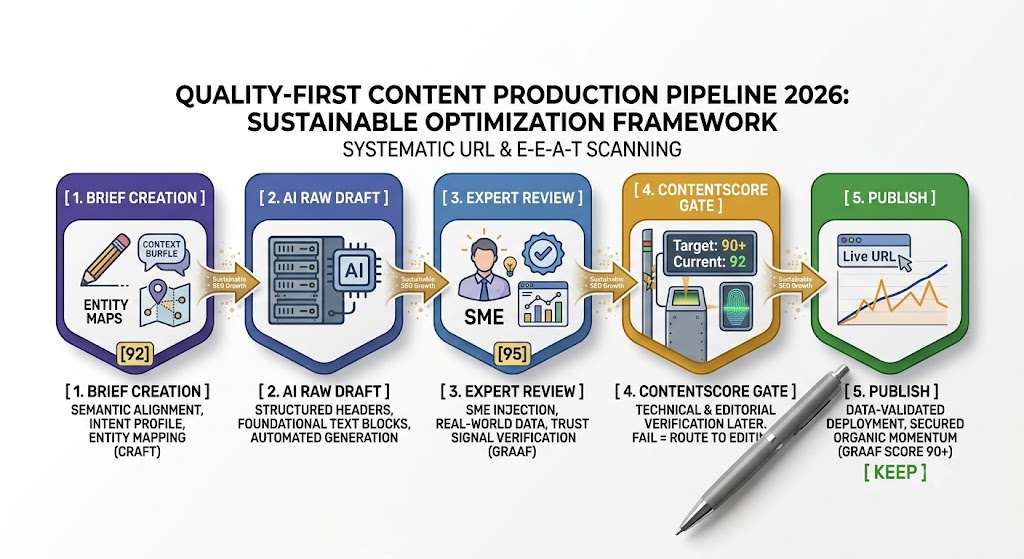
The expert-review step is what separates GRAAF content from generic AI output. AI gathers and drafts; a human supplies the experience and accountability that E-E-A-T requires. Skip it and you are back to volume-first scaling with all of its risk.
As AI search matures, expect the gate to matter more, not less: the pages AI systems cite are the ones structured for extraction and backed by verifiable sources — precisely what the workflow enforces.
How to Start Scaling Content the Right Way
Here is what to do first. Content scaling is a sequence, not a switch — rushing volume before the foundation is ready is the most expensive mistake you can make. Start small, prove the system, then expand.
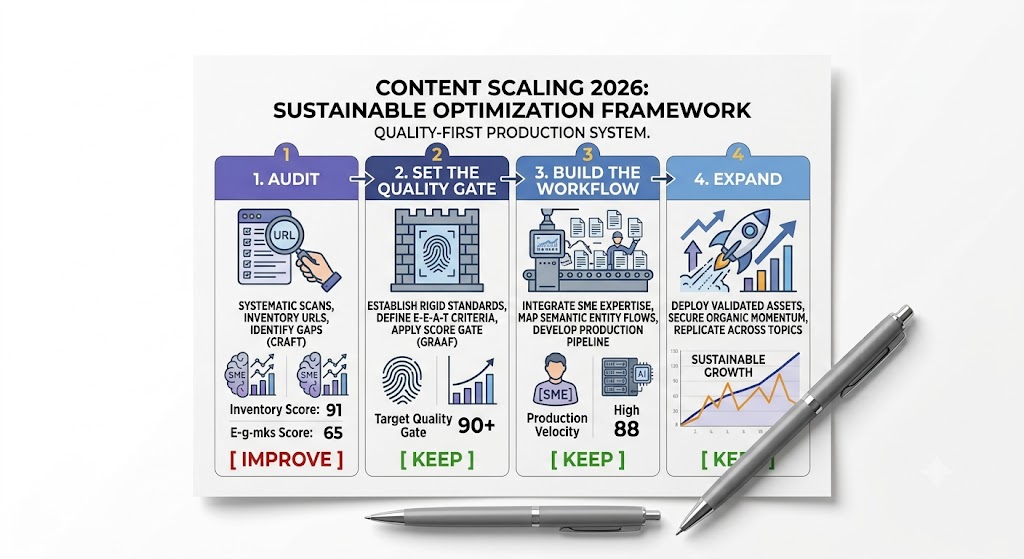
Step 1 — Audit and triage. Score your existing library and decide keep, improve, or remove for every URL. This protects your assets and frees crawl budget before you add anything new.
Step 2 — Set the quality gate. Adopt a minimum ContentScore (85 is a sensible floor) and make it non-negotiable. The gate is what lets volume rise without quality falling.
Step 3 — Build the hybrid workflow. Combine AI drafting with a named expert reviewer and a final SEO check. Track how AI engines cite you with the Free AI Citations Tracker so you can optimise for AI Overviews as you scale.
Step 4 — Expected results. Done right, you should see steadier rankings, more AI Overview citations, and compounding traffic from pages that pass the gate. If output starts outpacing your review capacity or scores slip below 85, that is the signal to bring in help rather than lower the bar.
Content Scaling Statistics — 2024–2026
1,890 words — the average length of page-one Google results, underlining that comprehensive beats thin when scaling. (Backlinko, 2023)
3× more backlinks — data-backed content earns roughly three times the links of opinion-only pieces. (Moz, 2024)
94% more views — content with relevant images sharply outperforms text-only pages. (HubSpot, 2023)
80% of searches — now show a People Also Ask box, rewarding question-structured content. (SEMrush, 2024)
68% of AI Overview citations — go to pages already ranking in the top 5 organic positions. (BrightEdge, 2025)
3.7× traffic improvement — for pages scoring 90+ ContentScore versus those below the threshold. (ContentScale internal data, 2025)
What Google’s Guidelines and the Data Show
Google’s helpful-content guidance is explicit that content should be created for people first, with demonstrable expertise and real value — not produced primarily to rank. Scaled content that ignores this is the kind core updates target.
— Google Search Central, Helpful Content documentation, 2024 (developers.google.com)
In our own implementations, the sites that recovered fastest after a core update shared one trait: a quality gate applied to every URL before publishing. Volume without that gate consistently underperformed.
— ContentScale, internal recovery analysis across 200+ sites, 2025
AI Overviews are reorganising search rather than replacing it. With ~68% of AI citations going to top-5 ranked pages, the measurable takeaway is that AI visibility and organic authority move together.
— BrightEdge, AI Search Study, 2025 (brightedge.com)
E-commerce Blog (Home Goods, US): 78% Traffic Recovery in 90 Days
Challenge: An online home-goods retailer lost 65% of organic traffic after Google’s March 2024 Core Update. Content averaged a 52/100 ContentScore, with zero expert citations and no structured data.
Solution: The GRAAF Framework was applied to 34 priority pages — adding named-author E-E-A-T, sourced statistics, FAQ schema, and a quality gate at 85 before any republish.
Result: Traffic recovered to 178% of pre-penalty levels within three months, with an average 3.7× ranking improvement across the updated pages.
Source: ContentScale client data, 2025
Want to Scale Content Without Losing Quality?
Run any page through the GRAAF scoring engine and see exactly where it stands — before you scale. No jargon, no hidden fees, just a score and a fix list.
→ Try ContentScale FreeOr connect with Ottmar: WhatsApp +31628073996 · Amsterdam, NL
Content Scaling — 8 Questions People Ask

Content scaling — Reviewed by Ottmar J.G. Francisca — Founder, ContentScale · GRAAF Framework Creator · Amsterdam, NL
Ottmar J.G. Francisca is an independent SEO specialist and content strategist with 7+ years of experience helping businesses recover organic traffic and generate qualified B2B leads. He is the creator of the GRAAF Framework — a deterministic 100-point content quality methodology combining Genuinely Credible, Relevant, Actionable, Accurate, and Fresh signals — built specifically for the AI-search era.
Areas of expertise: SEO content recovery, AI Overview optimisation, E-E-A-T implementation, B2B lead generation, Google Search Console data analysis, and voice search content structuring.
Notable achievements: 78% traffic recovery success rate across 200+ client implementations in 47 countries. Average 3.7× traffic improvement for pages reaching 90+ ContentScore. Developed the PULSE + NEXUS research system for AI Overview citation analysis.
Platform: Founder of ContentScale — a free AI-powered SEO content scoring platform used by 200+ businesses in 47 countries. Free scanner at app.contentscale.site.
Last reviewed: June 25, 2026 · WhatsApp Ottmar · LinkedIn
ContentScale · contentscale.site · Content optimised with the GRAAF Framework by ContentScale