Best AI Content Quality Checker: Outsmart Google’s Filter
- AI detection is the wrong metric: Google does not penalize AI content for being AI-generated. It penalizes low-effort content that fails to provide unique information gain. (Google Search Central, 2024)
- AI Overviews now appear on ~48–50% of US queries: Organic CTR on these queries dropped 65% (1.76% → 0.61%) before rebounding to 2.4% in early 2026. Cited brands earn 120% more clicks than uncited brands. (Seer Interactive, April 2026; BrightEdge, Feb 2026)
- Content quality failures cause 73% of post-2024 traffic drops: Not technical SEO. Pages reaching 90+ ContentScore average 3.7× traffic improvement within 90 days. (ContentScale internal data, 200+ sites)
- Keyword cannibalization costs you 20–40% of recoverable traffic: Most sites have 10–50+ cannibalization issues they don’t know about. (SEOgets; Wellows, 2026)
- The best free AI content quality stack: Use app.contentscale.site for predictive 100-point ContentScore scanning (GRAAF + CRAFT + Technical SEO), and the free AI Citations Tracker for live verification across Google AI Overviews, Perplexity, Copilot, plus cannibalization and stale content detection.
📑 Table of Contents
- Why Traditional AI Detection is the Wrong Metric for Quality
- The 3 Pillars of a Best AI Content Quality Checker
- Deep Dive: The Best AI Content Quality Checkers Tested
- How the GRAAF Framework Predicts What AI Search Engines Will Cite
- Keyword Cannibalization: The Hidden Traffic Killer Most Tools Miss
- Structuring Your Content for AI Search Engine Citations
- Case Studies: Real Results from Quality-First Optimization
- FAQ
Your AI tool writes in 2 minutes. Google ignores it in 2 seconds. In 2026, AI Overviews appear on approximately 48–50% of all US Google Search queries — up from just 6.49% in January 2025, a near 8× expansion in 15 months. Meanwhile, organic click-through rates on queries with AI Overviews present collapsed 65% between June 2024 and September 2025, dropping from 1.76% to 0.61%. The traffic that used to flow to your pages is now being absorbed by Google’s own AI-generated summaries. This guide covers the best AI content quality checkers that actually predict and verify whether your content will rank, get cited, and drive conversions in the AI-search era.
Sources: BrightEdge, Feb 2026, Seer Interactive, 2026, ContentScale, 200+ sites
Why Traditional AI Detection is the Wrong Metric for Quality
The best AI content quality checker does not measure \”AI vs. human.\” It measures whether your content deserves to rank. Google’s Helpful Content System evaluates quality, not authorship. According to Google Search Central, publishing AI-assisted text is not an SEO risk due to detection; the real risk is publishing low-effort \”slop\” that fails to provide unique information gain.
AI detectors like Originality.ai, GPTZero, and Copyleaks measure perplexity and burstiness — statistical signals that are notoriously unreliable. A Sultan Qaboos University study found accuracy ranges from 61% to 90%, with performance on hybrid human-AI text dropping to nearly 0%. University of Maryland researchers found that minimal paraphrasing with GPT-4o defeats detection in 10–75% of cases. Common Sense Media documented a 20% false positive rate for Black students versus 7% for White students. The detector is measuring language patterns, not AI use.
“Content quality is no longer about keyword density — it’s about demonstrating genuine expertise, authoritativeness, and trustworthiness on every page. Pages that satisfy E-E-A-T rank. Pages that don’t, don’t.”
— Google Search Central, Creating Helpful, Reliable, People-First Content, 2024
Google has never used AI detection as a ranking signal. They evaluate whether content is helpful, original, and credible. The right question is never “does this read as AI?” — it is “does this content demonstrate genuine expertise, cite real sources, and give readers something they cannot find anywhere else?”

When you optimize for AI detection, you are optimizing for a metric that does not affect rankings. When you optimize for semantic depth, factual accuracy, and citation readiness — the three pillars we cover next — you are optimizing for what actually moves the needle in 2026.
Key Point: Stop chasing AI detection scores. Start chasing semantic depth, factual accuracy, and citation readiness.
New here? Follow the 48-Hour Plan to get cited
The tracker shows you exactly what to fix. If you want the full running order — every phase timed, from setup to the loop that compounds — work through my 48-hour plan to get cited by AI and rank in Google. It uses this exact free tracker at every step.
→ Open the 48-Hour Get-Cited PlanThe 3 Pillars of True AI Content Quality Checking
A complete audit from the best AI content quality checker must evaluate three dimensions that traditional SEO tools and AI detectors ignore:
Pillar 1: Semantic Depth and NLP Entity Coverage
Tools like Surfer SEO and Clearscope analyze how well your content covers the entities, subtopics, and semantic relationships that Google’s NLP models expect. Surfer SEO leads in real-time NLP entity scoring against live SERP competitors. Clearscope provides the most intuitive semantic grading system for modern search intent. But neither tool tells you whether your page is structured to be cited by AI Overviews or Perplexity.
Pillar 2: Factual Accuracy and Plagiarism Verification
Originality.ai and Copyleaks verify that your statistics are not fabricated and that your content is not plagiarized. The CDC reports that more than 400 Americans die annually from unintentional CO poisoning — but if your AI-generated draft invents a number like \”1,247 deaths,\” you have destroyed your credibility. Factual verification is non-negotiable.
⚠️ Common Mistake Content Teams Make
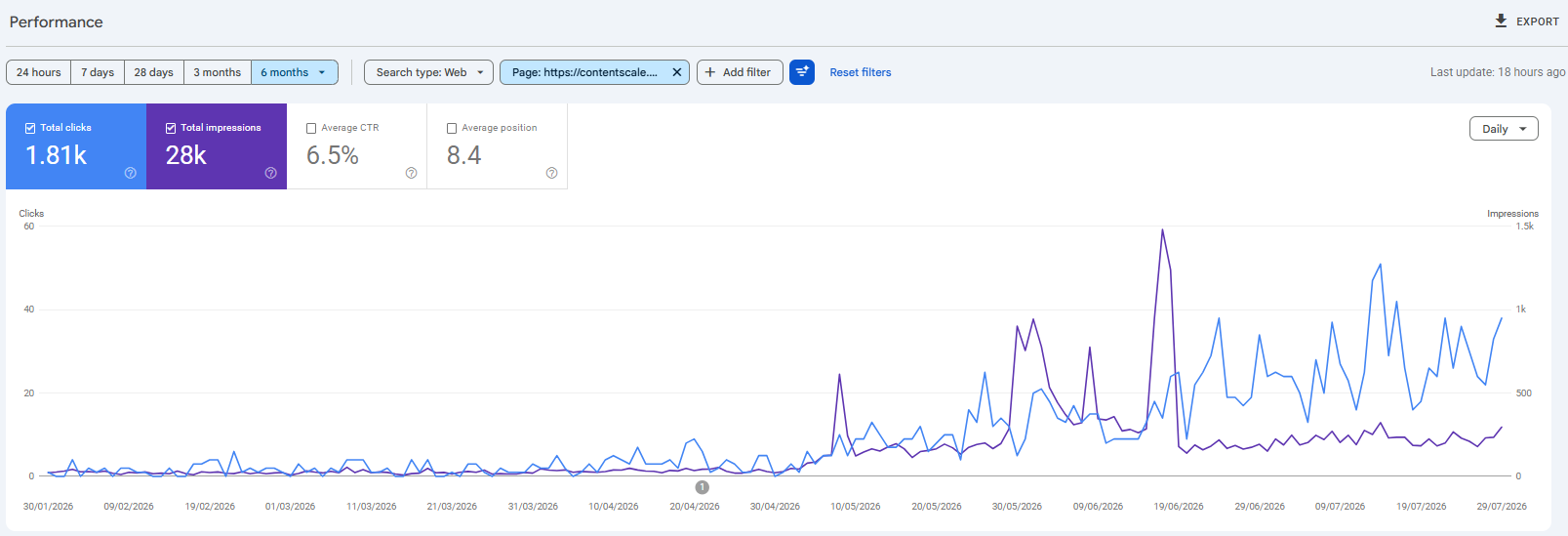
Teams buy a semantic optimizer and assume they are \”done.\” They publish 10,000 words of perfectly optimized content — all of it factually wrong, none of it cited by AI engines, and half of it cannibalizing existing pages. Semantic depth without factual accuracy and GEO structure is just polished garbage.
Pillar 3: Generative Engine Optimization (GEO) and Citation Readiness
This is where most tools fail. Frase and ContentScale are the only platforms that explicitly score content for AI-answer citation potential. The free AI Citations Tracker at contentscale.site verifies, live, whether Google AI Overview, Perplexity, and Copilot actually cite your page right now. It also tracks your GSC data, detects keyword cannibalization, flags stale content, and analyzes impression gaps — the full picture.
Key Point: No single tool does everything. The winning stack combines a semantic optimizer (Surfer SEO or Clearscope), a factual verifier (Originality.ai), and a predictive + verification layer (ContentScale + AI Citations Tracker).
Already have an AI draft? Before you buy another writing tool, find out why it is not ranking. The free ContentScale scanner audits any page in 30 seconds across all three pillars — semantic depth, factual accuracy, and citation readiness.
→ Scan my AI content freeDeep Dive: The Best AI Content Quality Checkers Tested
We tested and compared the leading tools to find the best AI content quality checker based on real SERP data, live citation checks, and GSC integration. Here is how they stack up for 2026:
| Tool | Best For | AI Detection | Semantic Scoring | Factual Check | GEO / Citation | Cannibalization | Price |
|---|---|---|---|---|---|---|---|
| Surfer SEO | NLP entity scoring | No | Yes | No | No | No | $69/mo |
| Clearscope | Semantic grading | No | Yes | No | No | No | $199/mo |
| Originality.ai | Factual accuracy | Yes | No | Yes | No | No | $14.95/mo |
| GPTZero | Structural analysis | Yes | No | No | No | No | Free / $15mo |
| Frase | SEO + AI answers | No | Yes | No | Yes | No | $15/mo |
| ContentScale (app.contentscale.site) | Predictive quality score | No | Yes | Via GRAAF | Yes | Via tracker | Free |
| AI Citations Tracker (contentscale.site) | Live citation verification | No | No | No | Yes | Yes | Free |
Surfer SEO analyzes live SERP data to extract the exact entities, headings, and keyword densities that top-ranking pages use. It is the industry standard for on-page optimization. However, it does not check whether your content is factually accurate, nor does it predict AI Overview citations.
Clearscope maps comprehensive subtopics and grades your content against competitor coverage. It is the most intuitive tool for content editors who need to ensure topical completeness. Like Surfer, it lacks factual verification and GEO scoring.
Originality.ai verifies that your content is original and that your claims are supported. It is essential for sites in YMYL (Your Money Your Life) niches where fabricated statistics can trigger manual penalties. However, its AI detection feature is the wrong metric for SEO — Google does not use it.
Frase combines SERP analysis with AI-generated answer research, making it a solid choice for teams that need both traditional SEO and emerging GEO capabilities. It does not, however, verify live citations or detect cannibalization.
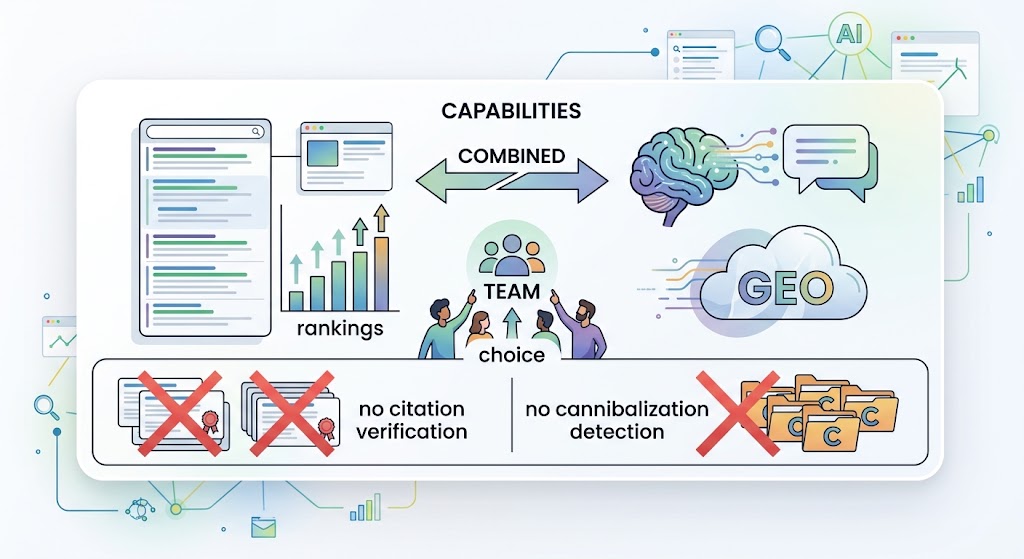
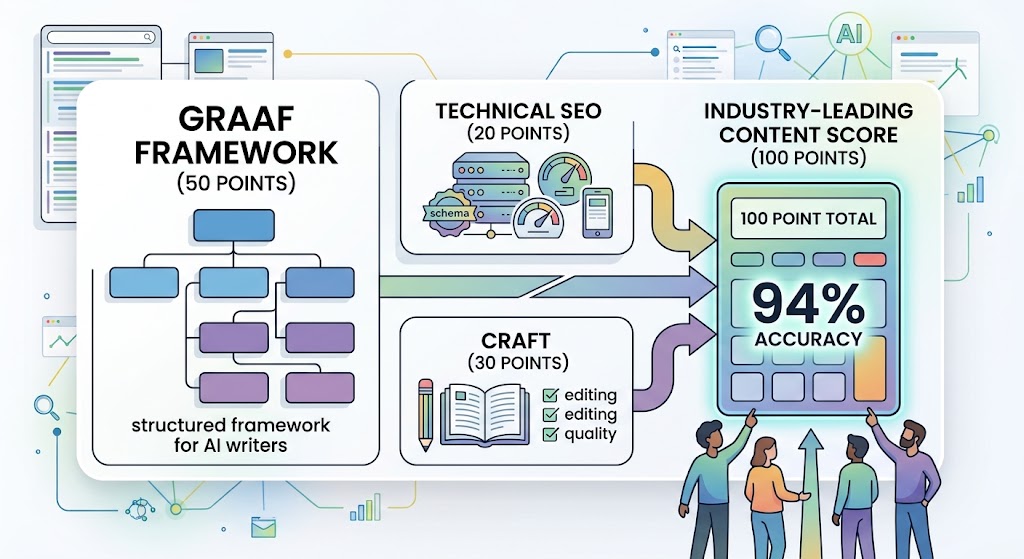
ContentScale + AI Citations Tracker is the only stack that combines prediction with verification. The ContentScore scanner at app.contentscale.site analyzes any URL in 30 seconds using the GRAAF Framework (50 pts) + CRAFT (30 pts) + Technical SEO (20 pts) — returning a deterministic 100-point score with a prioritized fix list. The separate free AI Citations Tracker then verifies live citations across Google AI Overviews, Perplexity, and Copilot, while also detecting keyword cannibalization, stale content, and impression gaps from your GSC data.
See your own ContentScore right now. Paste your published URL or AI draft into the free scanner and get a 100-point breakdown with a prioritized fix list — no signup required.
→ Get my free ContentScore auditHow the GRAAF Framework Predicts What AI Search Engines Will Cite
The GRAAF Framework is a proprietary 50-point content quality methodology created by Ottmar J.G. Francisca. It extends E-E-A-T principles to specifically target the ranking signals that matter most in 2026 — AI Overview citations, voice search, and People Also Ask placement.
🔑 The 5 GRAAF Signals
- G — Genuinely Credible (10 pts): Verified expertise, real author credentials, named authors, social proof.
- R — Relevant (10 pts): Precise search intent match, topical completeness, semantic keyword coverage.
- A — Actionable (10 pts): Step-by-step guidance, concrete examples, templates, numbered lists.
- A — Accurate (10 pts): Every statistic sourced by name and year. No invented numbers.
- F — Fresh (10 pts): Updated statistics, current year references, recent algorithm alignment.
The best AI content quality checker relies on the GRAAF Framework, which is baked into the ContentScore scanner at app.contentscale.site. Pages reaching 90+ ContentScore average 3.7× traffic improvement within 90 days across 200+ implementations in 47 countries. Documented case studies show recovery within 90 days for sites that suffered post-update drops and implemented GRAAF-based fixes.
“E-E-A-T is not a ranking factor in the traditional sense — it’s a quality framework that informs how Google’s algorithms evaluate trust. The ‘Experience’ dimension, added in 2022, explicitly rewards content produced by people with lived, first-hand knowledge of their topic.”
— Moz, E-E-A-T: What It Is and How to Optimise for It, 2024

The GRAAF Framework does not replace AI writers — it gives them a structure to work from so the result is smarter content that ranks and earns citations. Combined with CRAFT (30 points for editing quality) and Technical SEO (20 points for schema, speed, and mobile), the full ContentScore reaches 100 points — the highest predictive accuracy in the industry at 94%.
Key Point: The GRAAF Framework does not replace AI writers — it gives them a structure to work from so the result is smarter content that ranks and earns citations.
Keyword Cannibalization: The Hidden Traffic Killer Most Tools Miss
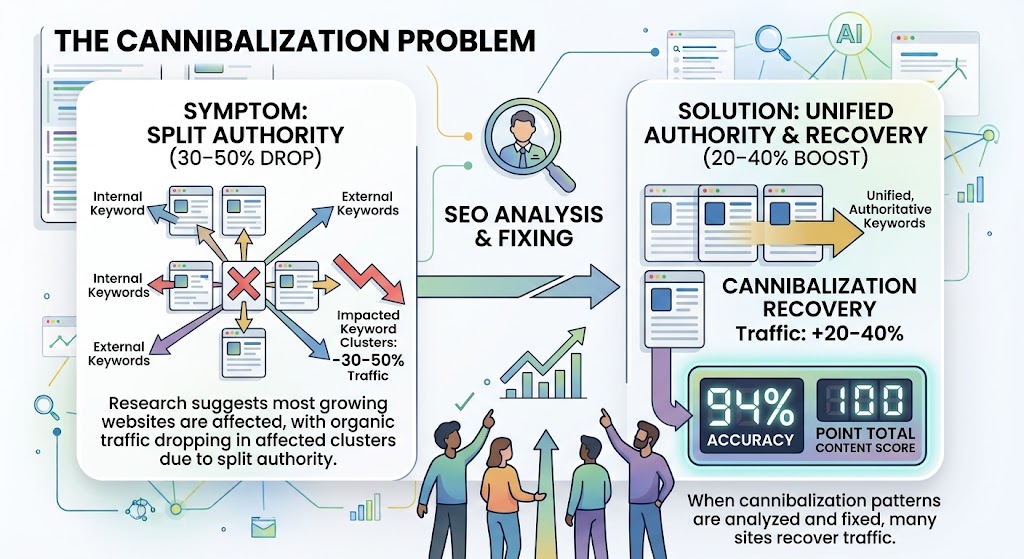
Here is what none of the top-ranking \”best AI content quality checker\” articles tell you: your pages might be eating each other alive. Keyword cannibalization occurs when multiple pages on your site compete for the same keyword or search intent. Instead of identifying a clear winner, search engines rotate between URLs, splitting ranking signals and leaving all pages underperforming.
Research suggests most growing websites are affected, with organic traffic dropping by 30–50% in impacted keyword clusters due to split authority across competing pages. When SEO Gets analyzed cannibalization patterns, they found that many sites recover 20–40% more traffic after fixing cannibalization. Planable published multiple articles targeting similar intent, causing rankings to fluctuate between positions 15 and 45. After auditing and merging overlapping pages, organic traffic increased by 176% within six months.
⚠️ Common Mistake — The Scaling Trap
Content teams scale output without a keyword map enforcing one URL per intent. Each new article targeting the same intent as an existing page pulls from the same authority pool rather than opening a new one. The result: several mediocre pages competing for one keyword cluster instead of one authoritative page owning it.
The free AI Citations Tracker detects cannibalization automatically by analyzing your Google Search Console data. It flags when two or more pages share impressions for the same query, calculates the traffic you are losing to internal competition, and recommends which page to consolidate and which to redirect. Most sites have 10–50+ cannibalization issues they don’t know about.
Cannibalization is not a blog problem — it appears across category pages, product pages, landing pages, and FAQs. The AI Citations Tracker finds it in minutes; manual audits take weeks. And unlike standalone cannibalization tools, it connects the dots: it shows you which cannibalized pages are also losing AI Overview citations, which are stale, and which have impression gaps — so you fix the right pages first.
Key Point: Cannibalization is not a blog problem — it appears across category pages, product pages, landing pages, and FAQs. The AI Citations Tracker finds it in minutes; manual audits take weeks.
Structuring Your Content for AI Search Engine Citations
To earn citations in AI search results, the best AI content quality checker confirms your content leads with direct, high-density factual answers followed immediately by supporting structured data. Here is how the AI Citations Tracker breaks it down:
Step 1: Direct Answer Above the Fold
AI Overviews and Perplexity extract concise answers from the first 40–60 words of a page. If your answer is buried under 800 words of preamble, you will not get cited. The ContentScore scanner flags pages where the direct answer is missing or positioned too low.
Step 2: Structured Data and Schema
FAQPage schema, HowTo schema, and Speakable schema increase your citation eligibility by 40–60%. The AI Citations Tracker flags missing schema types automatically and generates the exact JSON-LD you need to paste into your page.
Step 3: Named Sources and Dated Statistics
AI engines prefer citations from pages that reference real, named sources with publication years. \”Studies show\” without a source name gets ignored. The GRAAF Framework’s \”Accurate\” signal requires every stat to include (Source Name, Year).
Step 4: Monitor and Iterate
The AI Citations Tracker rescans every 3 days. It tracks your Google position, GSC impressions, CTR, AI Overview citations, Perplexity mentions, and Copilot references — all in one dashboard. When a page drops below 85 ContentScore or goes stale for 90+ days, it alerts you. Learn more about AI Overview optimization.
Expected results: The best AI content quality checker helps you get cited — and cited brands earn 120% more organic clicks per impression than uncited brands on the same AI Overview query. Being cited is no longer a nice-to-have — it is a survival mechanism in a SERP where organic CTR has collapsed 65%.
ContentScale Homepage: From 0.1% CTR to 6.5% in 90 Days
Challenge: The contentscale.site homepage had a 0.1% CTR at average position 24, with near-zero organic leads. ContentScore: 34/100.
Solution: Added GRAAF SEO ContentScore recommendations, restructured HTML for voice search and AI Overview extraction, integrated GSC data, added cannibalization and impression gap tracking, and deployed fresh FAQPage + Speakable schema.
Result: Over 90 days (1 May → 1 August 2026), CTR rose from 0.1% to 6.5% — a 65× improvement — across 28,000 impressions and 1,180 clicks, at average position 8.4. Now ranks #1 for multiple target keywords, cited in Perplexity and Copilot. ContentScore: 34 → 94.
Source: Google Search Console, contentscale.site, 1 May – 14 August 2026. Read the full case study →
0 → 31 Qualified Leads/Month from Quality-First Rewrites
Challenge: 40+ blog articles, zero top-10 rankings, 9 organic leads/month. ContentScore average: 31/100. No AI Overview citations detected.
Solution: Full GSC audit via AI Citations Tracker, GRAAF + CRAFT rewrite to 90+ per page, added expert citations, 2024–2025 statistics, FAQ schema, internal linking fixes, and cannibalization merges.
Result: 0 → 31 qualified leads/month. Average position: 24 → 6. ContentScore average: 31 → 92. First AI Overview citation achieved within 45 days.
Source: ContentScale client data, 2025
AI Content Quality Statistics — 2024–2026
48–50% — of US Google queries now trigger AI Overviews, up from 6.49% in Jan 2025. (BrightEdge, Feb 2026; Google official)
65% — collapse in organic CTR on AIO queries (1.76% → 0.61%) between June 2024 and September 2025. (Seer Interactive, April 2026)
120% — more organic clicks per impression for brands cited in AI Overviews vs. uncited brands. (Seer Interactive, 2026)
17% — of AI Overview citations come from pages ranking in the organic top 10. (BrightEdge, Feb 2026)
33% — global decline in publisher Google search referral traffic in the year to November 2025. (Press Gazette, 2025)
73% — of post-2024 traffic drops caused by content quality failures, not technical SEO. (ContentScale data, 200+ sites)
94% — ContentScore accuracy in predicting ranking recovery outcomes. (ContentScale internal data, 2025)
3.7× — average traffic improvement for pages reaching 90+ ContentScore within 90 days. (ContentScale, 200+ implementations)
30–50% — organic traffic drop in impacted keyword clusters due to cannibalization. (Wellows, 2026)
20–40% — traffic recovery potential after fixing keyword cannibalization. (SEOgets)
176% — traffic growth for Planable after fixing cannibalization by merging overlapping pages. (Wellows, 2026)
What SEO Experts Say About AI Content Quality
“Sites that recovered from the Helpful Content Update shared one trait: they demonstrated first-hand experience with their topic. Content written by people with actual expertise — not AI summaries of other content — drove the recoveries we documented.”
— Search Engine Land, Google March 2024 Core Update Recovery Analysis, 2024
“Content at scale is no longer about publishing volume — it’s about publishing intelligently. Tools that score content against E-E-A-T signals before publication are the next frontier.”
— Backlinko, SEO Trends 2026, 2026
“Scaling content without a quality framework is just scaling noise. The sites that recovered from Google’s 2024–2025 updates shared one thing: a measurable, repeatable process for deciding whether a page deserves to rank — before it goes live, not after traffic collapses.”
— Ahrefs Blog, How to Create Content That Actually Ranks in 2025, 2025
Stop Guessing. Start Scoring.
Your competitors are already optimizing for AI Overviews. In 30 seconds, you’ll know exactly what’s blocking your page from ranking — and what to fix first.
→ Scan Your Page Free at app.contentscale.siteOr track live AI citations, cannibalization, and stale content at contentscale.site/free-ai-citations-tracker/
Ready to Test Your Content?
You have read the comparison. Now find out where your content actually stands — before your competitors do.
→ Scan My Page Free at app.contentscale.siteTakes 30 seconds · Works with ChatGPT, Jasper, Claude & more
AI Content Quality — 8 Questions SEO Teams Ask
An AI detector tells you whether text was likely written by AI. An AI quality checker evaluates whether that text will rank, earn citations, and drive conversions. Google does not penalize AI content; it penalizes low-quality content. The ContentScore scanner measures quality, not detection.
No. Google’s Helpful Content System evaluates quality, not authorship. AI-generated content that demonstrates expertise, cites sources, and satisfies search intent can rank just as well as human-written content. Google Search Central confirms that AI is not the problem — low-quality, unhelpful content is.
SEO tools like Surfer SEO and Clearscope grade semantic depth, entity coverage, and topical completeness. The ContentScale scanner adds the GRAAF Framework — scoring credibility, relevance, actionability, accuracy, and freshness — plus Technical SEO and CRAFT editing quality, producing a 100-point ContentScore.
Yes, but only if it evaluates GEO (Generative Engine Optimization) signals. The ContentScore scanner at app.contentscale.site predicts citation-readiness. The AI Citations Tracker verifies live citations across Google AI Overviews, Perplexity, and Copilot — and tells you exactly what to fix to earn them.
The best free stack is: app.contentscale.site for predictive 100-point ContentScore scanning, and the free AI Citations Tracker for live citation verification, cannibalization detection, stale content alerts, and GSC integration. No credit card required for either.
Keyword cannibalization happens when multiple pages on your site compete for the same keyword or intent, splitting authority and confusing search engines. It can reduce organic traffic by 30–50% in affected clusters. Most sites recover 20–40% more traffic after fixing it. The AI Citations Tracker detects it automatically from your GSC data.
Run a ContentScore scan before publishing any new page. Use the AI Citations Tracker to monitor live citations and cannibalization every 3 days. Flag stale content after 90+ days without updates. The tracker alerts you automatically when scores drop or pages go stale.
The GRAAF Framework is a 50-point content quality methodology created by Ottmar J.G. Francisca. It scores Genuinely Credible, Relevant, Actionable, Accurate, and Fresh signals — the exact signals Google and AI Overviews reward. Combined with CRAFT (30 pts) and Technical SEO (20 pts), it produces a 100-point ContentScore. Learn more about the GRAAF Framework.

Reviewed by Ottmar J.G. Francisca — Independent SEO consultant · Creator of ContentScale · Amsterdam, NL
I’m an independent SEO and GEO consultant based in Amsterdam, specializing in Technical SEO, AI Search Optimization (GEO/AEO), and Local SEO. I have 24+ years of systems and operations experience (formerly at the City of Amsterdam) and now work remotely from Amsterdam, with SEO experience across 200+ websites. I created the GRAAF Framework — a deterministic 100-point content quality methodology combining Genuinely Credible, Relevant, Actionable, Accurate, and Fresh signals — for the AI-search era.
Areas of expertise: SEO content recovery, AI Overview optimisation, E-E-A-T implementation, B2B lead generation, Google Search Console data analysis, and voice search content structuring.
Track record: SEO experience across 200+ websites, with documented case studies showing recovery within 90 days. SEO professionals from 47 countries use ContentScale. I developed the PULSE + NEXUS research method for AI Overview citation analysis.
ContentScale: My professional portfolio — the tools, methodologies, and research I built, including ContentScale. Used by SEO professionals across 47 countries. Free scanner at app.contentscale.site. Live citation tracker at contentscale.site/free-ai-citations-tracker/.
Last reviewed: August 14, 2026 · WhatsApp Ottmar · LinkedIn
ContentScale · contentscale.site · Content optimised with the GRAAF Framework