AI Citation Optimization — The Gate for Existing and Pre-Write Briefs
You can rank at position 2 in Google and still be completely invisible to your buyer — because the AI Overview above the SERP cited your competitor instead of you.
This is not a ranking problem. Standard SEO fixes won’t close it. The issue is that ranking and being cited are evaluated by different signals — and most content briefs are built only from SERP data, making them structurally blind to the AI layer above it.
The GRAAF AIO Brief is the quality gate that closes this gap — before the first word is written.
Why scoring a page before you publish matters in 2026
In 2026, publishing content at scale without checking each page first is a measurable risk. Google’s back-to-back March and April 2026 core updates hit AI-generated content produced at volume the hardest — the exact pattern that scoring each page against a rubric before it ships is designed to catch.
This is not my opinion — it is what the update data shows. Independent audits of the March–April 2026 core updates found programmatic sites with thin AI content losing roughly 60–80% of their organic traffic, and affiliate sites with rewritten comparisons losing 40–60%. The common thread: volume without editorial judgement — no first-hand experience, no original data, no named author.
Google’s own framing is consistent. AI-assisted content is not penalised for being AI-generated — what gets penalised is content produced at scale without meaningful editorial judgement, original examples, or a unique perspective. Author credibility is now a structural ranking factor: industry tracking reported that roughly 73% of top-ranking YMYL pages now show detailed author credentials, up from 58% before this update cycle (source).
Ranking alone no longer guarantees traffic
Even when a page ranks, the click is no longer guaranteed. When an AI Overview appears, roughly 83% of those searches end without a click to any website, versus about 60% without one (SparkToro / Similarweb via Search Engine Land). For informational queries the zero-click rate is around 74% (Semrush intent study).
That is why I built my work around two questions instead of one: does the page still rank in Google, and is it cited inside the AI answer? The GRAAF Framework scores any page on 100 points before it ships, and the free AI Citations Tracker shows whether Google AI Overviews, Perplexity and Copilot actually cite it. Score, fix, re-check — before the update hits, not after.
Sources: Lucid Media — March/April 2026 core updates · March 2026 core update analysis · Search Engine Land / SparkToro · Omnibound zero-click data.
Step-by-step: audit → entity fix → GRAAF score → citation tracking. Uses the free tracker and scanner at every step.
- AI citation optimization is different from SEO: ranking signals and citation signals are not the same. A standard brief optimizes for one and ignores the other.
- The quality gate comes before writing: the GRAAF AIO Brief sets citation-readiness requirements before drafting — not as a fix after a page fails to get cited.
- Two modes, one system: Pre-Write Brief for new pages, 10 trackers + rewrite brief for existing pages.
- You control the inputs: keyword, optional H1, language, SERP region, manual AIO data — the system researches everything else.
- Multilingual and multi-region: briefs run natively per language — not translated English data.
- Verifiable: run any existing URL free at app.contentscale.site before committing to anything.
📑 On This Page
- Why AI Citation Optimization Is Different From SEO
- The Quality Gate: Why It Must Come Before Writing
- How the Brief Is Generated — Your 5-Step Input
- Pre-Write Brief: What It Outputs for New Pages
- Existing Content: The 10 Trackers
- Full Feature Table: New vs. Existing
- Real Brief Examples — What the Output Looks Like
- Multilingual & Multi-Region
- GRAAF ContentScore — The Measurable Quality Gate
- FAQ — 8 Questions People Ask
Why AI Citation Optimization Is Different From SEO
SEO and AI citation optimization share some foundations — entity clarity, E-E-A-T signals, structured data — but they optimize for fundamentally different outcomes measured by different systems using different signals.
Google’s ranking algorithm decides which pages appear in the blue-link results. AI retrieval systems — the engines behind Google AI Overviews, Perplexity and Copilot — decide which of those pages to quote, paraphrase or name in a synthesized answer. These are separate decisions, made separately, and a page can pass one without passing the other.
| Signal | Google Ranking | AI Citation |
|---|---|---|
| Primary evaluation | Backlinks, keywords, Core Web Vitals | Entity clarity, factual density, source authority |
| Content format | Keyword-matched, topically comprehensive | Direct-answer passage, structured FAQ, entity-attributed |
| Schema priority | Article, breadcrumb, rich results | FAQPage, Person, ProfessionalService, sameAs |
| Author signal | Author name, byline | Named author + credentials + linked external profile |
| Success metric | Position, clicks, impressions | Citation frequency + sentiment across AI platforms |
| Brief source | SERP top 10 | SERP top 5 + live AIO + Perplexity + Copilot |
The Princeton GEO study (Aggarwal et al., 2023) — the research that coined “Generative Engine Optimization” — tested nine optimization techniques and measured which produced the highest citation lift. The top four were: citing authoritative sources, adding verifiable statistics, including expert quotations and improving content fluency. Keyword density and backlink-style signals produced no measurable improvement in AI citation rates.
“Nearly 90% of the URLs ChatGPT cited for a set of related queries sat entirely outside Google’s top 20 organic results. A page can rank respectably in classic search and still be invisible to a growing share of AI-driven discovery.”
— Slate, citing Semrush research, 2026
Key point: A standard SEO content brief — built only from SERP data — cannot close the citation gap. It has no visibility into what the AI answer contains, who it cites, or what those cited pages have that ranking pages don’t. That structural blind spot is what the GRAAF AIO Brief was built to remove.
The Quality Gate: Why It Must Come Before Writing
Most content quality checks happen after a page is published — and by then, the structural problems are already baked in. The page has the wrong H2 architecture, the direct-answer passage is missing or buried, the entity attribution is incomplete, and there’s no FAQPage schema. Fixing those things post-publish is a rewrite, not an edit. It costs time, it delays citation, and it signals to AI crawlers that the page was patched rather than built correctly from the start.
The GRAAF AIO Brief moves the quality gate to before the first word. Every structural requirement — entity coverage, direct-answer placement, H2 sequence, schema type, FAQ format, word count — is specified in the brief before drafting starts. The writer, whether human or AI-assisted, works from a spec that already satisfies the citation requirements. The GRAAF ContentScore target is set in the brief; the draft doesn’t publish until it hits that score.
🔑 What “quality gate before writing” means in practice
- Entity map specified before drafting: which entities must appear, how they’re attributed, which are missing from all top-5 competitors — identified in the brief, not discovered during editing.
- Direct-answer passage position defined: the 40–60 word passage most likely to earn an AIO citation is specified — format, position, keyword and entity requirements — before a writer opens a blank document.
- FAQ priority ranked by citation opportunity: questions that appear in PAA but have no strong cited source are flagged as Priority 1 in the brief — not discovered after publishing when the citation gap is already visible in the tracker.
- Schema requirements listed per page: which Schema.org types apply and which properties AI-cited sources use — in the brief, ready to implement on first publish.
- GRAAF ContentScore target set: the minimum per-signal score the finished draft must reach. Publishing below target is not an option — the gate applies before the page goes live.
From my work across 200+ websites, the pages that consistently earn AI citations share one characteristic: every citation-relevant structural element was present on first publish, not added later as a fix. Pages built to a spec — where the quality gate came before writing — earn citations faster and hold them more reliably than pages that were retrofitted after ranking.
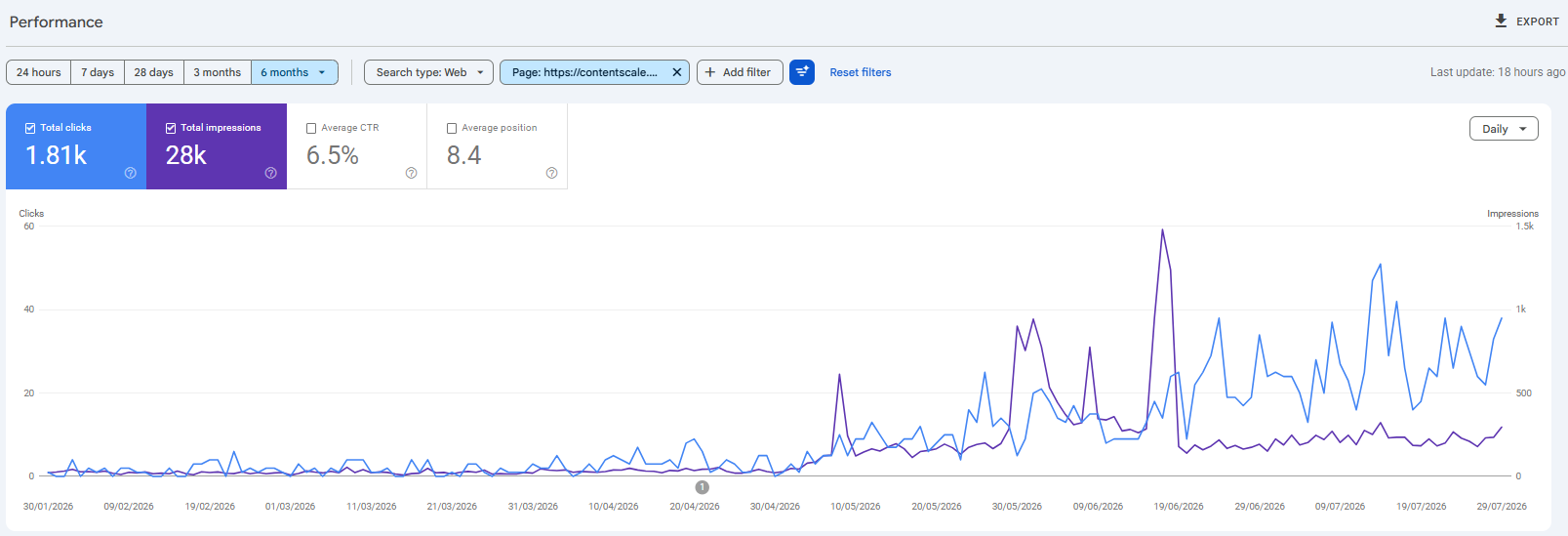
Real GSC data from ContentScale.site — CTR and ranking improvement tracked over 90 days after brief-driven optimization. My own site, not a client.
Key point: The quality gate is not a checklist you run after writing. It is the brief itself — a specification derived from live AI investigation data that determines what the page must contain before drafting starts. That is what makes AI citation optimization systematic rather than speculative.
How the Brief Is Generated — Your 5-Step Input
The GRAAF AIO Brief starts with what you know and researches what you don’t. You control five inputs; the system does the research:
The target search query for the new page. Drives the full research pipeline — SERP analysis, AIO capture, PAA extraction and competitor gap mapping all run against this keyword.
Add a working title or leave blank. The system checks it against keyword, SERP intent and AIO format — and flags if it needs adjustment. If blank, the brief recommends one based on what cited content and the AIO use.
Select the target language. The brief runs natively per language — PAA clusters, entity names and AIO citation patterns all differ by language. A Dutch brief investigates nl.google.com, not a translation of English results.
Choose the target Google region (NL, UK, US, AU, DE etc.). SERP composition — which pages rank, which AIO appears, which sources are cited — differs by region even for the same keyword. The brief uses region-native data throughout.
Paste the current Google AI Overview text for your keyword. Manual input because AI Overviews are dynamic and personalized — pasting what you actually see ensures the brief is built from the live answer your target audience receives, not a cached version. The system then compares it against top-5 content and maps what the AIO cites that competitors miss.
Pre-Write Brief: What It Outputs for New Pages
Every output section is derived from live research — nothing is templated or generic. The brief is a writing specification, not a topic outline:
The top 10 ranking pages analysed for content gaps across all of them — topics, entities, FAQs and structural signals that no current result covers well. These gaps are your citation opportunities.
The manually entered AI Overview is compared against top-5 ranked pages. What the AIO cites that competitors don’t cover — that delta is the structural citation gap your page is built to fill.
H2 structure derived from SERP, AIO and PAA data — not invented. Each heading includes keyword variation, intent alignment and entity coverage target. Word count calculated from cited content averages for that query type.
Primary and secondary entities from the AIO, top-5 SERP and knowledge graph. Which entities must appear, how they’re attributed, and which are missing from all current ranking pages — the strongest structural citation advantage for a new page.
People Also Ask clusters per language, cross-referenced against what top-5 pages answer and what the AIO cites. FAQs ranked by citation opportunity — questions with no strong cited source are Priority 1. Each includes answer format, length spec and FAQPage schema template.
Internal link targets from your existing site structure — so the new page is connected from day one. Schema requirements listed with the specific properties AI-cited sources use. Both included in the brief before writing starts.
- Google Search Spy (top 5) — per-competitor: what they have, what they miss, what the AIO cites that they don’t
- Perplexity answer analysis — sources cited, topics covered, divergence from Google AIO
- Copilot source check — format preferences, cited pages, structural signals
- Direct-answer passage spec — 40–60 word format, position and entity requirements
- GRAAF ContentScore target — minimum per-signal score before publishing
Existing Content: The 10 Trackers
For pages already published, ten real-time trackers feed the rewrite brief. Each answers a specific diagnostic question before a single fix is recommended:
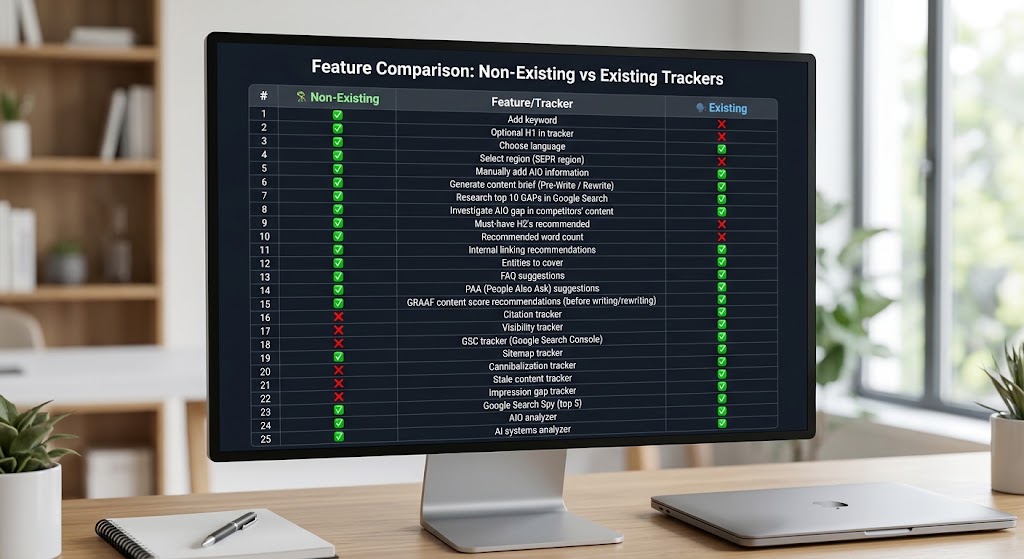
The AI Citations Tracker — citation status per platform alongside the 10 tracker outputs that feed the rewrite brief.
Full Feature Table: New Content vs. Existing Content
| # | Feature / Tracker | New Page | Existing |
|---|---|---|---|
| 1 | Add keyword | ✓ | — |
| 2 | Optional H1 in tracker | ✓ | — |
| 3 | Choose language | ✓ | ✓ |
| 4 | Select SERP region | ✓ | — |
| 5 | Manually add AIO information | ✓ | ✓ |
| 6 | Generate content brief (Pre-Write / Rewrite) | ✓ | ✓ |
| 7 | Research top 10 GAPs in Google Search | ✓ | ✓ |
| 8 | Investigate AIO gap in competitors’ content | ✓ | ✓ |
| 9 | Must-have H2s recommended | ✓ | — |
| 10 | Recommended word count | ✓ | — |
| 11 | Internal linking recommendations | ✓ | ✓ |
| 12 | Entities to cover | ✓ | ✓ |
| 13 | FAQ suggestions | ✓ | ✓ |
| 14 | PAA (People Also Ask) suggestions | ✓ | ✓ |
| 15 | GRAAF ContentScore (before writing/rewriting) | ✓ | ✓ |
| 16 | Citation Tracker | — | ✓ |
| 17 | Visibility Tracker | — | ✓ |
| 18 | GSC Tracker | — | ✓ |
| 19 | Sitemap Tracker | ✓ | ✓ |
| 20 | Cannibalization Tracker | — | ✓ |
| 21 | Stale Content Tracker | — | ✓ |
| 22 | Impression Gap Tracker | — | ✓ |
| 23 | Google Search Spy — Top 5 | ✓ | ✓ |
| 24 | AIO Analyzer | ✓ | ✓ |
| 25 | AI Systems Analyzer | ✓ | ✓ |
Real Brief Examples — What the Output Looks Like
These are real outputs from the ContentScale tracker — not mock-ups:
Direct-answer spec: The best AI content quality checker evaluates text across three dimensions: semantic depth, factual accuracy, and AI engine citation readiness. Tools like Surfer SEO and Clearscope grade semantic optimization; Originality.ai verifies factual accuracy.
Must-have H2s: Why Traditional AI Detection is the Wrong Metric · The 3 Pillars of True AI Content Quality Checking · Deep Dive: Best Tools Tested · How to Use the GRAAF Framework to Audit AI Content · Structuring Content for AI Citation
Top gap: None of the top 10 results bridge traditional SEO quality checking with GEO citation requirements — they focus on AI detection (which Google does not penalize on its own) without evaluating whether content is structured to be cited by AI Overviews or Perplexity.
Entities: Surfer SEO, Clearscope, Frase, Originality.ai, GPTZero, Copyleaks, NLP entities, semantic coverage, topical authority
Word count: ~2,500 · Structure: comparison · Priority FAQs: 5 PAA questions with no strong cited source
Citation status: Google AIO ✅ · Perplexity ✅ · Copilot ✅ · Google Position: #1
GSC Tracker: 7,607 impressions · 1,023 clicks · position 5.6 — impression-to-click gap flagged
Cannibalization finding: Top GSC query is “content at scale,” not target keyword “content scale.” Recommendation: retarget this page or move the keyword to the page Google already prefers.
HIGH priority fix — ready to paste:
<p>Content at scale is producing high-quality search content at volume. I use the GRAAF Framework to audit quality and the free Content Scale tracker to monitor AI citations.</p>
Multilingual & Multi-Region — Language-Native Briefs
A multilingual GRAAF AIO Brief is not a translated English brief. Entity names, PAA clusters, AI Overview citation patterns and SERP composition all differ by language — sometimes substantially. The brief investigates each language and locale natively:
Other languages: contact me to confirm coverage.
GRAAF ContentScore — The Measurable Quality Gate
Every GRAAF AIO Brief sets a GRAAF ContentScore target — the minimum per-signal score the finished page must reach before publishing. Not a word count. Not a keyword density check. A 100-point quality score across five signals that both Google and AI retrieval systems evaluate when choosing sources:
- G — Genuinely Credible (20 pts): Author credentials, linked citations, verifiable statistics. No anonymous claims, no unattributed data.
- R — Relevant (20 pts): Topical alignment between headline, body and search intent. No padding that dilutes the signal.
- A — Actionable (20 pts): The page gives the reader something concrete to do. AI systems prefer content that answers the full query.
- A — Accurate (20 pts): Factual consistency, current data, no contradictions. Errors here are the fastest way to lose a citation.
- F — Fresh (20 pts): Last-updated signals, current-year references, content that reflects 2026 — not 2022 data presented as current.

A GRAAF ContentScore of 65/100 is a problem. The per-signal breakdown shows exactly which signal is dragging the score and what to fix — before publishing or rewriting.
For new pages, the brief sets the target before drafting. For existing pages, the tracker scores the live page first — so the before-state is measured in numbers, not subjective feedback. Both tracks use the same scoring system; the difference is whether the score is a target or a baseline.
Run any URL free at app.contentscale.site. Full methodology: contentscale.site/graaf-framework/.
Check Your Current Citation Status — Free
Scan any existing page in 30 seconds. See your GRAAF ContentScore per signal — no account needed.
→ Run a Free GRAAF ScanOr: WhatsApp +31 6 2807 3996 · Amsterdam, NL
AI Citation Optimization — 8 Questions People Ask
Ready to Build Pages That Get Cited?
Start with a free GRAAF scan on an existing page — or open the tracker to run a Pre-Write Brief for your next page.
→ Open ContentScale Tracker Free Citation CheckWhatsApp +31 6 2807 3996 · Services · Amsterdam, NL
📚 Related
- The GRAAF Framework — the 100-point quality standard every brief scores against.
- Free AI Citations Tracker — check any existing page’s citation status across AI platforms in 60 seconds.
- GEO Consultant — how I use the AIO Brief within a full 90-day GEO engagement.
- 48-Hour Get-Cited Plan — step-by-step: audit, entity fix, score, track.
- What is an AI Overview? — how Google selects and cites sources in AI-generated answers.
Created by Ottmar J.G. Francisca · Independent SEO & GEO Consultant · GRAAF Framework Creator · Amsterdam, NL
I’m an independent consultant with 24+ years in systems and operations management (formerly City of Amsterdam) and SEO experience across 200+ websites. I created the GRAAF Framework and ContentScale tracker after analysing 200+ traffic recovery cases. The GRAAF AIO Brief is the pre-write tool I use on every new page I build. SEO professionals from 47 countries use ContentScale.
Verified: linkedin.com/in/ottmar-joseph-gregory-francisca · Free tool: app.contentscale.site
Last reviewed: August 2026 · WhatsApp +31 6 2807 3996 · LinkedIn
Content scored with the GRAAF Framework by Ottmar J.G. Francisca · contentscale.site