AI Citations Case Study: Documented GSC Results
- The documented baseline CTR was 0.1%; the three-month reporting window ending 1 August 2026 showed 6.5% CTR.
- Cumulative checkpoints rose from 909 clicks and 19.9k impressions through 3 July to 1.81k clicks and 28k impressions through 1 August. These totals cover different-length windows and are labelled accordingly.
- Sitewide average position remained broadly stable, moving from 7.9 to 8.4, while the documented core query reached #1. These are different metrics.
- The dated evidence snapshot confirmed citations in Perplexity and Copilot. AI results can change and must be rechecked per query and per system.
- The gains occurred during the implementation period while the GRAAF, GSC and Citation Brief workflow was applied. The contribution of each individual change cannot be isolated.
This AI citations case study documents Google Search Console results from contentscale.site. The evidence is shown as dated screenshots and clearly labelled checkpoints. Search rankings and AI answers vary by date, location, personalization and prompt, so live searches may not reproduce an earlier snapshot exactly. The purpose of this page is to preserve what was measured, not to promise that every site will obtain the same result.
The workflow was straightforward: I assessed the pages with the GRAAF ContentScore, reviewed GSC queries and page data, corrected search-intent overlap and stale sections, implemented the resulting Citation Brief actions, waited for recrawling, and recorded later checkpoints.
The AI evidence uses the current five-system method: the complete answers and source URLs from ChatGPT with web search, Claude, Perplexity, Microsoft Copilot, and Google AI Overview / Gemini are collected manually and saved per query. This separates a recommendation, a mention and a direct citation instead of treating them as the same signal.
AI citations case study #1: contentscale.site — three months of documented checkpoints
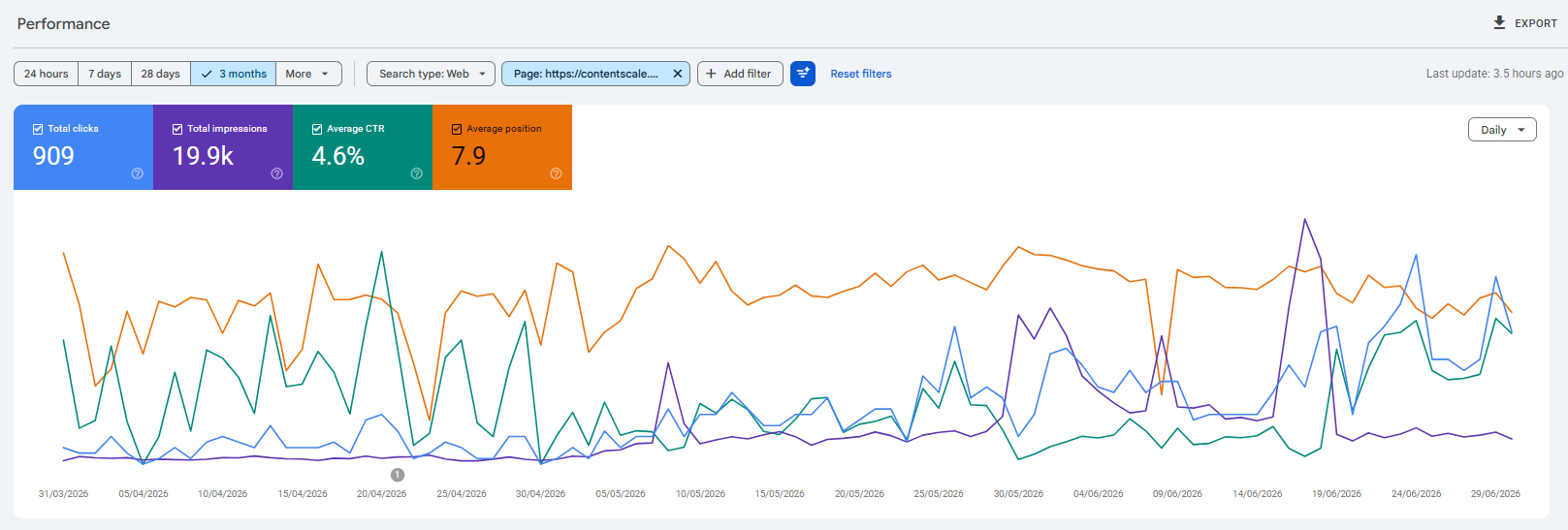
Source: Google Search Console · contentscale.site · 1 May – 3 July 2026
Earlier query-level evidence placed the target terms around positions 20–30. During the measurement period I applied the GRAAF, GSC and Citation Brief workflow. No paid advertising or purchased backlinks were used. The links below open current searches, but current results may differ from the dated evidence:
AI citations case study checkpoint: 5.6% CTR in the reporting window
For the May 1–July 19, 2026 reporting window, Google Search Console showed 5.6% CTR, 1.4k cumulative clicks, 25.1k impressions, and average position 8.3. The separately recorded baseline CTR was 0.1%. During this period I restructured the HTML with GRAAF, reviewed cannibalization and stale-content signals, and acted on GSC impression gaps. This is an observed before-and-after checkpoint; it does not isolate the effect of each individual change.
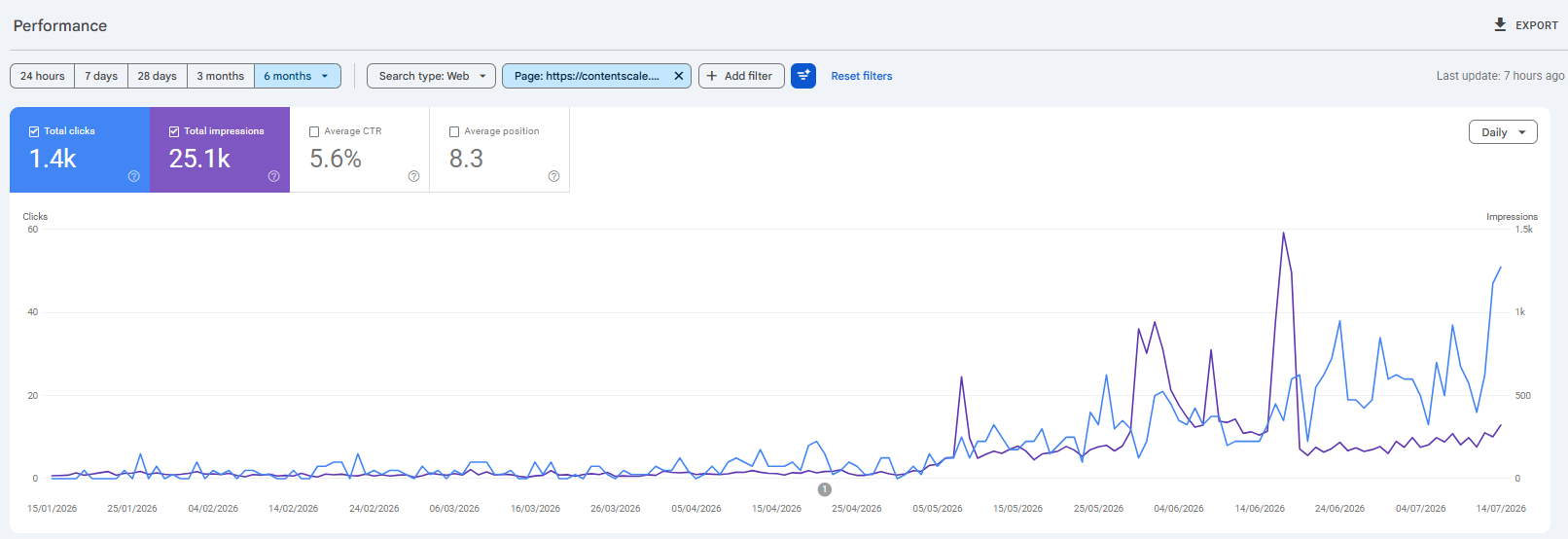
Evidence: Google Search Console screenshot for contentscale.site, reporting window May 1–July 19, 2026.
May 1–August 1: the next documented checkpoint
For the reporting window ending 1 August 2026, Google Search Console showed 6.5% CTR, 1.81k cumulative clicks, 28k impressions, and average position 8.4. The separately recorded baseline CTR was 0.1%. No paid advertising or purchased backlinks were used during this implementation period. These figures document the measured outcome; they do not prove that one individual change caused the full difference.
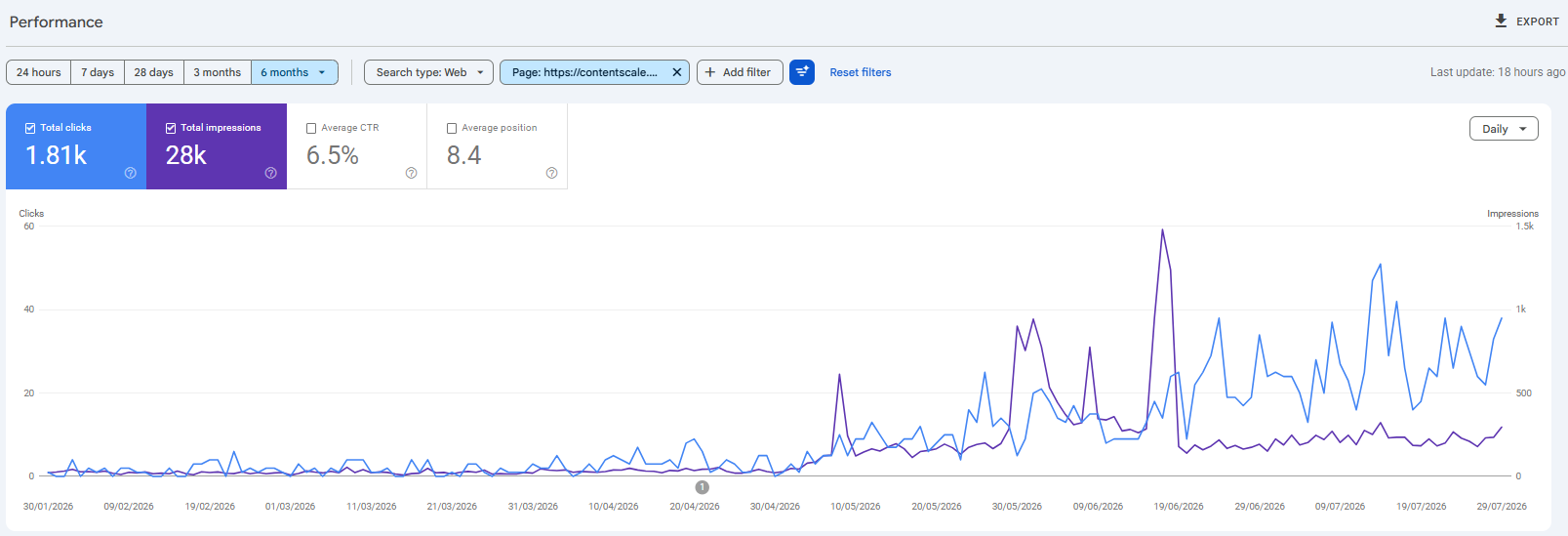
Screenshot: Google Search Console, contentscale.site · reporting window May 1–August 1, 2026. The screenshot is the evidence record; live Search results may differ.
What made the difference
Tools and methodologies used
A documented ranking and citation snapshot
At this checkpoint, the stored evidence showed the target query at #1 in Google Search and confirmed citations in Perplexity and Microsoft Copilot. The result was not confirmed in Google AI Overview at that moment. The current tracker now stores complete answers and source URLs from five systems — ChatGPT with web search, Claude, Perplexity, Copilot, and Google AI Overview / Gemini — so recommendation, mention and direct citation are evaluated separately. AI answers are not permanent and must be rechecked using the same query.
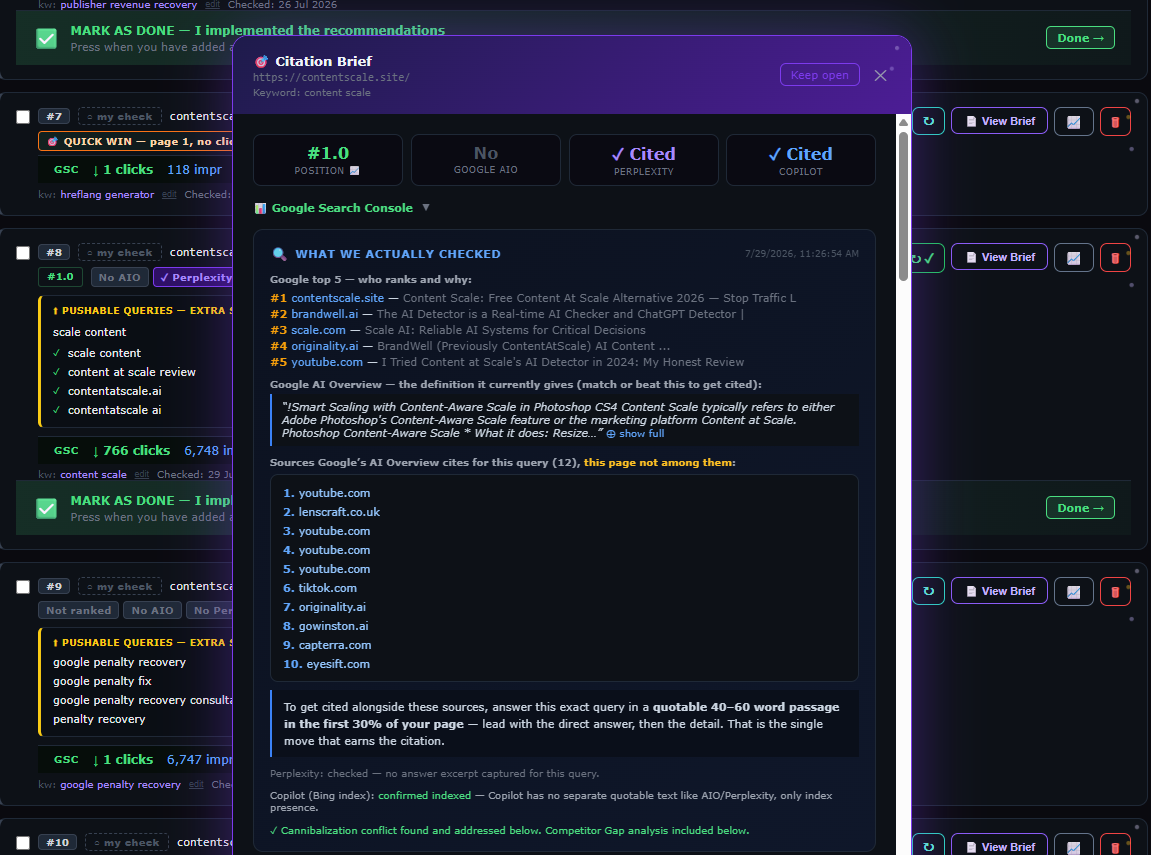
Evidence snapshot dated July 30, 2026. Preserve the exact query, complete answer and cited source URLs with each later recheck.
More AI citations case study results
contentscale.site
Three months of dated GSC checkpoints, including 909 cumulative clicks through July 3 and a query-specific #1 ranking snapshot.
Featured above ↗Traffic recovery on Google Search and AI systems including Google AI Overviews.
“Ottmar helped me well with getting back traffic on Google Search and AI systems like Google AI Overviews.”
Switched from Semrush to ContentScale’s Free AI Citations Tracker for deeper analysis.
“I even tried Semrush but the free AI citations tracker of ContentScale has so many extra tools…”
Challenge, solution, results — in full
The challenge. My own homepage sat at 0.1% CTR and average position 24 — buried on page 3. The ContentScore was 34/100. The page had impressions but almost no clicks, and it collided with an unrelated Android API term in search results.
The solution. I applied my own method, step by step:
- Measured the page with the GRAAF ContentScore and created a Citation Brief from the page, GSC evidence and competitive coverage.
- Rewrote the HTML for AI Overview and voice-search extraction.
- Added only structured data that accurately described visible page content; structured data was not treated as a ranking guarantee.
- Fixed keyword cannibalization and the search-intent mismatch.
- Detected and refreshed stale content, then closed the impressions gap flagged in Google Search Console.
- Rescanned, then repeated the loop every few weeks.
The results. The separately recorded CTR baseline was 0.1%. For the three-month window ending 1 August, GSC showed 6.5% CTR, 1.81k cumulative clicks, 28k impressions and average position 8.4. An earlier checkpoint through 3 July showed 909 cumulative clicks, 19.9k impressions and average position 7.9. Perplexity and Copilot citations were confirmed in the dated AI snapshot. These observations do not establish that every change contributed equally.
How to read this case study
This is a documented single-site before-and-after case, not a controlled experiment and not a guarantee. GSC totals are cumulative within the labelled reporting windows. Average position is a sitewide or filtered average; a #1 query position is query-specific. They should never be presented as the same metric.
AI evidence is also query- and date-specific. A valid record preserves the AI system, exact question, complete answer, recommendation status, direct-citation status and raw source URLs.
What people say
★★★★★ 5.0 average · 9 verified Google reviews · See all on Google →
The AI Citations Tracker has a game-changing feature called the Pre-Write Brief. I’m honestly amazed by how thorough it is.
I even tried Semrush, but the free AI Citations Tracker of ContentScale has so many extra tools.
Ottmar helped me well with getting back traffic on Google Search and AI systems like Google AI Overviews.
Ze hebben nu enkele platforms gemaakt. De Gratis AI Citations Tracker is wat mij geholpen heeft.
Wat een ontdekking! Als ondernemer in België had ik te maken met een daling in websiteverkeer. Gelukkig vond ik ContentScale.
Ik ben ontzettend blij met de hulp van ContentScale. Mijn website had te maken met een aanzienlijke daling in verkeer.
Let Ottmar Babysit Your Pages
Stop losing traffic. I monitor, diagnose, and fix your pages — so you can focus on running your business.
Free initial scan included · No commitment · Direct access, no middlemen
Frequently asked questions
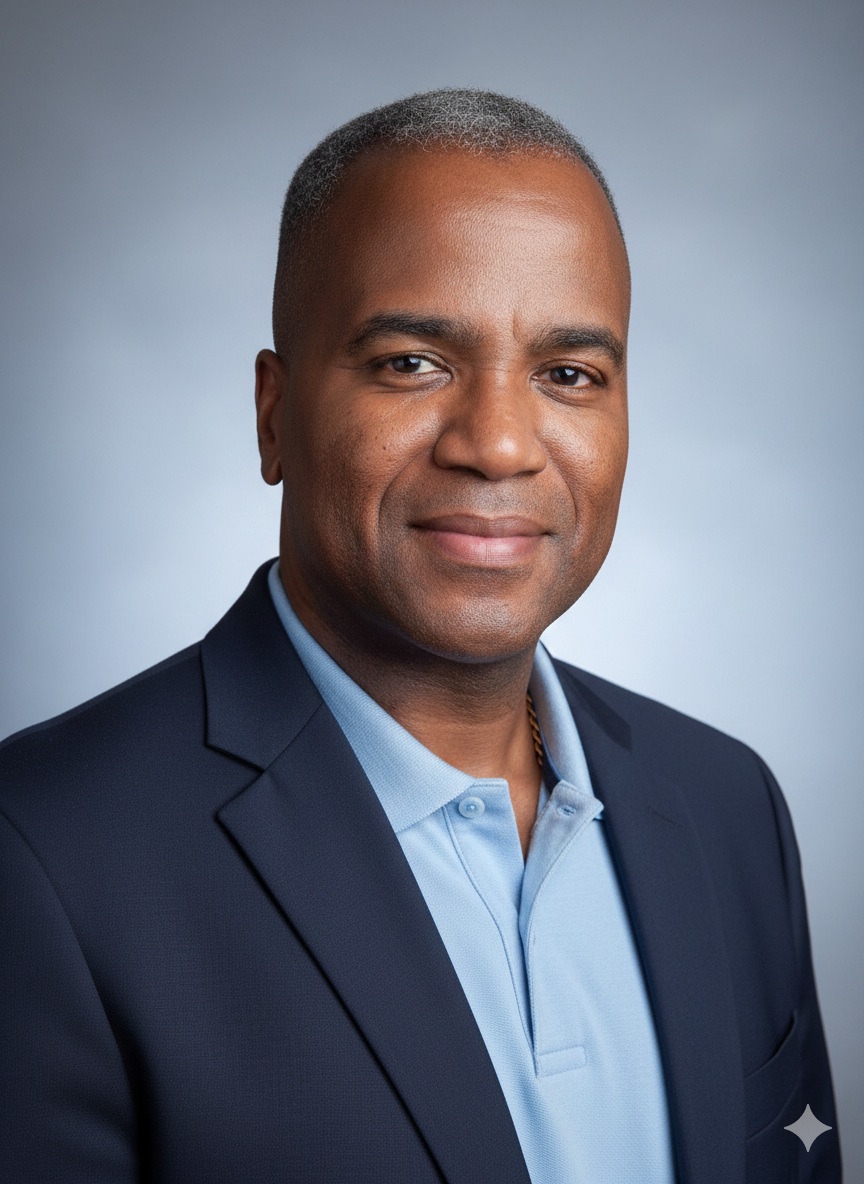
Written by Ottmar J.G. Francisca — Independent SEO consultant · Amsterdam
I’m an independent SEO and GEO consultant based in Amsterdam, specializing in Technical SEO, AI Search Optimization, and Local SEO. I created ContentScale — the GRAAF Framework and the free AI Citations Tracker — and I run the exact method documented on this page on my own site first. Every number here comes from my own Google Search Console.
Want to build an evidence trail for your own site? Start free.
Track one page, save the five AI answers and source URLs, and build a dated baseline before changing the page.
→ Try the Free AI Citations TrackerWant your results featured? WhatsApp Ottmar +31628073996 · Amsterdam, NL
ContentScale · contentscale.site · Results measured in Google Search Console · GRAAF Framework