Free AI Citations Tracker:
See Where AI & Google Search Cite Your Pages
Analyze How AI Search Platforms and Google Search Reference Your Website
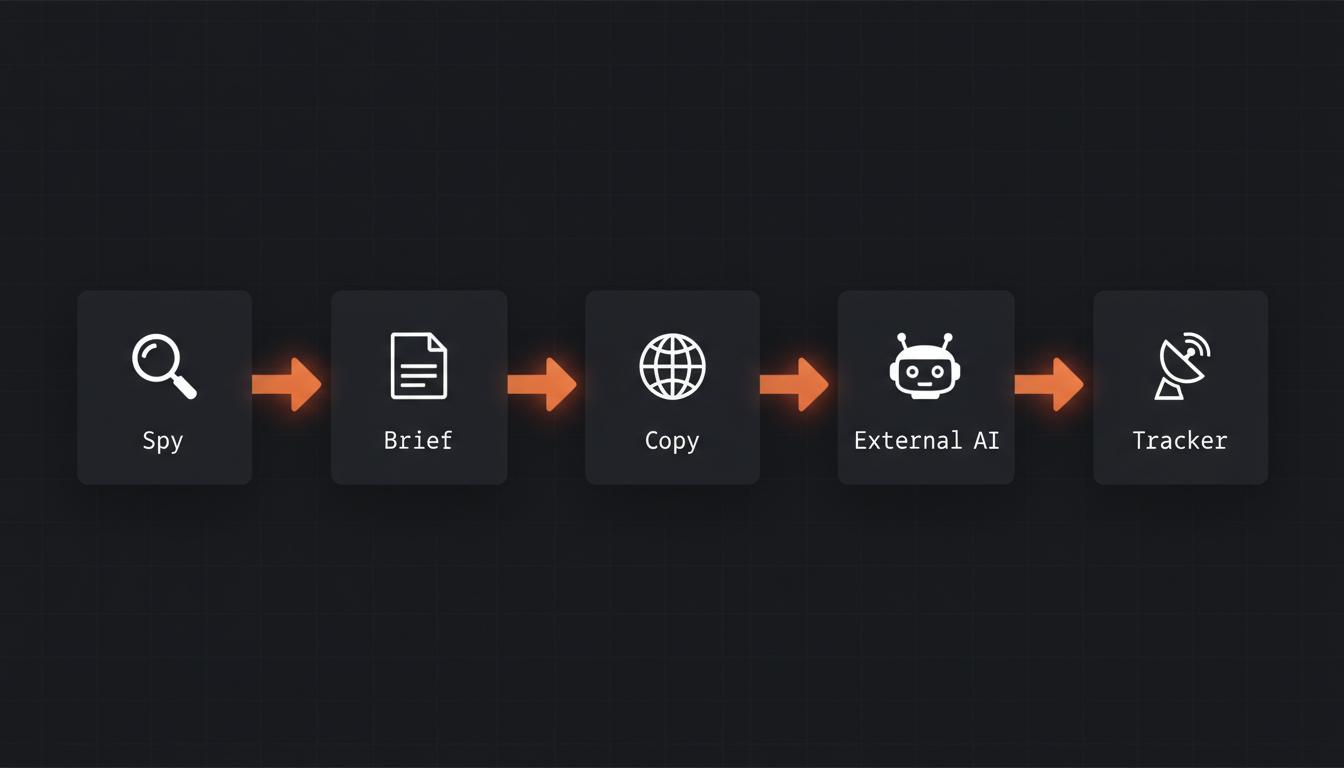
This free AI citation tracker records manually verified answers from Google AI Overviews or Gemini, ChatGPT Search, Perplexity, Claude and Microsoft Copilot, and analyses them alongside Google Search Console data. It preserves the source answers and URLs, then creates a multilingual Citation Brief with evidence-based actions for your page.
ContentScale combines manually verified five-engine AI evidence with GSC data, sitemap inventory, stale-content signals and query-level cannibalization analysis. It turns that combined evidence into a prioritized brief: what to change, where to change it, and which saved evidence supports the recommendation.
A free AI citations tracker records whether five AI systems cite or recommend your web pages for selected customer questions. You run the supplied prompt in each system and paste the complete answer with its sources; ContentScale analyses, classifies and saves that evidence. Free for 1 page, no login required.
Proven on my own site: I used this exact method to take the contentscale.site homepage from page-two obscurity to page one for my core keywords — including top spots for “content at scale” and “contentscale”. See the real Search Console results →
Last updated: September 20, 2026 — refreshed for five-engine evidence, query-level cannibalization analysis and safer recommendation wording.
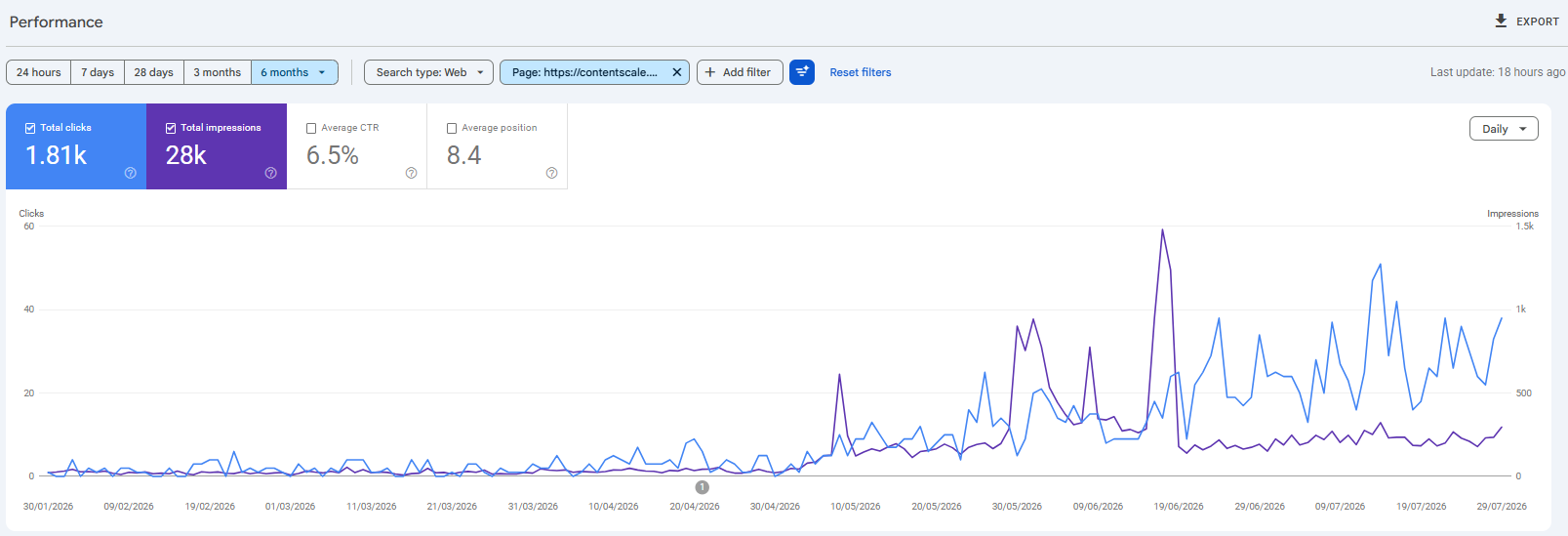
The AI Citations Tracker combines SERP intelligence, GSC analytics, manually verified five-system citation evidence and actionable briefs in one place. After you save the five answers, it generates a Citation Brief with evidence-linked actions.
Your Citation Brief is written in any language — English, Dutch, German, French, Spanish, Italian, Portuguese, Japanese, Korean, Chinese, Arabic, Russian, Hindi and 20+ more — matched to your page and your market, so the fixes are ready to publish as-is.
Start Tracking in 30 Seconds — Free
Enter your domain below. No credit card, no login for the free tier.
↓ Get My Free Tracker✓ Free for 1 page · ✓ No credit card · ✓ Five-system evidence · ✓ Saved proof history
📌 Saved evidence: Your tracker keeps the latest answers and source URLs until you add a new five-system check.
Does the AI Citation Tracker work in any language?
Yes. The ContentScale AI Citation Tracker analyzes pages and generates Citation Briefs and AI Search Visibility Reports in any language — including English, Dutch, German, French, Spanish, Italian, Portuguese, Polish, Turkish, Russian, Arabic, Chinese, Japanese, Korean and Hindi, among 20+ others. The brief is written in the same language as your page (auto-detected) or any language you choose, so every copy-paste fix is ready to publish for your market. Only the human-readable text is translated — your URLs, HTML, schema and brand names stay exactly as they are. This matters for both AI search (Google AI Overviews, Perplexity, Copilot) and traditional Google Search, where localized, citation-ready content is what earns the citation.
Generate Your Free AI Search Visibility Report
Enter the exact public name shown on the website. Do not enter a contact person or an internal label such as “Valmir PRT”; this name is used to separate brand searches from real cannibalization.
1 page free • No credit card • Upgrade for more pages • Privacy
Get 2-year access to the full AI citations tracker — €297 one-time (~€8/mo equivalent, vs €29-337/mo for comparable tools). Renew after 2 years.
New here? Follow the 48-Hour Plan to get cited
The tracker shows you exactly what to fix. If you want the full running order — every phase timed, from setup to the loop that compounds — work through my 48-hour plan to get cited by AI and rank in Google. It uses this exact free tracker at every step.
→ Open the 48-Hour Get-Cited PlanWhy I Built the AI Citation Tracker
Traditional SEO tools measure rankings, impressions, and clicks. They don’t explain how websites are selected as sources in AI-powered search experiences.
AI visibility products use different methods: some emphasize mention counts or share of voice, while others include audits or recommendations. ContentScale’s workflow is built around preserving each complete answer and its source URLs, then connecting that evidence to GSC, sitemap and page data.
The ContentScale AI Citation Tracker turns the five saved answers into a Citation Brief linked to the evidence. It identifies gaps and proposes page changes in your selected language. Review factual claims and approve every recommendation before publication.
As AI search continues to evolve, understanding citations, entity relationships, search intent, and topical authority has become just as important as traditional rankings.
I developed the AI Citation Tracker to help SEO professionals move beyond ranking reports and gain practical insights into how websites are referenced across Google AI Overviews, ChatGPT, Claude, Microsoft Copilot, and Perplexity. The goal isn’t simply to monitor AI visibility — it’s to identify actionable opportunities that improve discoverability across both traditional and AI-powered search.
What the AI Citation Tracker Analyzes
Your AI Citation Brief Includes
Who Is It For?
Behind the Analysis
The AI Citation Tracker combines multiple SEO disciplines rather than relying on a single visibility score. Analysis incorporates:
This allows recommendations to prioritize improvements that influence both traditional organic search and AI-powered search experiences.
How AI Chooses Sources — What Most SEO Tools Don’t Tell You
AI systems don’t rank pages the way Google Search does. They retrieve and cite sources based on different signals:
The AI Citation Tracker measures all of these signals and turns them into a prioritized brief with exact fixes. That’s what separates it from tools that only show you a score.
About ContentScale
The AI Citation Tracker is part of ContentScale, my professional portfolio documenting practical SEO methodologies, AI Search research, case studies and measurement tools. Created by Ottmar Francisca, it is designed to preserve the evidence behind every recommendation and measure each implementation against its own baseline.
Compare Free AI Citation Trackers
While many tools offer AI citation tracking, understanding which best suits your needs is crucial. Here’s how ContentScale’s Free AI Citations Tracker stands out:
- Comprehensive Analysis: Unlike basic checkers, the tracker provides detailed ‘Citation Briefs’ that not only identify where AI cites your content but also pinpoint gaps and suggest improvements.
- Focus on Recovery: It goes beyond simple tracking to offer actionable insights for recovering lost traffic, a key differentiator from tools focused solely on visibility.
- Ease of Use: The personal tracker link needs no login, and the analysis begins after you paste the five complete AI answers.
Explore the landscape of AI citation tracking and see why ContentScale offers a unique, actionable solution for content visibility and traffic recovery.
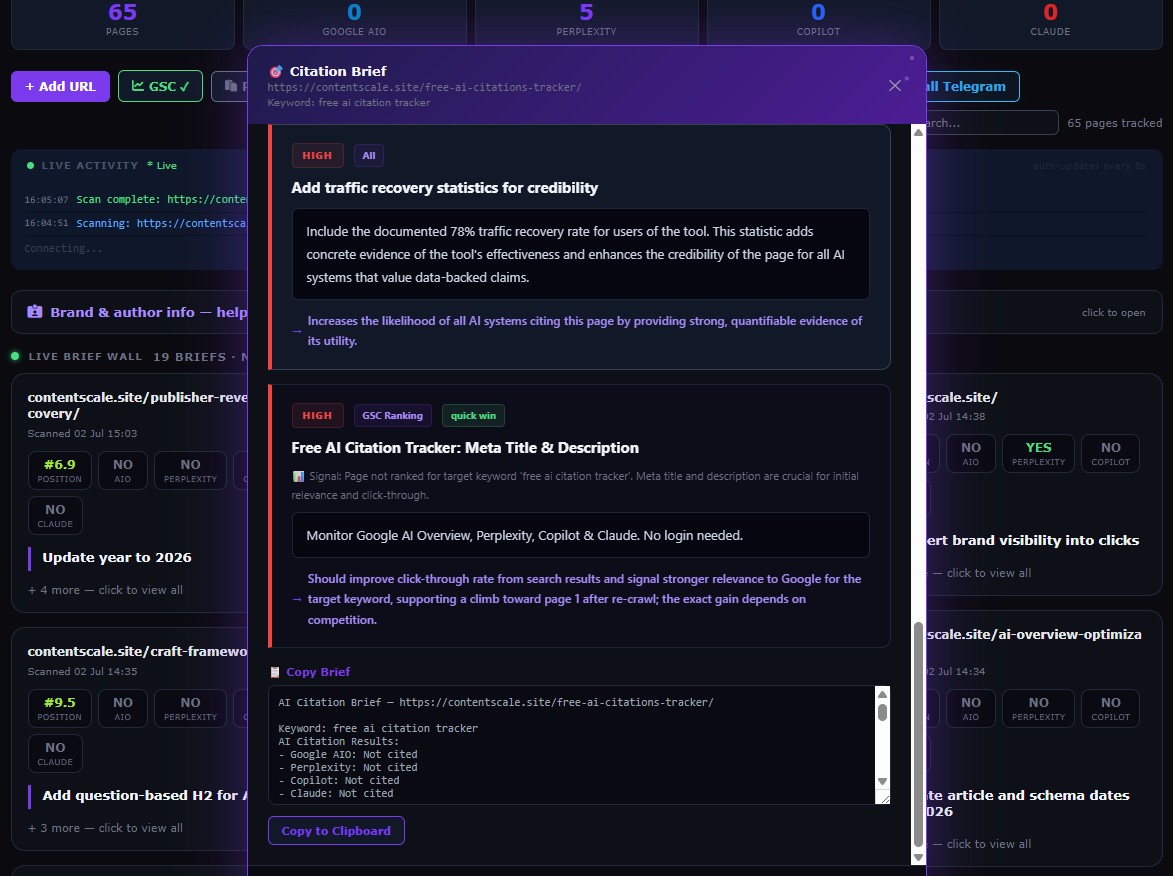 🔍 Click to view full size
Everything the ContentScale AI Citations Tracker does
One free tool, the whole workflow: it checks whether AI assistants cite your pages and tells you exactly what to fix — audits pages you already have and, with the Pre-Write Brief, blueprints pages that don’t exist yet from a single keyword. It imports your sitemap and Google Search Console data, catches keyword cannibalization, and writes every brief in your page’s own language or any of 20+ you choose.
🔍 5-system evidence check
Run Prompt 2 in Google AI Overviews or Gemini, ChatGPT Search, Perplexity, Claude and Microsoft Copilot. Paste each complete answer with its sources; the tracker analyses and saves every system separately.
📋 Citation Brief
Not vague advice — exact copy-paste sentences, where to add them, and which AI system each one targets. HIGH-priority actions first.
✏️ Pre-Write Brief — no URL needed
Writing a brand-new page? Enter just a keyword (plus optional working title, language and SERP region) — no URL. The tracker researches live competitors and returns a structured blueprint: proposed title/meta/H1/slug, a citeable opening, H2 sequence, entities, FAQs, competitor gaps and internal-link targets. Review and approve factual claims before publishing.
📈 GSC Brief
Add your Google Search Console data and get separate ranking actions — title, meta and content fixes based on your real clicks, impressions and position.
🗺️ Sitemap import
Paste your sitemap URL, it fetches every page, and you pick up to 80 to track — no copy-pasting URLs one by one.
⌨️ GSC keywords import
Drop or paste your Search Console Queries/Pages CSV (or one URL · keyword per line). Your real keywords drive every brief.
🔀 Keyword cannibalization
When pages overlap for the same query, the tracker uses query-level GSC evidence to classify the relationship as differentiate, keep separate, or consolidation candidate. It does not create redirects automatically.
🦺 Brand & author info
Add your real years in business, projects, service area and author. The briefs use only those facts — never invented credentials or fake relationships.
🎯 GRAAF ContentScore
A 100-point content score per page (Genuinely Credible, Relevant, Actionable, Accurate, Fresh) so you know how citeable each page is.
👥 Team & client recipients
Need the Citation Brief sent to a teammate or client too? Extra recipients can be added to your tracker — built for agencies and teams.
🔔 Email + Telegram alerts
Every brief arrives by email and Telegram, so your team sees new citation actions the moment a scan finishes.
🔗 Internal-link suggestions
The tracker compares your sitemap with your tracked pages and suggests missing internal links — with exact anchor text and a ready AI prompt.
♻️ Repeatable verification
Implement approved changes, record the update, and refresh the five AI answers and page evidence. The tracker compares the new result with the saved baseline.
This is the new SEO crisis. It’s not just algorithm updates anymore. AI assistants decide whose content gets cited — and most sites are invisible to them. You’re losing traffic to AI, not just to competitors. Google AI Overviews answer questions before anyone clicks your link. And you have no idea whether Perplexity, Copilot, or Google is even citing your pages.
Already paying an SEO agency? Run this first
Rankings and traffic do not show which AI systems cited a page for a specific question. Save that evidence separately and give your agency the baseline, sources and page-level actions alongside the usual SEO report.
📊 Bring the data to your agency
Run the scan yourself, get the Citation Brief, and hand your agency exact fixes instead of a vague “improve SEO” request.
🧭 Know before you sign
Before hiring or renewing with any AI SEO agency, see your current citation baseline — so you can measure whether their work actually moves it.
🤝 Built to complement, not replace
The GRAAF Framework behind every brief is the same quality bar hybrid AI + human agencies use — Genuinely Credible, Relevant, Actionable, Accurate, Fresh.
saved separately
search evidence
proof history
no credit card
How your free AI citations tracker cycle works
Your free AI citations tracker uses a verifiable cycle. Add your page, save one complete answer from each of the five AI systems, review the evidence-based brief, record approved changes and repeat the same five checks later. The analysis is automated; the AI answers are pasted manually so the evidence remains auditable.
Add your page
Enter the page and the customer questions you want to test.
Paste five answers
Use Prompt 2 in a fresh chat in each system, then paste the complete answers and source URLs.
Review the Citation Brief
The tracker classifies the saved evidence and creates prioritized, checkable actions.
Implement → record → repeat
Apply only approved changes, record the new version and repeat the five checks to compare with the baseline.
ContentScale · Research System included
Every Citation Brief is backed by two research engines running in parallel — PULSE for data, NEXUS for competitive intelligence.
- → Google Search Console clicks, impressions, CTR, positions
- → Top positions 1–5 deep research — what are they doing?
- → AI Overview citation research — which pages get cited and why?
- → Voice search query analysis — what phrases get spoken?
- → Impression vs click gap analysis — why rankings don’t convert
- → Reverse-engineer AI Overview citations — what did Google love?
- → What signals triggered the citation — structure, depth, source?
- → What can you write that is demonstrably better?
- → Voice search query-to-answer matching
- → Competitive intelligence into editorial advantage
Free AI citations tracker extras: sitemap import & internal linking
Sitemap Import
Your free AI citations tracker includes a sitemap import tool. Paste your sitemap URL. The system fetches all your pages, lets you pick which ones to track, and starts monitoring immediately. No copy-pasting URLs one by one.
→ 47 pages found
→ select which to track
→ import in one click
Internal Linking Analysis
The system scans your sitemap, compares all pages with your tracked pages, and uses AI to suggest missing internal links — with exact anchor text and where to add them.
→ add link to: /graaf-framework/
→ anchor: “GRAAF Framework”
→ where: first paragraph
The system only suggests links from your tracked page to other pages on your site — not back-links. This is how AI systems follow topical authority chains. Every suggestion comes with a copy-paste ready AI prompt so you can take it straight to Claude or ChatGPT for deeper analysis.
What does your AI citations tracker generate?
After you complete and save the five-system evidence set, the tracker creates a prioritized brief linked to the recorded answers and source URLs. Review each proposed sentence and factual claim before publishing.
 📄 Open a live Citation Brief →
5 AI systems your tracker records separately
Run Prompt 2 in a fresh chat with live web search in each system, then paste the complete answer and source URLs. ContentScale analyses and saves the evidence; it does not replace a system’s answer with an indirect search-engine proxy.
Google AI Overview / Gemini
Paste the answer you actually receive. AI Overview prevalence varies by query mix, intent, location and time, so the tracker measures your selected questions instead of claiming a universal percentage.
ChatGPT Search
Paste the complete researched answer and its source URLs. The tracker records recommendations, mentions, cited domains and exact cited pages separately.
Perplexity
Perplexity’s CEO reported 780 million queries for May 2025. That is a dated historical figure—not a current monthly guarantee—so your visibility is verified from a fresh answer.
Claude
Claude is supported now. Paste the complete live-web answer and its sources so the same questions can be compared with the other systems.
Microsoft Copilot
Paste the actual Copilot answer and its references. Bing visibility can provide context, but a Bing ranking is never counted as proof that Copilot cited your page.
Sources checked September 20, 2026: Google AI Overviews and Perplexity’s May 2025 figure.
Where this fits in content scaling
Content scale — the systematic process of producing and measuring high-quality content at volume — means more than ranking in 2026. Real content scaling now means earning citations in Google AI Overviews, Perplexity and Copilot at the same time as you rank. This free AI citations tracker is the AI-citation layer of that workflow: it shows where AI cites you and exactly what to add when it doesn’t.
For the full content-scaling system — scoring, briefs and lifecycle tracking — see the Content Scale platform (the independent Content at Scale alternative), the ContentScale system walkthrough, and the free GRAAF ContentScore scanner.
Free AI citations tracker vs Profound vs Otterly vs AI Mentions
Products and prices change. This comparison uses public entry points and describes the primary workflow without claiming that competitors lack a feature. Checked September 20, 2026.
| Feature | ContentScale | Profound | Otterly | AI Mentions |
|---|---|---|---|---|
| Public entry option | Free: 1 page | Free trial | From $29/month (monthly Lite) | Free to start |
| Public platform coverage | 5 manually verified systems | ChatGPT in trial; up to 9 on Enterprise | 4 core; Claude, Gemini and AI Mode as add-ons | Multiple AI assistants |
| Primary workflow | AI evidence + GSC + sitemap + proof history | AI visibility platform and agents | AI visibility, audits and recommendations | Brand mentions, prompts and sources |
| Implementation record | Saved baseline, HTML and proof timeline | Check current vendor plan | Check current vendor plan | Check current vendor plan |
Current vendor references: Profound pricing, Otterly pricing, and aiMentions. Recheck before purchase.
One-Time Deal — 2-Year Access
Start with the free AI citations tracker, then upgrade for more pages. Each paid tier below covers 2 years with one payment and no monthly subscription during that term. Choose your tier and pay directly via PayPal.
✓ Google AIO / Gemini, ChatGPT Search, Perplexity, Claude and Copilot
✓ Citation Brief after each completed evidence set
✓ GRAAF score (100-point)
✓ Email + Telegram alerts
✓ Sitemap import
✓ Internal linking analysis
✓ 10 pages tracked
✓ Repeatable five-system verification
✓ Google Ranking Brief
✓ GSC integration (real clicks + CTR)
✓ CTR gap analysis per query
✓ Competitor content gap analysis
✓ “From cited to #1” system
✓ 20 pages tracked
✓ Priority WhatsApp support
✓ Repeatable five-system verification
✓ Live top-10 SERP gap analysis
✓ AI Overview citation status check
✓ Recommended structure + must-have H2s
✓ Entities & FAQ questions to cover
✓ Ready-to-write passages for AI citation
✓ Any output language (incl. Arabic dialects)
✓ Any SERP region (US, UAE, Saudi, EU…)
✓ 20 briefs · no expiry
Writing, upload & images priced separately
Run an agency? Turn every scan into billable work
Use the AI Citations Tracker to create a documented baseline for each client. The saved five-system evidence can reveal page-level gaps and turn them into reviewable work for writers, SEOs and strategists.
🗂️ Every scan is a stack of briefs
Run any client or prospect through the tracker and one scan shows exactly what’s missing. Every gap becomes a Citation Brief — a concrete, copy-paste deliverable you hand straight to a writer. Invisible AI gaps turn into sellable work orders.
📈 Keep your specialists booked
Instead of chasing new logos just to keep the team busy, turn a single scan into a steady queue of work — for clients you already have. Feed your writers and SEOs a consistent flow instead of feast-or-famine.
💼 Grow retainers with proof clients can see
A free snapshot sells itself: the client sees they’re invisible to AI, and you’re the one who fixes it. Tier 1 (€297) monitors citations across every platform; Tier 2 (€697) adds Google Ranking Briefs + GSC — the “from cited to #1” system across 20 pages.
→ Start with one client’s site free — see how much work is hiding in a single scan, then roll it out across your whole book.
Agency & white-label plans
Run the tracker across your whole client book. One-time payment, 2 years of access — the more clients you add, the lower your cost per client. No monthly tool bill stacking up.
✓ 10 client domains × 10 pages each
✓ Citation Brief + Google Ranking Brief per client
✓ GSC integration per client
✓ GRAAF score (100-point) across all pages
✓ Central agency overview
✓ Email + WhatsApp support
✓ Repeatable five-system verification
✓ White-label — your brand, your logo
✓ Clients never see ContentScale
✓ 30 client domains × 10 pages each
✓ Lower cost per client
✓ Priority WhatsApp support
✓ Repeatable five-system verification
✓ Onboarding call with Ottmar
✓ “From cited to #1” system per client
More than 30 clients or need a custom setup? WhatsApp Ottmar for a tailored agency deal.
Key takeaways: what your free AI citations tracker does
- ✓ Records Google AIO / Gemini, ChatGPT Search, Perplexity, Claude and Microsoft Copilot separately
- ✓ Analyses pasted answers automatically while preserving the complete source evidence
- ✓ Generates a reviewable Citation Brief after each completed evidence set
- ✓ Tells you not just if you are cited, but why not and what to add
- ✓ Scores your page on the 100-point GRAAF ContentScore before publishing
- ✓ Imports your whole sitemap so you can pick pages to track in one click
- ✓ Suggests one-directional internal links with exact anchor text and placement
- ✓ Delivers briefs by email and Telegram — HIGH-priority actions first
- ✓ Free forever for 1 page — no credit card, no subscription
- The exact sentence, paragraph or schema to add — copy-paste ready
- Where on the page to add it (after your H1, in your opening paragraph, before the footer)
- Which AI system the change targets (AIO, Perplexity or Copilot)
- Whether to add, merge or replace — so you never duplicate existing content
- The expected impact, per AI system
- A separate Google ranking brief with your exact meta title and description
- Internal-link suggestions pulled only from your real sitemap
What the expert behind the tracker says
“Ranking in Google is no longer enough. In 2026 you have to win the citation — the moment an AI assistant decides whose page to quote. That decision happens before anyone sees a blue link.” — Ottmar J.G. Francisca, Creator of ContentScale & creator of the GRAAF Framework
“The Citation Brief connects saved AI answers and source URLs to page-level actions, so every recommendation can be reviewed against its evidence.” — Ottmar J.G. Francisca, ContentScale
“Citation eligibility is earned with structure: a quotable definition, verifiable data, clear authorship and clean schema. Score those signals and the citations follow.” — Ottmar J.G. Francisca, creator of the GRAAF Framework
Grounded in public guidance: Google rewards content with strong E-E-A-T signals, and AI assistants increasingly pull from pages with clean structured data. The GRAAF Framework converts those signals into a measurable 100-point score — so you can see exactly which ones your page is missing.
What the tracker measures before and after
ContentScale does not promise a fixed traffic multiple or recovery deadline. It preserves the baseline, implementation record and later verification so each change can be evaluated from saved evidence. Search and AI visibility results vary by site, market, query and implementation.
About the author
Ottmar J.G. Francisca built the ContentScale AI Citations Tracker and created the GRAAF Framework, the 100-point content-quality system behind every Citation Brief. Operating solo from Amsterdam with 24+ years in systems and operations management for the City of Amsterdam, he combines GRAAF with Julia McCoy’s CRAFT Framework and the PULSE + NEXUS research system. ContentScale is designed to preserve baselines, implementations and proof history so results are measured rather than promised.
- ✓ Five-system evidence recorded separately
- ✓ Baseline, implementation and proof history
- ✓ Creator of the GRAAF Framework
- ✓ 24+ years systems & operations management, City of Amsterdam
Why tracking AI citations matters — and how each model decides what to cite
Direct tracking is only half the story. To win citations you also need to understand why AI cites — and how to turn that into traffic. Here’s the deeper context most tools skip.
Why does tracking AI citations matter?
Because people increasingly ask Google AI Overviews, Perplexity, and Copilot instead of clicking blue links. If those models don’t cite you, you’re invisible to that traffic — even when you rank on page one. Tracking shows exactly where you’re named, where competitors are named instead, and what to add.
How do Google AIO, Perplexity and Copilot choose what to cite?
Citation selection is system- and query-dependent. Clear answers, verifiable claims, relevant source context and transparent authorship can improve eligibility, but no page structure guarantees a citation. Test the same questions in all five systems and retain their source URLs.
How do you turn citation data into more traffic?
Each completed evidence set returns a prioritized Citation Brief. After approved changes are published, record the new page version and repeat the same five questions so the later result can be compared with the saved baseline. See the documented ContentScale case study →
What makes ContentScale’s method different?
The scoring combines the GRAAF Framework with Julia McCoy’s CRAFT Framework and the PULSE + NEXUS research system. It is maintained through ongoing testing and a measurement workflow that records the baseline, implementation and later evidence.
Free AI citations tracker — frequently asked questions
A free AI citations tracker records whether your pages are cited or recommended by Google AI Overviews or Gemini, ChatGPT Search, Perplexity, Claude and Microsoft Copilot. You paste each complete answer and its sources; ContentScale analyses and saves the evidence and creates a prioritized Citation Brief.
ContentScale combines saved five-system answers with GSC, sitemap and page evidence. It turns that combined record into checkable recommendations and keeps the baseline and implementation history for later comparison.
The free AI citations tracker allows you to track 1 page. No credit card required. For more pages, ContentScale offers 2-year access starting at €297 (about €8/month equivalent). As a current external reference, Otterly lists its monthly Lite plan at $29 as of September 20, 2026; vendor prices can change, so check the official pricing page.
No. Your free AI citations tracker has a personal URL you bookmark. No account, no password, no app to install. Just a link that opens your tracker directly.
Repeat the five-system test when you want a fresh comparison. Each AI answer is added manually because it is the evidence being evaluated; the tracker then analyses and stores the result automatically.
Yes. The free AI citations tracker is not tied to any agency or platform. Many users run it next to their existing SEO or AI SEO agency to see the exact citation gaps — Google AI Overview, Perplexity, Copilot — and bring the Citation Brief to their next strategy call.
The tracker records five systems separately: Google AI Overviews or Gemini, ChatGPT Search, Perplexity, Claude and Microsoft Copilot. After you paste all five complete answers and their sources, it reports recommendations, mentions and cited pages for each system.
Paste the page HTML to establish the initial ContentScore and saved baseline. After implementing an approved brief, paste the updated HTML to record the new version and compare it with the baseline.
It is permanently free, not a trial. The free tier covers 1 page with no credit card and no login. ContentScale earns revenue from done-for-you optimization and 2-year access upgrades for more pages, so the free scanner and tracker stay free for the first page.
The ContentScore scanner evaluates on-page signals. The AI Citations Tracker records actual answers from five AI systems for selected questions and keeps their source URLs. The first is a page assessment; the second is saved external evidence.