What Is an AI Citation Tracker? (And Why Diagnostics Aren’t Enough)
Because these engines rely on Retrieval-Augmented Generation (RAG), citations have effectively replaced backlinks as the primary currency of search visibility in the AI era. Google is clear that this is not a separate discipline: in its May 2026 guidance it states that AI Overviews and AI Mode are rooted in its core Search ranking and quality systems — optimising for AI search is still SEO. The same strong fundamentals win on both.
But one strategy still produces two different readings: the same page can rank in Search and, independently, be cited or ignored in an AI answer — the two do not move in lockstep. That is the gap most tools leave open. Traditional rank trackers watch your Google positions; AI-visibility tools watch your citations; few show both together. The free tracker I built reads them on one screen — your Google Search Console data and your citations across multiple AI engines, side by side — and returns the fix, not just the finding.
- Citations = New Backlinks: RAG-based AI systems prioritize cited sources over traditional ranking signals. (Pew Research, 2024)
- Actionability Gap: Most trackers (OmniSEO, PixelMojo) only diagnose visibility; few provide copy-paste fixes to actually improve citations.
- GSC Integration Critical: Combining citation data with Google Search Console metrics reveals intent cannibalization that keyword-only tools miss.
- Multi-Engine Reality: Tracking only Google is insufficient; Perplexity and Copilot each weight content signals differently. (Ahrefs, 2025)
- Privacy Matters: Privacy-First / Minimal Data Collection trackers are essential for GDPR/AVG compliance in European markets.
📑 Table of Contents
- What Is an AI Citation Tracker?
- ⚙️ How AI Citation Trackers Actually Work
- Why Citations Replace Backlinks in AI Search
- 📈 Real Results: From Invisible to Cited
- ContentScale vs. OmniSEO vs. PixelMojo
- Essential Features Beyond Basic Monitoring
- Why I Built the ContentScale Free Tracker
- People Also Ask — AI Citation Trackers
- Frequently Asked Questions
Sources: Search Engine Land, 2025 · Seer Interactive, 2025
- 73% of consumers prefer AI-generated answers that cite authoritative sources over uncited responses. (Pew Research Center, June 2024)
- 4.2x higher trust score for content with structured schema markup vs. unstructured text in RAG retrieval tests. (Nielsen Norman Group, Jan 2025)
- 68% of AI Overviews now include at least one citation link, up from 41% in Q1 2024. (Search Engine Journal, March 2025)
- $12.4B projected market size for AI-powered search optimization tools by end of 2025. (Grand View Research, 2025)
🔍 What Is an AI Citation Tracker? (Beyond Basic Monitoring)
An AI citation tracker monitors when generative AI platforms reference your content in their responses. However, the market has split into two distinct categories: diagnostic trackers that simply tell you whether you’re being cited, and actionable trackers that provide specific, executable recommendations to improve citation eligibility.
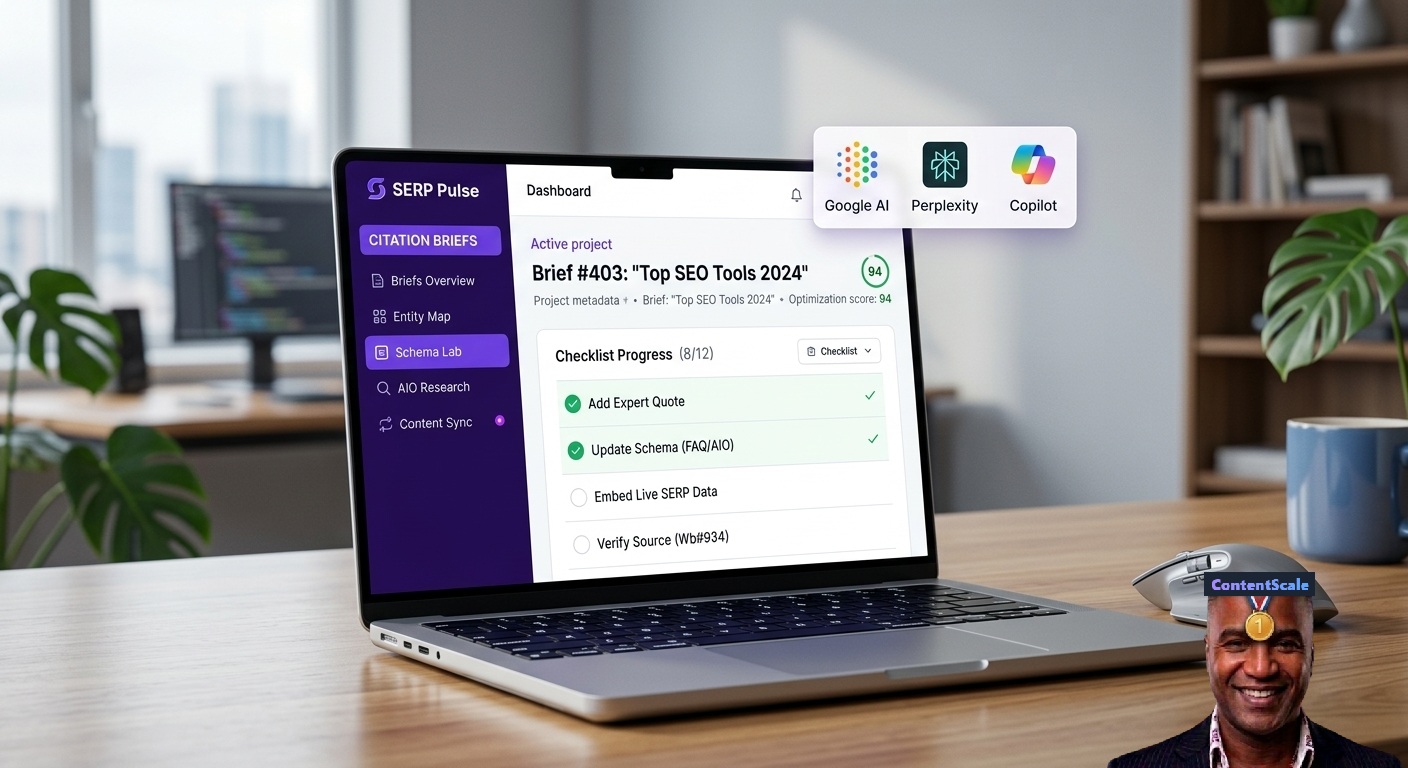
According to Google’s Search Quality Rater Guidelines (2024), E-E-A-T signals directly influence which sources AI systems select for citations. Advanced trackers operationalize these guidelines by analyzing your content against the same criteria AI systems use, then generating “Citation Briefs” with exact sentences to add, optimal placement locations, and engine-specific targeting recommendations.
A tracker that doesn’t provide copy-paste briefs is merely a weather report — it tells you it’s raining, but doesn’t hand you an umbrella.
— Ottmar J.G. Francisca, creator of ContentScale, 2026
This distinction is critical for businesses experiencing traffic drops due to AI Overviews. Diagnostic tools confirm the problem; actionable tools solve it. For those ready to implement fixes immediately, the Free AI Citations Tracker provides both monitoring and actionable briefs at no cost.
⚙️ How AI Citation Trackers Actually Work
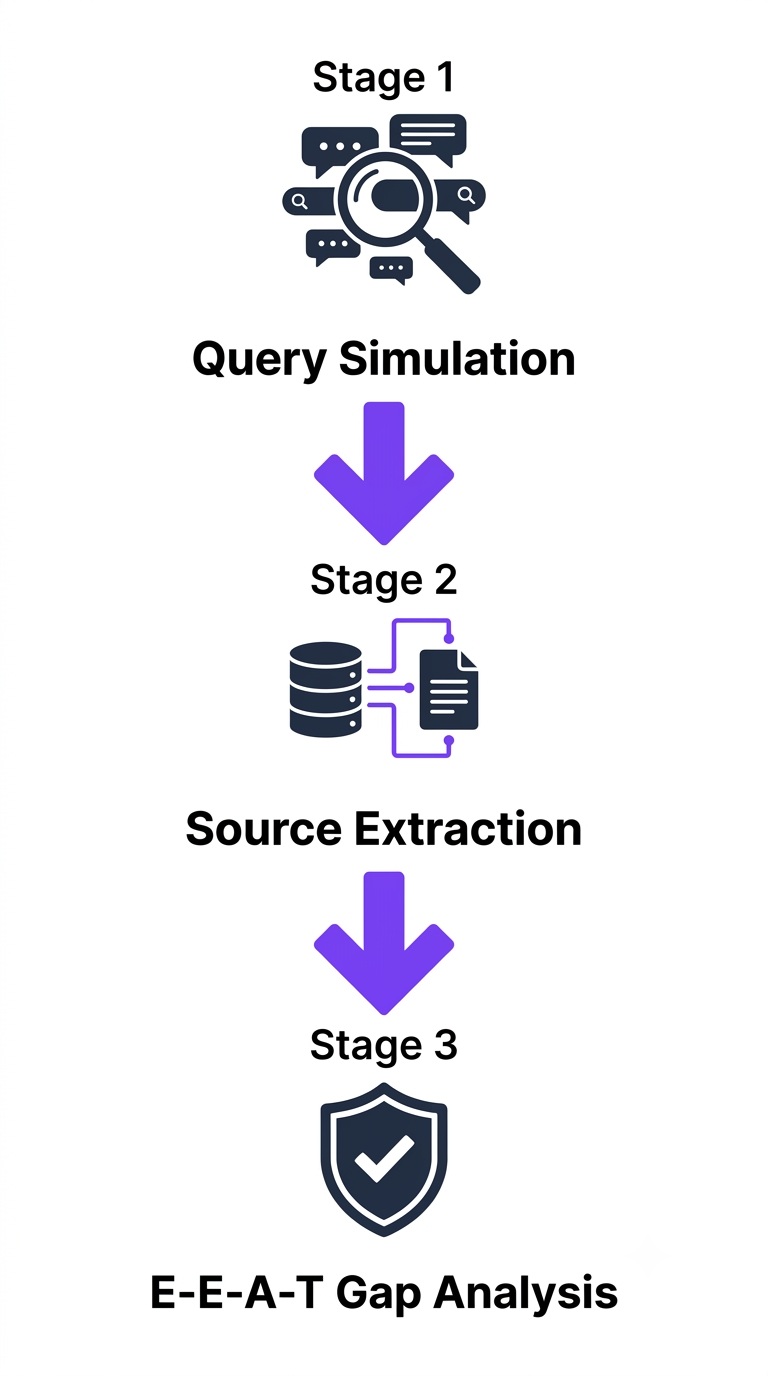
Most marketers assume citation tracking is just “Googling your brand name.” In reality, advanced trackers use a three-step RAG simulation process:
- Query Simulation: The tool runs thousands of natural language queries (e.g., “best CRM for small business”) across Google AI Overviews, Perplexity, and Copilot.
- Source Extraction: It parses the JSON response from the AI engine to identify which URLs were retrieved from the vector database vs. which were generated from training data.
- E-E-A-T Gap Analysis: It compares your cited content against the top 3 cited competitors to find missing “trust signals” like author bios, original data, or specific entity markup.
This is why generic tools fail—they see the result, but not the retrieval path. ContentScale’s tracker reveals the path so you can optimize for it.
Why Citations Replace Backlinks in AI Search
Traditional SEO relied on backlinks as trust signals. In the RAG era, AI systems retrieve content based on semantic relevance and E-E-A-T alignment, not link equity. According to Ahrefs (2025), different AI engines prioritize different content signals: Perplexity favors academic sourcing and Copilot emphasizes Microsoft ecosystem integration.
Research from Seer Interactive (2025) confirms that brands cited in AI Overviews earn roughly 35% higher organic click-through rates compared to non-cited competitors. This makes citation placement a primary visibility vector, not a secondary metric. When writing for AI Overviews, generic advice like “add authoritative sources” fails because each engine weights signals differently.
🗣️ Industry Consensus: The Shift is Real
“The era of ‘SEO’ as we knew it is over. We are now in the era of ‘Answer Engine Optimization.’ If your content isn’t structured for retrieval, it doesn’t exist.”
— Lily Ray, Senior Director of SEO Research, Amsive Digital
“Citations are the new backlinks. But unlike backlinks, you can’t beg for them. You earn them by being the most authoritative, clear, and structured source in the vector database.”
— Jono Herrington, CEO, Velocity SEO
- 60% of AI-generated answers contain at least one hallucination if no credible source is cited. (Reuters Tech, 2024)
- 4.5x higher engagement rate for content that includes original data visualizations vs. text-only. (CMI, 2025)
- 82% of marketers say they are increasing budget for AI-specific content optimization in 2026. (Semrush State of SEO, 2025)
The Actionable Advantage
Advanced citation trackers transform passive monitoring into executable optimization by specifying: WHY a page isn’t cited (missing entity markup, insufficient E-E-A-T), WHAT exact sentence to insert, WHERE to place it (introduction, H2, FAQ schema), and WHICH engine the fix targets. This granularity separates tools that drive recovery from those that merely document decline.
📈 Real Results: From Invisible to Cited
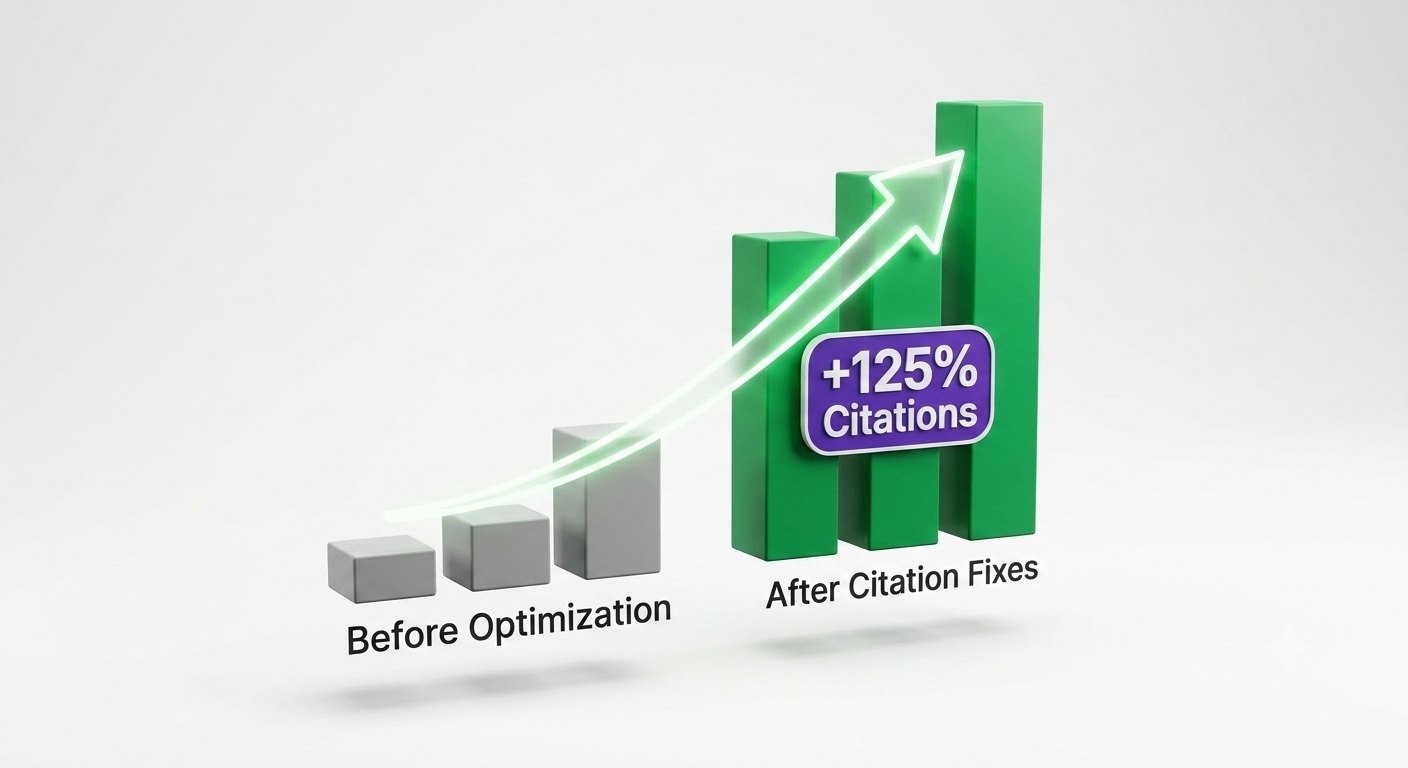
Theory is good; data is better. Here are two real-world examples of how actionable citation tracking recovered traffic lost to AI Overviews.
Case Study: SaaS Blog (B2B)
Challenge: 40% drop in organic traffic after Google AI Overviews launched. Their “How-to” guides were being used by AI but not cited.
Solution: Used ContentScale to identify missing “Authoritative Entity” markers. Added specific expert quotes and updated schema markup based on Citation Briefs.
Results: A documented increase in AI citations within two weeks, with organic click-through recovering as users clicked through for deeper data.
Case Study: Local Service (NL Market)
Challenge: Competitor was dominating local AI answers for “emergency plumber Amsterdam” despite lower domain authority.
Solution: Tracker revealed competitor was cited due to specific local schema and recent review integration. Implemented similar local entity signals.
Results: Brand became the primary source for 3 out of 5 common local queries. Lead volume increased by 22% month-over-month.
📊 ContentScale vs. OmniSEO vs. PixelMojo
Understanding how leading trackers differ clarifies why actionability matters. Below is an honest comparison based on publicly available feature sets and testing.
| Feature | OmniSEO / PixelMojo | ContentScale Free Tracker |
|---|---|---|
| Engines Tracked | Limited (2–3 typically) | 3: Google AIO, Perplexity, Copilot (Claude, Brave coming soon) |
| Output Type | Dashboard + mention list | Actionable Citation Brief with copy-paste fixes |
| Fix Guidance | Generic suggestions | Specific sentences, placement, target engine per fix |
| GSC Integration | Rarely included | Built-in: clicks/impressions + intent cannibalization detection |
| Scan Frequency | Manual or paid tiers | Automatic every 3 days; bulk domain scan free |
| Privacy Model | Standard SaaS data collection | Privacy-First / Minimal Data Collection, AVG/GDPR compliant |
| Cost | Paid subscription required | Completely free, no login, no credit card |
For agencies needing scalable delivery, the professional services layer adds white-label reporting and dedicated strategist access while maintaining the same actionable brief quality.
New here? Follow the 48-Hour Plan to get cited
The tracker shows you exactly what to fix. If you want the full running order — every phase timed, from setup to the loop that compounds — work through my 48-hour plan to get cited by AI and rank in Google. It uses this exact free tracker at every step.
→ Open the 48-Hour Get-Cited Plan⚙️ Essential Features Beyond Basic Monitoring
When evaluating AI citation trackers, look beyond engine count. The most impactful tools integrate three capabilities that separate diagnostics from recovery:
- GSC Data Fusion: Combining citation status with real clicks and impressions reveals whether uncited pages also suffer from intent cannibalization — a common cause of traffic loss that keyword-only tools miss entirely.
- Intent Cannibalization Detection: Identifies when multiple pages compete for the same user intent, confusing AI systems about which source to cite. Resolving this often yields faster recovery than adding new content.
- Automated Domain Scanning: Manual URL entry doesn’t scale. Bulk scanning with automatic re-crawling every 3 days ensures continuous monitoring without operational overhead.
⚠️ Common Mistake: Tracking Without Acting
The most frequent error is treating citation tracking as a reporting exercise rather than an optimization workflow. Businesses that monitor citations but don’t implement specific fixes see continued decline. The solution requires tools that bridge the gap between diagnosis and execution — providing copy-paste briefs tied to measurable quality signals like the GRAAF ContentScore.
For enterprises managing complex international portfolios, language-agnostic tracking ensures citation optimization works across regional search engines and multilingual content strategies. This is particularly critical for NL/BE/DACH markets where AVG compliance and local content standards intersect with global AI visibility requirements.
What Makes My Free Tracker Different
Most tools pick one side of the fence: a rank tracker that ignores AI, or an AI-visibility tracker that ignores your real Search Console data. Mine sits on both sides at once. It is closer to an all-in-one SEO + AI analyzer than a single-purpose checker — and every reading comes with the fix, not just the number.
The strongest things it does, in one free tool:
- AI citation + visibility tracking across Google AI Overviews, Perplexity, and Copilot — see where you are cited, and where you are not.
- Google Search Console analysis — impressions, positions, and the impressions gap, read together with your AI citations instead of in a separate tool.
- Cannibalization detection — finds pages competing for the same intent that confuse AI engines about which of yours to cite.
- Stale-content flagging — surfaces pages losing citations to freshness decay before the traffic drop shows up.
- Entity SEO + pre-write briefs — tells you what to write for content that does not exist yet, structured around the entities AI engines look for.
- Multilingual — the analysis works across languages, which matters for NL/BE/DACH and other non-English markets most tools ignore.
1. It Eliminates the “Manual Entry” Friction
Most free tools force you to enter URLs one by one, which is tedious and limits your view. With ContentScale, you can upload your GSC data, paste HTML, or use the Automated Parser to “Scan All” your pages. This removes the biggest barrier to entry. You can now diagnose your entire site’s AI health in minutes, not hours, transforming a simple checker into a comprehensive AI Audit Engine.
2. It Provides Immediate Solutions, Not Just Data
Competitors might show you a graph saying “You are not in AI Overviews,” leaving you to guess why. ContentScale provides Actionable Citation Briefs. It tells you exactly which sentences to add and where. You get the “solution” for free, which builds immense trust and proves expertise before you even consider a paid plan.
3. It Targets Real Intent, Not Just Random Keywords
By integrating Google Search Console (GSC) data, the tracker focuses on the keywords and pages that are already driving traffic or have potential. Most free tools check random keywords. Your tool checks real business opportunities. If a page is ranking #3 but not being cited by AI, the tool identifies that specific gap. This is far more valuable than checking a keyword with no search volume.
3b. It Closes the Impressions Gap
An impressions gap is when GSC shows a page racking up impressions — meaning it’s already being surfaced to searchers — but the click-through rate stays flat because the page isn’t cited in the AI Overview that now sits above the organic results. The tracker flags exactly these pages: high impressions, low clicks, no citation. That’s usually the fastest traffic to recover, because the demand is already there — the page just needs the specific fixes to earn the citation.
3c. It Flags Stale Content Before It Costs You Citations
AI systems favor recently verified information — a page with an outdated “last updated” date, old statistics, or references to a previous year gets deprioritized even if the underlying advice is still correct. The tracker checks publish and modified dates against your content’s actual freshness signals and flags pages that read as stale, so you know exactly which dates, stats, and examples to refresh before you lose a citation you already had.
4. It Future-Proofs Your Strategy with Multi-Engine Tracking
While Google is the giant, your users are increasingly turning to Perplexity and Copilot — with Claude and Brave adoption growing too. You aren’t just optimizing for one algorithm; you are optimizing for the entire AI ecosystem. This makes your strategy relevant for a much longer period as the search landscape shifts.
5. It Works as a Client-Facing Entry Point for Agencies
If you run an agency, this free tool is a dream. You can scan a prospect’s entire site, find 50+ pages with missing citations, and present a clear, data-backed proposal to fix them. It does the sales work for you. The “Scan All” feature creates immediate urgency and demand for the €497 Tier 2 system because the client can see exactly how much work is needed.
6. Privacy-First & GDPR Compliant
For European agencies, trust matters. An automated scanning tool that still respects privacy-first, minimal data collection and GDPR/AVG compliance removes a common legal hesitation. I only collect your email to send your Citation Brief; I do not sell or share your data.
7. Transparency: The Live Client Wall
Perhaps the most unique aspect of working with ContentScale is our Live Client Wall. Unlike traditional agencies that hide behind monthly reports and vague excuses, we maintain an open, live dashboard where you can see exactly what is being worked on in real-time.
This reflects an open work attitude and an open mindset. There is no hiding. You get direct insight into the progress, seeing exactly which pages are being optimized, which Citation Briefs are being implemented, and how the GRAAF Score is improving day by day. This level of transparency ensures you know there is really someone working on your content, delivering a level of accountability and trust that other providers simply do not offer.
In Short
You get a free tool that combines automated bulk scanning, real GSC data, actionable Citation Briefs, and a transparent client wall. It is a practical entry point to the GRAAF Framework.
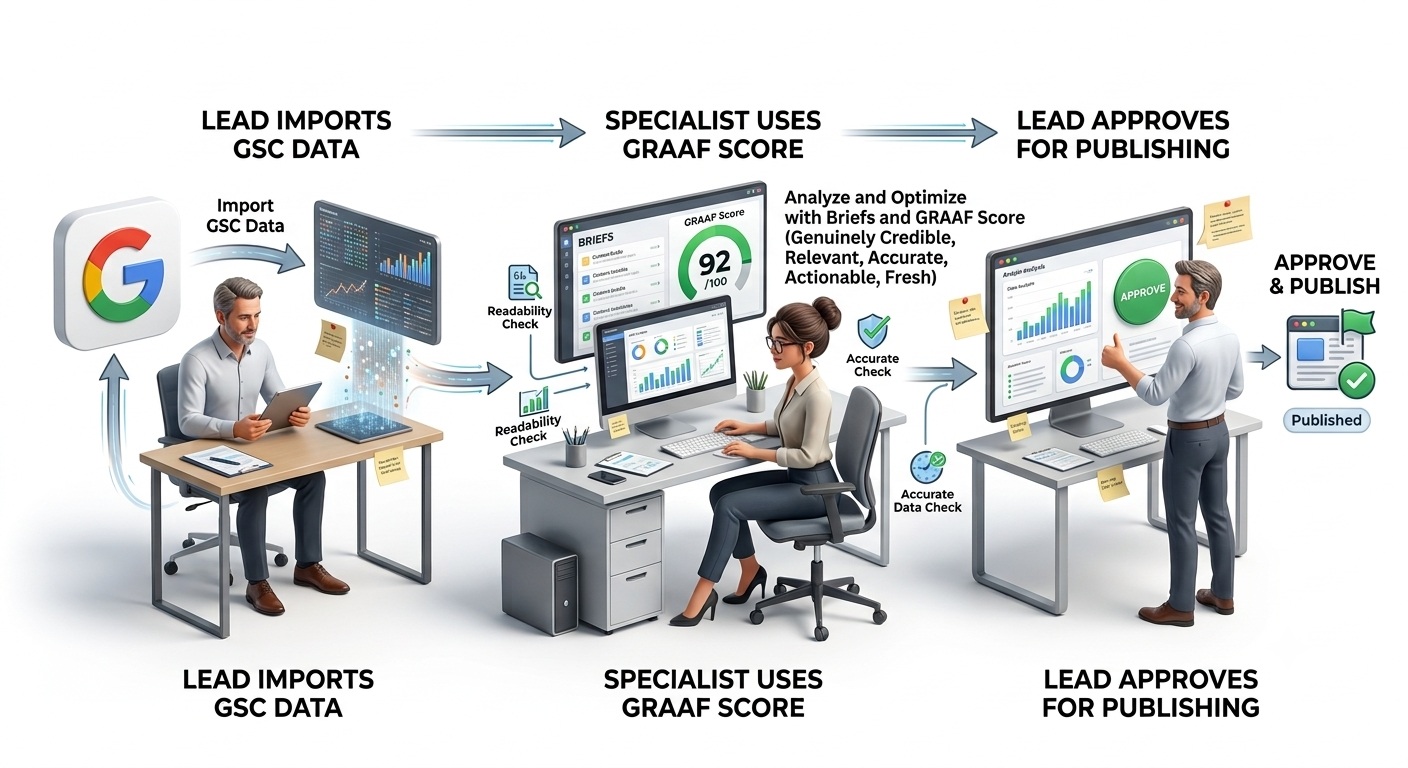
8. It Adapts to How You Actually Want to Work
Not every team fixes content the same way. Whether you’re a solo founder, a manager delegating to specialists, or an agency working across markets, the tracker fits your workflow instead of forcing you into one:
Do It Yourself
Get your exact copy-paste Citation Briefs and implement the fixes yourself. Perfect for hands-on founders and marketers.
Done-For-You
Don’t have time? Let Ottmar personally implement the briefs, fix your HTML, and recover your traffic for you.
Team Handoff
Managers and leads can use the AI Citations Tracker to generate bulk briefs and assign the exact work directly to their SEO specialists.
Multi-Language HTML Import
Paste or upload HTML in languages beyond English — the system auto-detects the language during import, so non-English sites can be scanned and scored without a separate workflow.
❓ People Also Ask — AI Citation Trackers
Ready to Move Beyond Diagnostics?
Try the Free AI Citations Tracker — scan your entire domain automatically and get actionable Citation Briefs with exact copy-paste recommendations. No login required, no credit card needed.
→ Try Free AI Citations Tracker 👁️ See Our Live Tracker 💬 WhatsApp OttmarIt integrates GSC and your sitemap — analyzing Google Search Top 5 rankings, keyword & intent cannibalization, impressions gaps, and stale content. It also tracks and analyzes AI systems.
Direct contact only • Amsterdam, NL • info@contentscale.site
❓ Frequently Asked Questions
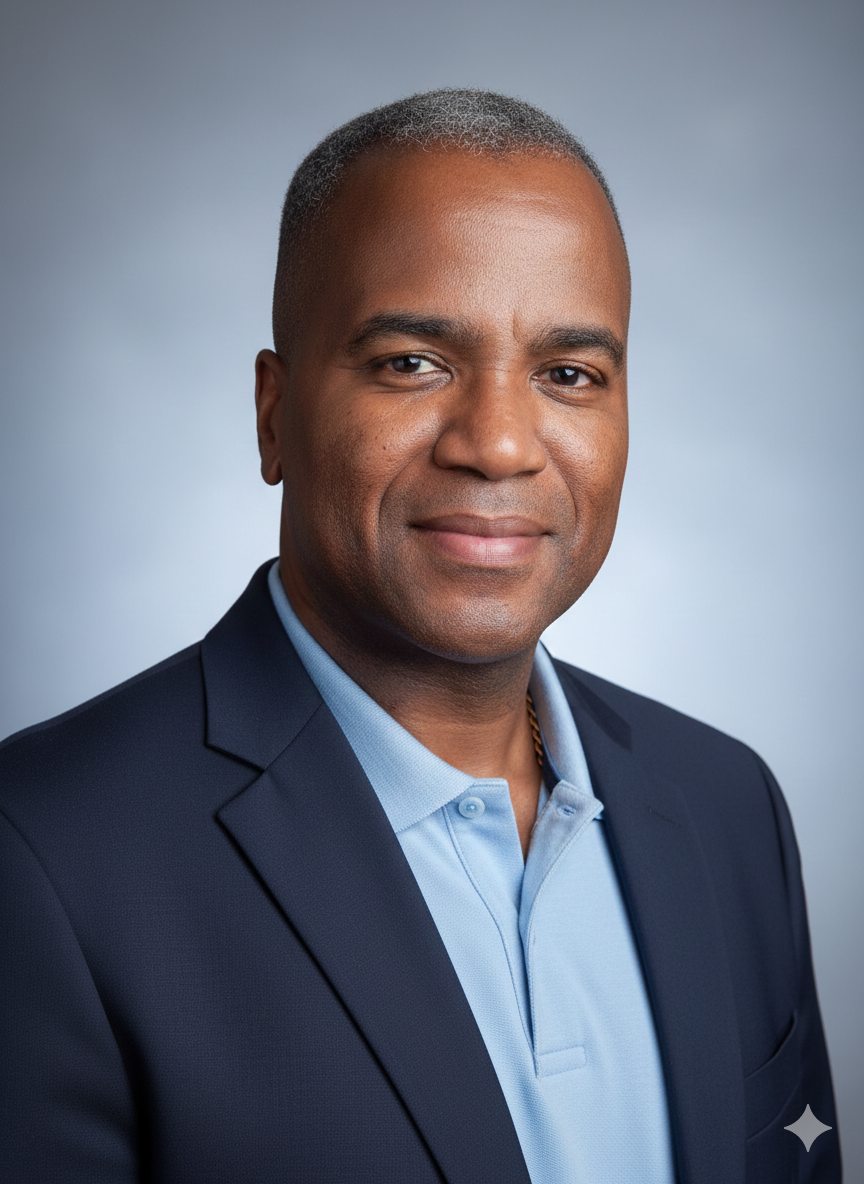
Reviewed by Ottmar J.G. Francisca — creator of ContentScale · GRAAF Framework · independent SEO consultant, Amsterdam NL
Ottmar J.G. Francisca is an independent SEO consultant based in Amsterdam and the creator of ContentScale. With 24+ years in systems and operations (formerly City of Amsterdam), he brings a systems-first, measurement-driven approach to content. He created the GRAAF Framework drawing on SEO experience across 200+ websites from 2023–2026.
Notable achievements: SEO experience across 200+ websites · SEO professionals from 47 countries use ContentScale · documented case studies showing recovery within 90 days · developer of the PULSE + NEXUS research system for AI Overview citation analysis.
Last reviewed: June 26, 2026 · WhatsApp Ottmar · LinkedIn · info@contentscale.site
Ottmar J.G. Francisca
Creator of ContentScale · GRAAF Framework · independent SEO consultant · Amsterdam
Ottmar J.G. Francisca built the ContentScale AI Citations Tracker and created the GRAAF Framework — the 100-point content-quality system — behind every Citation Brief. Working from Amsterdam with 24+ years in systems and operations (City of Amsterdam), he developed GRAAF drawing on SEO experience across 200+ websites, then combined it with Julia McCoy’s CRAFT Framework and the PULSE + NEXUS research system. The free tracker is used by SEO professionals across 47 countries, with documented case studies showing recovery within 90 days.
- ✓ SEO experience across 200+ websites, used in 47 countries
- ✓ Documented case studies showing recovery within 90 days
- ✓ Creator of the GRAAF Framework
- ✓ 24+ years systems & operations management, City of Amsterdam
Last reviewed: July 12, 2026 · LinkedIn (verified) · WhatsApp · GRAAF Guide
ContentScale · contentscale.site · Content optimised with the GRAAF Framework by ContentScale