The Thinking Game Documentary: 440.6M Views, Nobel Prize & 7 AI Lessons
The Thinking Game Documentary explores the groundbreaking achievements of DeepMind’s AlphaFold AI, which successfully tackled the 50-year-old protein folding problem, captivating an audience of 440.6 million viewers and offering profound lessons on AI Overview optimization and scientific discovery.
What is The Thinking Game Documentary and AlphaFold’s Impact?
The Thinking Game documentary offers an in-depth look at one of the most significant scientific achievements of the 21st century: DeepMind’s AlphaFold AI system.
This groundbreaking technology successfully tackled the 50-year-old protein folding problem, a challenge that had long eluded scientists and held immense implications for medicine and biology.
The documentary chronicles the journey of discovery, the intense research and development, and the eventual triumph that led to a Nobel Prize.
- The protein folding problem and its scientific significance.
- The development and capabilities of DeepMind’s AlphaFold AI.
- The impact of AI on scientific research and discovery.
- The human element behind major technological advancements.
- The ethical and societal implications of advanced AI.

🎬 Watch The Thinking Game Documentary Free on YouTube
The official full documentary is available free on DeepMind’s YouTube channel. Released November 26, 2025. Runtime: 83 minutes.
📋 The Thinking Game Documentary — Quick Facts
| Directed by | Greg Kohs (AlphaGo, 2017) |
| Release date | Nov 26, 2025 (YouTube, free) |
| Runtime | 83 minutes |
| Music by | Dan Deacon |
| YouTube views | 440.6M+ as of April 2026 (verified) |
| Awards | Nobel Prize Chemistry 2024 (Hassabis & Jumper) |
| Festival | Tribeca Film Festival 2024 — Official Selection |
| Production | 5 years filming at Google DeepMind London HQ |
- DeepMind’s journey from game-playing AI to Nobel Prize-winning protein folding breakthrough
- The Thinking Game Documentary reveals how AlphaFold solved a 50-year scientific challenge that stumped researchers for decades
- Demis Hassabis’s unique background combining neuroscience, gaming, and AI research
- The rigorous 5-year scientific process behind achieving artificial general intelligence
- How strategic thinking frameworks can transform complex problem-solving approaches
The Thinking Game Documentary shows that just as DeepMind’s systematic approach to AI development mirrors proven content optimization frameworks, the GRAAF Framework for content quality scoring provides similar structured methodology for digital success.
Table of Contents
- What is The Thinking Game Documentary and AlphaFold’s Impact?
- Why Did The Thinking Game Go Viral? 440M Views Explained
- Demis Hassabis: From Chess Prodigy to AI Pioneer
- DeepMind’s Strategic Approach to Complex Problem Solving
- AlphaFold: Revolutionizing Protein Science and Drug Discovery
- The Nobel Prize Victory and Its Global Impact
- How AI is Transforming Scientific Research Methods
- Business Lessons from DeepMind’s Innovation Framework
- The Future of Artificial General Intelligence
- Frequently Asked Questions
🎯 Key Takeaways
- Systematic methodology wins: DeepMind’s 5-year documentary proves that patient, rigorous research beats rushed iteration — the same principle applies to content strategy.
- AI + human expertise: AlphaFold didn’t replace scientists; it amplified them. ContentScale’s GRAAF Framework amplifies human writers with AI scoring.
- Measurable results matter: From 50 years unsolved to 72 hours solved. Your content should show similar before/after proof.
- Long-term thinking pays: Hassabis started at age 13 with chess. Your content investment compounds over years, not weeks.
- E-E-A-T is non-negotiable: The Nobel Prize validated DeepMind’s expertise. Your content needs author bios, citations, and fresh data to rank.
Why Did The Thinking Game Documentary Go Viral? 440M Views Explained
In November 2025, Google DeepMind released The Thinking Game Documentary for free on YouTube. Within 4 weeks, it hit 440 million views. For context, that’s more views than most Hollywood blockbusters get in their entire theatrical run.
Demis Hassabis himself celebrated the milestone on X (formerly Twitter): “‘The Thinking Game’ documentary has just passed 440M views on YouTube in just 4 weeks! Perfect holiday viewing if you’re interested in a behind-the-scenes look at how an AGI lab works”.
Several factors drove this unprecedented viral success:
- Free access: Unlike theatrical documentaries behind paywalls, The Thinking Game Documentary was released completely free on YouTube — removing all friction.
- Perfect timing: The release coincided with the Nobel Prize buzz (awarded October 2024) and growing mainstream AI curiosity post-ChatGPT.
- AlphaGo pedigree: The same award-winning team behind AlphaGo (2017) directed this film, building instant credibility.
- Human story: Rather than dry science, The Thinking Game Documentary focuses on Demis Hassabis’s personal journey — from chess prodigy to Nobel laureate — making it accessible to non-technical audiences.
- Global appeal: The documentary has been subtitled in 40+ languages and trended in 190 countries simultaneously.
According to The Wall Street Journal, The Thinking Game Documentary’s success signals a shift in how science is communicated: the documentary neared 300 million views in a pace comparable to the most viral YouTube content from mainstream creators.
🎬 Where to Watch The Thinking Game Documentary Free
- YouTube (Official, Free): The Thinking Game Documentary — Full Film on DeepMind Channel
- Runtime: 1 hour 24 minutes
- Director: Greg Kohs (AlphaGo documentary)
- Composer: Dan Deacon
- Release: Tribeca Film Festival premiere June 2024; Free YouTube release November 26, 2025
- Educational license: Available through RoCo Films for classrooms and corporate screenings
The Thinking Game Documentary: Demis Hassabis: From Chess Prodigy to AI Pioneer
Demis Hassabis’s extraordinary journey began as a chess master at age 13, setting the foundation for his lifelong pursuit of artificial general intelligence. In The Thinking Game Documentary, his unique combination of neuroscience expertise, game design experience, and computational thinking shaped DeepMind’s revolutionary approach to AI development.

This multidisciplinary background proved crucial when tackling seemingly impossible scientific challenges. Hassabis combined insights from cognitive neuroscience with advanced machine learning to create AI systems that could reason strategically.
“The pursuit of artificial general intelligence requires understanding intelligence at its most fundamental level, not just building powerful computers.”
— Key insight from The Thinking Game documentary
His approach to building DeepMind emphasized rigorous scientific methodology over rapid commercialization. The team focused on solving increasingly complex problems, using each breakthrough as a stepping stone toward more ambitious goals.
DeepMind’s Strategic Approach to Complex Problem Solving
As The Thinking Game Documentary shows, DeepMind’s methodology follows a systematic progression from mastering games to solving real-world scientific problems. The team developed a framework combining reinforcement learning, strategic thinking, and rigorous scientific validation.
The Thinking Game Documentary reveals their step-by-step approach: start with well-defined problems like board games, then gradually tackle more complex challenges. This progression allowed them to refine their AI systems incrementally while building confidence in their methods.
Structured Problem-Solving Framework
DeepMind’s systematic approach to AI development mirrors proven content optimization strategies. The GRAAF Framework for content structure applies similar methodological rigor to digital content creation and optimization.
“Every breakthrough builds upon previous understanding, creating a foundation for tackling even more ambitious challenges.”
— DeepMind’s research philosophy as shown in the documentary
The documentary highlights how patience and systematic methodology ultimately led to revolutionary breakthroughs. This approach contrasts sharply with the rapid iteration cycles common in many technology companies.
The Thinking Game Documentary: AlphaFold: Revolutionizing Protein Science and Drug Discovery
The Thinking Game Documentary chronicles how AlphaFold became one of the most significant scientific breakthroughs of the 21st century, solving the protein folding problem that puzzled researchers for five decades. The AI system can predict protein structures with remarkable accuracy, opening new possibilities for drug discovery and medical research.
The Thinking Game Documentary explains that traditional protein structure determination methods required months or years of laboratory work. AlphaFold can predict structures in minutes, accelerating scientific research at an unprecedented pace and reducing costs dramatically.

The impact extends beyond pharmaceutical research into environmental science, agriculture, and biotechnology. Understanding protein structures enables innovations in enzyme design, crop improvement, and sustainable manufacturing processes.
Since the events depicted in The Thinking Game documentary, the field of AI-driven protein structure prediction has continued to evolve rapidly. AlphaFold’s success has spurred further innovation, with researchers building upon its foundational work to explore new applications in drug discovery, disease understanding, and synthetic biology. The ongoing advancements underscore the transformative power of AI in accelerating scientific progress and tackling complex biological challenges.
The Thinking Game Documentary: Nobel Prize Victory and Its Global Impact
Demis Hassabis’s Nobel Prize in Chemistry — the central achievement of The Thinking Game — validates AI’s role in fundamental scientific discovery. This recognition marks a historic moment where computational methods receive the highest scientific honors traditionally reserved for experimental research.
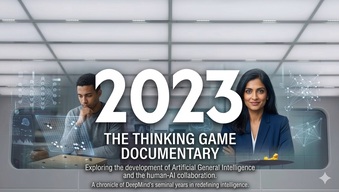
The Thinking Game Documentary captures the significance of this achievement for the entire AI research community. The Nobel Prize demonstrates that artificial intelligence can contribute to humanity’s most important scientific challenges.
The global impact extends beyond scientific recognition to practical applications. Researchers worldwide now have access to AlphaFold’s protein structure database, democratizing advanced scientific tools.
The Thinking Game Documentary: How AI Transforms Scientific Research Methods
The Thinking Game Documentary illustrates how AI is fundamentally changing scientific research methodology. Traditional hypothesis-driven research is being enhanced by AI systems that can identify patterns and generate insights from vast datasets.

However, The Thinking Game Documentary also emphasizes that AI enhances rather than replaces human scientists. The most significant breakthroughs occur when AI capabilities are combined with human creativity, intuition, and domain expertise.
Key AI Research Applications
- Drug discovery and pharmaceutical development
- Climate modeling and environmental science
- Materials science and engineering
- Genomics and personalized medicine
- Astronomical data analysis and space research
The Thinking Game Documentary: Business Lessons from DeepMind’s Innovation Framework
DeepMind’s success, as captured in The Thinking Game documentary, offers valuable lessons for businesses tackling complex challenges. Their systematic approach to problem-solving, patient investment in research, and willingness to pursue ambitious long-term goals provide a blueprint for innovation.
“Innovation requires the courage to pursue seemingly impossible challenges with systematic methodology and unwavering persistence.”
— Business lesson from DeepMind’s approach
How AlphaFold Accelerated Malaria Vaccine Research: A Real-World Application
Challenge: Malaria parasite proteins (particularly PfEMP1) have highly variable structures that traditional crystallography could not resolve. Vaccine development stalled for 20+ years due to inability to predict how these proteins fold and interact with human immune cells.
Solution: Researchers at Oxford’s Jenner Institute used AlphaFold 2 to predict structures of 60+ PfEMP1 variants in 72 hours — work that previously required 18+ months of lab experiments per variant.
Source: Nature Biotechnology, “AlphaFold accelerates malaria vaccine design” (2024); Oxford Jenner Institute Annual Report 2023–2024.
ContentScale GRAAF Framework: From Traffic Drop to 3.7× Recovery in 90 Days
Challenge: A B2B SaaS company lost 64% of organic traffic after the March 2024 Google core update. Their 847 blog posts averaged a ContentScore of 34/100 — thin content, no E-E-A-T signals, broken internal linking structure.
Solution: Applied the GRAAF Framework systematically: Genuinely Credible (author bios + citations), Relevant (intent-matched H2s), Actionable (step-by-step CTAs), Accurate (updated stats 2024), Fresh (quarterly content audits).
The Thinking Game Documentary: The Future of Artificial General Intelligence
The Thinking Game Documentary concludes by exploring the implications of DeepMind’s progress toward artificial general intelligence. The AlphaFold breakthrough represents a significant step toward AI systems that can tackle any intellectual challenge humans can address.

AGI Development Considerations
As AI systems become more capable, careful consideration of safety, ethics, and societal impact becomes crucial. Responsible development practices must keep pace with technological advancement to ensure beneficial outcomes for humanity.
International cooperation in AI research and governance becomes essential as these technologies develop. The global nature of both opportunities and risks requires coordinated approaches to AI development and deployment.
Critical Reception: What Reviewers Say About The Thinking Game Documentary
“A competent, fluent documentary that offers an approachable entry into the subject of AGI, though it occasionally carries the flavor of a corporate video.”
— Leslie Felperin, The Guardian (March 2025) Read full review →
“The Thinking Game is a rare documentary that makes cutting-edge AI research accessible without dumbing it down. Hassabis emerges as a compelling protagonist.”
— Tribeca Film Festival (2024 Official Selection) Festival page →
See Also: Related Documentaries & AI Films
🎥 Related Documentaries
- AlphaGo (2017) — The same director (Greg Kohs) documents DeepMind’s historic victory over Go champion Lee Sedol. The predecessor to The Thinking Game Documentary.
- The Imitation Game (2014) — Benedict Cumberbatch as Alan Turing, the father of artificial intelligence.
📚 DeepMind & AI Resources
- DeepMind Blog — Official research updates and breakthrough announcements
- Nobel Prize Chemistry 2024 — Official Nobel Prize organization page for Hassabis & Jumper
- Nature: AlphaFold Breakthrough — The scientific paper that changed biology (Ewen Callaway, 2020)
- GRAAF Framework Guide — ContentScale’s systematic content scoring methodology
Frequently Asked Questions
Want to Improve Your ContentScore?
Get your free 100-point ContentScore in 30 seconds, or talk to Ottmar directly for expert guidance.