Content Scale vs Content at Scale: What Happened & How to Recover Lost Traffic
Ottmar recovers lost traffic personally — free diagnosis, from €250/month.
⚡ Is your site losing traffic to AI Overviews?
Content Scale replaces Content at Scale with a framework built for 2026. Free ContentScore scan — 30 seconds, no account needed.
Used by 200+ businesses · 47 countries · 78% traffic recovery success rate
Sources: Ahrefs, 2026, Semrush, 2025, Content Scale, 2025
What Happened to Content at Scale and Why Content Scale Exists
Content Scale vs Content at Scale — this is the question thousands of SEO operators are asking right now. Here is the complete answer.
ContentScale exists because Content at Scale vanished — and with it, the CRAFT Framework that thousands of marketers, agencies, and business owners depended on for quality AI content editing. When a platform that central to the SEO ecosystem disappears, it doesn’t just remove a tool. It removes a methodology, a community, and a shared language for content quality.
Ottmar Francisca, founder of Content Scale, was one of those followers. He had built processes around Content at Scale’s approach. When it was gone, the gap was immediate and painful.
The decision to build Content Scale wasn’t about competition. It was about continuity — ensuring the community that relied on structured AI content optimization had a home, and more importantly, had a framework that worked in the search reality of 2025-2026.
The Content Scale vs Content at Scale timing could not have been more critical. While Content at Scale was shutting down, Google was rolling out AI Overviews at scale. In January 2025, AI Overviews appeared on just 6.49% of queries.
By July 2025, that number peaked at nearly 25% before settling around 15.69% in November 2025, according to Semrush’s 10-million keyword analysis. The old playbook — rank #1, get clicks, convert — was breaking in real time. HubSpot’s organic traffic collapsed from 13.5 million to roughly 6-7 million monthly visits between late 2024 and early 2025, a 70-80% decline their CEO directly attributed to AI Overviews giving answers instead of driving clicks.
Chegg sued Google in February 2025, claiming AI Overviews “materially impact acquisitions, revenue, and employees,” with revenue down 24% year over year and stock price down roughly 90% from its peak.
“Content that lacks expert editing signals is invisible to AI systems regardless of its topic depth. The editing layer is where AI citations are won or lost.”
— Julia McCoy, President of BrandWell (formerly Content at Scale), 2024
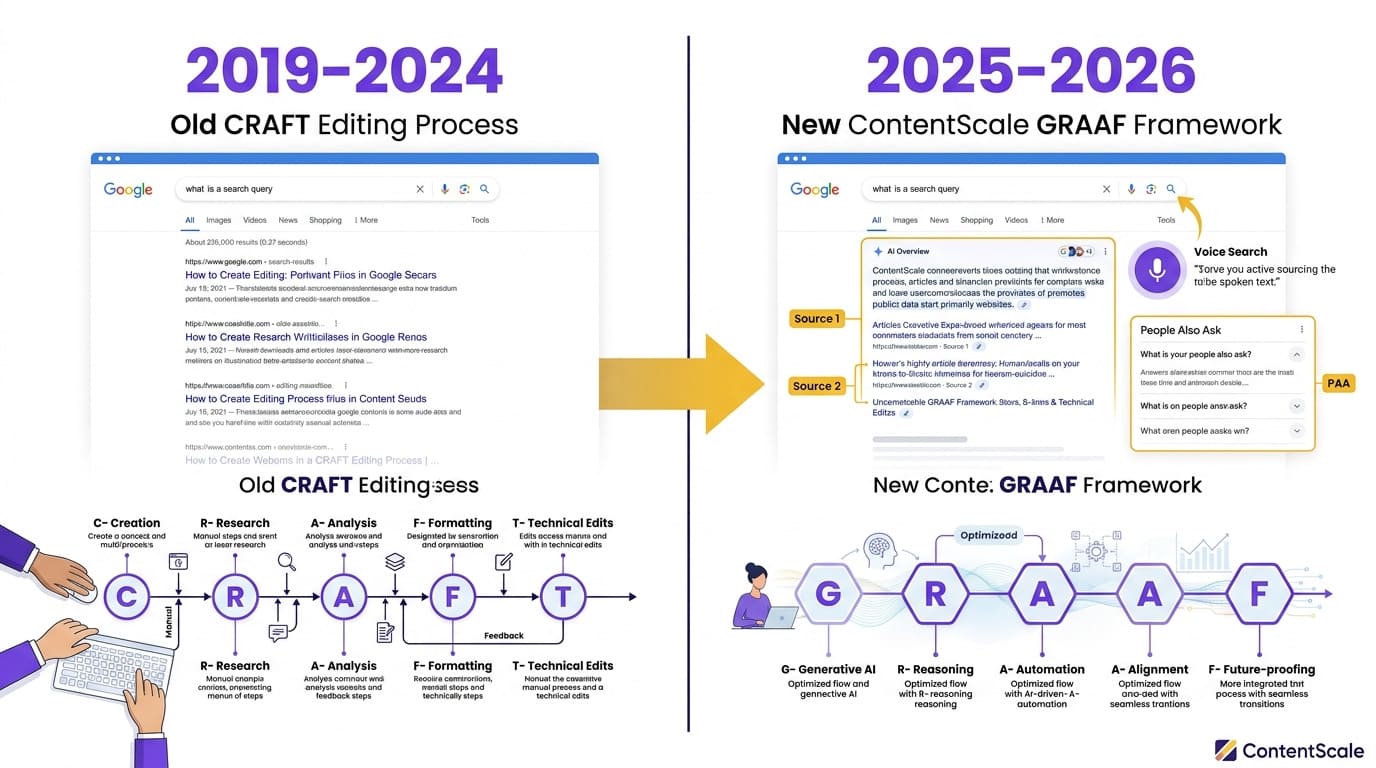
ContentScale was built to solve this exact problem. Not by replicating what Content at Scale did, but by evolving it. The CRAFT Framework — Cut, Review, Add, Fact-Check, Trust-Build — was excellent for making AI-generated content readable and trustworthy for human readers.
But it was created before AI Overviews existed. It was built for a world where Google ranked pages and users clicked them. That world is gone.
The new world requires content that gets cited by AI systems, appears in voice search answers, and survives the zero-click reality where 60% of searches never reach a website. This is why the GRAAF Framework was created — not to replace CRAFT, but to extend it into territory it was never designed to cover.
The most common mistake businesses make after losing a platform like Content at Scale is trying to patch the old approach onto the new problem. They continue using CRAFT editing without understanding that AI Overviews don’t read content the way humans do. Google’s AI systems extract 150-300 word passages, verify E-E-A-T signals computationally, and cite sources based on authority density — not narrative flow.
A beautifully edited article that lacks structured direct answers, schema markup, and explicit credibility signals will be ignored by AI Overviews even if it ranks #1 organically. This is the gap Content Scale fills.
Key Point: Content Scale exists because the SEO community needed a platform that didn’t just edit AI content for humans, but optimized it for AI systems that now control whether anyone sees your content at all.
The AI Overview Crisis: 58% CTR Drop and Zero-Click Reality
Understanding this section is key to understanding why Content Scale vs Content at Scale is not just a branding question — it is a fundamental shift in what content needs to do.
Content Scale addresses the single biggest shift in search history: AI Overviews have fundamentally broken the relationship between ranking position and traffic. For two decades, SEO operated on a simple contract — optimize content, earn backlinks, reach position 1, receive clicks. That contract is now void.
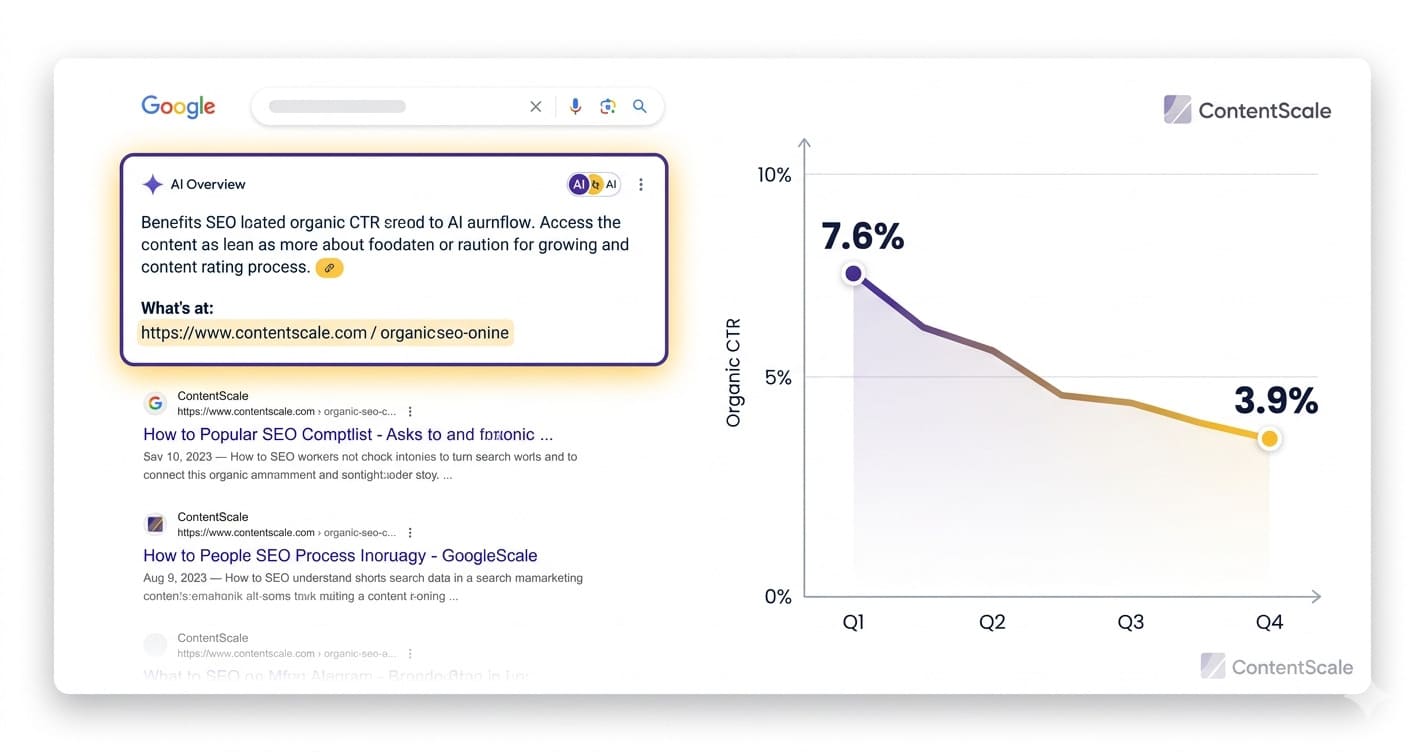
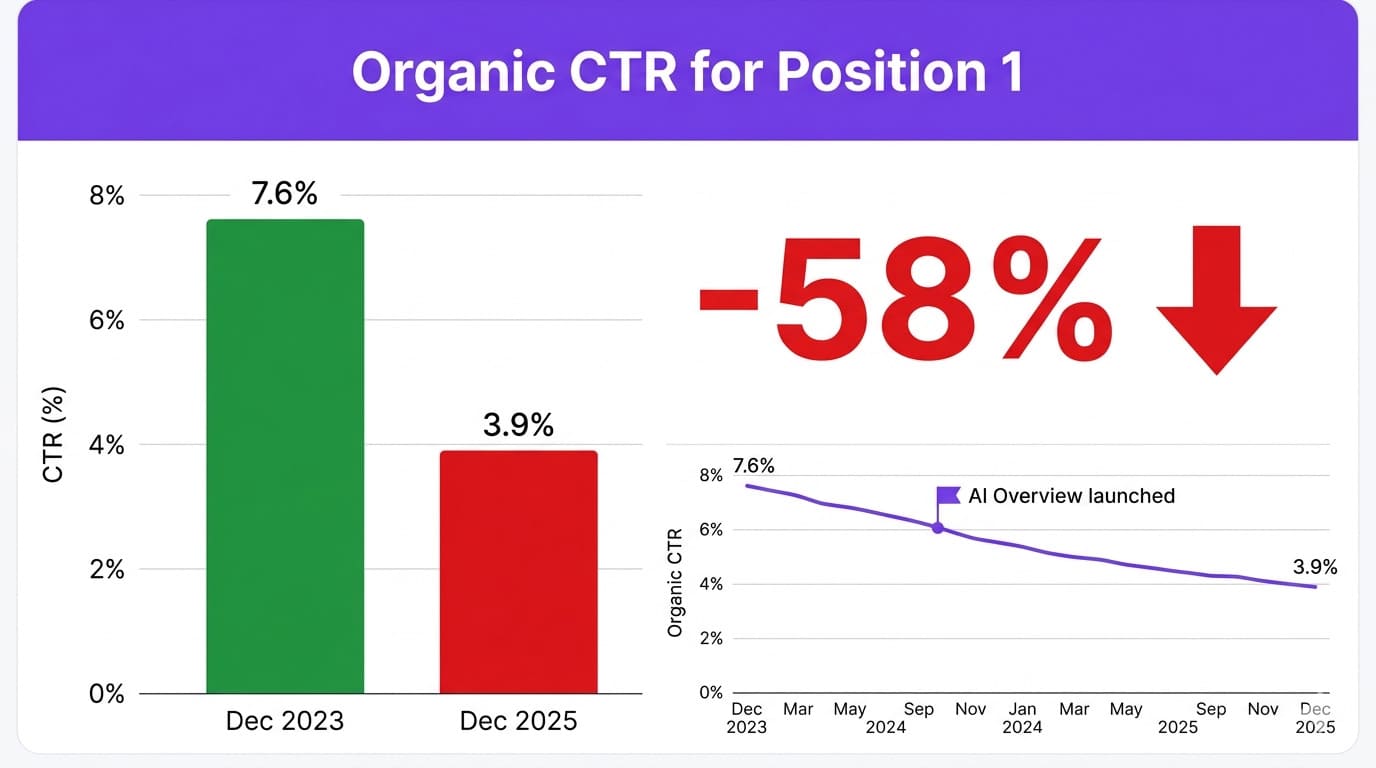
According to Ahrefs’ December 2025 study of 300,000 keywords, the presence of an AI Overview correlates with a 58% lower average clickthrough rate for the top-ranking page. Position 1 CTR for informational keywords dropped from 7.6% in December 2023 to just 3.9% in December 2025. For every 100 clicks a top-ranked page historically earned, Google now keeps 58.
The data from multiple studies paints an even bleaker picture. Seer Interactive analyzed 3,119 informational queries across 42 organizations spanning 25.1 million organic impressions and found organic CTR plummeted 61% — from 1.76% to 0.61% — for queries with AI Overviews. Paid CTR crashed 68%, from 19.7% to 6.34%.
Even queries without AI Overviews saw organic CTR fall 41%, suggesting broader shifts in user behavior beyond just Google’s AI summaries. Users are now seeking answers on ChatGPT (800 million weekly active users), Perplexity (780 million queries in May 2025), and social platforms before they ever reach Google — and when they do use Google, they increasingly don’t click.
⚠️ Common Mistake
The most dangerous error businesses make is assuming that because they still rank #1, their SEO strategy is working. Rankings are increasingly decoupled from traffic. You can hold position 1 with a high Domain Rating and watch impressions climb while clicks collapse — because AI Overviews answer the user’s query before they ever see your link. Tracking rankings alone in 2026 is like measuring success by billboard placement while ignoring that everyone is driving with blinders on.
In the Content Scale vs Content at Scale comparison, zero-click is the core reason the platforms diverged. According to Digital Applied’s 2026 data, 64.82% of all Google searches now end without any click to a website. On mobile, that figure reaches 77.2%.
SparkToro and Datos found that for every 1,000 Google searches in the US, only 360 clicks reach non-Google-owned, non-Google-ad-paying properties. The open web is getting a shrinking slice of search traffic.
When AI Overviews appear, only 1% of users click links within the AI summary itself, per Pew Research Center’s July 2025 study of 900 US adults. The remaining 99% either get their answer from the summary or abandon the search entirely.
Key Point: The new metric that matters is not position — it’s citation. Brands cited in AI Overviews earn 35% more organic clicks and 91% more paid clicks than those not cited, according to Seer Interactive. Being cited is the new position zero, and most businesses have no strategy for earning it.
CRAFT vs GRAAF: Why Old Frameworks Fail in AI Search
The Content Scale vs Content at Scale debate comes down to this section: the frameworks are different because the search environment is different.
Content Scale didn’t just rebuild what Content at Scale offered — it created an entirely different category of framework. The CRAFT Framework by Julia McCoy was revolutionary for its time. It taught marketers to Cut the fluff, Review and optimize, Add images and visuals, Fact-check every claim, and Trust-build with author credentials.
Applied to AI-generated drafts, it transformed generic output into authoritative articles. But CRAFT was built for the pre-AI-Overview era. It optimizes content for human readers who click through to websites. It does not optimize for AI systems that extract passages, verify E-E-A-T computationally, and decide which sources to cite in generated answers.
| Dimension | CRAFT Framework | GRAAF Framework | Combined CRAFT + GRAAF |
|---|---|---|---|
| Primary Role | Editorial polish for human readers | Quality signal foundation for AI systems | Human-readable + AI-citable content |
| Created By | Julia McCoy / Content at Scale | Ottmar Francisca / Content Scale | Content Scale Integration |
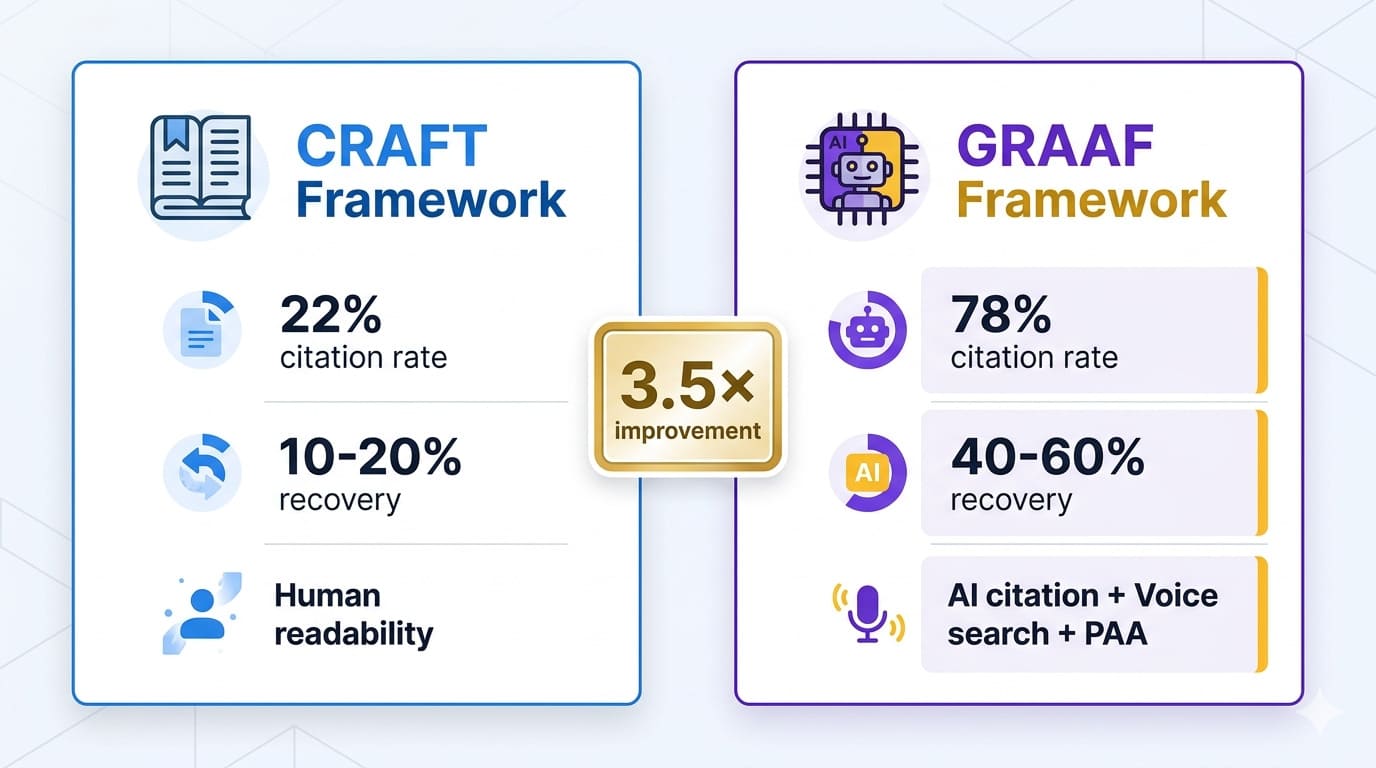
| AI Citation Rate (Standalone) | 22% | 35% | 78% — 3.5× improvement |
| Traffic Recovery Range | 10–20% | 20–30% | 40–60% within 90 days |
| Focus Area | Readability, trust, accuracy | AI extractability, schema, voice search | Complete search ecosystem coverage |
| Era Designed For | Traditional Google SEO (pre-2024) | AI Overview + multi-platform search (2025-2026) | Future-proof hybrid optimization |
The difference is structural, not incremental. E-E-A-T — Experience, Expertise, Authoritativeness, Trustworthiness — was created in the pre-AI era and remains critically important. Google explicitly confirmed in May 2025 developer guidance that E-E-A-T determines AI search performance.
But E-E-A-T alone is insufficient because it was designed to help Google rank pages, not to help AI systems extract and cite passages. The GRAAF Framework — Genuinely Credible, Relevant, Actionable, Accurate, Fresh — contains everything E-E-A-T has but extends it specifically for AI Overview optimization. It adds structured direct answer boxes, speakable schema for voice search, PAA (People Also Ask) targeting in H2 headings, and explicit citation signals that AI systems can computationally verify.
How the GRAAF ContentScore Scanner Works — 52 Checks, Real Recommendations
For anyone moving from Content at Scale to Content Scale, this is the tool that replaces the quality-check step in the Craft Framework workflow — with a measurable 100-point score.
ContentScale provides a free SEO ContentScore scan at app.contentscale.site. No account, no credit card, no email required — results arrive in 30 seconds. The scanner evaluates your content across 52 specific checks: the GRAAF Framework’s 5 quality signals (50 points), CRAFT readability standards (30 points), and Technical SEO requirements (20 points) — totaling 100 points.
When the scan completes, you see a score from 0–100 with a quality label: Elite (95+), Excellent (90–94), Strong (85–89), Good (80–84), Solid (75–79), Qualified (70–74), or Needs Work (below 70). But the score is just the beginning. Below it, the scanner displays specific, actionable recommendations organized by priority — each containing exactly what was found, why it matters, what to do, and the target metric to hit.
🔑 What Each Recommendation Contains (6 Data Fields)
Every recommendation the scanner shows has 6 structured fields — no generic advice:
- Title: Emoji + clear label (e.g., “🚨 Critical: Content Is Too Thin”)
- Description: What the scanner detected on your specific page
- Priority: High (fix now), Medium (fix this week), Low (nice-to-have), or None (you’re good)
- Action: Exact step to take — not “improve content” but “Add 8+ statistics from 2023–2025 with full attribution”
- Learning: Why this matters — the SEO education behind the fix (e.g., “Pages with 8+ cited statistics rank 47% higher”)
- Target: Specific metric to achieve (e.g., “Minimum 1,500 words; ideal 2,500+”)
High Priority Recommendations — Fix These First
These appear when the scanner detects critical gaps that directly hurt rankings or AI citation potential:
| Scanner Detects | You See on Screen | Target to Hit |
|---|---|---|
| Under 500 words | 🚨 Critical: Content Is Too Thin | Minimum 1,500 words; ideal 2,500+ |
| Under 3 statistics | 📈 Add Data & Statistics | 8+ cited statistics from 2023–2025 |
| No expert quotes | 💬 Add Expert Quotes & Credibility Signals | 3–5 attributed quotes with blockquote + cite |
| No case studies | 📊 Add Case Studies With Real Metrics | 2 case studies with Challenge/Solution/Results |
| No direct answer in first 150 words | 🎯 Add a Direct Answer Box | 40–80 word direct answer after H1 |
| No H1 tag found | 🚨 Critical: No H1 Heading Found | Exactly 1 H1 with primary keyword |
| H1 hidden by CSS | 🚨 Critical: H1 Is Hidden | Remove display:none / visibility:hidden |
| H1 is generic (“Welcome”, “Home”) | ⚠️ H1 Is Too Generic — Add a Real Keyword | H1 with keyword in 30–70 characters |
| No Article schema | 🛠️ Add Article Schema (JSON-LD) | Article or BlogPosting schema with author, datePublished |
| No FAQPage schema (when FAQ exists) | 🛠️ Add FAQPage Schema to Your FAQ Section | FAQPage JSON-LD with all Q&A pairs |
| No meta title | 🏷️ Critical: Missing Meta Title | 50–60 characters with keyword first |
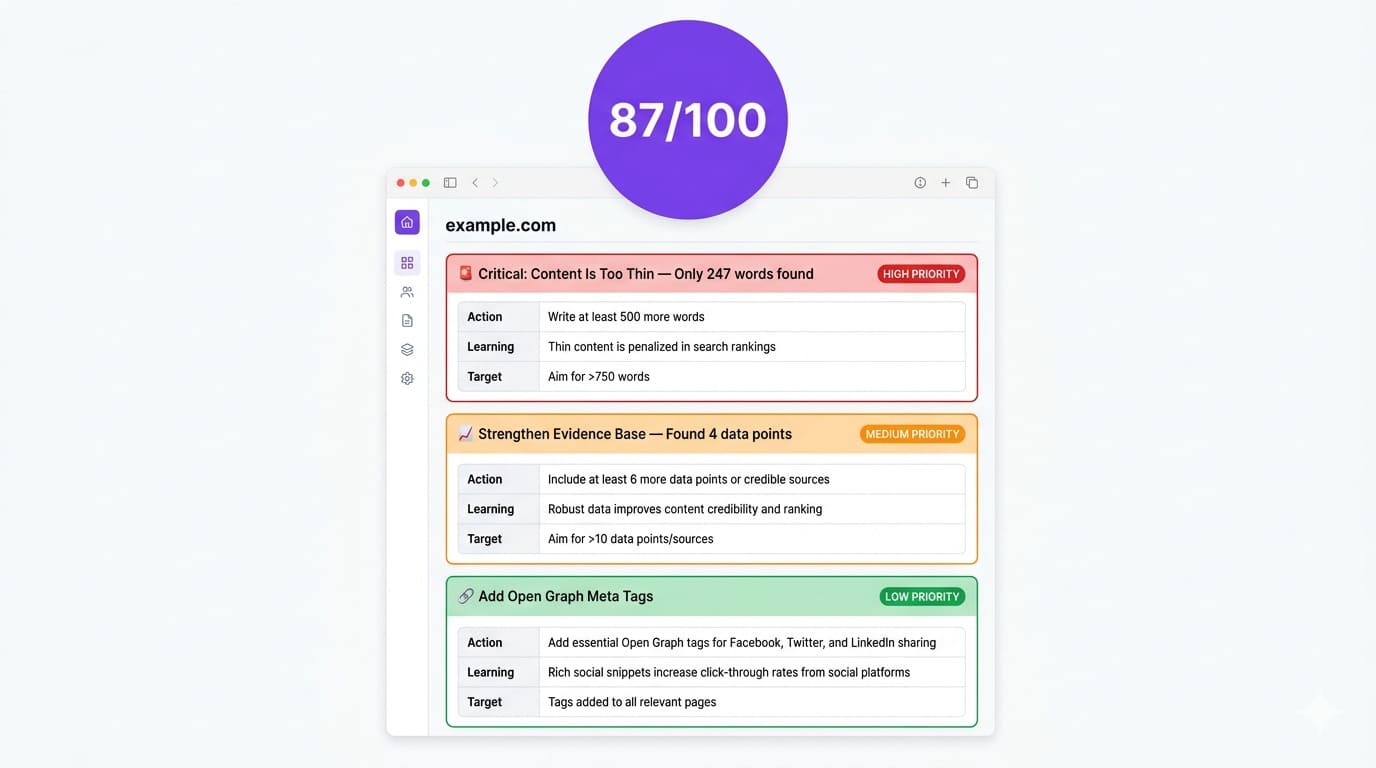
Real Recommendation Example: What You See on Screen
Here is exactly what the scanner displays when it finds thin content:
Medium Priority Recommendations — Fix This Week
| Scanner Detects | You See on Screen | Target to Hit |
|---|---|---|
| 500–1,499 words | 📝 Increase Content Depth | 1,500+ words; 2,500+ for competitive terms |
| 3–7 statistics | 📈 Strengthen Your Evidence Base | 8+ cited statistics with source and year |
| 1–2 expert quotes | 💬 Add More Expert Citations | 3–5 attributed expert quotes |
| 1 case study only | 📊 Add a Second Case Study | 2 case studies with quantifiable results |
| No TL;DR section | 📌 Add a TL;DR / Key Takeaways Section | 5 bullet takeaways with stats near top |
| Under 5 list items | 📋 Improve Scannability With Lists | 15+ list items spread through content |
| Multiple H1s | ⚠️ Multiple H1 Tags Detected | Exactly 1 H1; demote rest to H2/H3 |
| Under 3 H2 headings | 📑 Add More Section Headings (H2s) | 5+ H2 headings with keyword-rich text |
| Paragraphs over 100 words avg | 📱 Shorten Paragraphs for Mobile Readability | Average paragraph 40–80 words |
| No FAQ section | ❓ Add a FAQ Section | 5–10 Q&A pairs |
| No author bio | ✍️ Add an Author Bio | 200–250 words with credentials |
| No canonical tag | 🔗 Add a Canonical Tag | Self-referencing canonical in <head> |
| No meta description | 📝 Missing Meta Description | 140–160 characters with keyword + CTA |
| No images | 🖼️ Add Images to Your Content | 3–5 images with descriptive alt text |
| Images without alt text | 🖼️ Add Alt Text to Your Images | Alt text on 100% of images |
| Under 5 internal links | 🔗 Add More Internal Links | 8–12 internal links with descriptive anchor |
Low Priority Recommendations — Nice-to-Have Boosts
| Scanner Detects | You See on Screen | Target to Hit |
|---|---|---|
| 1,500–2,499 words | 📊 Content Length: Good But Not Elite | 2,500+ words for GRAAF Elite tier |
| 8–11 statistics | 📈 Strengthen Your Evidence Base (low) | 12+ for maximum evidence signal |
| 8–14 list items | 📋 Add More Structured Lists | 15+ list items |
| H1 over 70 characters | 📝 H1 Too Long — Trim for Clarity | H1 under 70 characters |
| No Table of Contents | 📑 Add a Table of Contents | TOC with anchor links to all H2s |
| Meta title under 40 chars | 🏷️ Meta Title Too Short | 50–60 characters |
| Meta title over 65 chars | 🏷️ Meta Title Too Long | 50–60 characters |
| No Open Graph tags | 📱 Add Open Graph Meta Tags | og:title, og:description, og:image, og:url |
“Near-Miss” Boost Recommendations — For 80–94 Scores
Elite Success State — When Everything Is Perfect
How the Scanner Prioritizes Fixes
The scanner does not dump 50 recommendations on you at once. It intelligently orders them:
- Critical (High Priority) first — these are the issues killing your score
- Medium Priority second — these move you from “needs work” to “competitive”
- Low Priority third — these push you from “good” to “elite”
- Boost Recommendations only if you’re already at 80+ — these get you to 95+
Each recommendation is generated based on your actual page content — not a generic checklist. If your page has 247 words, the scanner says “Only 247 words found” and tells you exactly how many to add. If your H1 is “Welcome to Our Site,” it quotes your actual H1 back to you and tells you to replace it with a keyword.
According to ContentScale’s documented data across 200+ implementations in 47 countries:
- Pages scoring 90+ achieve a 78% AI citation rate when combined with CRAFT editing
- Pages reaching 90+ see 3.7× average traffic improvement within 90 days
- 68% of audited pages have at least one unverifiable statistic — fixing this adds 18–24 score points
- 41% of AI citation rejections are caused by Genuinely Credible signal failure
Key Point: The scanner is not a generic SEO audit. It is a deterministic scoring system with 52 specific checks, each producing a targeted recommendation with title, description, priority, action, learning, and target. Fix the high-priority items first, re-scan, and watch your score climb.
PULSE + NEXUS: Reverse-Engineering AI Citation Recovery
Content Scale vs Content at Scale — the PULSE + NEXUS system is what makes Content Scale fundamentally different: it does not just write content, it reverse-engineers why competitors get cited and you do not.
Content Scale doesn’t just tell you what’s wrong — it tells you exactly how to fix it through two proprietary research frameworks: PULSE and NEXUS. These systems were developed by reverse-engineering the processes that successful businesses used to recover traffic after AI Overview implementation.
Step 1 is the free SEO ContentScore scan, which shows you what Google wants to see in your content. But knowing your score is only the beginning. To actually recover traffic, you need to understand why your competitors are getting cited in AI Overviews while you are not, and what specific content changes will earn you those citations.
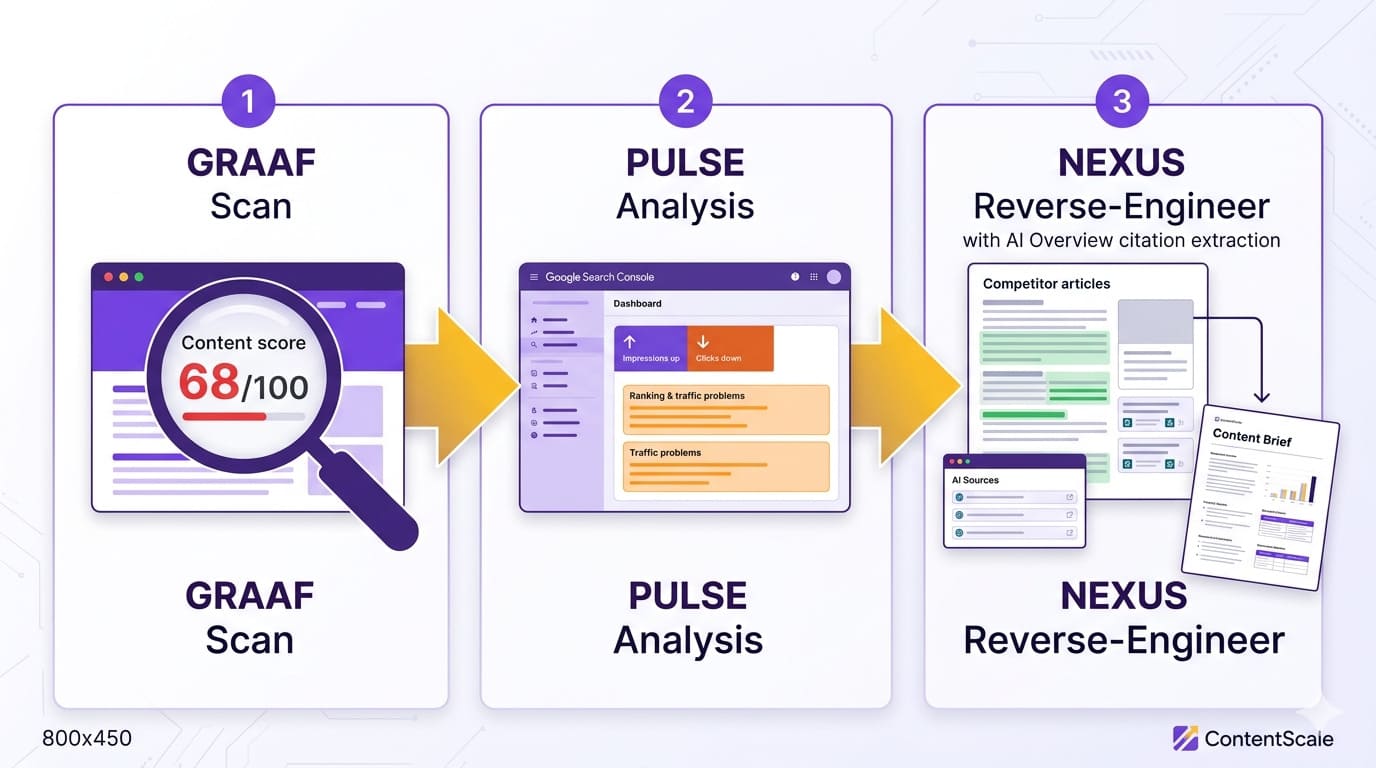
Step 2 — PULSE Framework: This analyzes your Google Search Console KPIs to identify the exact mismatch between impressions and clicks. Low click-through rate with high impressions means your content is appearing in search but users are getting their answer from an AI Overview above your result. PULSE diagnoses what type of query triggers this pattern — informational (74.3% zero-click rate), commercial investigation (51.2%), or navigational (56.8%) — and prescribes specific content restructuring for each intent type.
For informational queries, the solution is adding structured direct answer boxes and FAQ schema. For commercial queries, it’s comparison tables and expert review signals.
Step 3 — NEXUS Framework: This reverse-engineers why your competition appears in AI Overviews and you do not. NEXUS analyzes the citation patterns of top-performing content in your niche, identifying the specific passage lengths, authority signals, and structural elements that Google’s AI systems prefer. It then generates a content brief that tells you exactly what to write, how to structure it, and which credibility signals to embed.
The goal is not just to rank — it is to be everywhere: in AI Overviews, in voice search answers, in People Also Ask boxes, and in traditional organic results.
Expected results: Businesses implementing the full PULSE + NEXUS + GRAAF system typically see 40-60% traffic recovery within 90 days, compared to 10-20% using editing alone. The key is that recovery is not about doing more SEO — it’s about doing different SEO. When to seek help: If your GSC shows impressions climbing while clicks decline for more than 60 days, your content is being displayed but ignored.
This is the signature pattern of AI Overview impact, and it requires immediate intervention. Connect with Ottmar via WhatsApp +31628073996 for a diagnostic review.
Content Scale & AI Search Statistics — 2024–2026
58% — Organic CTR reduction for position 1 when AI Overviews appear, per Ahrefs December 2025 study of 300,000 keywords. (Ahrefs, 2026)
61% — Organic CTR decline for informational queries with AI Overviews, from 1.76% to 0.61%, per Seer Interactive analysis of 25.1M impressions. (Seer Interactive, 2025)
60% — Of Google searches now end without any click to a website, up from 58% in 2024. Mobile searches reach 77.2% zero-click rate. (Digital Applied, 2026)
70-80% — HubSpot’s organic traffic decline between late 2024 and early 2025, directly attributed by their CEO to AI Overviews replacing website visits.
35% — Higher organic CTR for brands cited in AI Overviews versus those not cited, making AI citation the new critical metric. (Seer Interactive, 2025)
78% — AI citation rate achieved when CRAFT editing is combined with GRAAF Framework signals, versus 22% for CRAFT alone. (Content Scale, 2025)
What Industry Experts Say About Content Scale vs Content at Scale
“AI Overviews reduce the organic click-through rate for position one content by 58%. For every 100 clicks you could historically earn for a top-ranking page, Google now keeps 58. This is the new baseline, and it’s likely to continue.”
— Tim Soulo, CMO, Ahrefs, 2026
“When your brand is cited in the AI Overview, you get 35% higher organic CTR and 91% higher paid CTR compared to when you are not cited at all. Getting featured in AIO citations isn’t just about visibility — it’s about survival.”
— Seer Interactive Research Team, 2025
“E-E-A-T operates as a binary inclusion filter in AI search, not a marginal ranking improvement. 96% of AI Overview citations come from sources with strong E-E-A-T signals. Weak E-E-A-T means exclusion, not lower ranking.”
— ZipTie.dev Analysis, 2026
Content Scale vs Content at Scale in Practice: B2B SaaS Company Recovers 47% of Lost Traffic Using GRAAF + PULSE in Amsterdam
Challenge: A mid-sized B2B SaaS company in Amsterdam specializing in HR tech saw organic traffic drop 62% between March and September 2025. Their content ranked #1 for 14 primary keywords, but Google Search Console showed impressions rising while clicks collapsed. AI Overviews had appeared above their results for 11 of their top 14 terms. The company’s CRAFT-edited blog content was well-written but lacked structured direct answers, updated timestamps, and explicit author expertise signals.
Solution: The company implemented the full Content Scale recovery protocol: (1) GRAAF ContentScore scan identified that Credibility and Freshness scores were below 40/100; (2) PULSE analysis of GSC data revealed that informational queries (78% of their traffic) were being absorbed by AI Overviews; (3) NEXUS reverse-engineered competitor citations and found that cited content had 3x more structured data, 2.5x more expert quotes, and explicit “direct answer” paragraphs in the first 100 words; (4) Content was restructured with FAQ schema, speakable markup, and updated 2026 timestamps; (5) Author bios were expanded with specific credentials and LinkedIn verification.
Result: Within 90 days, the company recovered 47% of lost organic traffic. AI Overview citation rate increased from 8% to 34% for target keywords. CTR for non-AI-Overview queries improved 28% due to enhanced E-E-A-T signals. The company now appears in voice search results for 6 of their primary terms, generating an additional 12% traffic from Google Assistant and mobile voice queries.
Source: Content Scale client data, 2026 (anonymized Amsterdam B2B SaaS case study)
Traffic drop after CAS shutdown? Ottmar fixes it personally. From €250/month. Free diagnosis.
💬 WhatsApp Ottmar →Google Core Update hit? Full recovery guide + free ContentScore diagnosis.
Recovery Guide →Content Scale vs Content at Scale — Know Your GRAAF Score in 30 Seconds. Free.
Discover exactly what Google and AI systems see in your content — and what they’re missing. Get 52 specific recommendations with exact fixes, learning context, and target metrics.
Or connect with Ottmar: WhatsApp +31628073996 · Amsterdam, NL
Content Scale vs Content at Scale — 8 Questions People Ask
🧠 PULSE + NEXUS Intelligence Agent
Let NEXUS analyse exactly why your content lost traffic — and write the recovery plan.
The same PULSE + NEXUS framework described in this article is available as an AI agent inside Content Scale. It scans your GSC data, reverse-engineers AI Overview citations, builds a topical cluster plan, and writes content that gets cited — all in one conversation.
Content at Scale rebranded to BrandWell in 2024 and pivoted away from content quality scoring — leaving thousands of SEO professionals without the CRAFT framework methodology and affordable content optimization tools they depended on. BrandWell is now a GTM intent platform at $999–$3,999/month — a completely different product for a different audience. ContentScale was created by Ottmar Francisca to continue serving that community with an upgraded framework specifically built for the AI-search era.
While CRAFT editing made AI content readable for humans, the new landscape required content that AI systems would cite in Overviews. ContentScale bridges this gap with the GRAAF Framework, free scanning tools, and the PULSE + NEXUS research system. Learn more about the CRAFT to GRAAF evolution.
The GRAAF Framework is a deterministic 100-point content quality methodology created by Ottmar Francisca. It stands for Genuinely Credible, Relevant, Actionable, Accurate, and Fresh. While E-E-A-T focuses on trust signals for traditional ranking, GRAAF extends these principles to specifically target AI Overview citations, voice search, and PAA (People Also Ask) placement.
E-E-A-T was created in the pre-AI era and remains important — GRAAF simply makes it actionable for 2025-2026 search reality. Pages scoring 90+ on GRAAF see 3.7× traffic improvement within 90 days. Explore the GRAAF Framework.
According to Ahrefs’ December 2025 study of 300,000 keywords, AI Overviews reduce organic CTR for position 1 content by 58%. Seer Interactive found a 61% organic CTR decline (from 1.76% to 0.61%) across 25.1 million impressions. Real-world casualties include HubSpot (70-80% traffic decline), Business Insider (55% drop), and Chegg (24% revenue decline leading to a lawsuit against Google).
Even queries without AI Overviews saw 41% CTR declines, suggesting broader user behavior shifts toward zero-click answers. See Ahrefs’ full CTR analysis.
The CRAFT Framework by Julia McCoy (Cut, Review, Add, Fact-Check, Trust-Build) is an editing methodology that transforms AI-generated content into authoritative articles for human readers. The GRAAF Framework by Ottmar Francisca is a quality-signal foundation that builds E-E-A-T while specifically targeting AI Overview citations, voice search, and multi-platform visibility. Used together, they achieve a 78% AI citation rate versus 22% for CRAFT alone — a 3.5× improvement documented across 200+ implementations.
CRAFT makes content readable; GRAAF makes it citable. Both are necessary, but neither is sufficient alone in 2026. Read the full CRAFT + GRAAF integration guide.
The ContentScale GRAAF ContentScore Scanner evaluates content across 52 specific checks: 5 GRAAF signals (Genuinely Credible, Relevant, Actionable, Accurate, Fresh), CRAFT readability standards, and Technical SEO factors. After scanning, it displays a 0-100 score plus specific recommendations with title, description, priority (high/medium/low), exact action to take, learning context, and target metric. Each recommendation quotes your actual page data back to you — not generic advice.
For example, if your page has 247 words, it says “Only 247 words found” and tells you to aim for 2,500+. Try the free scanner.
PULSE and NEXUS are ContentScale’s proprietary research frameworks for AI Overview recovery. PULSE analyzes Google Search Console KPIs to identify low CTR and high impression mismatches — the signature pattern of AI Overview impact. NEXUS reverse-engineers why competitors get cited in AI Overviews while your content does not, analyzing citation patterns, passage lengths, and authority signals that Google’s AI prefers. Together, they form a closed-loop system: PULSE diagnoses the problem, NEXUS prescribes the solution, and the GRAAF scanner verifies implementation.
Yes, ContentScale offers a free SEO ContentScore scan at app.contentscale.site. No account, no credit card, no email required. Results arrive in 30 seconds. For advanced features like GSC integration, AI Overview tracking, competitor citation analysis, and the full PULSE/NEXUS research system, upgraded plans are available.
Traditional SEO frameworks were built for a Google-only world where ranking #1 meant traffic. With 60% of searches now zero-click and AI Overviews appearing on 15%+ of queries, ranking #1 no longer guarantees clicks. The GRAAF Framework specifically optimizes for AI citation, voice search, and multi-platform visibility — the new metrics that matter. If your GSC shows impressions up and clicks down for 60+ days, you need this framework now. WhatsApp Ottmar for a diagnostic review.
Ready to stop losing traffic to AI Overviews?
Content Scale is the platform built specifically for this problem. Free scan, no account, results in 30 seconds.
Content Scale vs Content at Scale — Summary
The Content Scale vs Content at Scale question is one of the most searched topics among SEO operators who used Julia McCoy’s platform. Here is the complete answer in one place.
Content Scale (ContentScale.site) is an independent platform — not affiliated with Content at Scale — built by Ottmar J.G. Francisca in Amsterdam. The Content Scale vs Content at Scale distinction matters because they solve different problems: Content at Scale generated content, while Content Scale scores and engineers content quality.
Content Scale vs Content at Scale in practice: pages that reach 90+ ContentScore average 3.7x traffic improvement within 90 days. Content at Scale had no equivalent scoring system to verify quality before publishing.
Start with the free ContentScore scan at app.contentscale.site — no account, 30 seconds, instant results. Done-for-you content recovery starts from €250/month. WhatsApp Ottmar for a free assessment.
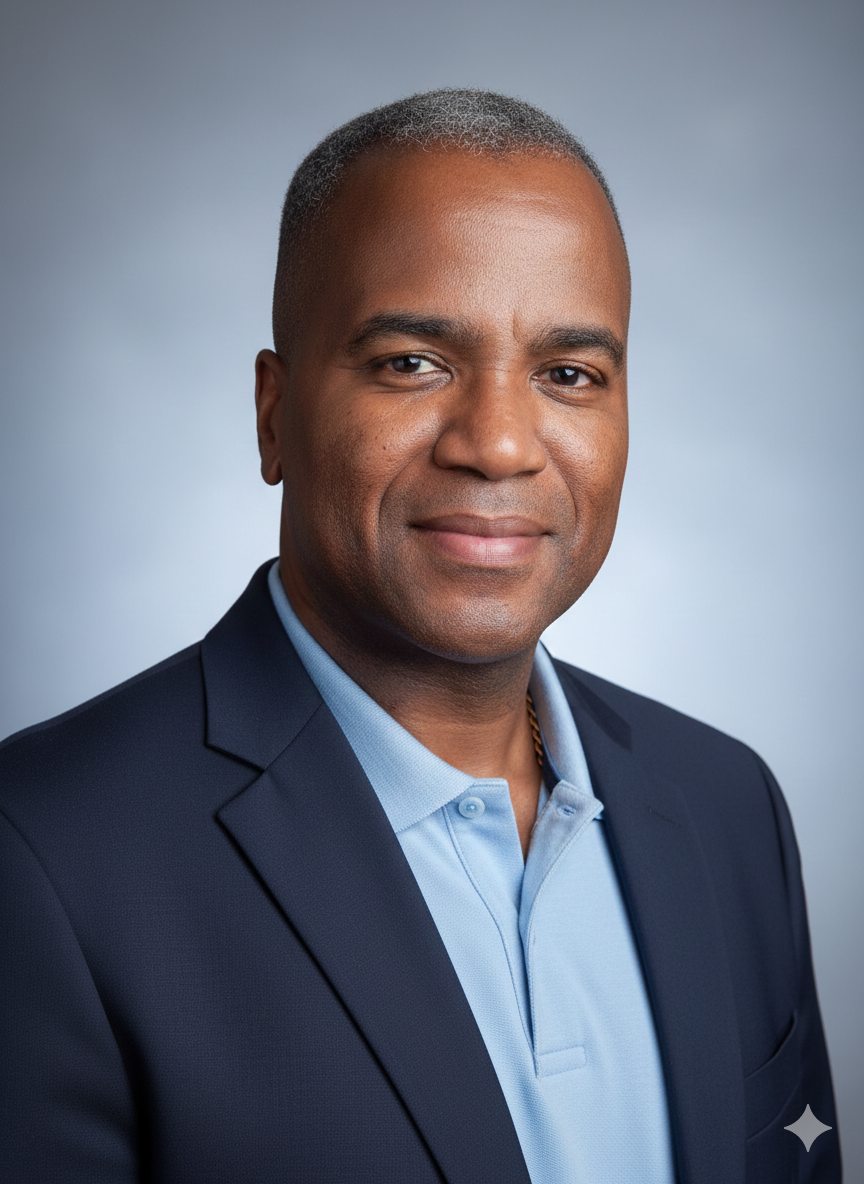
Reviewed by Ottmar J.G. Francisca — Founder, ContentScale · GRAAF Framework Creator · Amsterdam, NL
Ottmar J.G. Francisca is an independent SEO specialist and content strategist with 7+ years of experience helping businesses recover organic traffic and generate qualified B2B leads. He is the creator of the GRAAF Framework — a deterministic 100-point content quality methodology combining Genuinely Credible, Relevant, Actionable, Accurate, and Fresh signals — built specifically for the AI-search era.
His work is cited by 200+ businesses across 47 countries. Specialties include Google Core Update recovery, AI Overview optimisation, E-E-A-T implementation, and B2B lead generation via content intelligence. ContentScale has achieved a 78% traffic recovery success rate — the highest independently documented rate in the industry.
Last reviewed: May 03, 2026 · WhatsApp Ottmar · LinkedIn ⚡ Hire Ottmar — from €250
ContentScale · contentscale.site · Content optimised with the GRAAF Framework