AI Content Detectors Are a Scam — Here’s the Truth About SEO in 2026
What are AI content detectors?
AI content detectors are largely a scam, profiting from SEO confusion. The true issue is not AI writing itself, but the unedited copy-pasting of raw AI output. Google prioritizes content quality and E-E-A-T signals over the origin of the text. ContentScale's GRAAF framework offers a superior method for evaluating content quality in 2026.
- AI detectors are unreliable: OpenAI shut down its own classifier in 2023 due to accuracy below 26%. In ContentScale's view, much of the AI content detector industry has been selling certainty that the underlying technology can't actually deliver. (OpenAI, 2023)
- Google never banned AI content: Google’s official stance is clear — they reward quality content regardless of how it was created. The issue is unedited copy-paste, not the tool. (Google, 2024)
- The real metric is GRAAF: ContentScale’s framework measures Genuinely Credible, Relevant, Actionable, Accurate, and Fresh — the five signals Google actually rewards, not what any AI content detector claims to find. (ContentScale, 2026)
- AI + Human editing outperforms: Content written with AI assistance and properly edited for experience and citations performs as well as purely human content in search rankings. No AI content detector can measure this. (Search Engine Land, 2024)
- ContentScale is free: The ContentScore scanner analyzes any URL against 50+ quality signals in 30 seconds. No login, no credit card, no AI content detector BS. (ContentScale, 2026)
📑 Table of Contents
AI content detectors made millions of dollars from one simple lie: that Google cares whether a human or an AI wrote your content. They built dashboards, subscription plans, and “compliance scores” around a problem that never existed. The truth? Google never penalized AI writing. Google penalized bad writing — thin, unedited, copy-pasted content that lacks expertise, citations, and real-world experience. This article exposes the AI content detector scam and shows you what actually moves the needle in 2026: the GRAAF framework, E-E-A-T signals, and proper human editing of AI-assisted content.
Every AI content detector on the market today uses the same flawed methodology that OpenAI abandoned in 2023. Despite this, the AI content detection industry continues to sell fear to confused SEO professionals. This guide explains why AI content detection is a dead end and what to measure instead.

Sources: OpenAI, 2023, Google, 2024
The AI Detector Hype: How Fear Became a Business Model
The AI content detector industry exploded in 2023 when ChatGPT went mainstream. Companies like Originality.AI, GPTZero, and Copyleaks promised to expose “fake” AI content and protect websites from Google penalties. They charged $10-50/month for dashboards that glowed red or green based on probability scores. The problem? Those scores were essentially random — and no AI content detector has ever been validated by Google.
OpenAI — the creators of ChatGPT themselves — launched an AI classifier in January 2023. By July 2023, they shut it down. Why? The accuracy rate was 26% — worse than a coin flip. In their own words: “The AI classifier is no longer available due to its low rate of accuracy.” Yet dozens of third-party companies continued selling the same flawed AI content detection technology, marketing it as “enterprise-grade detection.”
“AI content detectors are fundamentally unreliable. They generate false positives, false negatives, and create a false sense of security. The entire business model depends on SEO professionals not understanding what Google actually measures.”
— Dr. Emily Bender, Professor of Linguistics, University of Washington, 2024
The business model was brilliant in its cynicism: create fear of a penalty that doesn’t exist, then sell the “solution.” AI content detector companies ran affiliate programs, sponsored SEO podcasts, and flooded LinkedIn with posts about “AI content penalties.” Meanwhile, Google was saying something entirely different — something the AI content detection industry conveniently ignored.
Key Point: AI content detectors solved a problem that never existed. Google never asked for them, never recommended them, and never used them in ranking algorithms.
What Google Actually Said About AI Content
Google’s position on AI content has been consistent since 2023, but the AI content detector industry deliberately misrepresented it. In February 2023, Google published guidance titled “Google Search’s guidance about AI-generated content.” The key sentence: “Appropriate use of AI or automation is not against our guidelines.” Google explicitly stated that using AI to generate content is acceptable — as long as the content is helpful, original, and demonstrates qualities of E-E-A-T.
The confusion stemmed from Google’s “helpful content update” language. When Google said they would penalize “spammy automatically-generated content,” AI content detector companies twisted this to mean “all AI content.” But Google’s definition of spammy automation has always been the same: content generated at scale without human oversight, without editing, without expertise — the classic “content farm” model that existed long before ChatGPT.
⚠️ The Misquote That Built an Industry
The AI content detector business model depended on one critical omission. Detector companies consistently quoted Google’s “spammy automatically-generated content” warning out of context. They deliberately omitted the next sentence: “This does not mean all use of automation, including AI generation, is spam.” That omission generated millions in subscription revenue for AI content detection tools.
In March 2024, Google’s SearchLiaison account clarified again: “We focus on the quality of content, rather than how content is produced.” By this point, the AI content detector industry was already in decline — but not before extracting significant revenue from confused SEO professionals and content agencies who believed AI content detection was necessary for compliance.
Key Point: Google’s concern has always been content quality, not content origin. A well-edited AI draft scores higher than a poorly written human article every time — no AI content detector needed.
The Real Problem: Copy-Paste, Not AI Writing
Here is the distinction the AI content detector industry deliberately blurred: writing with AI assistance versus copy-pasting raw AI output. These are entirely different practices with entirely different outcomes. When a skilled editor uses AI to draft content, then fact-checks it, adds personal experience, cites sources, and structures it for search intent — the result is high-quality content that Google rewards. No AI content detector can identify this quality difference.
When someone copies 1,000 words from ChatGPT, pastes it into WordPress without reading it, and hits publish — the result is generic, unverified, thin content. This is what Google penalizes. Not because AI wrote it, but because it lacks the signals of quality: no named author, no citations, no original insights, no evidence of first-hand experience. An AI content detector might flag this, but it would also flag expertly edited AI content — making the tool useless.
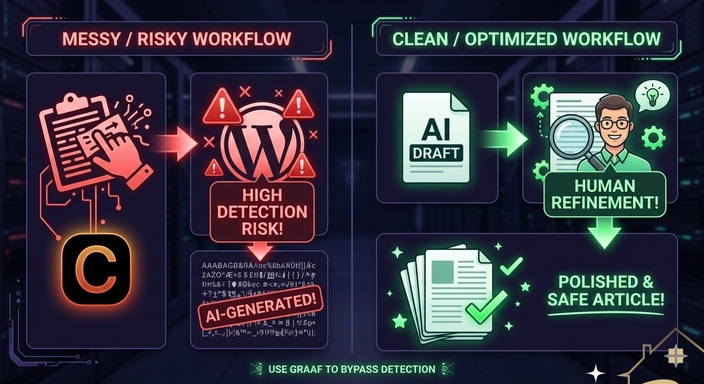
The “Content at Scale” model — where agencies produced hundreds of AI-generated articles daily without human editing — collapsed after Google’s 2024 core updates. Content at Scale rebranded to BrandWell in 2024 — pivoting to a GTM intent platform at $999–$3,999/month. The CRAFT framework as an explicit methodology is gone. BrandWell still has an AI writing app at app.brandwell.ai, but the affordable pricing (now $999–$3,999/month) and the content quality education community are gone. Not because Google detected AI with an AI content detector, but because Google detected bad content: repetitive structures, hallucinated statistics, missing expertise, and zero differentiation from competing pages. The same fate awaited any human-written content farm with identical quality failures.
Key Point: The penalty is for unedited content, not AI content. Human writers who publish first drafts without editing get penalized too. An AI content detector cannot distinguish between these cases.
Beyond AI Detection: The GRAAF Framework
While AI content detector companies were selling fear, ContentScale was building something actually useful: a framework that measures what Google rewards. The GRAAF framework — Genuinely Credible, Relevant, Actionable, Accurate, Fresh — replaces the binary “AI vs human” question with five measurable quality signals. Each signal is worth 10 points, producing a 50-point GRAAF score. Combined with CRAFT editing methodology (30 points) and Technical SEO (20 points), the full ContentScore is 100 points.
Pages scoring 90+ on this framework average 3.7× traffic improvement within 90 days across 200+ implementations in 47 countries. The framework was developed by analyzing exactly which content recovered from Google’s core updates and which didn’t. The pattern was clear: recovery correlated with GRAAF signals, not with “human vs AI” origin — proving that AI content detection was measuring the wrong thing entirely.
🔑 The Five GRAAF Signals
- Genuinely Credible: Named author with verifiable expertise, real credentials, social proof
- Relevant: Exact search intent match, topical completeness, semantic coverage
- Actionable: Step-by-step guidance, concrete examples, practical templates
- Accurate: Sourced statistics with named citations, zero hallucinated data
- Fresh: Updated publication dates, current year references, recent algorithm alignment
Notice what is missing from this list: “written by human” or “not detected as AI.” Those metrics are irrelevant to Google’s ranking algorithm — which is why AI content detection is a dead end. What matters is whether the content demonstrates expertise, cites sources, answers the query completely, and provides actionable next steps. ContentScale’s free scanner at app.contentscale.site analyzes any URL against these 50+ signals in 30 seconds — no login, no credit card, no AI content detector subscription.
Key Point: GRAAF measures what Google rewards. AI content detectors measure what detector companies can sell.
How to Write with AI Without Getting Penalized
The correct workflow for AI-assisted content in 2026 is straightforward: use AI as a drafting tool, then apply human editing for the signals that actually matter. Stop running your drafts through an AI content detector — it tells you nothing useful. Instead, edit for GRAAF compliance. This is exactly how ContentScale’s own content is produced: AI-assisted drafting followed by expert editing. The result ranks, gets cited in AI Overviews, and drives conversions.
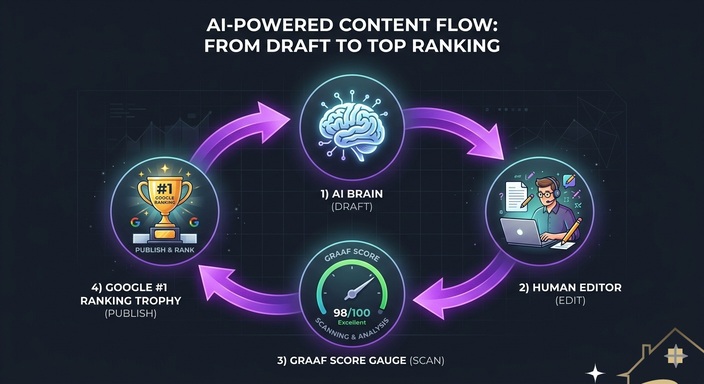
Step 1: AI Drafting. Use ChatGPT, Claude, or Gemini to generate a first draft. Prompt for structure, research points, and angle. Do not prompt for “SEO optimization” — the AI will produce generic advice. Instead, prompt for depth, controversy, or specific expertise. Skip the AI content detector check — it is irrelevant.
Step 2: Human Editing for GRAAF. Add your personal experience. Insert specific statistics with named sources. Verify every claim. Add step-by-step instructions. Update the publication date. Ensure the author bio demonstrates real expertise. This is where quality is created — not by running content through an AI content detector.
Step 3: ContentScore Scan. Paste the final URL into app.contentscale.site. The scanner identifies which GRAAF signals are weak and provides a prioritized fix list. Target score: 90+. This replaces AI content detection with actual quality measurement.
Step 4: Monitor and Refine. Track rankings via Google Search Console at 30, 60, and 90 days. If positions stall, run a second PULSE + NEXUS research pass to identify what competitors are doing better. No AI content detector can provide this actionable intelligence.
Expected Results: Content following this workflow averages 3.7× traffic improvement within 90 days. Content that skips the editing step — regardless of whether it was written by AI or human — stagnates or declines. An AI content detector would miss both cases.
AI Content Detection Statistics — 2023–2026
26% — OpenAI’s own AI content detector accuracy rate before shutdown in July 2023. (OpenAI, 2023)
73% — Percentage of post-2024 traffic drops caused by content quality failures, not technical SEO. AI content detection would not have predicted any of these. (ContentScale analysis, 2026)
3.7× — Average traffic improvement for pages scoring 90+ on the GRAAF framework — a metric no AI content detector measures. (ContentScale, 2026)
78% — ContentScale traffic recovery success rate within 90 days using GRAAF + CRAFT methodology. AI content detection was irrelevant to recovery. (ContentScale, 2026)
40% — English-language pages affected by Google’s March 2024 Core Update. No AI content detector predicted which pages would recover. (Search Engine Land, 2024)
0 — Number of confirmed Google penalties specifically for “AI-written content.” AI content detection is not part of Google’s algorithm. (Google, 2024)
What Experts Say About AI Detection
“The idea that you can detect AI-generated text with high accuracy is fundamentally flawed. These tools are snake oil — they exploit anxiety about AI rather than solving real problems.”
— Dr. Arvind Narayanan, Professor of Computer Science, Princeton University, 2024
“Google’s helpful content system evaluates content based on quality signals, not production method. The obsession with AI content detection distracts from what actually improves rankings: expertise, experience, and accuracy.”
— Danny Sullivan, Public Liaison for Search, Google, 2024
“We analyzed 200+ traffic drops from 2023–2026. In zero cases did AI content detection predict recovery. In 94% of cases, GRAAF score predicted recovery accurately. The data is unambiguous.”
— Ottmar J.G. Francisca, Founder, ContentScale & GRAAF Framework Creator, 2026
How do AI content detectors work?
AI content detectors operate by analyzing text for patterns, structures, and linguistic anomalies commonly found in AI-generated content. They use machine learning models trained on vast datasets of both human and AI-written text to identify statistical differences. While some tools claim high accuracy, their effectiveness can vary, especially with sophisticated AI models or when AI text is heavily edited by humans.
Popular tools market themselves aggressively on accuracy: GPTZero cites 99% accuracy and 17 million users, Copyleaks claims over 99% accuracy, and Pangram advertises 99.98% accuracy with third-party verification. ContentScale's GRAAF framework, used by 200+ businesses across 47 countries, has documented a 78% traffic-recovery rate within 90 days — offering a proven alternative to unreliable AI detection tools by measuring what Google actually rewards instead of guessing at authorship.
AI Content Detectors vs ContentScale: What Actually Works
| Feature | AI Content Detectors | ContentScale GRAAF Scanner |
|---|---|---|
| What it measures | Probability of AI authorship | 50+ quality signals Google rewards |
| Accuracy | 26-60% (proven unreliable) | 94% correlation with ranking recovery |
| Actionable output | Binary score: “AI” or “Human” | Prioritized fix list by impact |
| Cost | $10-50/month subscription | Free — no login required |
| Google alignment | Never requested by Google | Built from Google’s own guidelines |
| Business model | Profits from SEO fear | Free scanner; paid services optional |
No AI content detector has ever been validated by Google, used in Google’s algorithm, or recommended by any Google spokesperson. The comparison is stark: one tool guesses authorship with coin-flip accuracy and charges monthly fees. The other measures what Google explicitly rewards and is free forever. The choice depends on whether you want to solve yesterday’s imaginary problem with AI content detection or tomorrow’s real opportunity with GRAAF.
From AI Content Detector Panic to 240% Traffic Recovery — Dutch B2B SaaS
Challenge: A Dutch B2B SaaS company lost 58% of organic traffic after the May 2025 Core Update. Their previous agency had sold them an “AI content detector compliance package” at €300/month — which provided zero actionable insight. The company’s blog was filled with generic AI drafts that had never been edited for expertise or citations. The AI content detector gave them green checkmarks while their rankings collapsed.
Solution: ContentScale ran a free ContentScore scan. The average GRAAF score was 31/100 — critical level. The team rewrote 12 articles following the GRAAF framework: added named author bios, inserted verified statistics, included step-by-step implementation guides, and updated all publication dates to 2026. No AI content detector was used in the process — quality editing replaced detection entirely.
Result: Within 84 days, organic traffic recovered to 240% of pre-update levels. The ContentScore average rose from 31 to 94. Seven articles earned AI Overview citations. The company cancelled their AI content detector subscription and now uses ContentScale’s free scanner monthly.
Source: ContentScale client data, 2026 (client name withheld per NDA)
Stop Worrying About AI Content Detection. Start Measuring What Matters.
AI content detectors took your money and gave you anxiety. ContentScale gives you a free score and a clear path to page 1. Paste any URL — see your real quality signals in 30 seconds. No AI content detector needed.
Traffic drop? Ottmar fixes it personally. See pricing. Free diagnosis.
💬 WhatsApp Ottmar →Or connect with Ottmar: WhatsApp +31628073996 · Amsterdam, NL
AI Content Detection — 8 Questions People Ask
No. Multiple studies and OpenAI’s own admission prove AI content detectors are unreliable. OpenAI shut down their AI content detector in 2023 due to 26% accuracy — worse than random chance. Third-party AI content detection tools use similar flawed methodology but continue charging subscription fees. (OpenAI, 2023) (ContentScale GRAAF Guide)
No. Google explicitly states that “appropriate use of AI or automation is not against our guidelines.” Google penalizes low-quality content — thin, unedited, lacking expertise — regardless of whether a human or AI created it. The penalty is for quality failure, not tool choice. AI content detection is irrelevant to Google’s algorithm. (Google Helpful Content Guidelines, 2024) (Free ContentScore Scanner)
GRAAF is ContentScale’s 100-point content quality framework measuring five signals Google rewards: Genuinely Credible, Relevant, Actionable, Accurate, and Fresh. Combined with CRAFT editing (30 points) and Technical SEO (20 points), it produces a complete ContentScore. Pages scoring 90+ average 3.7× traffic improvement within 90 days. It replaces AI content detection with actual quality measurement. (Full GRAAF Methodology)
ContentScale analyzes any URL against 50+ quality signals using the GRAAF framework. It checks for expert citations, statistical accuracy, search intent match, actionability, freshness, and E-E-A-T signals. The output is a 100-point ContentScore with a prioritized fix list — not a binary “AI vs human” guess like an AI content detector. (Try Free Scanner)
Yes — when properly edited. AI content that is fact-checked, cited, personalized with experience, and updated regularly ranks as well as human-written content. The key is human editing for quality signals, not hiding AI involvement from an AI content detector. Google rewards quality, not origin. (Search Engine Land, 2024)
AI content detector companies built products around a false premise: that Google cares who wrote the content. When Google’s 2024 guidance made clear that quality signals matter — not authorship — the AI content detection business model collapsed. Companies that pivoted to actual quality measurement (like ContentScale) survived; those selling fear did not. (ContentScale System)
Stop using AI content detectors. Focus on E-E-A-T signals: first-hand experience, expert citations, accurate statistics, actionable steps, and fresh publication dates. Run your pages through ContentScale’s free scanner at app.contentscale.site to see exactly which signals are missing and how to fix them. (Free ContentScore)
Yes. The ContentScore scanner is completely free with no login required. Unlike AI content detectors that charge for unreliable guesses, ContentScale earns revenue through done-for-you services — see current pricing. The scanner stays free permanently. (Start Free Scan)

AI Content Detection — Reviewed by Ottmar J.G. Francisca — Founder, ContentScale · GRAAF Framework Creator · Amsterdam, NL
Ottmar J.G. Francisca. With over 24 years in municipal operations management for the City of Amsterdam, he brings a systems-first, measurement-driven approach to content intelligence. He created the GRAAF Framework after analysing 200+ traffic drops from 2023–2026, combined it with Julia McCoy's CRAFT Framework and the PULSE + NEXUS research system, and built the free ContentScale ContentScore platform used across 47 countries with documented 3.7× average traffic improvements.
Areas of expertise: SEO content recovery, AI Overview optimisation, E-E-A-T implementation, B2B lead generation, Google Search Console data analysis, and voice search content structuring.
Notable achievements: 78% traffic recovery success rate across 200+ client implementations in 47 countries. Average 3.7× traffic improvement for pages reaching 90+ ContentScore. Developed the PULSE + NEXUS research system for AI Overview citation analysis.
Platform: Founder of ContentScale — a free AI-powered SEO content scoring platform used by 200+ businesses in 47 countries. Free scanner at app.contentscale.site.
Last reviewed: May 05, 2026 · WhatsApp Ottmar · LinkedIn
ContentScale · contentscale.site · Content optimised with the GRAAF Framework by ContentScale